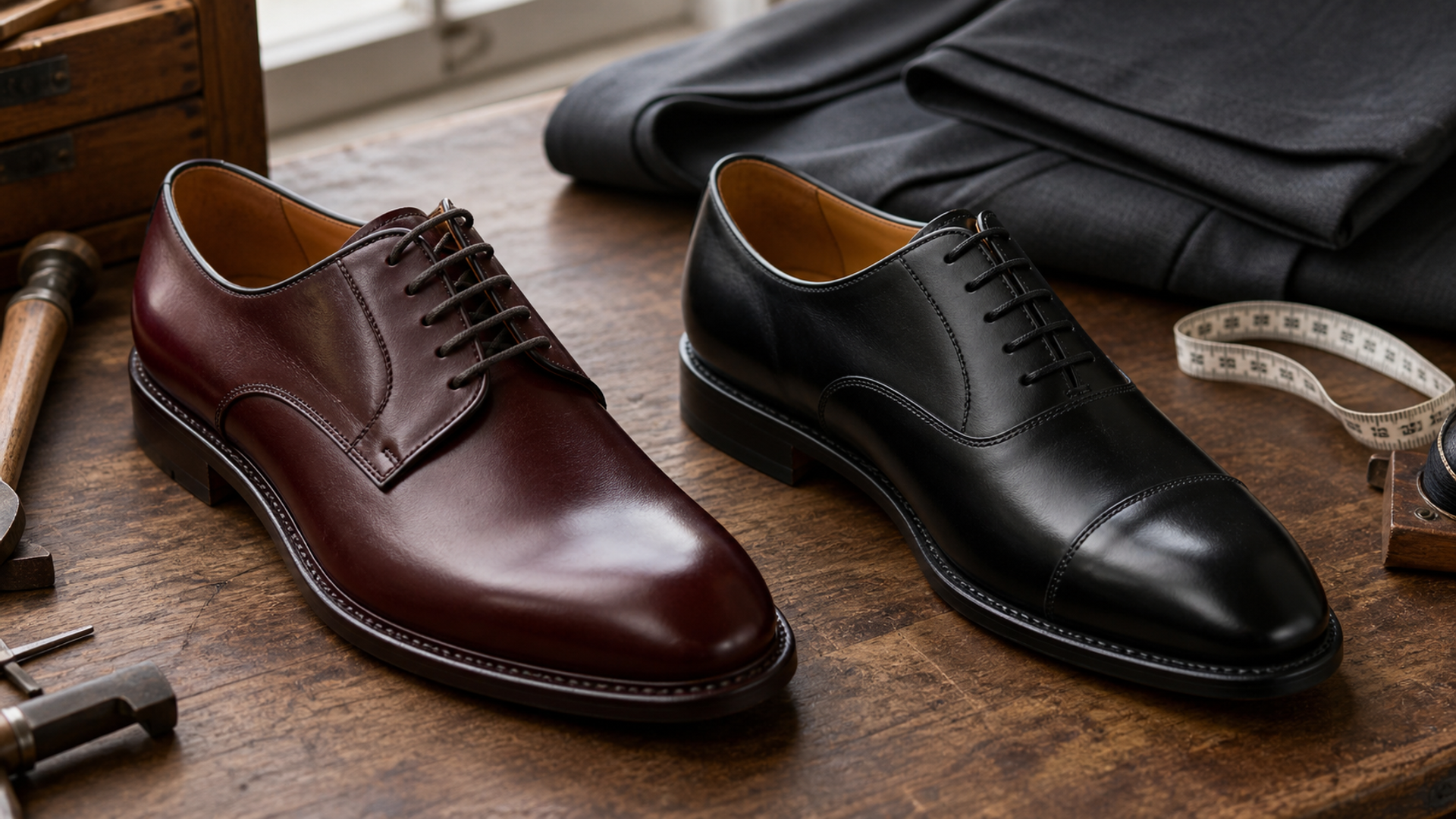
Derby and Oxford shoes are separated by lacing construction, not simply by colour or price. A Derby's quarters sit over the vamp and open more freely; an Oxford's quarters are closed beneath the vamp for a cleaner continuous line. That distinction affects visual formality and can affect how the upper accommodates the instep, but the exact last, width, leather, pattern and construction still decide fit. A useful comparison therefore puts the shoes on the same feet, with the intended socks and trousers, after enough standing and walking to expose pressure.
Read the lacing before reading the dress code
Choose a Derby when open lacing, easier adjustment and a slightly more relaxed line suit the foot and wardrobe. Choose an Oxford when a closed-laced profile supports formal tailoring and the last fits without forcing the facings apart. Use another last or shoe type when neither construction resolves heel hold, forefoot width, toe shape or the actual dress code.
| Decision factor | Derby shoe | Oxford shoe | Use another last or shoe type |
|---|---|---|---|
| Lacing | Open quarters permit broader adjustment | Closed quarters create a cleaner line | A different last may matter more |
| Instep | Often accommodates volume more visibly | Can expose strain when the last is too shallow | Measure both feet late in the day |
| Formality | Textured or country Derbies span smart casual | Plain or cap-toe Oxfords suit formal tailoring | Material and colour can reverse the signal |
| Trousers | Works naturally with flannel, denim and chinos | Works naturally with worsted suits and formal trousers | Test the actual hem and break |
| Walking | Fit, sole and heel geometry decide comfort | Fit, sole and heel geometry decide comfort | Do not infer comfort from lacing alone |
| Care | Open facings collect dust but are accessible | Closed facings need careful polishing at the throat | Follow leather and maker guidance |
This derby vs oxford shoes matrix is the article's working value object. Read the derby vs oxford shoes rows together: the decisive failure mode depends on this topic's evidence, operating context and reader objective.
Instep and last decide comfort
Evidence 1. Crockett & Jones defines the Oxford through closed lacing and the Derby through open lacing, while also showing substantial variation in lasts and patterns.
Evidence 2. The maker's style guide treats construction, last, leather and intended occasion as connected decisions rather than declaring one category universally superior.
Evidence 3. A gap between Oxford facings can be normal, but excessive strain, numbness or heel movement indicates that the exact last or size needs reassessment.
Evidence 4. Suede, grain, colour, sole edge and broguing can shift perceived formality within either lacing family.
Reader-visible sources checked for this article:
crockettandjones.com — reader-visible current or official evidence
crockettandjones.com — reader-visible current or official evidence
crockettandjones.com — reader-visible current or official evidence
For derby vs oxford shoes, these sources establish only the claims inside their documented scope. Recheck every changeable specification, availability condition, price, policy or service term in the relevant market before acting.
Fit shoes with the trousers and walking day
Read lacing as a stop/go test: open quarters permit broader adjustment supports the first option; closed quarters create a cleaner line supports the second; and a different last may matter more supports the third. Record which source proves the condition and when it was checked.
A buyer can resolve instep without starting from a brand preference. Ask whether often accommodates volume more visibly; compare that with whether can expose strain when the last is too shallow; then use measure both feet late in the day as the third route's safeguard. An unknown condition stays unknown.
On formality, popularity is not enough. The evidence for option one is that textured or country Derbies span smart casual. Option two means plain or cap-toe Oxfords suit formal tailoring. Option three is rational where material and colour can reverse the signal. Recheck any changeable term immediately before commitment.
The decision changes at trousers. Choose the first path only if works naturally with flannel, denim and chinos; move to the second when works naturally with worsted suits and formal trousers; use the third when test the actual hem and break. Save the downside that would make this row fail.
For walking, the first route works when fit, sole and heel geometry decide comfort; the second requires fit, sole and heel geometry decide comfort. The control for the third is do not infer comfort from lacing alone. Verify this row against the exact product, property, account or environment before it can reverse the decision.
The care row exposes a practical boundary. Route one assumes open facings collect dust but are accessible, while route two is defensible only when closed facings need careful polishing at the throat. Route three depends on follow leather and maker guidance. If that evidence is absent, keep the more reversible option.
Facts that would reverse the current choice
Reversal control 1 — Lacing. Before choosing Derby shoe, write down how the decision changes if “Open quarters permit broader adjustment” proves false. Do the same for Oxford shoe and “Closed quarters create a cleaner line”. Keep the Use another last or shoe type route available until “A different last may matter more” is verified. This control belongs to derby vs oxford shoes; update it from the cited source or exact supplier rather than copying a generic checklist.
Reversal control 2 — Instep. Before choosing Derby shoe, write down how the decision changes if “Often accommodates volume more visibly” proves false. Do the same for Oxford shoe and “Can expose strain when the last is too shallow”. Keep the Use another last or shoe type route available until “Measure both feet late in the day” is verified. This control belongs to derby vs oxford shoes; update it from the cited source or exact supplier rather than copying a generic checklist.
Reversal control 3 — Formality. Before choosing Derby shoe, write down how the decision changes if “Textured or country Derbies span smart casual” proves false. Do the same for Oxford shoe and “Plain or cap-toe Oxfords suit formal tailoring”. Keep the Use another last or shoe type route available until “Material and colour can reverse the signal” is verified. This control belongs to derby vs oxford shoes; update it from the cited source or exact supplier rather than copying a generic checklist.
Reversal control 4 — Trousers. Before choosing Derby shoe, write down how the decision changes if “Works naturally with flannel, denim and chinos” proves false. Do the same for Oxford shoe and “Works naturally with worsted suits and formal trousers”. Keep the Use another last or shoe type route available until “Test the actual hem and break” is verified. This control belongs to derby vs oxford shoes; update it from the cited source or exact supplier rather than copying a generic checklist.
Reversal control 5 — Walking. Before choosing Derby shoe, write down how the decision changes if “Fit, sole and heel geometry decide comfort” proves false. Do the same for Oxford shoe and “Fit, sole and heel geometry decide comfort”. Keep the Use another last or shoe type route available until “Do not infer comfort from lacing alone” is verified. This control belongs to derby vs oxford shoes; update it from the cited source or exact supplier rather than copying a generic checklist.
Reversal control 6 — Care. Before choosing Derby shoe, write down how the decision changes if “Open facings collect dust but are accessible” proves false. Do the same for Oxford shoe and “Closed facings need careful polishing at the throat”. Keep the Use another last or shoe type route available until “Follow leather and maker guidance” is verified. This control belongs to derby vs oxford shoes; update it from the cited source or exact supplier rather than copying a generic checklist.
Measure the feet and instep
Measure both feet while standing late in the day and note instep volume, width and heel shape. Use the intended sock and compare several lasts, not just sizes. For this Derby versus Oxford shoes decision, keep the exact item, setting, date and test condition in one evidence log. Separate a measured result from category shorthand and repeat the check in the intended environment. If a different last removes pressure, reverse any category-level verdict. If that reversal condition appears, reopen the decision instead of defending the earlier preference.
Read the facing behaviour
Lace each shoe to normal tension and photograph the quarters from above. Walk until the leather warms, then check throat pressure and heel movement. For this Derby versus Oxford shoes decision, keep the exact item, setting, date and test condition in one evidence log. Separate a measured result from category shorthand and repeat the check in the intended environment. If secure closure requires painful tension, reject that last. If that reversal condition appears, reopen the decision instead of defending the earlier preference.
Build three complete outfits
Pair each shoe with the real suit, flannel or denim hem under daylight. Judge proportion from standing distance instead of a close product image. For this Derby versus Oxford shoes decision, keep the exact item, setting, date and test condition in one evidence log. Separate a measured result from category shorthand and repeat the check in the intended environment. If the leather and sole change formality more than lacing, update the wardrobe rule. If that reversal condition appears, reopen the decision instead of defending the earlier preference.
Run the walking test
Use stairs, pavement, carpet and a seated hour while noting hot spots. Recheck fit after the normal daily swelling pattern. For this Derby versus Oxford shoes decision, keep the exact item, setting, date and test condition in one evidence log. Separate a measured result from category shorthand and repeat the check in the intended environment. If discomfort persists beyond reasonable break-in guidance, do not rationalise it. If that reversal condition appears, reopen the decision instead of defending the earlier preference.
Plan maintenance and repair
Ask about upper leather, sole construction, resoling, trees, polish and wet-weather rotation. Price ownership across realistic wears rather than one event. For this Derby versus Oxford shoes decision, keep the exact item, setting, date and test condition in one evidence log. Separate a measured result from category shorthand and repeat the check in the intended environment. If the shoe cannot be maintained for its intended use, choose the more robust pair. If that reversal condition appears, reopen the decision instead of defending the earlier preference.
Four wardrobes, four answers
Conservative formal office
A well-fitted dark Oxford often supplies the cleanest line. Define the fact that would reverse this recommendation before committing.
Business-casual travel
A flexible Derby can cover more trousers and accommodate foot changes. Define the fact that would reverse this recommendation before committing.
High instep with formal need
A suitable Oxford last may work, but open lacing can be the safer fitting route. Define the fact that would reverse this recommendation before committing.
Outdoor country event
A grain Derby with a practical sole can outperform a delicate formal Oxford. Define the fact that would reverse this recommendation before committing.
Action checklist
Identify lacing construction.
Measure both feet.
Record instep volume.
Try multiple lasts.
Wear intended socks.
Test actual trousers.
Walk on mixed surfaces.
Check heel hold.
Inspect facing strain.
Confirm resoling.
Plan wet-weather rotation.
Photograph the final fit.
Continue the decision
The linked VERTU articles expand adjacent parts of the derby vs oxford shoes decision. They do not substitute for the external evidence above.
The Derby-versus-Oxford verdict
Choose a Derby when open lacing, easier adjustment and a slightly more relaxed line suit the foot and wardrobe. Choose an Oxford when a closed-laced profile supports formal tailoring and the last fits without forcing the facings apart. Use another last or shoe type when neither construction resolves heel hold, forefoot width, toe shape or the actual dress code.
Keep the derby vs oxford shoes decision reversible until its material cost, safety, access, privacy and compatibility facts are verified. Unknown evidence stays unknown; it is never silently scored as favourable.