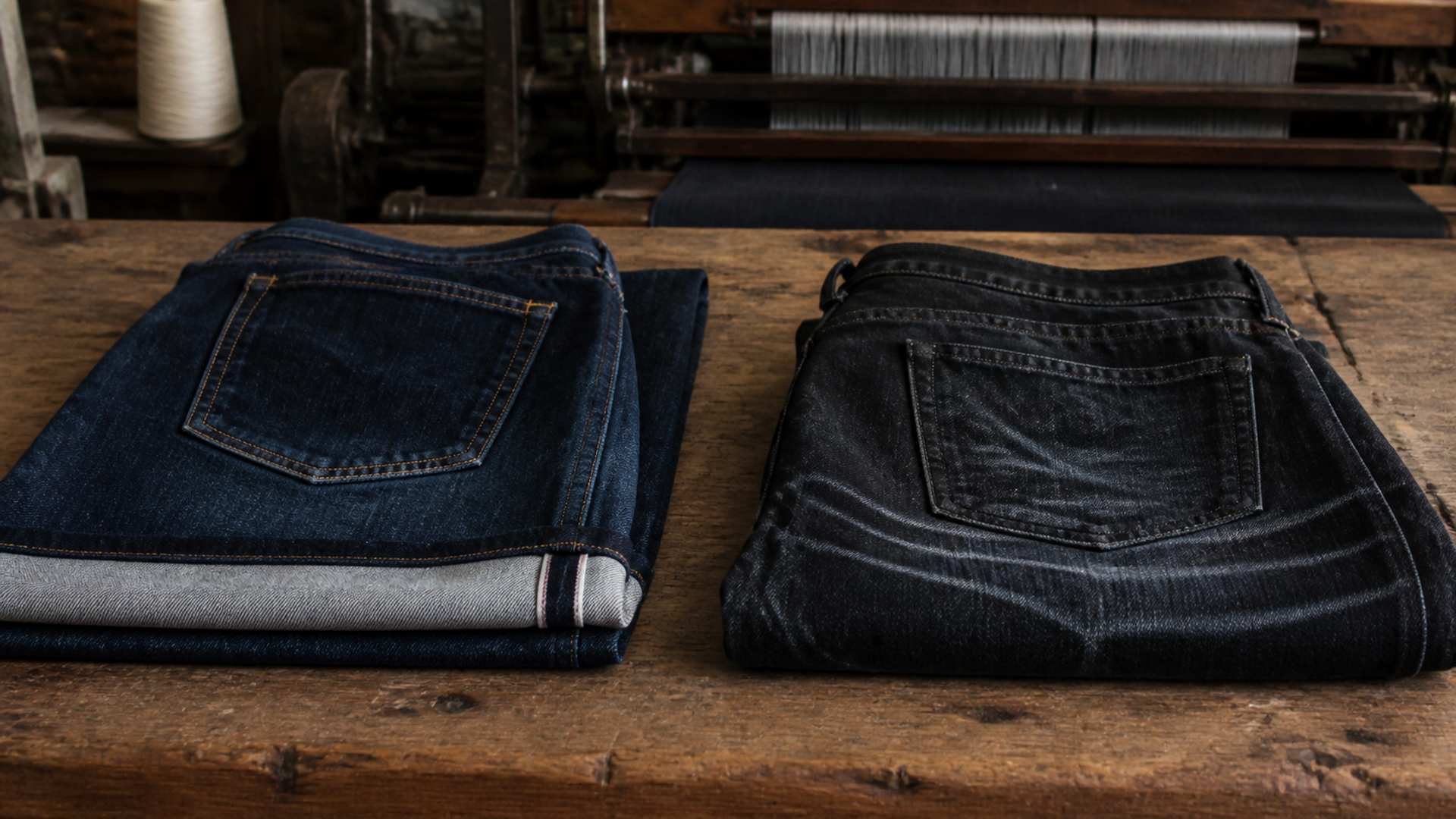
Selvedge and raw describe different things. Selvedge refers to the self-finished edge produced on narrower fabric, commonly associated with shuttle looms. Raw refers to denim sold without a substantial pre-wash or distressing process after dyeing and construction. A pair can be both, either or neither. That distinction prevents a common buying mistake, but it does not decide comfort or quality: fibre, yarn, weave, weight, dye, sanforisation, pattern, stitching, fit and care matter more in daily wear.
Construction and wash state are different axes
Choose selvedge when the cloth construction, finished edge and maker's fabric story matter and the actual fit is right. Choose raw denim when a rigid starting state and personal fade development justify break-in and careful washing. Choose by fabric, fit and care instead when the label premium does not improve comfort, construction, repairability or cost per wear.
| Decision factor | Selvedge denim | Raw denim | Choose by fabric, fit and care instead |
|---|---|---|---|
| Meaning | Describes a self-finished fabric edge | Describes an unwashed or minimally washed state | One pair can carry both labels |
| Loom and width | Often linked to narrower shuttle-loom cloth | Can be woven on different equipment | Verify the mill and fabric |
| Feel | Can be soft or rigid depending on finish | Usually begins rigid and changes with wear | Handle the exact pair |
| Shrink | Selvedge alone does not set shrink risk | Unsanforised raw denim can shrink materially | Follow the maker's measurements |
| Fades | Fading depends on dye, wear and washing | Personal creases can develop strongly | Do not sacrifice hygiene or fit |
| Value | Premium may reflect cloth and small-run production | Premium may reflect fabric and construction | Inspect seams, pattern and repair access |
This selvedge vs raw denim matrix is the article's working value object. Read the selvedge vs raw denim rows together: the decisive failure mode depends on this topic's evidence, operating context and reader objective.
The labels can overlap without meaning the same thing
Evidence 1. Levi's consumer guidance distinguishes raw denim as unwashed material and selvedge denim by its finished edge, confirming that the terms are not synonyms.
Evidence 2. A garment can be both raw and selvedge because one label concerns finishing state and the other concerns fabric construction.
Evidence 3. Shrink behaviour depends on whether the fabric is sanforised or otherwise treated, not on the selvedge edge alone.
Evidence 4. Levi's product-care guidance recommends washing less often where appropriate and caring according to condition, but hygiene, fit and maker instructions still govern the routine.
Reader-visible sources checked for this article:
levihelp.levi.com — reader-visible current or official evidence
levi.com — reader-visible current or official evidence
For selvedge vs raw denim, these sources establish only the claims inside their documented scope. Recheck every changeable specification, availability condition, price, policy or service term in the relevant market before acting.
Inspect the cloth and run a fit trial
On meaning, popularity is not enough. The evidence for option one is that describes a self-finished fabric edge. Option two means describes an unwashed or minimally washed state. Option three is rational where one pair can carry both labels. Recheck any changeable term immediately before commitment.
The decision changes at loom and width. Choose the first path only if often linked to narrower shuttle-loom cloth; move to the second when can be woven on different equipment; use the third when verify the mill and fabric. Save the downside that would make this row fail.
For feel, the first route works when can be soft or rigid depending on finish; the second requires usually begins rigid and changes with wear. The control for the third is handle the exact pair. Verify this row against the exact product, property, account or environment before it can reverse the decision.
The shrink row exposes a practical boundary. Route one assumes selvedge alone does not set shrink risk, while route two is defensible only when unsanforised raw denim can shrink materially. Route three depends on follow the maker's measurements. If that evidence is absent, keep the more reversible option.
Read fades as a stop/go test: fading depends on dye, wear and washing supports the first option; personal creases can develop strongly supports the second; and do not sacrifice hygiene or fit supports the third. Record which source proves the condition and when it was checked.
A buyer can resolve value without starting from a brand preference. Ask whether premium may reflect cloth and small-run production; compare that with whether premium may reflect fabric and construction; then use inspect seams, pattern and repair access as the third route's safeguard. An unknown condition stays unknown.
Facts that would reverse the current choice
Reversal control 1 — Meaning. Before choosing Selvedge denim, write down how the decision changes if “Describes a self-finished fabric edge” proves false. Do the same for Raw denim and “Describes an unwashed or minimally washed state”. Keep the Choose by fabric, fit and care instead route available until “One pair can carry both labels” is verified. This control belongs to selvedge vs raw denim; update it from the cited source or exact supplier rather than copying a generic checklist.
Reversal control 2 — Loom and width. Before choosing Selvedge denim, write down how the decision changes if “Often linked to narrower shuttle-loom cloth” proves false. Do the same for Raw denim and “Can be woven on different equipment”. Keep the Choose by fabric, fit and care instead route available until “Verify the mill and fabric” is verified. This control belongs to selvedge vs raw denim; update it from the cited source or exact supplier rather than copying a generic checklist.
Reversal control 3 — Feel. Before choosing Selvedge denim, write down how the decision changes if “Can be soft or rigid depending on finish” proves false. Do the same for Raw denim and “Usually begins rigid and changes with wear”. Keep the Choose by fabric, fit and care instead route available until “Handle the exact pair” is verified. This control belongs to selvedge vs raw denim; update it from the cited source or exact supplier rather than copying a generic checklist.
Reversal control 4 — Shrink. Before choosing Selvedge denim, write down how the decision changes if “Selvedge alone does not set shrink risk” proves false. Do the same for Raw denim and “Unsanforised raw denim can shrink materially”. Keep the Choose by fabric, fit and care instead route available until “Follow the maker's measurements” is verified. This control belongs to selvedge vs raw denim; update it from the cited source or exact supplier rather than copying a generic checklist.
Reversal control 5 — Fades. Before choosing Selvedge denim, write down how the decision changes if “Fading depends on dye, wear and washing” proves false. Do the same for Raw denim and “Personal creases can develop strongly”. Keep the Choose by fabric, fit and care instead route available until “Do not sacrifice hygiene or fit” is verified. This control belongs to selvedge vs raw denim; update it from the cited source or exact supplier rather than copying a generic checklist.
Reversal control 6 — Value. Before choosing Selvedge denim, write down how the decision changes if “Premium may reflect cloth and small-run production” proves false. Do the same for Raw denim and “Premium may reflect fabric and construction”. Keep the Choose by fabric, fit and care instead route available until “Inspect seams, pattern and repair access” is verified. This control belongs to selvedge vs raw denim; update it from the cited source or exact supplier rather than copying a generic checklist.
Decode the product page
Record fabric mill, country of weave, fibre, weight, dye, selvedge claim, raw or rinse state and sanforisation. Ask the maker to clarify missing or conflicting terminology. In this selvedge versus raw denim comparison, preserve the exact item, setting, date and test condition in the evidence log. Keep measured results separate from category shorthand and repeat the check in the intended environment. If the cloth story cannot be verified, stop paying a provenance premium. When that reversal condition appears, reopen the choice instead of defending the original preference.
Measure the garment
Record waist, rise, thigh, knee, hem and inseam using the maker's method. Compare a pair that fits after a full day rather than relying on tagged size. In this selvedge versus raw denim comparison, preserve the exact item, setting, date and test condition in the evidence log. Keep measured results separate from category shorthand and repeat the check in the intended environment. If the pattern restricts movement or creates pressure, reject it before planning break-in. When that reversal condition appears, reopen the choice instead of defending the original preference.
Model shrink and stretch
Use maker guidance for the exact fabric and distinguish temporary waistband stretch from permanent pattern fit. Measure before and after the first controlled wash. In this selvedge versus raw denim comparison, preserve the exact item, setting, date and test condition in the evidence log. Keep measured results separate from category shorthand and repeat the check in the intended environment. If projected shrink removes required room, change size, fabric or treatment state. When that reversal condition appears, reopen the choice instead of defending the original preference.
Plan the care cycle
Choose wash frequency from wear, soil, odour, climate and maker guidance rather than a fade myth. Turn garments inside out, use an appropriate gentle process and air dry when instructed. In this selvedge versus raw denim comparison, preserve the exact item, setting, date and test condition in the evidence log. Keep measured results separate from category shorthand and repeat the check in the intended environment. If delaying washing harms hygiene or the garment, wash it and accept the resulting fade. When that reversal condition appears, reopen the choice instead of defending the original preference.
Inspect construction and repair
Check seams, belt loops, pockets, rivets, zipper or buttons and high-friction areas. Identify a repair service before holes grow and log cost per wear. In this selvedge versus raw denim comparison, preserve the exact item, setting, date and test condition in the evidence log. Keep measured results separate from category shorthand and repeat the check in the intended environment. If repair access or construction is weak, the premium edge does not rescue the purchase. When that reversal condition appears, reopen the choice instead of defending the original preference.
Four wardrobes, four answers
Collector interested in cloth provenance
A documented selvedge fabric can make the construction story meaningful. Define the fact that would reverse this recommendation before committing.
Wearer seeking personal fades
Raw denim can provide the desired starting state with a realistic care plan. Define the fact that would reverse this recommendation before committing.
First premium-jeans purchase
Fit, fabric comfort and repairability should outrank both labels. Define the fact that would reverse this recommendation before committing.
Hot or humid daily use
A lighter washed fabric may outperform a rigid raw pair despite less mythology. Define the fact that would reverse this recommendation before committing.
Action checklist
Separate the two terms.
Verify fabric mill.
Record weight.
Record raw or rinse state.
Check sanforisation.
Measure the garment.
Test seated fit.
Plan the first wash.
Record shrink.
Inspect construction.
Find repair support.
Calculate cost per wear.
Continue the decision
The linked VERTU articles expand adjacent parts of the selvedge vs raw denim decision. They do not substitute for the external evidence above.
The selvedge-versus-raw-denim verdict
Choose selvedge when the cloth construction, finished edge and maker's fabric story matter and the actual fit is right. Choose raw denim when a rigid starting state and personal fade development justify break-in and careful washing. Choose by fabric, fit and care instead when the label premium does not improve comfort, construction, repairability or cost per wear.
Keep the selvedge vs raw denim decision reversible until its material cost, safety, access, privacy and compatibility facts are verified. Unknown evidence stays unknown; it is never silently scored as favourable.