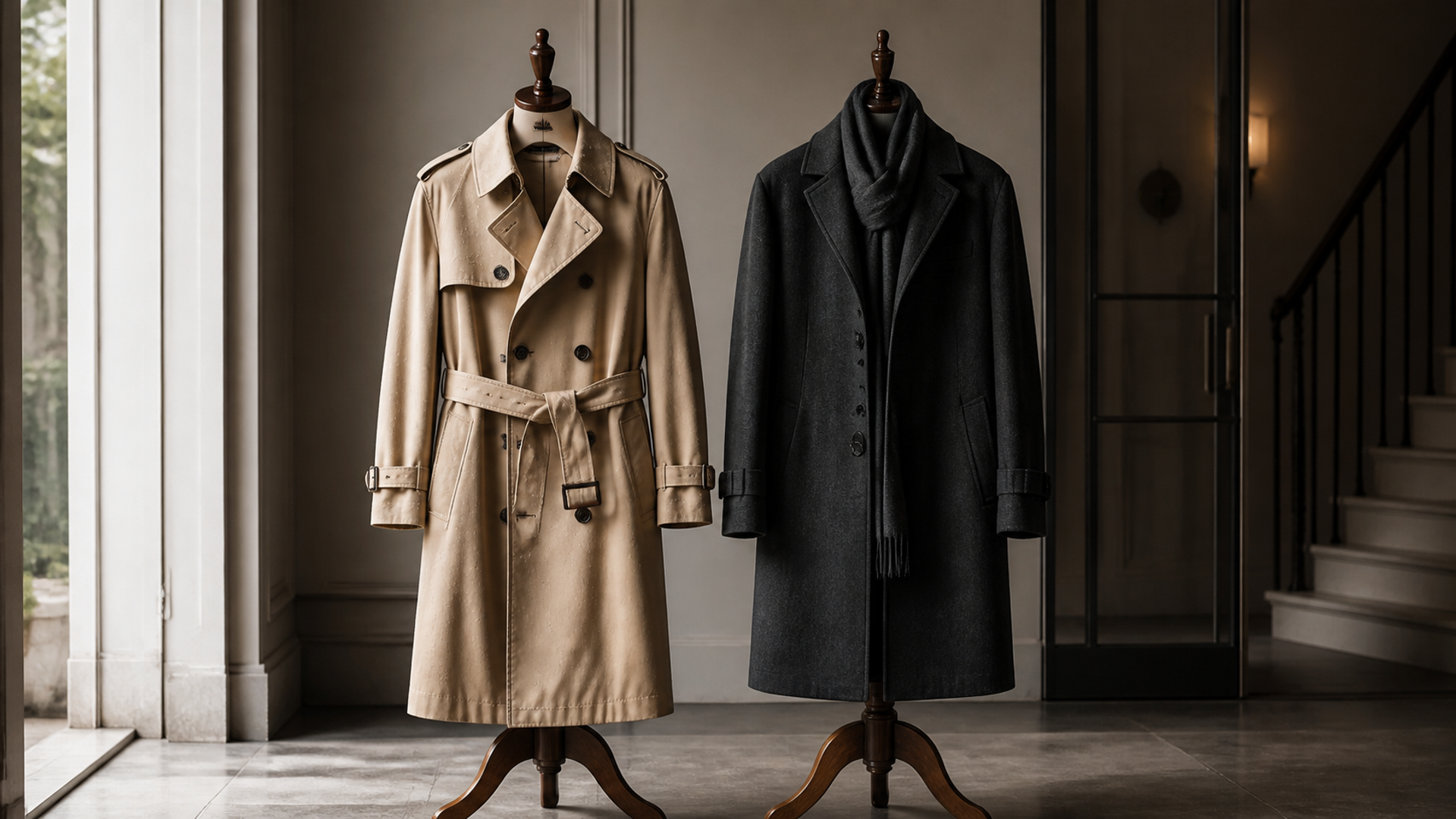
A trench coat and an overcoat can look equally formal in a photograph, but they manage different weather. The classic trench descends from protective rainwear, using a tightly woven shell, storm details and a belted silhouette rather than heavy insulation. An overcoat is usually a longer tailored outer layer in wool or another substantial cloth, designed to trap warmth over suiting or winter layers. Modern linings, membranes and blends blur the boundary, so cloth, construction and fit matter more than the name.
Begin with weather and tailoring
Choose a trench coat for rain, wind, transitional temperatures and a lighter layer over business or casual clothing. Choose a wool overcoat for cold, dry conditions and warmth over tailoring. Own one versatile layer when the local climate is moderate, but make the compromise explicit: a lined water-resistant coat may not replace true winter insulation, and wool needs protection in persistent rain.
| Decision factor | Trench coat | Wool overcoat | Own one versatile outer layer |
|---|---|---|---|
| Weather | Rain and wind are the leading exposure | Cold and insulation are the leading exposure | Choose a technical lined coat for mixed extremes |
| Layering | Cut allows light tailoring underneath | Shoulders and armholes accept winter layers | Try on with the thickest real layer |
| Formality | Belt and military details can dress up or down | Clean tailored line suits formal winter wear | Choose restrained colour and hardware |
| Travel | Lighter shell packs more easily | Bulk buys warmth but consumes luggage | Wear the heavier coat in transit |
| Care | Shell needs proofing and hardware care | Wool needs brushing, drying and specialist cleaning | Budget lifetime maintenance |
| Fit | Belt position and sleeve length control shape | Shoulder, collar and drape control shape | Alter only where construction permits |
This trench coat vs overcoat matrix is the article's working value object. Read the trench coat vs overcoat rows together: the decisive failure mode depends on this topic's evidence, operating context and reader objective.
Construction reveals the real job
Evidence 1. Burberry traces the trench coat to weather-protective gabardine construction and military-derived design details.
Evidence 2. A trench's water performance depends on the exact cloth, seams, finish and condition; heritage styling alone is not a waterproof certification.
Evidence 3. Overcoat warmth depends on fibre, cloth weight, weave, lining, length and the layers worn underneath.
Evidence 4. Dry-cleaning, reproofing, moth protection and alteration feasibility should be confirmed from the exact maker and care label.
Reader-visible sources checked for this article:
burberryplc.com — reader-visible current or official evidence
vam.ac.uk — reader-visible current or official evidence
For trench coat vs overcoat, these sources establish only the claims inside their documented scope. Recheck every changeable specification, availability condition, price, policy or service term in the relevant market before acting.
Try the coat over the intended wardrobe
The weather row exposes a practical boundary. Route one assumes rain and wind are the leading exposure, while route two is defensible only when cold and insulation are the leading exposure. Route three depends on choose a technical lined coat for mixed extremes. If that evidence is absent, keep the more reversible option.
Read layering as a stop/go test: cut allows light tailoring underneath supports the first option; shoulders and armholes accept winter layers supports the second; and try on with the thickest real layer supports the third. Record which source proves the condition and when it was checked.
A buyer can resolve formality without starting from a brand preference. Ask whether belt and military details can dress up or down; compare that with whether clean tailored line suits formal winter wear; then use choose restrained colour and hardware as the third route's safeguard. An unknown condition stays unknown.
On travel, popularity is not enough. The evidence for option one is that lighter shell packs more easily. Option two means bulk buys warmth but consumes luggage. Option three is rational where wear the heavier coat in transit. Recheck any changeable term immediately before commitment.
The decision changes at care. Choose the first path only if shell needs proofing and hardware care; move to the second when wool needs brushing, drying and specialist cleaning; use the third when budget lifetime maintenance. Save the downside that would make this row fail.
For fit, the first route works when belt position and sleeve length control shape; the second requires shoulder, collar and drape control shape. The control for the third is alter only where construction permits. Verify this row against the exact product, property, account or environment before it can reverse the decision.
Facts that would reverse the current choice
Reversal control 1 — Weather. Before choosing Trench coat, write down how the decision changes if “Rain and wind are the leading exposure” proves false. Do the same for Wool overcoat and “Cold and insulation are the leading exposure”. Keep the Own one versatile outer layer route available until “Choose a technical lined coat for mixed extremes” is verified. This control belongs to trench coat vs overcoat; update it from the cited source or exact supplier rather than copying a generic checklist.
Reversal control 2 — Layering. Before choosing Trench coat, write down how the decision changes if “Cut allows light tailoring underneath” proves false. Do the same for Wool overcoat and “Shoulders and armholes accept winter layers”. Keep the Own one versatile outer layer route available until “Try on with the thickest real layer” is verified. This control belongs to trench coat vs overcoat; update it from the cited source or exact supplier rather than copying a generic checklist.
Reversal control 3 — Formality. Before choosing Trench coat, write down how the decision changes if “Belt and military details can dress up or down” proves false. Do the same for Wool overcoat and “Clean tailored line suits formal winter wear”. Keep the Own one versatile outer layer route available until “Choose restrained colour and hardware” is verified. This control belongs to trench coat vs overcoat; update it from the cited source or exact supplier rather than copying a generic checklist.
Reversal control 4 — Travel. Before choosing Trench coat, write down how the decision changes if “Lighter shell packs more easily” proves false. Do the same for Wool overcoat and “Bulk buys warmth but consumes luggage”. Keep the Own one versatile outer layer route available until “Wear the heavier coat in transit” is verified. This control belongs to trench coat vs overcoat; update it from the cited source or exact supplier rather than copying a generic checklist.
Reversal control 5 — Care. Before choosing Trench coat, write down how the decision changes if “Shell needs proofing and hardware care” proves false. Do the same for Wool overcoat and “Wool needs brushing, drying and specialist cleaning”. Keep the Own one versatile outer layer route available until “Budget lifetime maintenance” is verified. This control belongs to trench coat vs overcoat; update it from the cited source or exact supplier rather than copying a generic checklist.
Reversal control 6 — Fit. Before choosing Trench coat, write down how the decision changes if “Belt position and sleeve length control shape” proves false. Do the same for Wool overcoat and “Shoulder, collar and drape control shape”. Keep the Own one versatile outer layer route available until “Alter only where construction permits” is verified. This control belongs to trench coat vs overcoat; update it from the cited source or exact supplier rather than copying a generic checklist.
Map the climate
Review rain days, wind, temperature range, commute exposure and time spent outdoors. Separate a five-minute car transfer from a forty-minute walk and identify the worst recurring condition. Record the exact product, material, room, garment, vehicle, water report or operating condition and the time of the check. Separate observed behaviour from marketing language, and repeat the comparison in the intended setting rather than an ideal demonstration. If neither coat protects the actual exposure, choose technical outerwear rather than forcing style categories. Preserve the evidence that would reverse the choice: a change in fit, specification, maintenance, safety, price or environment must reopen the decision rather than inherit an old conclusion.
Fit over real clothing
Try the coat over the suit, knit or jacket it must cover and sit, reach and carry a bag. Check collar seal, shoulder drag, button strain, belt position, sleeve coverage and rear vent. Record the exact product, material, room, garment, vehicle, water report or operating condition and the time of the check. Separate observed behaviour from marketing language, and repeat the comparison in the intended setting rather than an ideal demonstration. If the correct layer ruins movement or silhouette, change size or pattern. Preserve the evidence that would reverse the choice: a change in fit, specification, maintenance, safety, price or environment must reopen the decision rather than inherit an old conclusion.
Inspect construction
Read fibre content, lining, seam, button, pocket, cuff and weather-treatment details. Ask which elements can be repaired, altered or reproofed locally and inspect spare hardware. Record the exact product, material, room, garment, vehicle, water report or operating condition and the time of the check. Separate observed behaviour from marketing language, and repeat the comparison in the intended setting rather than an ideal demonstration. If a surface claim has no care route, long-term value can reverse. Preserve the evidence that would reverse the choice: a change in fit, specification, maintenance, safety, price or environment must reopen the decision rather than inherit an old conclusion.
Build a care plan
Air and dry the coat correctly, brush wool, manage stains promptly and store with breathable support. Follow maker instructions for cleaning, pressing and water-repellent renewal. Record the exact product, material, room, garment, vehicle, water report or operating condition and the time of the check. Separate observed behaviour from marketing language, and repeat the comparison in the intended setting rather than an ideal demonstration. If the household cannot maintain a delicate cloth, a more robust material may earn more wear. Preserve the evidence that would reverse the choice: a change in fit, specification, maintenance, safety, price or environment must reopen the decision rather than inherit an old conclusion.
Three climates, three answers
Wet London-style shoulder season
A well-cut trench can bridge business and casual wardrobes. Define the fact that would reverse this recommendation before committing.
Cold continental winter
A properly weighted overcoat supports warmth and tailoring. Define the fact that would reverse this recommendation before committing.
Frequent flights across climates
One moderate coat plus modular knitwear may be more practical. Define the fact that would reverse this recommendation before committing.
Action checklist
Map climate.
Define commute.
Try thickest layer.
Check movement.
Read fibre content.
Verify rain claim.
Price alterations.
Plan cleaning.
Store correctly.
Buy for recurring weather.
Continue the decision
The linked VERTU articles expand adjacent parts of the trench coat vs overcoat decision. They do not substitute for the external evidence above.
The trench-versus-overcoat verdict
Choose a trench coat for rain, wind, transitional temperatures and a lighter layer over business or casual clothing. Choose a wool overcoat for cold, dry conditions and warmth over tailoring. Own one versatile layer when the local climate is moderate, but make the compromise explicit: a lined water-resistant coat may not replace true winter insulation, and wool needs protection in persistent rain.
Keep the trench coat vs overcoat decision reversible until its material cost, safety, access, privacy and compatibility facts are verified. Unknown evidence stays unknown; it is never silently scored as favourable.