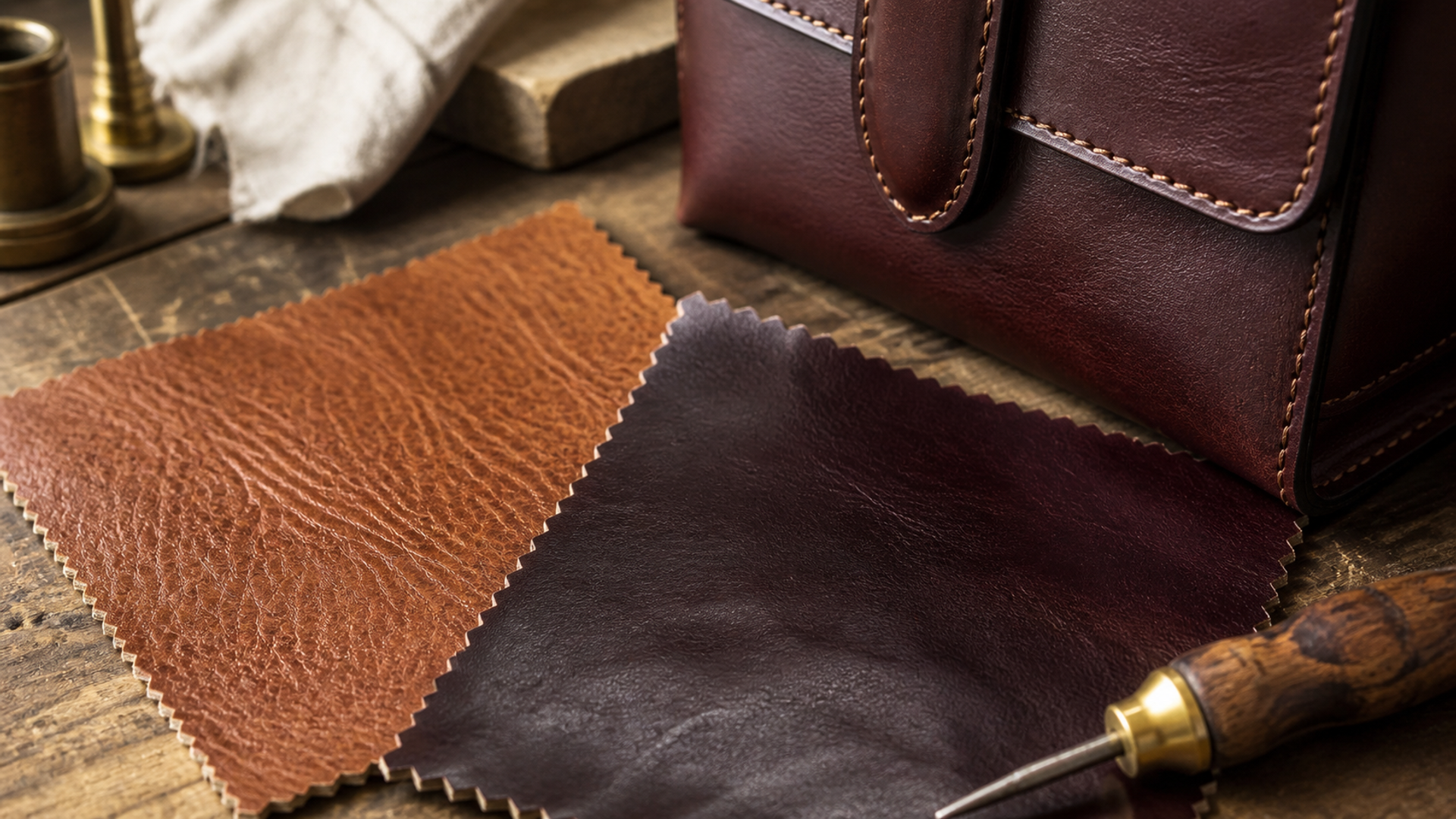
Leather labels can sound more precise than they are. Full-grain describes how much of the original grain remains, while 'genuine leather' is often used as a broad product description rather than a guarantee of a particular finish, thickness or longevity. A luxury buyer should therefore read the label beside the construction: where the leather is used, how it is finished, whether the maker discloses the material and what kind of ageing the object is expected to show.
The short answer by ownership objective
Choose full-grain leather when visible natural character, repairability and long-term patina are central; choose a well-finished leather described more broadly when consistency, softness, colour and price fit the use better. Ask for the material and finish to be identified clearly, inspect edges and stitching, and judge the finished object rather than treating one label as a complete quality score.
| Decision factor | Natural-character full grain | Consistent finished leather | Material-specific maker disclosure |
|---|---|---|---|
| Visual aim | Visible grain and a changing patina are welcome | Uniform colour and texture matter | The buyer wants a precise finish description |
| Wear pattern | Marks can become part of the story | A protective finish limits variation | The finish is judged against the intended use |
| Repair | Edges and surface can be maintained over time | The coating or correction is understood | The maker explains service and refinishing |
| Disclosure | Grain, thickness and finish are stated | The broader label is supplemented by facts | The maker identifies composition and origin claims |
| Use | Bags, cases or shoes benefit from character | High-contact use favours consistency | The material is selected for the object's job |
| Value | Long ownership and patina justify cost | Comfort and finish justify the decision | Evidence is stronger than a prestige adjective |
This full grain leather vs genuine leather matrix is the article's working value object. Read the full grain leather vs genuine leather rows together: the decisive failure mode depends on this topic's evidence, operating context and reader objective.
What the labels can and cannot tell you
Evidence 1. The US Federal Trade Commission's Leather Guides address how leather and imitation-leather claims should be presented; buyers should distinguish a regulated disclosure framework from a universal grading system.
Evidence 2. Full-grain generally refers to retaining the original grain surface, but the performance of a finished good also depends on tanning, thickness, construction, edge treatment, stitching, lining and use.
Evidence 3. A smooth corrected or coated surface can be practical and attractive, while a more natural surface can show marks and variation; neither outcome alone proves that the finished item is suitable or unsuitable.
Evidence 4. Leather Working Group describes environmental and operational assessment work across leather supply chains; a sustainability or certification claim should be checked in the scope and market in which it is made.
Reader-visible sources checked for this article:
ftc.gov — reader-visible current or official evidence
leatherworkinggroup.com — reader-visible current or official evidence
For full grain leather vs genuine leather, these sources establish only the claims inside their documented scope. Recheck every changeable specification, availability condition, price, policy or service term in the relevant market before acting.
Inspect the finished good, not only the hide
A buyer can resolve visual aim without starting from a brand preference. Ask whether visible grain and a changing patina are welcome; compare that with whether uniform colour and texture matter; then use the buyer wants a precise finish description as the third route's safeguard. An unknown condition stays unknown.
On wear pattern, popularity is not enough. The evidence for option one is that marks can become part of the story. Option two means a protective finish limits variation. Option three is rational where the finish is judged against the intended use. Recheck any changeable term immediately before commitment.
The decision changes at repair. Choose the first path only if edges and surface can be maintained over time; move to the second when the coating or correction is understood; use the third when the maker explains service and refinishing. Save the downside that would make this row fail.
For disclosure, the first route works when grain, thickness and finish are stated; the second requires the broader label is supplemented by facts. The control for the third is the maker identifies composition and origin claims. Verify this row against the exact product, property, account or environment before it can reverse the decision.
The use row exposes a practical boundary. Route one assumes bags, cases or shoes benefit from character, while route two is defensible only when high-contact use favours consistency. Route three depends on the material is selected for the object's job. If that evidence is absent, keep the more reversible option.
Read value as a stop/go test: long ownership and patina justify cost supports the first option; comfort and finish justify the decision supports the second; and evidence is stronger than a prestige adjective supports the third. Record which source proves the condition and when it was checked.
Facts that would reverse the current choice
Reversal control 1 — Visual aim. Before choosing Natural-character full grain, write down how the decision changes if “Visible grain and a changing patina are welcome” proves false. Do the same for Consistent finished leather and “Uniform colour and texture matter”. Keep the Material-specific maker disclosure route available until “The buyer wants a precise finish description” is verified. This control belongs to full grain leather vs genuine leather; update it from the cited source or exact supplier rather than copying a generic checklist.
Reversal control 2 — Wear pattern. Before choosing Natural-character full grain, write down how the decision changes if “Marks can become part of the story” proves false. Do the same for Consistent finished leather and “A protective finish limits variation”. Keep the Material-specific maker disclosure route available until “The finish is judged against the intended use” is verified. This control belongs to full grain leather vs genuine leather; update it from the cited source or exact supplier rather than copying a generic checklist.
Reversal control 3 — Repair. Before choosing Natural-character full grain, write down how the decision changes if “Edges and surface can be maintained over time” proves false. Do the same for Consistent finished leather and “The coating or correction is understood”. Keep the Material-specific maker disclosure route available until “The maker explains service and refinishing” is verified. This control belongs to full grain leather vs genuine leather; update it from the cited source or exact supplier rather than copying a generic checklist.
Reversal control 4 — Disclosure. Before choosing Natural-character full grain, write down how the decision changes if “Grain, thickness and finish are stated” proves false. Do the same for Consistent finished leather and “The broader label is supplemented by facts”. Keep the Material-specific maker disclosure route available until “The maker identifies composition and origin claims” is verified. This control belongs to full grain leather vs genuine leather; update it from the cited source or exact supplier rather than copying a generic checklist.
Reversal control 5 — Use. Before choosing Natural-character full grain, write down how the decision changes if “Bags, cases or shoes benefit from character” proves false. Do the same for Consistent finished leather and “High-contact use favours consistency”. Keep the Material-specific maker disclosure route available until “The material is selected for the object's job” is verified. This control belongs to full grain leather vs genuine leather; update it from the cited source or exact supplier rather than copying a generic checklist.
Reversal control 6 — Value. Before choosing Natural-character full grain, write down how the decision changes if “Long ownership and patina justify cost” proves false. Do the same for Consistent finished leather and “Comfort and finish justify the decision”. Keep the Material-specific maker disclosure route available until “Evidence is stronger than a prestige adjective” is verified. This control belongs to full grain leather vs genuine leather; update it from the cited source or exact supplier rather than copying a generic checklist.
Ask what remains visible after finishing
A material description should lead to a physical inspection. Look at the grain under light, the edge paint or burnish, the cut edge where visible, the lining and the stress points. If the product is a bag, examine handle turns, base corners and strap attachment; if it is a case, examine the closure and repeated bend. A leather label cannot tell you whether the object is overbuilt, underlined or badly stitched. Quality is a relationship between material and construction.
Separate patina from damage
Natural grain can develop colour and surface variation, but a structural tear, delamination, sticky coating or collapsed edge is a different event. Ask how the maker expects the item to age and which marks can be repaired. A finish that resists water may also change how the leather responds to conditioning. Do not apply a generic oil or polish to a luxury item without checking the maker's instructions; an enthusiastic repair can remove the surface the warranty or future restorer needs to see.
Read 'genuine' as a prompt for a second question
When a product says genuine leather, ask what part is leather, how it is finished and which areas use another material. The phrase may be legally constrained in a market while still leaving the buyer without the detail needed for a long-term decision. Look for thickness, construction, origin and care information. If the seller avoids a direct answer, value the object as an attractive accessory with an unknown material profile rather than paying a premium for an assumption.
Match material to the life of the object
A natural-character leather may be ideal for a briefcase that travels and becomes personal; a consistent finished leather may be better for a light-coloured evening bag or a piece used in variable weather. Think about hand oils, rain, abrasion, storage, repairs and whether the owner wants the first-day appearance to last. The best choice is the material and finish that will still look intentional after the object's real routine, not the one that wins a label comparison in isolation.
Three luxury-buying situations that change the choice
The daily briefcase
Full-grain character can reward long ownership when the buyer accepts marks, follows care instructions and values repair over uniformity. Define the fact that would reverse this recommendation before committing.
The light-coloured evening piece
A consistent finished surface may be more practical when colour control and resistance to visible handling matter. Define the fact that would reverse this recommendation before committing.
The collector purchase
Precise maker disclosure, provenance, construction and service support deserve more weight than the single word used on a product page. Define the fact that would reverse this recommendation before committing.
Action checklist
Ask whether the original grain surface remains.
Identify coatings, corrections and edge treatments.
Inspect stitching, lining, corners and hardware.
Read maker care and service instructions.
Separate patina from structural damage.
Check exactly where leather is used.
Treat broad labels as prompts for more evidence.
Ask how water and abrasion affect the finish.
Record warranty and repair terms.
Judge the material against the object's actual life.
Continue the decision
The linked VERTU articles expand adjacent parts of the full grain leather vs genuine leather decision. They do not substitute for the external evidence above.
The leather verdict
Choose full-grain leather when visible natural character, repairability and long-term patina are central; choose a well-finished leather described more broadly when consistency, softness, colour and price fit the use better. Ask for the material and finish to be identified clearly, inspect edges and stitching, and judge the finished object rather than treating one label as a complete quality score.
Keep the full grain leather vs genuine leather decision reversible until its material cost, safety, access, privacy and compatibility facts are verified. Unknown evidence stays unknown; it is never silently scored as favourable.