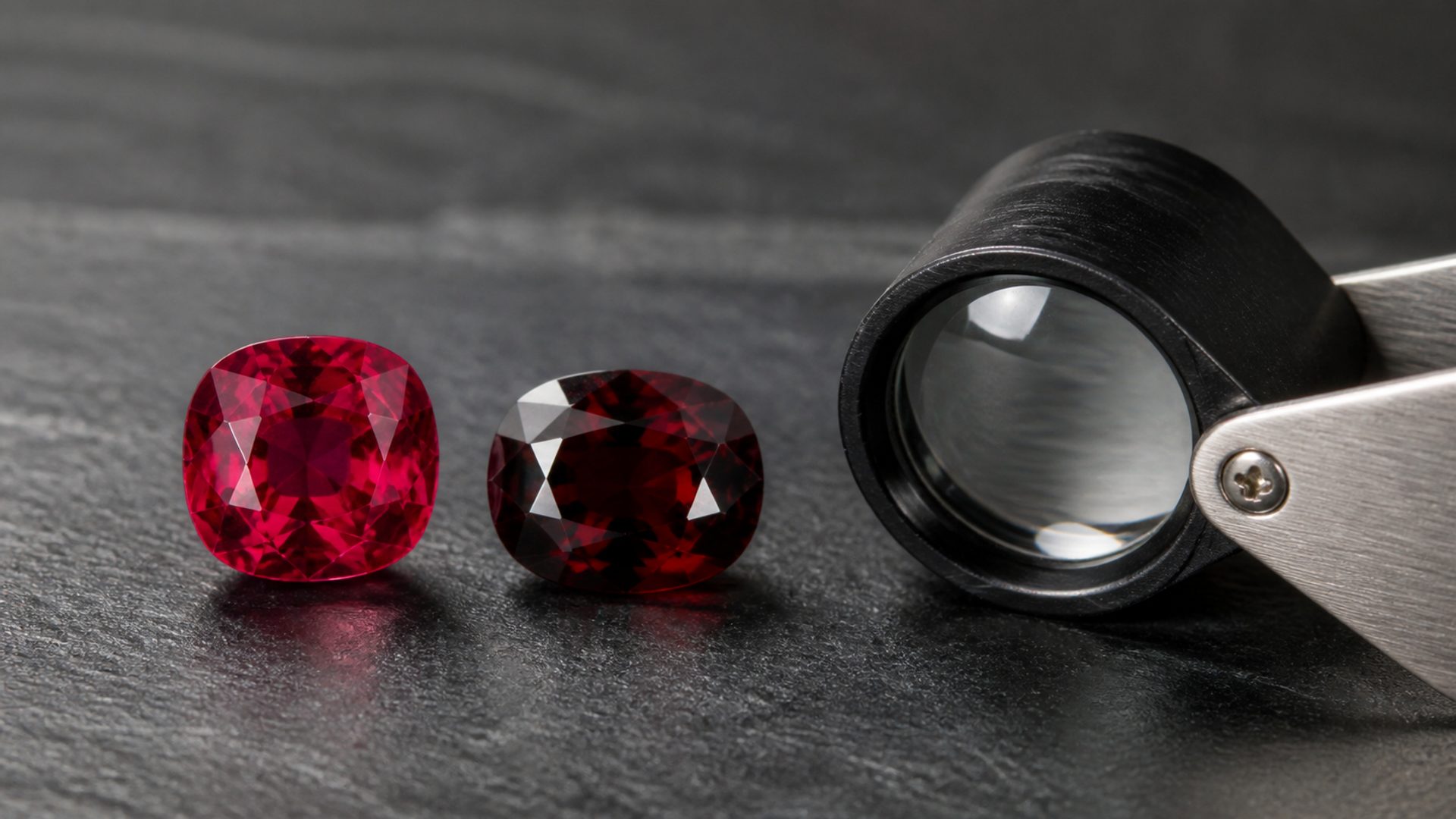
Ruby and garnet can both present as rich red gemstones, yet they belong to different mineral families and carry different durability, treatment and rarity profiles. Ruby is red corundum and sits at 9 on the Mohs hardness scale. Garnet names a group of minerals with broader properties. A purchase should begin with verified identity, colour, treatment disclosure and intended setting.
Start with identity and intended wear
Choose ruby when corundum durability, characteristic red colour and the rarity narrative justify the price after treatment and origin claims are documented. Choose garnet when a particular species, hue and stronger size-for-budget proposition suit the design. Pause for independent identification when a valuable stone lacks credible evidence.
| Decision factor | Ruby | Garnet | Pause for laboratory identification |
|---|---|---|---|
| Identity | Report confirms natural or laboratory-grown ruby | Report identifies garnet species where material | Do not infer identity from red colour |
| Colour | Hue, tone and saturation remain attractive in normal light | The selected garnet character fits the design | Compare stones loose and in the intended metal |
| Durability | Corundum suits frequent wear with normal care | Exact garnet properties suit the setting | Use a more protective setting |
| Treatment | Heating or filling is fully disclosed | Any treatment or stability issue is disclosed | Require documentation before valuing the stone |
| Rarity claim | Origin or unheated premium is supported | Species and quality support value | Treat unsupported storytelling as marketing |
| Budget | Price reflects verified quality and documentation | Size, colour and craft deliver the result | Allocate more to setting or testing |
This ruby vs garnet matrix is the article's working value object. Read the ruby vs garnet rows together: the decisive failure mode depends on this topic's evidence, operating context and reader objective.
Why two red stones behave differently
Evidence 1. GIA identifies ruby as the red variety of corundum and gives corundum a Mohs hardness of 9.
Evidence 2. Garnet is a mineral group rather than one single gem; species can differ in composition, colour and market profile.
Evidence 3. Heat treatment is common in ruby, while fracture filling can materially alter care and value and requires disclosure.
Evidence 4. Colour on a screen cannot establish identity, treatment, origin or value; important purchases need direct inspection and appropriate laboratory evidence.
Reader-visible sources checked for this article:
gia.edu — reader-visible current or official evidence
gia.edu — reader-visible current or official evidence
For ruby vs garnet, these sources establish only the claims inside their documented scope. Recheck every changeable specification, availability condition, price, policy or service term in the relevant market before acting.
Inspect colour, treatment and paperwork
For identity, the first route works when report confirms natural or laboratory-grown ruby; the second requires report identifies garnet species where material. The control for the third is do not infer identity from red colour. Verify this row against the exact product, property, account or environment before it can reverse the decision.
The colour row exposes a practical boundary. Route one assumes hue, tone and saturation remain attractive in normal light, while route two is defensible only when the selected garnet character fits the design. Route three depends on compare stones loose and in the intended metal. If that evidence is absent, keep the more reversible option.
Read durability as a stop/go test: corundum suits frequent wear with normal care supports the first option; exact garnet properties suit the setting supports the second; and use a more protective setting supports the third. Record which source proves the condition and when it was checked.
A buyer can resolve treatment without starting from a brand preference. Ask whether heating or filling is fully disclosed; compare that with whether any treatment or stability issue is disclosed; then use require documentation before valuing the stone as the third route's safeguard. An unknown condition stays unknown.
On rarity claim, popularity is not enough. The evidence for option one is that origin or unheated premium is supported. Option two means species and quality support value. Option three is rational where treat unsupported storytelling as marketing. Recheck any changeable term immediately before commitment.
The decision changes at budget. Choose the first path only if price reflects verified quality and documentation; move to the second when size, colour and craft deliver the result; use the third when allocate more to setting or testing. Save the downside that would make this row fail.
Facts that would reverse the current choice
Reversal control 1 — Identity. Before choosing Ruby, write down how the decision changes if “Report confirms natural or laboratory-grown ruby” proves false. Do the same for Garnet and “Report identifies garnet species where material”. Keep the Pause for laboratory identification route available until “Do not infer identity from red colour” is verified. This control belongs to ruby vs garnet; update it from the cited source or exact supplier rather than copying a generic checklist.
Reversal control 2 — Colour. Before choosing Ruby, write down how the decision changes if “Hue, tone and saturation remain attractive in normal light” proves false. Do the same for Garnet and “The selected garnet character fits the design”. Keep the Pause for laboratory identification route available until “Compare stones loose and in the intended metal” is verified. This control belongs to ruby vs garnet; update it from the cited source or exact supplier rather than copying a generic checklist.
Reversal control 3 — Durability. Before choosing Ruby, write down how the decision changes if “Corundum suits frequent wear with normal care” proves false. Do the same for Garnet and “Exact garnet properties suit the setting”. Keep the Pause for laboratory identification route available until “Use a more protective setting” is verified. This control belongs to ruby vs garnet; update it from the cited source or exact supplier rather than copying a generic checklist.
Reversal control 4 — Treatment. Before choosing Ruby, write down how the decision changes if “Heating or filling is fully disclosed” proves false. Do the same for Garnet and “Any treatment or stability issue is disclosed”. Keep the Pause for laboratory identification route available until “Require documentation before valuing the stone” is verified. This control belongs to ruby vs garnet; update it from the cited source or exact supplier rather than copying a generic checklist.
Reversal control 5 — Rarity claim. Before choosing Ruby, write down how the decision changes if “Origin or unheated premium is supported” proves false. Do the same for Garnet and “Species and quality support value”. Keep the Pause for laboratory identification route available until “Treat unsupported storytelling as marketing” is verified. This control belongs to ruby vs garnet; update it from the cited source or exact supplier rather than copying a generic checklist.
Reversal control 6 — Budget. Before choosing Ruby, write down how the decision changes if “Price reflects verified quality and documentation” proves false. Do the same for Garnet and “Size, colour and craft deliver the result”. Keep the Pause for laboratory identification route available until “Allocate more to setting or testing” is verified. This control belongs to ruby vs garnet; update it from the cited source or exact supplier rather than copying a generic checklist.
Read the laboratory report as a boundary
Match report number, measurements, weight and identifying features to the stone. Note natural versus laboratory-grown origin, detectable treatment and geographic origin. A report is not a valuation; it narrows factual uncertainty. Verify the issuing laboratory and report directly when an unheated or origin premium drives price.
Judge colour in several lights
View the gem face-up and tilted under daylight-equivalent, warm interior and lower illumination. Record hue, tone, saturation, extinction and windowing. Compare candidates at similar size because larger gems can appear darker. Automatic phone processing can distort red, so the final judgement should remain visual and documented.
Design for the real wearer
Map ring, bracelet, pendant or earring exposure to impact, abrasion, cosmetics, heat and cleaning. Ruby hardness supports frequent wear, but fractures and treatments still matter. Garnet can work in a ring when the exact material and setting are appropriate. Use protective mounting when the wear pattern demands it.
Separate stone and finished-jewel value
Price gem, setting metal, fabrication, design authorship, taxes and aftercare separately. A smaller well-cut ruby with credible evidence may outperform a larger opaque stone bought for name alone. A fine garnet may offer stronger colour within the same budget. Save disclosures and care instructions with the report.
Three jewellery briefs
Daily-wear anniversary ring
A documented ruby in a protective setting may justify its durability and symbolic premium. Define the fact that would reverse this recommendation before committing.
Large expressive cocktail jewel
A fine garnet can deliver saturated colour and scale while leaving budget for fabrication. Define the fact that would reverse this recommendation before committing.
High-value loose stone with vague paperwork
Independent identification should precede claims about treatment, origin or investment value. Define the fact that would reverse this recommendation before committing.
Action checklist
Define wear pattern.
Verify report number.
Confirm natural or laboratory-grown status.
Record treatments.
Inspect in several lights.
Check cut and transparency.
Compare equal-size stones.
Choose protective setting.
Separate gem and setting costs.
Save disclosures.
Continue the decision
The linked VERTU articles expand adjacent parts of the ruby vs garnet decision. They do not substitute for the external evidence above.
The ruby-garnet verdict
Choose ruby when corundum durability, characteristic red colour and the rarity narrative justify the price after treatment and origin claims are documented. Choose garnet when a particular species, hue and stronger size-for-budget proposition suit the design. Pause for independent identification when a valuable stone lacks credible evidence.
Keep the ruby vs garnet decision reversible until its material cost, safety, access, privacy and compatibility facts are verified. Unknown evidence stays unknown; it is never silently scored as favourable.