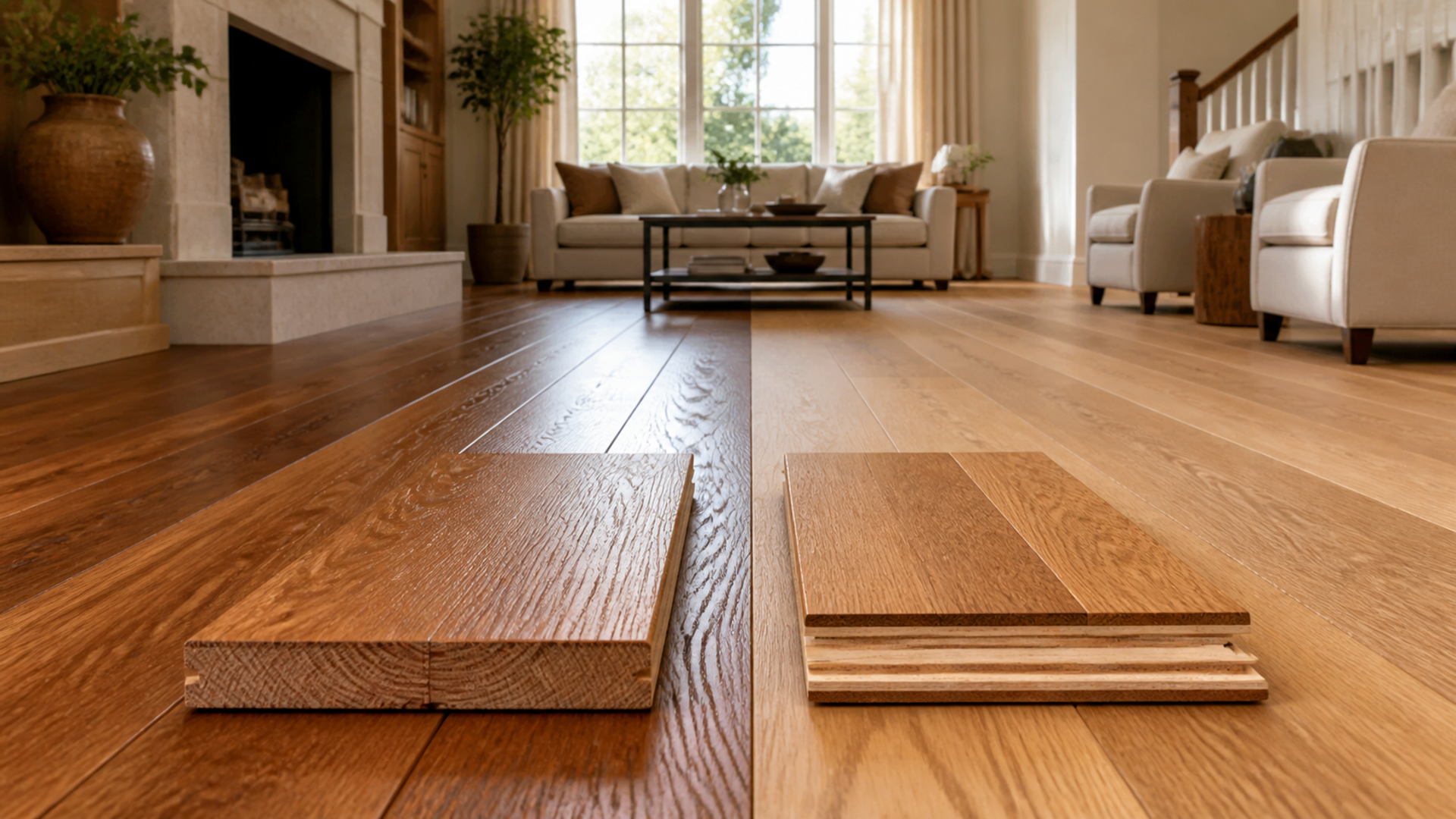
Solid hardwood and engineered wood can present the same species and finish at the surface, but their structures behave differently below it. Solid boards are one piece of wood; engineered boards combine a real-wood wear layer with a layered core. Subfloor, moisture, radiant heat, board dimensions, finish and wear-layer thickness determine the sensible choice.
Start below the visible surface
Choose solid hardwood when site conditions are stable, the installation method fits and repeated sanding is a credible long-term advantage. Choose engineered wood when dimensional stability, wider boards, concrete subfloors or compatible radiant heat matter more. Refinish or repair the present floor when its substrate and wear layer remain sound.
| Decision factor | Solid hardwood | Engineered wood | Keep or refinish the present floor |
|---|---|---|---|
| Subfloor | Approved wood subfloor supports the fixing method | The product is approved for wood or concrete | Repair movement and flatness first |
| Moisture | Indoor moisture stays within the solid-board range | Layered construction suits the verified conditions | Find and stop the moisture source |
| Refinishing | Board thickness supports future sanding | Wear layer supports the intended service life | Refinish the existing sound floor |
| Radiant heat | Maker approves species, width and temperature | Exact engineered board is approved | Keep the present surface until system limits are known |
| Board format | Movement gaps suit the chosen width | Wide format remains stable when installed correctly | Use a narrower or more stable format |
| Repair route | Individual boards and matching finish can be restored | Spare boards and wear layer make repair credible | Secure repair stock before purchase |
This hardwood vs engineered wood flooring matrix is the article's working value object. Read the hardwood vs engineered wood flooring rows together: the decisive failure mode depends on this topic's evidence, operating context and reader objective.
What construction changes
Evidence 1. The National Wood Flooring Association distinguishes solid wood flooring from engineered flooring built from multiple layers with a real-wood face.
Evidence 2. Wood movement is influenced by moisture conditions, so acclimation and site moisture measurements belong to installation planning.
Evidence 3. The number of possible refinishes depends on usable wood above the tongue or on the engineered product's wear layer, not the category name alone.
Evidence 4. Adhesives, finishes, composite cores and installation moisture can affect indoor-air and durability outcomes, so exact product documentation controls.
Reader-visible sources checked for this article:
woodfloors.org — reader-visible current or official evidence
epa.gov — reader-visible current or official evidence
For hardwood vs engineered wood flooring, these sources establish only the claims inside their documented scope. Recheck every changeable specification, availability condition, price, policy or service term in the relevant market before acting.
Test moisture, wear and repairability
Read subfloor as a stop/go test: approved wood subfloor supports the fixing method supports the first option; the product is approved for wood or concrete supports the second; and repair movement and flatness first supports the third. Record which source proves the condition and when it was checked.
A buyer can resolve moisture without starting from a brand preference. Ask whether indoor moisture stays within the solid-board range; compare that with whether layered construction suits the verified conditions; then use find and stop the moisture source as the third route's safeguard. An unknown condition stays unknown.
On refinishing, popularity is not enough. The evidence for option one is that board thickness supports future sanding. Option two means wear layer supports the intended service life. Option three is rational where refinish the existing sound floor. Recheck any changeable term immediately before commitment.
The decision changes at radiant heat. Choose the first path only if maker approves species, width and temperature; move to the second when exact engineered board is approved; use the third when keep the present surface until system limits are known. Save the downside that would make this row fail.
For board format, the first route works when movement gaps suit the chosen width; the second requires wide format remains stable when installed correctly. The control for the third is use a narrower or more stable format. Verify this row against the exact product, property, account or environment before it can reverse the decision.
The repair route row exposes a practical boundary. Route one assumes individual boards and matching finish can be restored, while route two is defensible only when spare boards and wear layer make repair credible. Route three depends on secure repair stock before purchase. If that evidence is absent, keep the more reversible option.
Facts that would reverse the current choice
Reversal control 1 — Subfloor. Before choosing Solid hardwood, write down how the decision changes if “Approved wood subfloor supports the fixing method” proves false. Do the same for Engineered wood and “The product is approved for wood or concrete”. Keep the Keep or refinish the present floor route available until “Repair movement and flatness first” is verified. This control belongs to hardwood vs engineered wood flooring; update it from the cited source or exact supplier rather than copying a generic checklist.
Reversal control 2 — Moisture. Before choosing Solid hardwood, write down how the decision changes if “Indoor moisture stays within the solid-board range” proves false. Do the same for Engineered wood and “Layered construction suits the verified conditions”. Keep the Keep or refinish the present floor route available until “Find and stop the moisture source” is verified. This control belongs to hardwood vs engineered wood flooring; update it from the cited source or exact supplier rather than copying a generic checklist.
Reversal control 3 — Refinishing. Before choosing Solid hardwood, write down how the decision changes if “Board thickness supports future sanding” proves false. Do the same for Engineered wood and “Wear layer supports the intended service life”. Keep the Keep or refinish the present floor route available until “Refinish the existing sound floor” is verified. This control belongs to hardwood vs engineered wood flooring; update it from the cited source or exact supplier rather than copying a generic checklist.
Reversal control 4 — Radiant heat. Before choosing Solid hardwood, write down how the decision changes if “Maker approves species, width and temperature” proves false. Do the same for Engineered wood and “Exact engineered board is approved”. Keep the Keep or refinish the present floor route available until “Keep the present surface until system limits are known” is verified. This control belongs to hardwood vs engineered wood flooring; update it from the cited source or exact supplier rather than copying a generic checklist.
Reversal control 5 — Board format. Before choosing Solid hardwood, write down how the decision changes if “Movement gaps suit the chosen width” proves false. Do the same for Engineered wood and “Wide format remains stable when installed correctly”. Keep the Keep or refinish the present floor route available until “Use a narrower or more stable format” is verified. This control belongs to hardwood vs engineered wood flooring; update it from the cited source or exact supplier rather than copying a generic checklist.
Reversal control 6 — Repair route. Before choosing Solid hardwood, write down how the decision changes if “Individual boards and matching finish can be restored” proves false. Do the same for Engineered wood and “Spare boards and wear layer make repair credible”. Keep the Keep or refinish the present floor route available until “Secure repair stock before purchase” is verified. This control belongs to hardwood vs engineered wood flooring; update it from the cited source or exact supplier rather than copying a generic checklist.
Measure the site, not the showroom
Record subfloor material, flatness, moisture, below-grade exposure, room humidity and heating system across representative days. Ask the installer to state acceptable readings in writing. A board that performs in one store or climate may fail when installed over a damp slab or next to a large glazed wall.
Inspect the cross-section
For solid boards, measure thickness above the tongue and understand the fastening system. For engineered boards, record total thickness, wear-layer thickness, ply construction, core species and edge profile. Marketing terms such as premium or multi-layer do not answer whether a future repair is possible.
Model expansion and transitions
Map board direction, room spans, thresholds, stairs, fixed cabinetry and perimeter gaps. Wide planks and open plans can make movement more visible. Confirm where expansion joints are required and how transitions will look before ordering, rather than hiding structural needs in the installer quote.
Build a repair reserve
Buy and condition spare boards from the same production run, save finish codes and photograph the substrate before coverage. Price local sanding, board replacement and colour matching. A floor earns long-term value when realistic repairs remain possible after water, impact or layout changes.
Three rooms, three answers
Stable upper-floor heritage room
Solid hardwood can justify itself when refinishing and period detailing are genuine long-term priorities. Define the fact that would reverse this recommendation before committing.
Concrete apartment with wide planks
A fully specified engineered product may better manage installation and dimensional constraints. Define the fact that would reverse this recommendation before committing.
Existing floor with superficial wear
Professional assessment and refinishing can preserve more material and value than replacement. Define the fact that would reverse this recommendation before committing.
Action checklist
Identify the subfloor.
Measure moisture.
Record room humidity.
Check radiant-heat approval.
Measure wear layer.
Review installation method.
Map expansion joints.
Price refinishing.
Buy repair stock.
Save batch and finish codes.
Continue the decision
The linked VERTU articles expand adjacent parts of the hardwood vs engineered wood flooring decision. They do not substitute for the external evidence above.
The hardwood-engineered verdict
Choose solid hardwood when site conditions are stable, the installation method fits and repeated sanding is a credible long-term advantage. Choose engineered wood when dimensional stability, wider boards, concrete subfloors or compatible radiant heat matter more. Refinish or repair the present floor when its substrate and wear layer remain sound.
Keep the hardwood vs engineered wood flooring decision reversible until its material cost, safety, access, privacy and compatibility facts are verified. Unknown evidence stays unknown; it is never silently scored as favourable.