Introduction
If you’re shopping designer gemstone jewelry in 2026, the “trend” isn’t just color or silhouette—it’s how designers are balancing statement with longevity. This guide translates designer gemstone jewelry trends 2026 into buying choices you’ll still like (and still wear) years from now.
What you will learn about 2026 Designer Gemstone Jewelry
You’ll learn the trend pillars worth paying attention to (and which are mostly noise), how to evaluate colored stones with a collector’s eye, and which settings actually protect your gems in real life.
Who this guide serves and how to use it
This is for readers who love design—sculptural metalwork, unusual cuts, confident color—but want to buy intelligently.
Use it in order:
Start with the trend map to spot what you’re drawn to.
Use the buyer’s guide to pressure-test quality, treatments, and documentation.
Finish with durability, styling, and care so your jewelry fits your life—not just your mood.
How trends, metals prices, and durability affect smart choices
When metal prices move, designers respond: you’ll see bigger visual impact without “wasting” precious metal, and more emphasis on proportion, negative space, and clever settings. Meanwhile, the wrong setting can turn a gorgeous gemstone into an anxiety ring. In 2026, the smartest buys are the pieces that look directional and wear well.
2026 Trend Map: Designer Gemstone Jewelry Trends 2026
2026 is giving you permission to be specific: color with intention, cuts that feel designed (not default), and metalwork that reads like wearable sculpture.
Color-forward gemstones and antique-cut diamonds
Color is no longer an accent—it’s the main storyline. Expect saturated blues and greens, and bolder pairings that feel personal rather than “matching.” Trend forecasts for 2026 repeatedly highlight vivid gemstones as a centerpiece choice rather than a supporting detail (see Brilliant Earth’s Jewelry Trends 2026 and Blue Nile’s 2026 jewelry trend overview).
Antique-cut diamonds (think old-mine, old-European, and other vintage-inspired faceting) are also showing up because they bring texture—so the piece feels lived-in, not sterile.
Collector’s note: Antique cuts are less about “sparkle per carat” and more about candlelight character. If you love them, judge them in multiple lighting environments before you commit.
Elongated cuts, East–West, multi-stone settings
Elongated stones are everywhere because they change the line of the hand. The 2026 update is orientation: East–West ring settings rotate the stone horizontally for a modern, slightly architectural profile.
Multi-stone layouts are also rising—toi-et-moi pairings, clusters, and asymmetric compositions. The best versions don’t look busy; they look edited.
Mixed metals, sculptural silver, torques
Mixed metal jewelry is no longer a workaround—it’s the point. Yellow gold against silver, darkened metal against bright polish, and pieces that look designed from every angle.
Torques and collar-like silhouettes are also back because they deliver impact with clean lines. You’ll see this “wearable sculpture” sensibility echoed in trend reporting from the 2026 jewelry circuit, including ELLE’s 2026 Couture Jewelry Show trend recap.
Market & Metals Context
Gold, platinum, and silver: price signals and design responses
When gold runs hot, designers get clever. Instead of simply “more gold,” you’ll often see:
thicker-looking silhouettes built with smart geometry
negative space that keeps a piece airy
mixed metals that let color and contrast do the heavy lifting
silver treated as deliberate—not secondary
Investment mindset: statement forms without excess metal
If you want statement forms that don’t feel like overpaying for weight, look for design value:
a torque that sits perfectly and feels engineered
a sculptural cuff with tension and balance
a ring that uses profile and proportion to look substantial
In other words: buy the idea and the workmanship—not just mass.
Buyer’s Guide: Evaluation & Proof
Colored gem priorities: color, clarity norms, cut craft, carat impact
Start with color. In colored stones, the best “color” is the one that stays beautiful in real conditions: daylight, restaurant lighting, and indoor overheads.
Then calibrate clarity expectations to the stone:
Some gems are commonly included; “perfectly clean” may be unrealistic—or a sign you should ask tougher questions.
Others should look crisp and lively without obvious dullness.
Cut craftsmanship is the quiet differentiator. A well-cut colored stone manages brightness, windowing, and symmetry so the gem looks alive—not like a tinted piece of glass.
Carat impact is personal, but here’s the practical truth: bigger stones magnify everything—beauty, yes, but also fragility, setting vulnerability, and maintenance.
Treatments and disclosure: what to ask and avoid
Treatments aren’t automatically “bad,” but undisclosed or unstable treatments are.
Ask directly:
What treatments has the stone received (if any)?
Are they considered stable/permanent?
Is the treatment stated on a lab report?
Be especially careful with treatments that meaningfully affect value or long-term care (for example, clarity filling or surface-reaching enhancements). If a seller is vague, treat that as information.
How to verify: If the answer is “minor enhancement” without specifics, ask for the exact treatment language and supporting documentation. A confident seller can explain it cleanly.
Trusted reports: GIA, AGL, SSEF; origin opinions and when to use them
For meaningful colored stones, a respected lab report is your baseline. Buyers commonly rely on labs such as GIA, AGL, and SSEF to document identification and detectable treatments; origin conclusions, when offered, are best understood as professional opinions based on available evidence at the time.
If origin matters to you (emotionally or financially), use it strategically:
Request it when it meaningfully changes the market value or collectability.
Don’t pay for “origin romance” if you haven’t already confirmed color quality, cut, and condition.
Now add a practical layer that high-net-worth buyers already use in other luxury categories: verification as a service workflow.
A VERTU-style concierge mindset is useful here—not as marketing, but as a checklist for how complex purchases get de-risked. Instead of trying to solve everything alone, you verify sourcing, coordinate documents, and arrange viewings the way you would for any high-consideration acquisition.
If you want that approach in your life, start with how VERTU frames private assistance and follow-through as part of ownership in its discussion of VERTU’s concierge service and value model. The transferable lesson: great outcomes usually come from great coordination.
If you’re planning a private viewing, treat it like a controlled test:
Ask for the lab report in advance.
View the piece in at least two lighting conditions.
Confirm return and service policies in writing.
If you’re comparing options, ask the seller to lay out two to three stones side-by-side at the same time—your eye is better at comparison than memory.
Durability & Protective Settings
Mohs hardness vs toughness: daily-wear suitability
Mohs hardness tells you how easily a gem scratches. Toughness tells you how easily it chips or breaks. Stability tells you how it reacts to heat, chemicals, and wear.
As GIA puts it, durability is bigger than Mohs alone—hardness, toughness, and stability all matter (see GIA’s explanation: More than the Mohs Scale).
If you want a quick screening tool, think in terms of gemstone durability (Mohs hardness + real-world toughness)—then let setting choice do the rest.
A practical filter for rings you’ll wear constantly:
Excellent daily-wear candidates: diamond (10), sapphire/ruby (9)
Often suitable with care and protective settings: many stones in the ~7–8 range
Better as occasion pieces: softer or more fragile gems (especially below ~7)
This is the heart of the decision: gemstone durability Mohs hardness is only one input, plus setting design determines whether a piece can be a true daily signature.
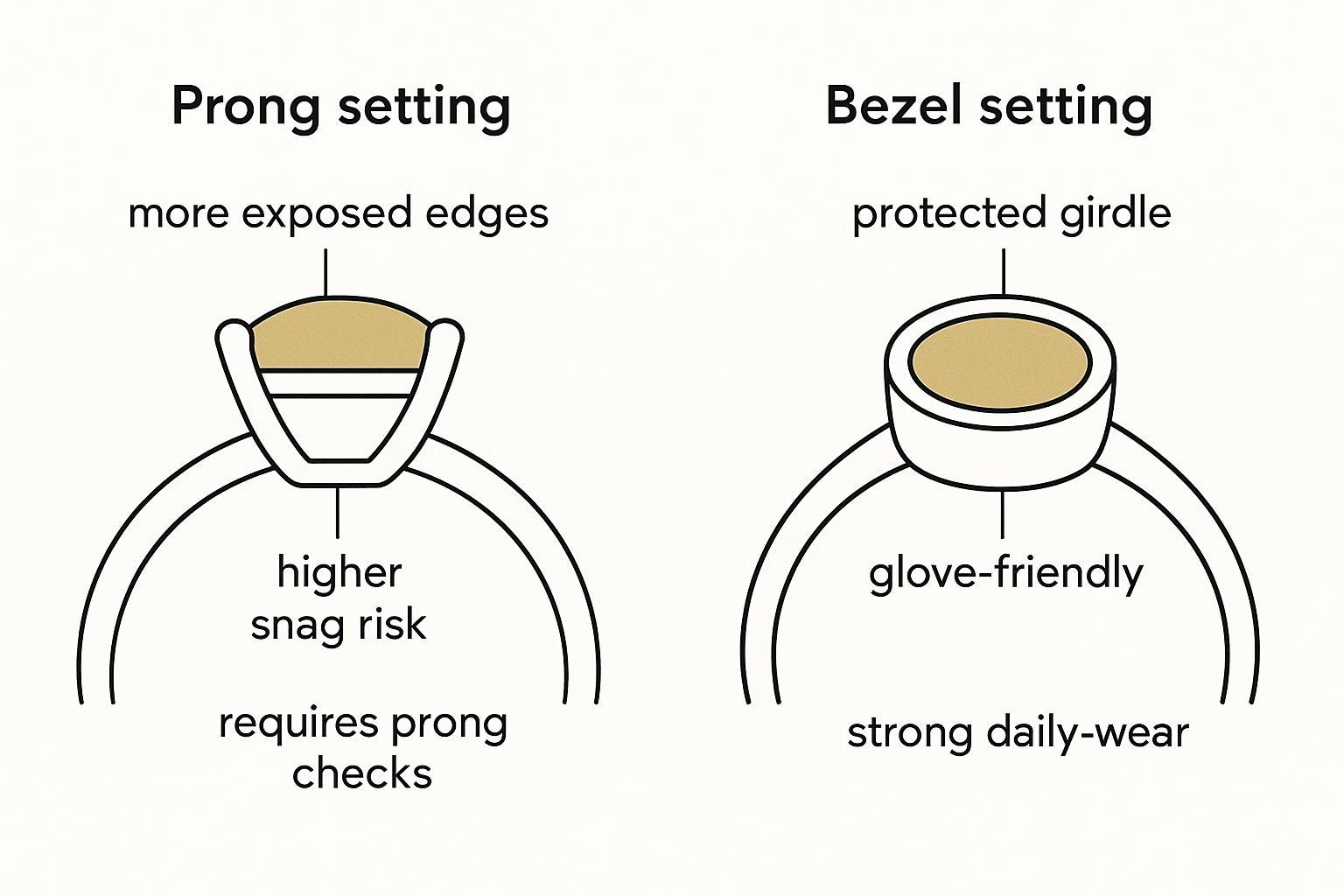
Safer mountings: bezels, low-profile prongs, secure seats
Settings are not just aesthetics—they’re your insurance policy.
Bezel settings (metal encircling the stone) protect edges and reduce snag risk.
Low-profile prongs can work beautifully, but they demand periodic checks.
A secure seat matters more than dramatic height.
Lifestyle filters: travel, sport, and glove-friendly silhouettes
Before you buy, run the lifestyle test:
If you travel often, choose profiles that won’t catch on knitwear, bags, or coat linings.
If you’re active, prioritize protective settings and avoid high crowns.
If you wear gloves, look for smooth bezels, low domes, and minimal protrusions.
Styling: Day-to-Night Frameworks
One focal gem by day; intentional layers by night
Day styling works when it’s edited: one focal gemstone (ring or earrings) with everything else quiet.
At night, layer with intention:
add a second chain with contrast
introduce a sculptural cuff
stack a second ring that echoes metal tone, not gemstone color
Mixed-metal contrasts and East–West to modernize basics
If your wardrobe is mostly neutrals, mixed metal jewelry is an easy way to make basics look deliberate.
East–West settings also modernize classic pieces because they change silhouette without needing more stones.
Signature anchors: torque, sculptural cuff, cluster/toi-et-moi rings
If you want a signature, pick one anchor shape:
a torque that sits like architecture
a sculptural cuff with negative space
a cluster or toi-et-moi ring that feels personal
Then repeat it—not every day, but often enough that it becomes your line.
Care & Longevity Essentials
Cleaning methods: warm soapy water, ultrasonic/steam cautions
The safest default is simple: warm water, mild soap, soft brush, thorough rinse, gentle dry.
Be cautious with ultrasonic or steam cleaning—especially if the stone is fragile, included, or treated. For consumer-safe guidance, see GIA’s tips on caring for jewelry and the American Gem Society’s cleaning methods guide.
Storage, travel, and insurance checklists
Store pieces separately (hard stones can scratch softer ones). For travel, use soft pouches and keep high-value items in carry-on.
Insurance isn’t glamorous, but it’s part of owning jewelry you actually wear. Keep:
purchase receipts
lab reports
clear photos of the piece on and off hand
an updated appraisal when the piece is materially changed (reset, resized, upgraded)
Conclusion
Key takeaways for confident Designer Gemstone Jewelry decisions
Trends are useful when they map to your wardrobe and life.
Prioritize color quality, cut craft, and documentation over “more carats.”
Protective settings (especially bezels and low profiles) are the unsung luxury of daily wear.
Mixed metals and East–West silhouettes deliver modernity without forcing novelty.
If you remember one line from this guide, make it this: designer gemstone jewelry trends 2026 are only worth following when they come with craftsmanship, documentation, and wearability.
Next steps to build a timeless, high-impact collection
Start with one directional piece you’ll wear often—then build around it slowly.
If you’re buying at the level where sourcing, verification, and private viewings matter, borrow a luxury buyer’s habit: treat coordination as part of quality. VERTU’s broader heritage story is built on craftsmanship and an ownership relationship, not just an object—see VERTU’s brand legend and heritage overview.
Disclosure: This article references VERTU pages. Editorial judgment remains the priority.