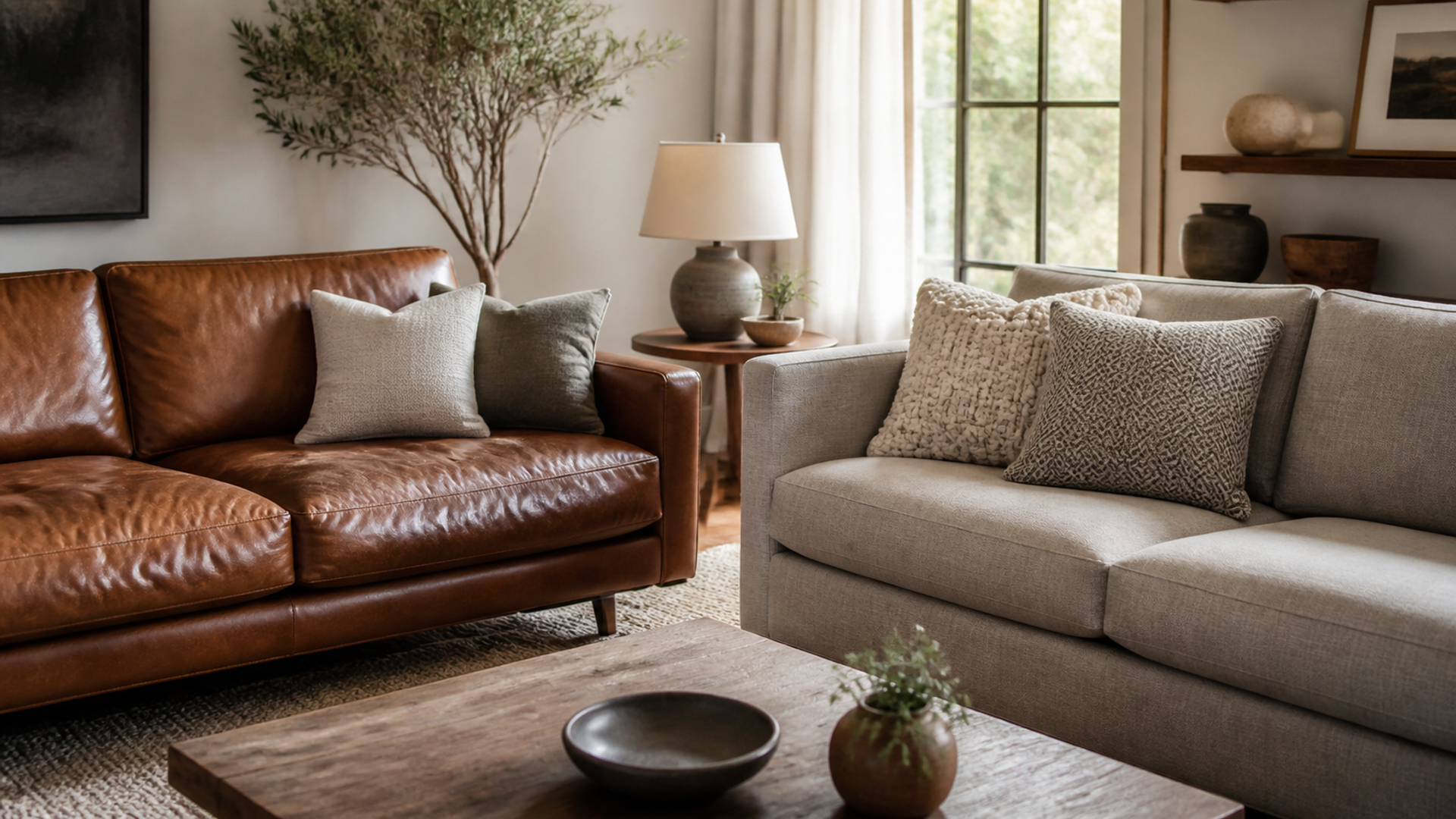
Leather versus fabric sofa searches invite a false universal winner. Upholstery is only one layer: hide grade or textile composition, weave, finish, cushion construction, frame, colour, direct sun, humidity, children, pets and cleaning habits all change the outcome. Leather can age with patina and wipe clean easily; fabric can offer softer initial hand, broader colour choice and washable covers. The exact sample and care plan decide more than the category name.
Begin with the household, not the showroom
Choose leather when easy surface wiping, developing patina and repairable character fit the household. Choose fabric when breathability, softness, colour choice or removable covers matter more. Choose a mixed or replaceable-cover design when soil, pets or changing interiors make reversibility decisive.
| Decision factor | Leather sofa | Fabric sofa | Choose removable or mixed upholstery |
|---|---|---|---|
| Climate | The hide feels comfortable in the room | The textile stays breathable and pleasant | Use removable throws |
| Spills | The finish permits prompt approved wiping | The cover is washable or verified stain resistant | Choose replaceable covers |
| Pets | Claw marks and patina are acceptable | The weave resists snagging and hair | Protect contact panels |
| Sunlight | Finish tolerates the planned exposure | Colourfastness suits actual light | Move or shade the sofa |
| Maintenance | Conditioning and specialist repair are realistic | Label-specific cleaning fits the routine | Choose lower-risk care |
| Lifetime value | Frame, hide and service justify premium | Construction and replaceable fabric last | Spend first on frame and cushions |
This leather vs fabric sofa matrix is the article's working value object. Read the leather vs fabric sofa rows together: the decisive failure mode depends on this topic's evidence, operating context and reader objective.
What upholstery changes over years
Evidence 1. DFS presents fabric and leather as different comfort, colour, durability and ageing choices rather than one quality hierarchy.
Evidence 2. IKEA's material guide distinguishes grain leather, split leather and coated materials and gives different care instructions for them.
Evidence 3. Leather labels can cover materially different grain, split, coated and match constructions.
Evidence 4. Fabric durability depends on fibre, weave, backing, finish and care instructions.
Reader-visible sources checked for this article:
dfs.co.uk — reader-visible current or official evidence
ikea.com — reader-visible current or official evidence
For leather vs fabric sofa, these sources establish only the claims inside their documented scope. Recheck every changeable specification, availability condition, price, policy or service term in the relevant market before acting.
Test material and construction together
Read climate as a stop/go test: the hide feels comfortable in the room supports the first option; the textile stays breathable and pleasant supports the second; and use removable throws supports the third. Record which source proves the condition and when it was checked.
A buyer can resolve spills without starting from a brand preference. Ask whether the finish permits prompt approved wiping; compare that with whether the cover is washable or verified stain resistant; then use choose replaceable covers as the third route's safeguard. An unknown condition stays unknown.
On pets, popularity is not enough. The evidence for option one is that claw marks and patina are acceptable. Option two means the weave resists snagging and hair. Option three is rational where protect contact panels. Recheck any changeable term immediately before commitment.
The decision changes at sunlight. Choose the first path only if finish tolerates the planned exposure; move to the second when colourfastness suits actual light; use the third when move or shade the sofa. Save the downside that would make this row fail.
For maintenance, the first route works when conditioning and specialist repair are realistic; the second requires label-specific cleaning fits the routine. The control for the third is choose lower-risk care. Verify this row against the exact product, property, account or environment before it can reverse the decision.
The lifetime value row exposes a practical boundary. Route one assumes frame, hide and service justify premium, while route two is defensible only when construction and replaceable fabric last. Route three depends on spend first on frame and cushions. If that evidence is absent, keep the more reversible option.
Facts that would reverse the current choice
Reversal control 1 — Climate. Before choosing Leather sofa, write down how the decision changes if “The hide feels comfortable in the room” proves false. Do the same for Fabric sofa and “The textile stays breathable and pleasant”. Keep the Choose removable or mixed upholstery route available until “Use removable throws” is verified. This control belongs to leather vs fabric sofa; update it from the cited source or exact supplier rather than copying a generic checklist.
Reversal control 2 — Spills. Before choosing Leather sofa, write down how the decision changes if “The finish permits prompt approved wiping” proves false. Do the same for Fabric sofa and “The cover is washable or verified stain resistant”. Keep the Choose removable or mixed upholstery route available until “Choose replaceable covers” is verified. This control belongs to leather vs fabric sofa; update it from the cited source or exact supplier rather than copying a generic checklist.
Reversal control 3 — Pets. Before choosing Leather sofa, write down how the decision changes if “Claw marks and patina are acceptable” proves false. Do the same for Fabric sofa and “The weave resists snagging and hair”. Keep the Choose removable or mixed upholstery route available until “Protect contact panels” is verified. This control belongs to leather vs fabric sofa; update it from the cited source or exact supplier rather than copying a generic checklist.
Reversal control 4 — Sunlight. Before choosing Leather sofa, write down how the decision changes if “Finish tolerates the planned exposure” proves false. Do the same for Fabric sofa and “Colourfastness suits actual light”. Keep the Choose removable or mixed upholstery route available until “Move or shade the sofa” is verified. This control belongs to leather vs fabric sofa; update it from the cited source or exact supplier rather than copying a generic checklist.
Reversal control 5 — Maintenance. Before choosing Leather sofa, write down how the decision changes if “Conditioning and specialist repair are realistic” proves false. Do the same for Fabric sofa and “Label-specific cleaning fits the routine”. Keep the Choose removable or mixed upholstery route available until “Choose lower-risk care” is verified. This control belongs to leather vs fabric sofa; update it from the cited source or exact supplier rather than copying a generic checklist.
Reversal control 6 — Lifetime value. Before choosing Leather sofa, write down how the decision changes if “Frame, hide and service justify premium” proves false. Do the same for Fabric sofa and “Construction and replaceable fabric last”. Keep the Choose removable or mixed upholstery route available until “Spend first on frame and cushions” is verified. This control belongs to leather vs fabric sofa; update it from the cited source or exact supplier rather than copying a generic checklist.
Inspect every panel
Ask which panels use the stated upholstery, then inspect edges, backing, seams, nap and cushion recovery. Sit long enough to test temperature, grip, sound and support in daylight and warm interior light. Record the exact model, material, room, recipe or operating condition and the time of the check. Keep the observation separate from a marketing promise, and repeat the test under the intended use rather than an ideal showroom condition. If a swatch hides mixed panels or weak construction, the upholstery name cannot rescue the sofa. Save the result and the evidence that would reverse it, because a change in fit, specification, service, price or environment must reopen this decision rather than inherit an old conclusion.
Build a soil plan
List drinks, oils, denim transfer, cosmetics, claws, hair, dust and direct sun. Read the maker label and test only approved cleaner or protector on a hidden area after full drying. Record the exact model, material, room, recipe or operating condition and the time of the check. Keep the observation separate from a marketing promise, and repeat the test under the intended use rather than an ideal showroom condition. If the household cannot sustain the care routine, choose a removable surface. Save the result and the evidence that would reverse it, because a change in fit, specification, service, price or environment must reopen this decision rather than inherit an old conclusion.
Separate surface from structure
Check frame, joints, suspension, cushion density, refill access, module connectors and delivery route. Read abrasion or colourfastness evidence only when it applies to the exact fabric, and compare warranty remedy and exclusions. Record the exact model, material, room, recipe or operating condition and the time of the check. Keep the observation separate from a marketing promise, and repeat the test under the intended use rather than an ideal showroom condition. If the frame or cushions fail, premium upholstery is poor value. Save the result and the evidence that would reverse it, because a change in fit, specification, service, price or environment must reopen this decision rather than inherit an old conclusion.
Model visible ageing
Decide whether creasing, scratches and tonal leather variation or fabric pilling, fading and pile marks look coherent. Keep large samples in the room for several days against the floor, wall and real daylight. Record the exact model, material, room, recipe or operating condition and the time of the check. Keep the observation separate from a marketing promise, and repeat the test under the intended use rather than an ideal showroom condition. If the expected ageing pattern feels like damage, change the material before purchase. Save the result and the evidence that would reverse it, because a change in fit, specification, service, price or environment must reopen this decision rather than inherit an old conclusion.
Three rooms, three answers
Busy family room
A durable fabric sofa with removable labelled covers can simplify recovery. Define the fact that would reverse this recommendation before committing.
Formal long-ownership room
A well-built leather sofa may reward care and patina. Define the fact that would reverse this recommendation before committing.
Pets and frequent redecorating
Replaceable covers can preserve flexibility better than either pure category. Define the fact that would reverse this recommendation before committing.
Action checklist
Map stains.
Check sunlight.
Read labels.
Identify panels.
Test comfort.
Read cleaning codes.
Price repair.
Review frame.
Measure delivery.
Keep samples in room.
Continue the decision
The linked VERTU articles expand adjacent parts of the leather vs fabric sofa decision. They do not substitute for the external evidence above.
The leather-versus-fabric verdict
Choose leather when easy surface wiping, developing patina and repairable character fit the household. Choose fabric when breathability, softness, colour choice or removable covers matter more. Choose a mixed or replaceable-cover design when soil, pets or changing interiors make reversibility decisive.
Keep the leather vs fabric sofa decision reversible until its material cost, safety, access, privacy and compatibility facts are verified. Unknown evidence stays unknown; it is never silently scored as favourable.