

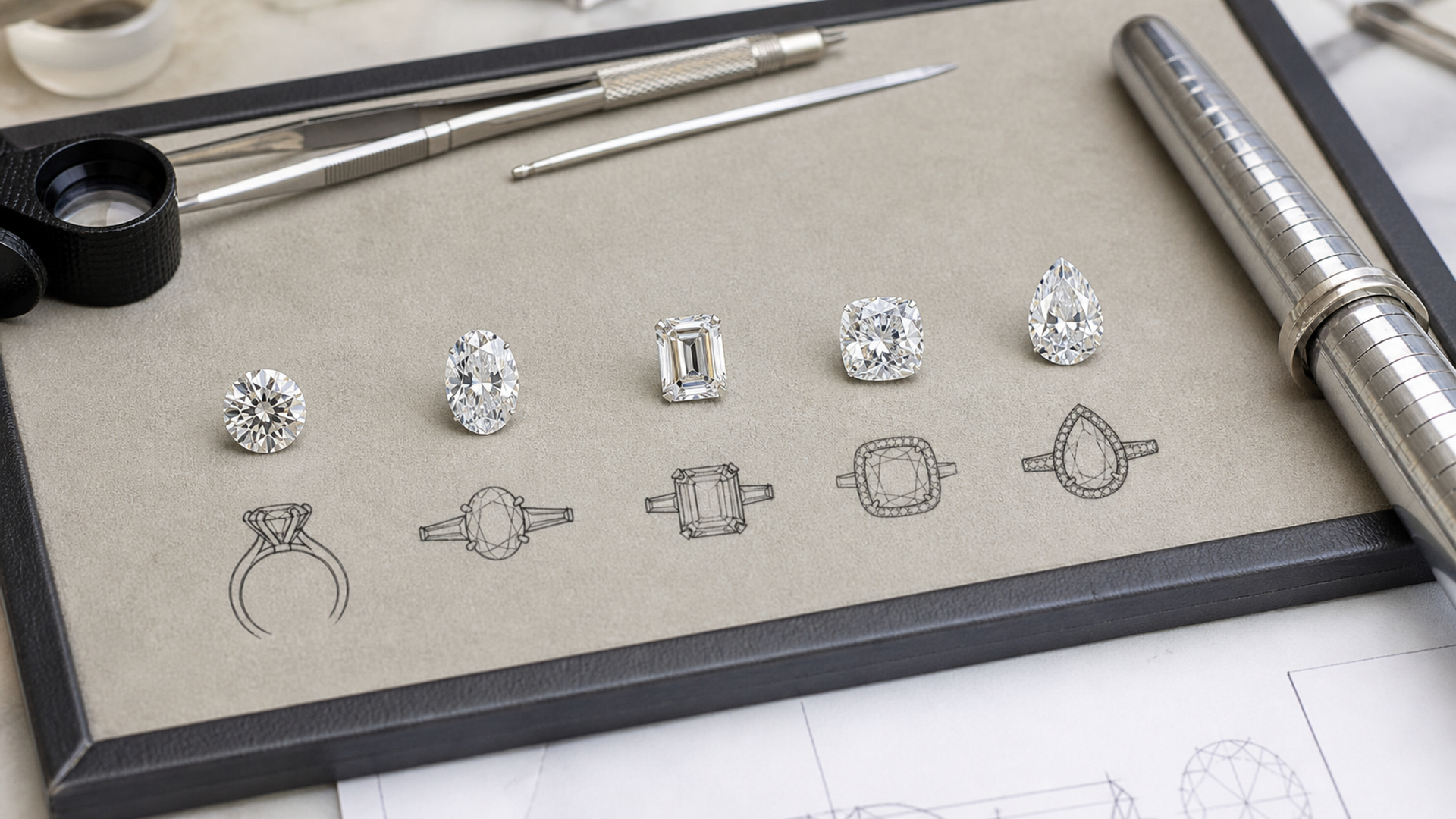
The costly mistake in this category is not simply choosing the less famous option. It is paying for a story that does not survive contact with the exact product, the owner's habits and the local service or buying conditions. This guide compares Round or oval brilliant, Emerald or Asscher step cut and the disciplined alternative—Pear, marquise, cushion or radiant—using current official material, a live VERTU content-inventory check and a decision framework designed for real ownership.
The aim is not to manufacture one universal winner. It is to identify which facts should change the choice, which claims need reference-level confirmation and when waiting is more intelligent than buying. Prices, availability, specifications, policies and service conditions can change by market and date, so verify the exact item and terms before committing.
The short answer
Choose round for the most standardised brilliance benchmark, oval for a longer face-up look, emerald or Asscher for clean geometry that rewards higher clarity, and pear or marquise only with a setting that protects points. The best shape is the one whose outline, facet style and setting still look right on the wearer's hand at the actual budget.
That answer is deliberately conditional. A high-value decision should remain sensible after the novelty wears off, after the first repair or service question, and after the product has to perform in an ordinary week. If the recommendation collapses when one marketing assumption is removed, the evidence is not yet strong enough.
Comparison at a glance
| Decision factor | Round or oval brilliant | Emerald or Asscher step cut | Pear, marquise, cushion or radiant |
|---|---|---|---|
| Visual effect | High brilliance; oval elongates | Hall-of-mirrors geometry | Distinct personality and varied sparkle |
| Face-up spread | Oval often looks large for weight | Broad table but depth varies | Marquise and pear can look long |
| Clarity sensitivity | Brilliant facets can mask inclusions | Open facets reveal inclusions | Depends on facet pattern |
| Setting risk | Round is forgiving; oval needs symmetry | Protect corners and align geometry | Protect points; inspect prongs |
| Budget | Round often carries a premium | May trade sparkle for clarity | Value varies widely by outline |
| Best buyer | Classic or maximum-sparkle preference | Architectural, quiet look | Buyer with a strong shape preference |
Read the table as a sequence of verification prompts, not a scorecard. Some factors are non-negotiable and others are preferences. Weight each row according to actual use, then compare the exact references and local terms on the same day.
What current official material confirms
GIA distinguishes shape, the outline seen from above, from cut style, the arrangement of facets. Brilliant styles prioritise sparkle and can mask some inclusions; step cuts use larger open facets and reveal clarity and colour more readily. GIA notes that elongated shapes can appear larger for the same carat weight and that pointed shapes need protective setting decisions.
The primary sources used here are visible to readers:
Official pages are the best starting point for specifications, benefit wording and care guidance, but their scope matters. A family page may cover several references; a network benefit can depend on the issuer; and a material standard cannot prove personal fit. Save the exact page and date behind any fact that changes the purchase.
How to interpret the decision matrix
Visual effect. For Round or oval brilliant, the practical case is: High brilliance; oval elongates. For Emerald or Asscher step cut, it is: Hall-of-mirrors geometry. The control is to distinct personality and varied sparkle. That last step matters because a headline specification or familiar name does not prove the result for the exact reference, market, owner or pattern of use. Record the evidence before letting price, scarcity or presentation decide the comparison.
Face-up spread. For Round or oval brilliant, the practical case is: Oval often looks large for weight. For Emerald or Asscher step cut, it is: Broad table but depth varies. The control is to marquise and pear can look long. That last step matters because a headline specification or familiar name does not prove the result for the exact reference, market, owner or pattern of use. Record the evidence before letting price, scarcity or presentation decide the comparison.
Clarity sensitivity. For Round or oval brilliant, the practical case is: Brilliant facets can mask inclusions. For Emerald or Asscher step cut, it is: Open facets reveal inclusions. The control is to depends on facet pattern. That last step matters because a headline specification or familiar name does not prove the result for the exact reference, market, owner or pattern of use. Record the evidence before letting price, scarcity or presentation decide the comparison.
Setting risk. For Round or oval brilliant, the practical case is: Round is forgiving; oval needs symmetry. For Emerald or Asscher step cut, it is: Protect corners and align geometry. The control is to protect points; inspect prongs. That last step matters because a headline specification or familiar name does not prove the result for the exact reference, market, owner or pattern of use. Record the evidence before letting price, scarcity or presentation decide the comparison.
Budget. For Round or oval brilliant, the practical case is: Round often carries a premium. For Emerald or Asscher step cut, it is: May trade sparkle for clarity. The control is to value varies widely by outline. That last step matters because a headline specification or familiar name does not prove the result for the exact reference, market, owner or pattern of use. Record the evidence before letting price, scarcity or presentation decide the comparison.
Best buyer. For Round or oval brilliant, the practical case is: Classic or maximum-sparkle preference. For Emerald or Asscher step cut, it is: Architectural, quiet look. The control is to buyer with a strong shape preference. That last step matters because a headline specification or familiar name does not prove the result for the exact reference, market, owner or pattern of use. Record the evidence before letting price, scarcity or presentation decide the comparison.
The matrix also exposes false precision. A single numerical advantage rarely determines long-term satisfaction. The strongest choice combines minimum acceptable performance, low ownership friction and a design or service proposition the owner continues to value after the launch story disappears.
Separate shape from cut quality
A shopper can love an oval outline and still reject a poorly performing oval. Shape describes the silhouette; cutting quality describes how proportions, symmetry, polish and facets handle light. GIA assigns a formal cut grade only to round brilliants, so fancy shapes require more visual comparison. Inspect several stones of the same stated grade rather than treating the laboratory report as a photograph.
Decide how much sparkle matters
Round, oval, pear, marquise, cushion and radiant styles generally use brilliant faceting that creates active light return. Emerald and Asscher cuts use broader step facets and produce flashes rather than constant scintillation. Neither is objectively more luxurious. View stones in diffuse daylight, office light and low evening light so the chosen personality works beyond the jewellery counter.
Face-up size is not carat weight
Carat measures weight, while visible spread depends on outline, depth and proportions. Elongated shapes can look larger on the finger than a round stone of the same weight, but excessive shallowness may sacrifice performance or durability. Compare millimetre dimensions and photographs on the hand. A lower-carat stone with balanced spread can be the more satisfying purchase.
Hand proportion is a preference, not a rule
Elongated shapes can visually lengthen a finger, while round or cushion shapes create a compact centre. These are styling tendencies, not prescriptions based on hand type. Try temporary settings or scaled printouts and check the view from normal conversation distance. The wearer should recognise the shape instantly and feel comfortable with its presence.
Protect corners and points
Pear, marquise and princess shapes have vulnerable points or corners that deserve protective prongs or a bezel. Emerald and Asscher corners also need secure seating. Ask the jeweller how the setting protects the outline during everyday knocks and whether future tightening is straightforward. A beautiful shape that requires a lifestyle the wearer cannot maintain is a poor match.
Clarity and colour budgets move by shape
Step cuts expose more of the stone's interior and can make colour easier to see, so buyers may allocate more budget to clarity or colour. Brilliant styles can disguise some inclusions, although dark or centrally placed features remain visible. Judge the stone face-up with the naked eye, then use magnification to understand rather than fear the inclusion map.
The setting changes the apparent shape
A halo enlarges the visual footprint, side stones alter proportion and thick prongs can hide corners. A bezel gives protection but changes the edge. Check the wedding-band fit, height above the finger and snag risk. The centre stone and setting must be chosen together; selecting a loose stone without a setting plan can create avoidable redesign costs.
Use a two-stage budget
Set one amount for the centre stone and another for metal, craftsmanship, side stones, tax, sizing and insurance. Then compare shapes within the centre-stone budget using millimetres, not carat alone. Do not spend every available pound on weight and leave no room for a secure setting. The ring's daily success depends on the whole object.
Match the choice to the owner
Maximum sparkle
Begin with round, then compare well-cut oval and radiant stones. Turn that recommendation into a testable buying rule: identify the feature that changes the outcome, confirm it on the exact product or service, and set a walk-away condition before the sales conversation. This keeps the decision attached to use rather than status.
Architectural minimalism
Compare emerald and Asscher cuts with sufficient clarity and a protective setting. Turn that recommendation into a testable buying rule: identify the feature that changes the outcome, confirm it on the exact product or service, and set a walk-away condition before the sales conversation. This keeps the decision attached to use rather than status.
Largest visual spread
Inspect oval, pear and marquise dimensions while rejecting weak light performance. Turn that recommendation into a testable buying rule: identify the feature that changes the outcome, confirm it on the exact product or service, and set a walk-away condition before the sales conversation. This keeps the decision attached to use rather than status.
Active daily wearer
Favour protected outlines and a lower, secure setting over exposed points. Turn that recommendation into a testable buying rule: identify the feature that changes the outcome, confirm it on the exact product or service, and set a walk-away condition before the sales conversation. This keeps the decision attached to use rather than status.
These scenarios are intentionally different because one category can serve several jobs. The same buyer may also reach a different conclusion after a move, a change in travel pattern or a shift from occasional to daily use. Re-run the decision when the use case changes rather than defending an old purchase thesis.
The ownership-cost test
Start with the total amount required to acquire and put the choice into use. Add taxes, sizing or alterations, insurance, accessories, service, repair access and any cost created by the buying channel. Then estimate realistic years and occasions of use. A high price can still be rational when use is frequent and the product remains serviceable; a lower price can be poor value when fit, maintenance or duplicated benefits prevent use.
Avoid treating resale as a guaranteed rebate. Secondary-market outcomes depend on reference, condition, documentation, timing, fees and the spread between asking and completed prices. Use a conservative exit value or zero in the first calculation. If the decision only works with an optimistic resale assumption, the budget is carrying more risk than the product page reveals.
Time is another ownership cost. Waiting lists, claims, repairs, international shipping, repeated benefit enrolment and hard-to-source parts can outweigh a modest price difference. Record who will solve the problem, where the item can be serviced and what evidence is required before purchase. Premium should reduce meaningful friction, not merely rename it.
Pre-purchase verification checklist
Confirm the laboratory report and matching inscription where applicable.
Compare at least three stones of the same shape.
View each stone in multiple lighting conditions.
Record millimetre dimensions as well as carat weight.
Inspect bow-tie, symmetry, corners and points.
Choose the setting and wedding-band plan before purchase.
Price sizing, tax, insurance and future prong checks.
Use an independent return or inspection period when available.
Do the checklist with the exact reference, issuer, model, size or material in front of you. Save screenshots or documents for the facts that control the choice. If a salesperson cannot identify the source of an important claim, treat it as unverified until the relevant brand, issuer, certifier or service provider confirms it.
A practical scoring worksheet
Give each option a score from one to five for fit, verified performance, ownership support, daily usability and personal design preference. Multiply only the two factors that genuinely control the decision; leave the rest unweighted. Then subtract one point for every unresolved dependency such as unclear availability, missing policy wording, unknown service access or a specification that belongs to a different reference.
Next, write a one-sentence reason to buy and a one-sentence reason to walk away. The buy reason must describe an outcome, not prestige. The walk-away reason must be observable before payment. This simple discipline prevents an attractive object or benefit from becoming its own justification and makes comparison across retailers or markets more consistent.
Finally, wait long enough for urgency to cool. Recheck the evidence, the full cost and the alternative that already meets the minimum need. Scarcity can be real, but scarcity is not proof of fit. The better luxury purchase is the one that remains coherent without pressure.
Related VERTU guides
These internal guides provide adjacent decision frameworks, not substitute evidence for the current comparison. Use them to understand the wider ownership context, then return to the official source for the exact product, market, policy or service being considered.
Verdict
Choose round for the most standardised brilliance benchmark, oval for a longer face-up look, emerald or Asscher for clean geometry that rewards higher clarity, and pear or marquise only with a setting that protects points. The best shape is the one whose outline, facet style and setting still look right on the wearer's hand at the actual budget.
Choose the verified outcome rather than the loudest category signal. Confirm the exact reference and local terms, price the ownership friction, and be willing to wait when the evidence does not yet support a confident purchase.
![How to Scan Receipts and Documents with Your Phone [Full Guide]](https://cdn.sanity.io/images/e0gp1l2g/production/0db13feec1d5e72b8a8a5f976d1f3e86619c9228-3840x1860.webp?w=180&h=180&q=78&auto=format&fit=crop)
![How to Scan Receipts and Documents with Your Phone [Full Guide]](https://cdn.sanity.io/images/e0gp1l2g/production/0db13feec1d5e72b8a8a5f976d1f3e86619c9228-3840x1860.webp?w=800&h=450&q=82&auto=format&fit=crop)
![Top 10 Two-Tone Carbon-Fibre Watches for Men [2026 List]](https://cdn.sanity.io/images/e0gp1l2g/production/18870799ba33fab0e038968359cd5772d7d7db30-1024x576.webp?w=800&h=450&q=82&auto=format&fit=crop)
![Top 10 Luxury Watches with Digital Complication Displays for Men [Latest]](https://cdn.sanity.io/images/e0gp1l2g/production/c4f6bf8c080f291c39f7cc85c7344ecff2fd3799-1024x553.webp?w=800&h=450&q=82&auto=format&fit=crop)