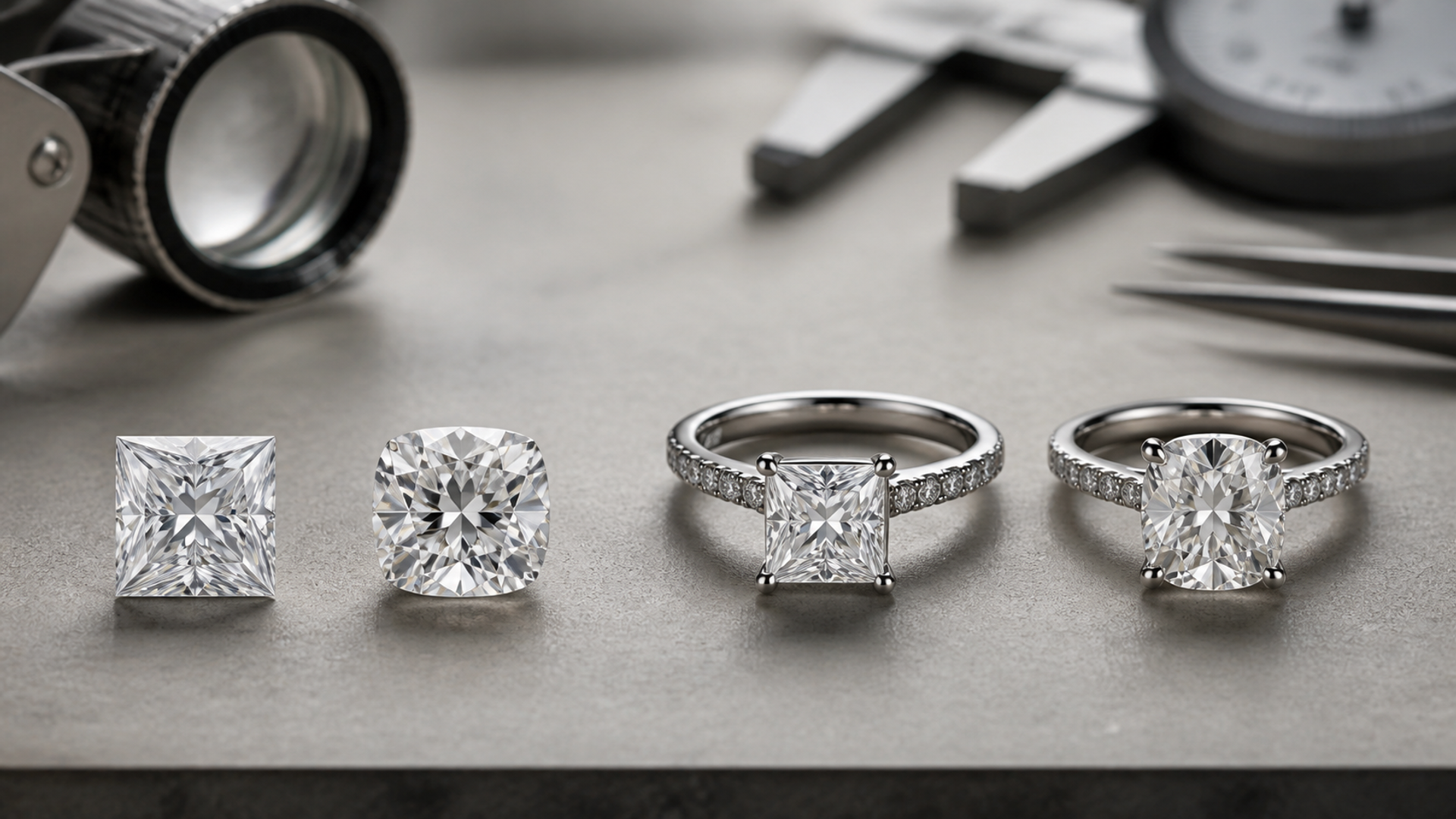
Princess cut versus cushion cut diamond is a geometry, light-performance and setting decision. A princess cut presents a square or rectangular outline with pointed corners and angular brilliance. A cushion cut combines rounded corners with a square or elongated pillow outline, and its facet patterns vary widely. Neither name guarantees beauty or value. Proportions, symmetry, colour, clarity, bow-tie or leakage, corner protection, spread and laboratory evidence must be judged on the actual stone.
Start with silhouette and wear
Choose a princess cut when crisp geometry, strong angular scintillation and efficient square spread fit the design, with protected corners. Choose a cushion cut when softer outline and a specific facet pattern create the preferred character. Compare another shape when neither performs attractively in the intended setting and light.
| Decision factor | Princess-cut diamond | Cushion-cut diamond | Compare another shape |
|---|---|---|---|
| Outline | Sharp square geometry leads | Rounded pillow geometry leads | Compare radiant or emerald cut |
| Corner risk | Setting fully protects points | Rounded corners suit active wear | Use a lower-risk setting |
| Light pattern | Angular scintillation looks lively | Chunky or crushed-ice pattern is preferred | Inspect videos and daylight |
| Colour | The princess retains acceptable face-up colour | The cushion's colour presentation suits the brief | Adjust grade by actual appearance |
| Spread | Dimensions look balanced for weight | Outline gives pleasing face-up area | Compare millimetres, not carats alone |
| Setting | Prongs and gallery secure the princess | Halo or solitaire supports the cushion | Design around the exact stone |
This princess cut vs cushion cut diamond matrix is the article's working value object. Read the princess cut vs cushion cut diamond rows together: the decisive failure mode depends on this topic's evidence, operating context and reader objective.
How the faceting and corners differ
Evidence 1. GIA identifies princess and cushion among distinct fancy diamond shapes whose appearance depends on outline and faceting.
Evidence 2. GIA advises evaluating fancy shapes with dimensions, symmetry and visual inspection because round-brilliant cut grades do not apply in the same way.
Evidence 3. Princess-cut pointed corners require protection from impact and chipping risk in the setting.
Evidence 4. Cushion cuts can vary in outline and facet pattern, so two stones with the same report descriptors can look materially different.
Reader-visible sources checked for this article:
4cs.gia.edu — reader-visible current or official evidence
4cs.gia.edu — reader-visible current or official evidence
For princess cut vs cushion cut diamond, these sources establish only the claims inside their documented scope. Recheck every changeable specification, availability condition, price, policy or service term in the relevant market before acting.
Read the report and inspect the actual stone
On outline, popularity is not enough. The evidence for option one is that sharp square geometry leads. Option two means rounded pillow geometry leads. Option three is rational where compare radiant or emerald cut. Recheck any changeable term immediately before commitment.
The decision changes at corner risk. Choose the first path only if setting fully protects points; move to the second when rounded corners suit active wear; use the third when use a lower-risk setting. Save the downside that would make this row fail.
For light pattern, the first route works when angular scintillation looks lively; the second requires chunky or crushed-ice pattern is preferred. The control for the third is inspect videos and daylight. Verify this row against the exact product, property, account or environment before it can reverse the decision.
The colour row exposes a practical boundary. Route one assumes the princess retains acceptable face-up colour, while route two is defensible only when the cushion's colour presentation suits the brief. Route three depends on adjust grade by actual appearance. If that evidence is absent, keep the more reversible option.
Read spread as a stop/go test: dimensions look balanced for weight supports the first option; outline gives pleasing face-up area supports the second; and compare millimetres, not carats alone supports the third. Record which source proves the condition and when it was checked.
A buyer can resolve setting without starting from a brand preference. Ask whether prongs and gallery secure the princess; compare that with whether halo or solitaire supports the cushion; then use design around the exact stone as the third route's safeguard. An unknown condition stays unknown.
Facts that would reverse the current choice
Reversal control 1 — Outline. Before choosing Princess-cut diamond, write down how the decision changes if “Sharp square geometry leads” proves false. Do the same for Cushion-cut diamond and “Rounded pillow geometry leads”. Keep the Compare another shape route available until “Compare radiant or emerald cut” is verified. This control belongs to princess cut vs cushion cut diamond; update it from the cited source or exact supplier rather than copying a generic checklist.
Reversal control 2 — Corner risk. Before choosing Princess-cut diamond, write down how the decision changes if “Setting fully protects points” proves false. Do the same for Cushion-cut diamond and “Rounded corners suit active wear”. Keep the Compare another shape route available until “Use a lower-risk setting” is verified. This control belongs to princess cut vs cushion cut diamond; update it from the cited source or exact supplier rather than copying a generic checklist.
Reversal control 3 — Light pattern. Before choosing Princess-cut diamond, write down how the decision changes if “Angular scintillation looks lively” proves false. Do the same for Cushion-cut diamond and “Chunky or crushed-ice pattern is preferred”. Keep the Compare another shape route available until “Inspect videos and daylight” is verified. This control belongs to princess cut vs cushion cut diamond; update it from the cited source or exact supplier rather than copying a generic checklist.
Reversal control 4 — Colour. Before choosing Princess-cut diamond, write down how the decision changes if “The princess retains acceptable face-up colour” proves false. Do the same for Cushion-cut diamond and “The cushion's colour presentation suits the brief”. Keep the Compare another shape route available until “Adjust grade by actual appearance” is verified. This control belongs to princess cut vs cushion cut diamond; update it from the cited source or exact supplier rather than copying a generic checklist.
Reversal control 5 — Spread. Before choosing Princess-cut diamond, write down how the decision changes if “Dimensions look balanced for weight” proves false. Do the same for Cushion-cut diamond and “Outline gives pleasing face-up area”. Keep the Compare another shape route available until “Compare millimetres, not carats alone” is verified. This control belongs to princess cut vs cushion cut diamond; update it from the cited source or exact supplier rather than copying a generic checklist.
Reversal control 6 — Setting. Before choosing Princess-cut diamond, write down how the decision changes if “Prongs and gallery secure the princess” proves false. Do the same for Cushion-cut diamond and “Halo or solitaire supports the cushion”. Keep the Compare another shape route available until “Design around the exact stone” is verified. This control belongs to princess cut vs cushion cut diamond; update it from the cited source or exact supplier rather than copying a generic checklist.
Define the silhouette
Choose square or elongated proportions and place outline templates on the intended finger. Compare length-to-width ratio and millimetre dimensions instead of using carat weight as size. Record the exact model, recipe, room, climate, material or operating condition and the time of the check. Separate observed behaviour from a marketing label, and repeat the test in the intended setting rather than under ideal showroom conditions. If the outline fights the hand or setting, more carat weight will not fix the design. Save the evidence that would reverse the choice, because a change in fit, specification, maintenance, service, price or environment must reopen the decision rather than inherit an old conclusion.
Inspect light performance
View the loose stone face-up, tilted and moving under diffuse, spot and normal room light. Look for brightness, contrast, scintillation and persistent dead zones, and avoid judging from one magnified still. Record the exact model, recipe, room, climate, material or operating condition and the time of the check. Separate observed behaviour from a marketing label, and repeat the test in the intended setting rather than under ideal showroom conditions. If the preferred pattern disappears outside jewellery lighting, reject the stone rather than the shape category. Save the evidence that would reverse the choice, because a change in fit, specification, maintenance, service, price or environment must reopen the decision rather than inherit an old conclusion.
Reconcile the report
Match report number, measurements, inscription and clarity features to the stone. Verify natural or laboratory-grown origin and any treatment disclosure without treating the report as a valuation. Record the exact model, recipe, room, climate, material or operating condition and the time of the check. Separate observed behaviour from a marketing label, and repeat the test in the intended setting rather than under ideal showroom conditions. If identity or disclosure cannot be reconciled, pause before setting or payment. Save the evidence that would reverse the choice, because a change in fit, specification, maintenance, service, price or environment must reopen the decision rather than inherit an old conclusion.
Engineer the setting
Ask the jeweller how points, girdle, prongs, gallery and wedding-band clearance will be protected. Review resizing, cleaning, inspection, insurance and replacement implications for daily wear. Record the exact model, recipe, room, climate, material or operating condition and the time of the check. Separate observed behaviour from a marketing label, and repeat the test in the intended setting rather than under ideal showroom conditions. If the setting exposes a vulnerable corner or traps the intended light, redesign before purchase. Save the evidence that would reverse the choice, because a change in fit, specification, maintenance, service, price or environment must reopen the decision rather than inherit an old conclusion.
Three rings, three answers
Graphic modern solitaire
A well-proportioned princess cut can emphasise clean geometry. Define the fact that would reverse this recommendation before committing.
Soft vintage-inspired halo
A cushion cut can complement rounded detail. Define the fact that would reverse this recommendation before committing.
Very active daily wearer
A more protected shape or setting may be the better decision. Define the fact that would reverse this recommendation before committing.
Action checklist
Choose outline.
Compare millimetres.
Set ratio range.
View several lights.
Inspect corners.
Match report.
Verify origin.
Design prongs.
Check band clearance.
Insure and inspect.
Continue the decision
The linked VERTU articles expand adjacent parts of the princess cut vs cushion cut diamond decision. They do not substitute for the external evidence above.
The princess-versus-cushion verdict
Choose a princess cut when crisp geometry, strong angular scintillation and efficient square spread fit the design, with protected corners. Choose a cushion cut when softer outline and a specific facet pattern create the preferred character. Compare another shape when neither performs attractively in the intended setting and light.
Keep the princess cut vs cushion cut diamond decision reversible until its material cost, safety, access, privacy and compatibility facts are verified. Unknown evidence stays unknown; it is never silently scored as favourable.