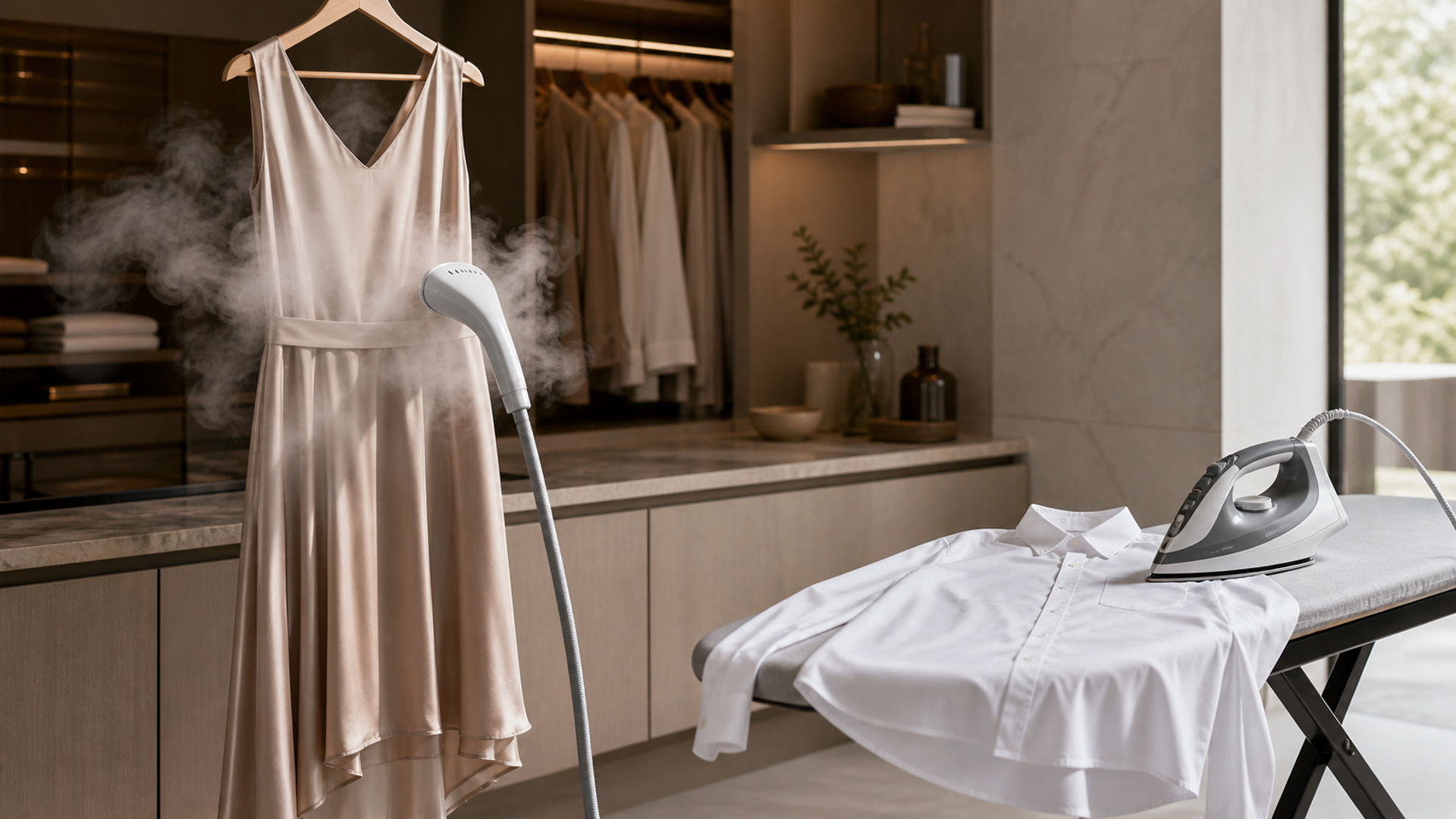
A garment steamer and a steam iron both use heat and moisture, but they do not finish cloth in the same way. A steamer relaxes fibres while a garment hangs, which can refresh drape and release soft wrinkles without a hard board. An iron combines heat, steam, pressure and a flat surface, which is better for crisp collars, seams and trouser creases. Fibre, weave, construction, trims and care labels decide what is safe; the idea that steam is automatically gentle is too broad.
Begin with fabric and finish
Choose a garment steamer for hanging garments, soft wrinkle release, travel speed and surfaces where pressing would mark the pile. Choose an iron for sharp structure, cotton shirts, linen, hems and deliberate creases. Use both when the wardrobe genuinely includes both draped delicate pieces and tailored washable staples, but follow each care label before applying heat or moisture.
| Decision factor | Garment steamer | Steam iron | Use both for separate jobs |
|---|---|---|---|
| Desired finish | Soft drape without a pressed line | Crisp seams and defined creases | Use both in sequence only if allowed |
| Fabric sensitivity | Distance reduces direct plate contact | Temperature setting gives controlled contact | Use a pressing cloth or specialist care |
| Tailoring | Hanging steam can relax minor wrinkles | Board pressure shapes collars and fronts | Professional pressing protects structure |
| Speed | Quick for one hanging outfit | Fast for flat repeatable panels | Prepare garments in batches |
| Travel | Compact steamer may suit hotel use | Travel iron needs a safe surface | Use bathroom steam only as a weak fallback |
| Safety | Hot vapour and condensate need control | Hot soleplate and board need control | Cool, drain and store securely |
This steam iron vs garment steamer matrix is the article's working value object. Read the steam iron vs garment steamer rows together: the decisive failure mode depends on this topic's evidence, operating context and reader objective.
Steam and pressure create different results
Evidence 1. Philips positions steamers for convenient wrinkle removal and irons for pressed results across different garment-care needs.
Evidence 2. Steam can burn skin and can damage water-sensitive dyes, finishes, adhesives or trims despite the absence of a soleplate.
Evidence 3. An iron's safe temperature and steam setting depend on the garment care label and exact material.
Evidence 4. Neither appliance proves disinfection or stain removal without a validated time-temperature process and applicable product instructions.
Reader-visible sources checked for this article:
acc.usa.philips.com — reader-visible current or official evidence
philips.co.uk — reader-visible current or official evidence
For steam iron vs garment steamer, these sources establish only the claims inside their documented scope. Recheck every changeable specification, availability condition, price, policy or service term in the relevant market before acting.
Test on the least visible area
A buyer can resolve desired finish without starting from a brand preference. Ask whether soft drape without a pressed line; compare that with whether crisp seams and defined creases; then use use both in sequence only if allowed as the third route's safeguard. An unknown condition stays unknown.
On fabric sensitivity, popularity is not enough. The evidence for option one is that distance reduces direct plate contact. Option two means temperature setting gives controlled contact. Option three is rational where use a pressing cloth or specialist care. Recheck any changeable term immediately before commitment.
The decision changes at tailoring. Choose the first path only if hanging steam can relax minor wrinkles; move to the second when board pressure shapes collars and fronts; use the third when professional pressing protects structure. Save the downside that would make this row fail.
For speed, the first route works when quick for one hanging outfit; the second requires fast for flat repeatable panels. The control for the third is prepare garments in batches. Verify this row against the exact product, property, account or environment before it can reverse the decision.
The travel row exposes a practical boundary. Route one assumes compact steamer may suit hotel use, while route two is defensible only when travel iron needs a safe surface. Route three depends on use bathroom steam only as a weak fallback. If that evidence is absent, keep the more reversible option.
Read safety as a stop/go test: hot vapour and condensate need control supports the first option; hot soleplate and board need control supports the second; and cool, drain and store securely supports the third. Record which source proves the condition and when it was checked.
Facts that would reverse the current choice
Reversal control 1 — Desired finish. Before choosing Garment steamer, write down how the decision changes if “Soft drape without a pressed line” proves false. Do the same for Steam iron and “Crisp seams and defined creases”. Keep the Use both for separate jobs route available until “Use both in sequence only if allowed” is verified. This control belongs to steam iron vs garment steamer; update it from the cited source or exact supplier rather than copying a generic checklist.
Reversal control 2 — Fabric sensitivity. Before choosing Garment steamer, write down how the decision changes if “Distance reduces direct plate contact” proves false. Do the same for Steam iron and “Temperature setting gives controlled contact”. Keep the Use both for separate jobs route available until “Use a pressing cloth or specialist care” is verified. This control belongs to steam iron vs garment steamer; update it from the cited source or exact supplier rather than copying a generic checklist.
Reversal control 3 — Tailoring. Before choosing Garment steamer, write down how the decision changes if “Hanging steam can relax minor wrinkles” proves false. Do the same for Steam iron and “Board pressure shapes collars and fronts”. Keep the Use both for separate jobs route available until “Professional pressing protects structure” is verified. This control belongs to steam iron vs garment steamer; update it from the cited source or exact supplier rather than copying a generic checklist.
Reversal control 4 — Speed. Before choosing Garment steamer, write down how the decision changes if “Quick for one hanging outfit” proves false. Do the same for Steam iron and “Fast for flat repeatable panels”. Keep the Use both for separate jobs route available until “Prepare garments in batches” is verified. This control belongs to steam iron vs garment steamer; update it from the cited source or exact supplier rather than copying a generic checklist.
Reversal control 5 — Travel. Before choosing Garment steamer, write down how the decision changes if “Compact steamer may suit hotel use” proves false. Do the same for Steam iron and “Travel iron needs a safe surface”. Keep the Use both for separate jobs route available until “Use bathroom steam only as a weak fallback” is verified. This control belongs to steam iron vs garment steamer; update it from the cited source or exact supplier rather than copying a generic checklist.
Reversal control 6 — Safety. Before choosing Garment steamer, write down how the decision changes if “Hot vapour and condensate need control” proves false. Do the same for Steam iron and “Hot soleplate and board need control”. Keep the Use both for separate jobs route available until “Cool, drain and store securely” is verified. This control belongs to steam iron vs garment steamer; update it from the cited source or exact supplier rather than copying a generic checklist.
Sort the wardrobe
Group garments by fibre, weave, lining, embellishment, pile and required finish. Read care labels and identify pieces that say no steam, low heat or professional clean only. Record the exact product, material, room, garment, vehicle, water report or operating condition and the time of the check. Separate observed behaviour from marketing language, and repeat the comparison in the intended setting rather than an ideal demonstration. If the wardrobe is mostly structured shirts, an iron should lead; if mostly draped dresses, reassess. Preserve the evidence that would reverse the choice: a change in fit, specification, maintenance, safety, price or environment must reopen the decision rather than inherit an old conclusion.
Run a hidden-area test
Use distilled or specified water and the lowest appropriate setting on an inconspicuous area. Check colour transfer, water spotting, shine, shrinkage, adhesive movement and texture after cooling. Record the exact product, material, room, garment, vehicle, water report or operating condition and the time of the check. Separate observed behaviour from marketing language, and repeat the comparison in the intended setting rather than an ideal demonstration. Any change in surface or structure reverses home treatment for that garment. Preserve the evidence that would reverse the choice: a change in fit, specification, maintenance, safety, price or environment must reopen the decision rather than inherit an old conclusion.
Measure a complete outfit
Time filling, heat-up, hanging or boarding, finishing, drying, cooling and storage. Judge collar, cuff, seam, panel and hem rather than the easiest centre area. Record the exact product, material, room, garment, vehicle, water report or operating condition and the time of the check. Separate observed behaviour from marketing language, and repeat the comparison in the intended setting rather than an ideal demonstration. If speed disappears on details, the second tool or professional pressing may be justified. Preserve the evidence that would reverse the choice: a change in fit, specification, maintenance, safety, price or environment must reopen the decision rather than inherit an old conclusion.
Control storage and water
Empty and cool appliances as instructed, manage limescale and keep cords and hot surfaces away from fabrics. Check voltage, leakage protection and travel rules for the intended destination. Record the exact product, material, room, garment, vehicle, water report or operating condition and the time of the check. Separate observed behaviour from marketing language, and repeat the comparison in the intended setting rather than an ideal demonstration. If scale or spitting marks clothing, service the appliance before blaming the method. Preserve the evidence that would reverse the choice: a change in fit, specification, maintenance, safety, price or environment must reopen the decision rather than inherit an old conclusion.
Three wardrobes, three answers
Silk-blend dress before dinner
A cautious steamer test may protect drape better than direct pressing. Define the fact that would reverse this recommendation before committing.
Cotton shirts for a formal week
An iron and board deliver repeatable collars and creases. Define the fact that would reverse this recommendation before committing.
Tailored jacket with fused construction
Professional advice can be safer than either home tool. Define the fact that would reverse this recommendation before committing.
Action checklist
Read labels.
Sort fabrics.
Choose finish.
Test hidden area.
Use correct water.
Control temperature.
Support garment.
Protect hands.
Let fabric dry.
Escalate valuable tailoring.
Continue the decision
The linked VERTU articles expand adjacent parts of the steam iron vs garment steamer decision. They do not substitute for the external evidence above.
The steamer-versus-iron verdict
Choose a garment steamer for hanging garments, soft wrinkle release, travel speed and surfaces where pressing would mark the pile. Choose an iron for sharp structure, cotton shirts, linen, hems and deliberate creases. Use both when the wardrobe genuinely includes both draped delicate pieces and tailored washable staples, but follow each care label before applying heat or moisture.
Keep the steam iron vs garment steamer decision reversible until its material cost, safety, access, privacy and compatibility facts are verified. Unknown evidence stays unknown; it is never silently scored as favourable.