

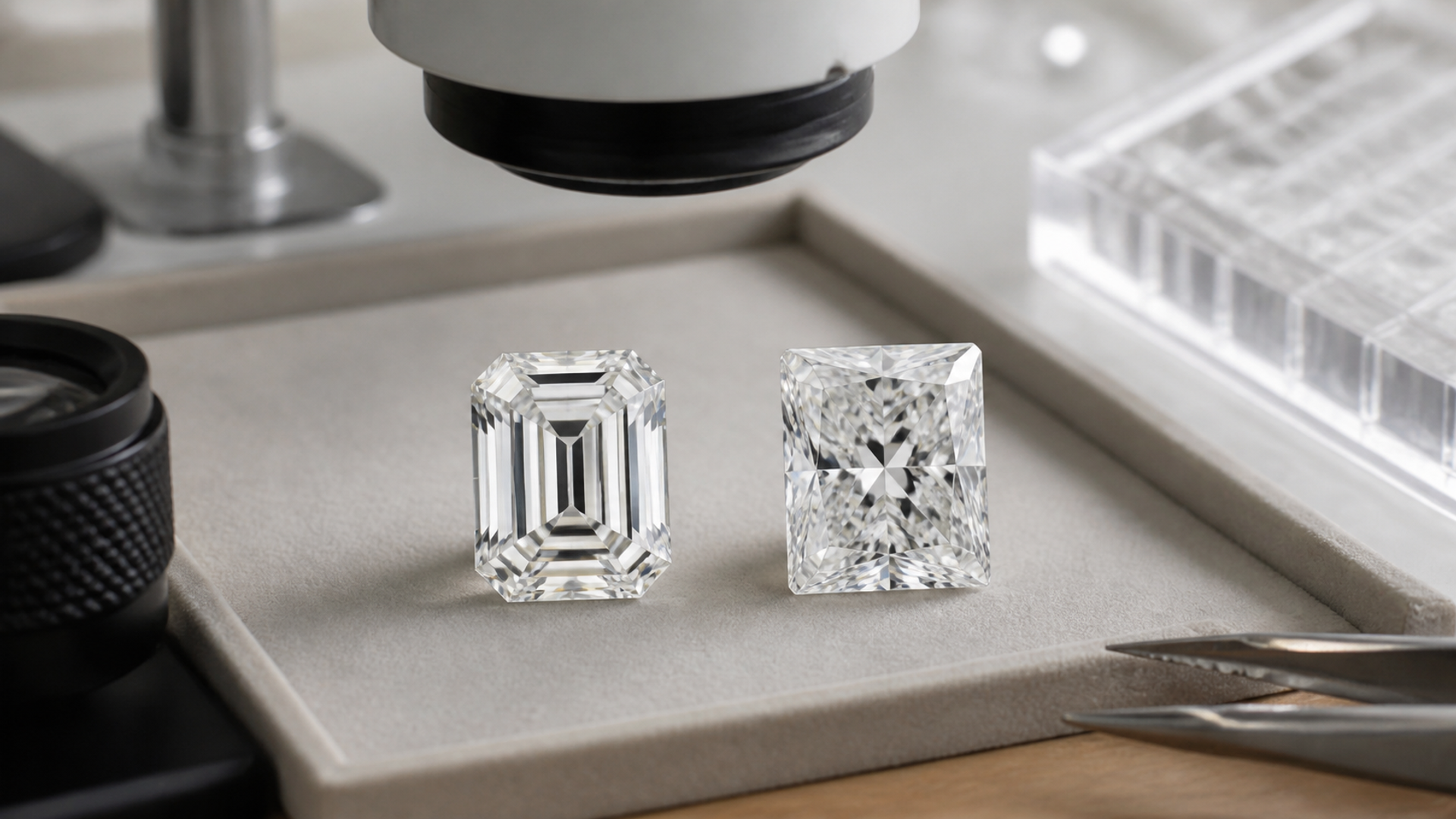
Emerald and radiant cuts can share a rectangular outline and cropped corners while producing very different light patterns. Emerald cuts use broad step facets for a hall-of-mirrors effect; radiant cuts use a modified brilliant arrangement for more scintillation. The exact proportions, clarity, colour and setting decide whether that difference flatters a particular stone.
Compare exact stones before comparing labels
Choose an emerald cut when open step facets, architectural lines and visible clarity are the point. Choose a radiant cut when stronger scintillation and a more inclusion-forgiving pattern suit the brief. Compare exact stones blind when spread, length-to-width ratio or a crushed-ice pattern matters more than the category name.
| Decision factor | Emerald cut | Radiant cut | Compare exact stones blind |
|---|---|---|---|
| Light pattern | Broad flashes and hall-of-mirrors lead | Frequent sparkle and scintillation lead | The exact stone is viewed in motion |
| Clarity | Open facets support the chosen clarity | Brilliant pattern masks selected inclusions | Reports and loupe inspection agree |
| Face-up outline | Length and cropped corners suit the hand | Square or rectangular radiant suits the hand | Millimetres decide before carat |
| Colour | Step facets show the chosen colour acceptably | Radiant pattern handles the chosen colour | Both are checked in neutral light |
| Setting | Corners and long sides are securely protected | Cropped corners fit the intended setting | A jeweller approves the exact geometry |
| Budget | Higher clarity remains comfortably funded | Sparkle is achieved without unnecessary grade | Cut and workmanship keep priority |
This emerald vs radiant cut diamond matrix is the article's working value object. Read the emerald vs radiant cut diamond rows together: the decisive failure mode depends on this topic's evidence, operating context and reader objective.
How step and brilliant faceting differ
Evidence 1. GIA distinguishes shape from cutting style: emerald cuts are step-cut, while radiant cuts combine a rectangular or square outline with brilliant-style faceting.
Evidence 2. Step facets tend to reveal colour and clarity more readily than busy brilliant patterns, so the same paper grade can present differently.
Evidence 3. GIA does not provide a universal cut grade for every fancy-shape diamond; exact proportions and appearance require direct assessment.
Evidence 4. Carat is weight, not face-up size, so measurements and length-to-width ratio belong beside the grading report.
Reader-visible sources checked for this article:
debeers.com — reader-visible current or official evidence
igi.org — reader-visible current or official evidence
For emerald vs radiant cut diamond, these sources establish only the claims inside their documented scope. Recheck every changeable specification, availability condition, price, policy or service term in the relevant market before acting.
Inspect spread, clarity and setting together
The decision changes at light pattern. Choose the first path only if broad flashes and hall-of-mirrors lead; move to the second when frequent sparkle and scintillation lead; use the third when the exact stone is viewed in motion. Save the downside that would make this row fail.
For clarity, the first route works when open facets support the chosen clarity; the second requires brilliant pattern masks selected inclusions. The control for the third is reports and loupe inspection agree. Verify this row against the exact product, property, account or environment before it can reverse the decision.
The face-up outline row exposes a practical boundary. Route one assumes length and cropped corners suit the hand, while route two is defensible only when square or rectangular radiant suits the hand. Route three depends on millimetres decide before carat. If that evidence is absent, keep the more reversible option.
Read colour as a stop/go test: step facets show the chosen colour acceptably supports the first option; radiant pattern handles the chosen colour supports the second; and both are checked in neutral light supports the third. Record which source proves the condition and when it was checked.
A buyer can resolve setting without starting from a brand preference. Ask whether corners and long sides are securely protected; compare that with whether cropped corners fit the intended setting; then use a jeweller approves the exact geometry as the third route's safeguard. An unknown condition stays unknown.
On budget, popularity is not enough. The evidence for option one is that higher clarity remains comfortably funded. Option two means sparkle is achieved without unnecessary grade. Option three is rational where cut and workmanship keep priority. Recheck any changeable term immediately before commitment.
Facts that would reverse the current choice
Reversal control 1 — Light pattern. Before choosing Emerald cut, write down how the decision changes if “Broad flashes and hall-of-mirrors lead” proves false. Do the same for Radiant cut and “Frequent sparkle and scintillation lead”. Keep the Compare exact stones blind route available until “The exact stone is viewed in motion” is verified. This control belongs to emerald vs radiant cut diamond; update it from the cited source or exact supplier rather than copying a generic checklist.
Reversal control 2 — Clarity. Before choosing Emerald cut, write down how the decision changes if “Open facets support the chosen clarity” proves false. Do the same for Radiant cut and “Brilliant pattern masks selected inclusions”. Keep the Compare exact stones blind route available until “Reports and loupe inspection agree” is verified. This control belongs to emerald vs radiant cut diamond; update it from the cited source or exact supplier rather than copying a generic checklist.
Reversal control 3 — Face-up outline. Before choosing Emerald cut, write down how the decision changes if “Length and cropped corners suit the hand” proves false. Do the same for Radiant cut and “Square or rectangular radiant suits the hand”. Keep the Compare exact stones blind route available until “Millimetres decide before carat” is verified. This control belongs to emerald vs radiant cut diamond; update it from the cited source or exact supplier rather than copying a generic checklist.
Reversal control 4 — Colour. Before choosing Emerald cut, write down how the decision changes if “Step facets show the chosen colour acceptably” proves false. Do the same for Radiant cut and “Radiant pattern handles the chosen colour”. Keep the Compare exact stones blind route available until “Both are checked in neutral light” is verified. This control belongs to emerald vs radiant cut diamond; update it from the cited source or exact supplier rather than copying a generic checklist.
Reversal control 5 — Setting. Before choosing Emerald cut, write down how the decision changes if “Corners and long sides are securely protected” proves false. Do the same for Radiant cut and “Cropped corners fit the intended setting”. Keep the Compare exact stones blind route available until “A jeweller approves the exact geometry” is verified. This control belongs to emerald vs radiant cut diamond; update it from the cited source or exact supplier rather than copying a generic checklist.
Reversal control 6 — Budget. Before choosing Emerald cut, write down how the decision changes if “Higher clarity remains comfortably funded” proves false. Do the same for Radiant cut and “Sparkle is achieved without unnecessary grade”. Keep the Compare exact stones blind route available until “Cut and workmanship keep priority” is verified. This control belongs to emerald vs radiant cut diamond; update it from the cited source or exact supplier rather than copying a generic checklist.
View without knowing the labels
Compare stones of similar weight and colour in diffuse daylight, spot lighting and normal indoor light. Record brightness, dark areas and pattern before revealing price.
Read the report beside the stone
Match report number and inscription where present. Review measurements, clarity plot, fluorescence, polish and symmetry without turning any single field into the verdict.
Test the setting geometry
Ask how prongs or a bezel protect cropped corners and whether a wedding band can sit as intended. The setting can change both spread and light return.
Allocate budget to visible value
Protect the quality of the exact cut and workmanship before buying an invisible clarity increment. Keep a written reason for the rejected stone.
Three diamond briefs
Architectural, low-flash brief
An emerald cut can win when long clean facets and transparency are deliberately valued. Define the fact that would reverse this recommendation before committing.
Sparkle-led rectangular brief
A radiant cut can deliver a brighter, busier pattern while retaining cropped corners. Define the fact that would reverse this recommendation before committing.
Fixed budget and hand coverage
Blind comparison by millimetres and appearance can overturn assumptions based on carat or shape prestige. Define the fact that would reverse this recommendation before committing.
Action checklist
Compare similar dimensions.
View in three light types.
Check length-to-width ratio.
Verify grading report.
Inspect clarity placement.
Assess dark zones.
Test setting protection.
Check wedding-band fit.
Protect workmanship budget.
Document the exact stone.
Continue the decision
The linked VERTU articles expand adjacent parts of the emerald vs radiant cut diamond decision. They do not substitute for the external evidence above.
The emerald-radiant verdict
Choose an emerald cut when open step facets, architectural lines and visible clarity are the point. Choose a radiant cut when stronger scintillation and a more inclusion-forgiving pattern suit the brief. Compare exact stones blind when spread, length-to-width ratio or a crushed-ice pattern matters more than the category name.
Keep the emerald vs radiant cut diamond decision reversible until its material cost, safety, access, privacy and compatibility facts are verified. Unknown evidence stays unknown; it is never silently scored as favourable.
![How to Scan Receipts and Documents with Your Phone [Full Guide]](https://cdn.sanity.io/images/e0gp1l2g/production/0db13feec1d5e72b8a8a5f976d1f3e86619c9228-3840x1860.webp?w=180&h=180&q=78&auto=format&fit=crop)
![How to Scan Receipts and Documents with Your Phone [Full Guide]](https://cdn.sanity.io/images/e0gp1l2g/production/0db13feec1d5e72b8a8a5f976d1f3e86619c9228-3840x1860.webp?w=800&h=450&q=82&auto=format&fit=crop)
![Top 10 Two-Tone Carbon-Fibre Watches for Men [2026 List]](https://cdn.sanity.io/images/e0gp1l2g/production/18870799ba33fab0e038968359cd5772d7d7db30-1024x576.webp?w=800&h=450&q=82&auto=format&fit=crop)
![Top 10 Luxury Watches with Digital Complication Displays for Men [Latest]](https://cdn.sanity.io/images/e0gp1l2g/production/c4f6bf8c080f291c39f7cc85c7344ecff2fd3799-1024x553.webp?w=800&h=450&q=82&auto=format&fit=crop)