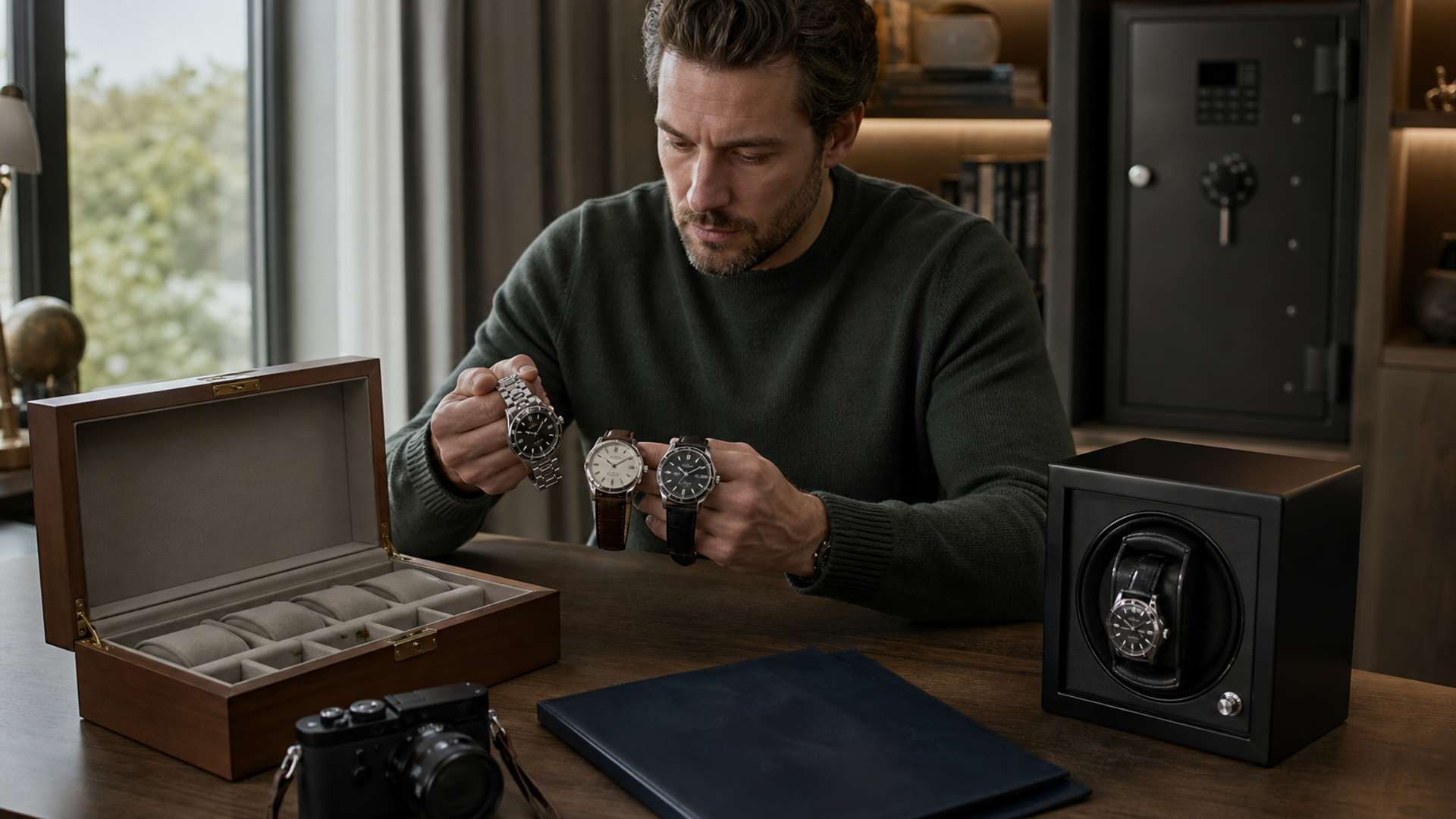
A watch winder solves readiness, a watch box solves organisation, and a safe solves part of the security problem. None replaces the others. Most collections need a layered system: a lined box or roll to prevent contact damage, a professionally specified safe for high-value pieces, and a winder only for automatic watches whose complications or wearing pattern make continuous running genuinely useful.
The wrong purchase begins when a collector asks, “Which is the best storage product?” The better question is, “What failure am I trying to prevent: scratches, stopped movements, theft, fire, lost paperwork or inconvenient access?”
The storage matrix
| Storage option | Best at | Weak at | Suitable use |
|---|---|---|---|
| Lined watch box | Separation, dust control, daily access | Theft and fire | Regular rotation in a controlled room |
| Travel roll or pouch | Preventing contact during transport | Home security | A small number of watches in transit |
| Watch winder | Keeping selected automatics running | Security unless built into safe | Complex automatic watches worn intermittently |
| Anchored rated home safe | Burglary resistance and controlled access | Daily convenience and off-site disaster risk | Valuable collection used regularly |
| Bank safe or specialist vault | Off-site security | Immediate access | Rarely worn or irreplaceable pieces |
This is an ownership framework, not security engineering or insurance advice. Safe specifications, alarm design and policy terms should be agreed with qualified local professionals and the insurer covering the collection.
What a watch box actually does
A good box prevents watches, bracelets and buckles from rubbing against one another. It reduces dust and gives each piece a consistent location. That sounds modest, but daily handling causes many avoidable marks: a steel bracelet touching a polished case, a crown pressing into the next watch, or a loose deployant clasp sliding under a dial.
Look for stable dividers, cushions that fit the bracelet without forcing it, a lining that does not shed fibres, and enough clearance for crowns and thick crystals. The box should sit away from direct sun, obvious moisture, strong magnets and large temperature changes.
Do not over-tighten a bracelet around an oversized cushion. Long-term tension can distort a strap or clasp. Leather should be dry before storage; a watch worn through heat or rain should not go directly into a sealed box with moisture trapped underneath.
A box is not a security control simply because it has a small lock. If the entire box can be carried away, the lock mainly protects privacy and casual access.
When a watch winder is useful
A winder rotates an automatic watch to keep the mainspring supplied with energy. Its best case is a complicated automatic watch that is worn often enough to justify readiness but not often enough to remain running. Re-setting a perpetual calendar, annual calendar or moon phase can be more involved than setting a simple three-hand watch.
For a simple automatic, stopping is normal. Patek Philippe's care guidance says a stopped self-winding watch can be restarted with a few gentle turns of the crown, while noting model-specific power reserves. A winder is therefore a convenience, not a universal maintenance requirement.
Three details matter:
Direction: some calibres wind clockwise, some anticlockwise and some in both directions.
Turns per day: too few will not maintain the watch; an unnecessarily aggressive programme adds motion without benefit.
Rest periods: a considered programme alternates motion and rest rather than rotating continuously.
Use the movement maker's instructions or an authorised service centre to set direction and turns. Do not copy a setting from a different watch that happens to share the same brand. A poorly documented generic winder can create more uncertainty than manually setting the watch when needed.
A winder also needs physical quality: a secure cushion, quiet motor, stable power supply and enough space to prevent a large watch touching the enclosure. If it has a glass display, understand that display and discretion pull in opposite directions.
When a home safe becomes necessary
Collection value is only one trigger. Replaceability, sentimental importance, public visibility and how often the home is empty also matter. A unique inherited watch may justify stronger protection than a more expensive model that is easily replaced.
Chubb's guidance for valuables recommends assessing safe resistance, anchoring, alarms and fire protection as a system. Its public material distinguishes a real high-security safe from a small portable box, noting that a safe should be too heavy to carry or professionally fixed to the structure and should have an appropriate tested resistance rating.
The exact rating and installation must be chosen locally. A heavy safe placed on an unsuitable floor can create structural risk. An impressive safe that is not anchored can become a container for the thief. A safe installed without regard to fire, water or alarm design can protect against one threat while remaining exposed to another.
Daily behaviour matters too. Do not leave watches outside the safe because putting them away feels cumbersome. If the storage routine is too awkward to follow, redesign the routine rather than relying on intention.
When off-site storage is better
A bank safe or specialist vault is appropriate for watches worn rarely, documents that should not share the same disaster exposure as the collection, or a group whose total value exceeds the home's risk appetite. Off-site storage sacrifices spontaneity. Access may depend on opening hours, identity checks and jurisdiction-specific rules.
It also creates a documentation task. Keep an encrypted inventory that records reference, serial number, photographs, purchase and service documents, appraisal, insurer and storage location. Do not store the only copy of that inventory beside the watches.
Chubb suggests balancing value, frequency of access, time away from home and the actual security of the in-home safe when deciding between home and bank storage. That is the right shape of decision even when another insurer provides the policy.
Control the environment before buying furniture
The room matters more than the upholstery. Avoid long exposure to direct sunlight, rapid temperature swings, condensation and persistent high humidity. Leather straps can dry, crack or absorb moisture; seals and lubricants age; luminous and coloured materials can change with prolonged light exposure.
A domestic box should sit on a stable surface away from bathrooms, radiators and exterior windows. A safe may need ventilation or humidity control appropriate to its construction and location. Do not add a generic desiccant pack and forget it: an exhausted pack is ineffective, while an overly dry micro-environment can be unhelpful for leather and some organic materials.
If the collection includes vintage pieces, unusual dials or watches with known moisture sensitivity, ask a qualified watchmaker about the appropriate storage range. The objective is stability, not the lowest possible humidity number.
Document the collection without advertising it
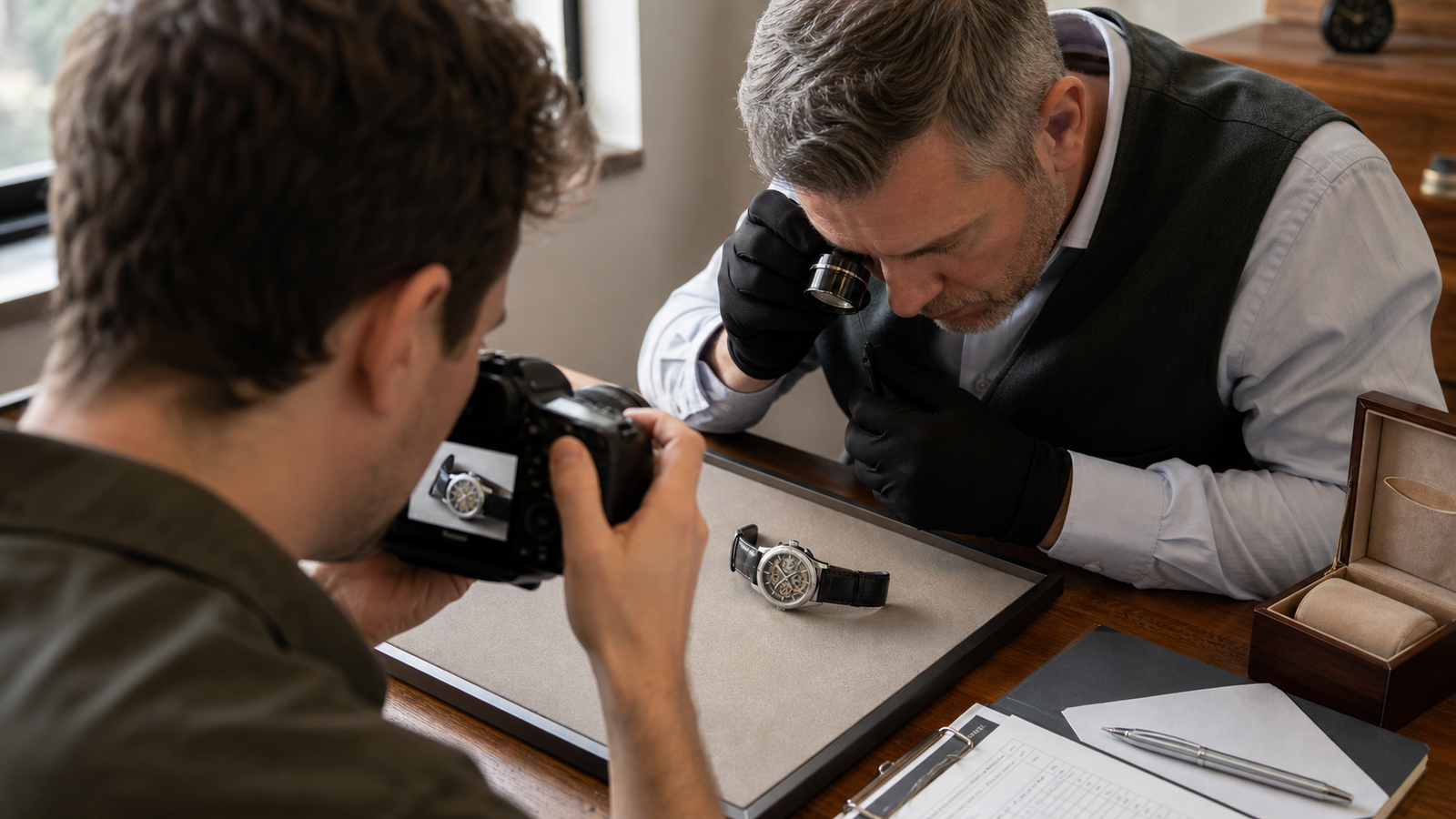
Create an inventory with reference and serial numbers, purchase evidence, service history, current photographs and distinguishing marks. Store one protected copy away from the watches. Photographs should show condition clearly enough to support identification and an insurance claim, including clasp, caseback and existing damage.
Review insurance wording rather than assuming home contents cover is sufficient. Check single-item limits, worldwide cover, unattended-vehicle exclusions, safe requirements, valuation intervals and whether market appreciation is recognised. Chubb's watch-collection guidance highlights both rising values and the need to reassess security as a collection changes.
Do not keep the only ownership records inside the safe with the watches. A burglary, fire or lock failure could remove the evidence and property together. Avoid publishing serial numbers, home layout or a complete collection photograph on public social media.
Set the winder to the movement, not the display
An automatic watch winder should be configured to the calibre's requirements: turns per day and winding direction where relevant. More rotation is not inherently better. Excessive or incorrect running adds wear without increasing useful power reserve once the mainspring's protection is engaged.
Use the manufacturer's instructions or a competent watchmaker as the source. Do not infer settings from the case brand alone; brands use multiple movements. If the watch is due for service, a winder does not correct degraded lubrication or a failing seal.
Complicated calendars are the strongest practical case for a winder because resetting them can be time-consuming and may involve restricted adjustment periods. A simple three-hand watch worn monthly can usually rest in a box and be set when needed. The collector is buying convenience, not preservation by motion.
Handling rules that prevent avoidable damage
Close folding clasps before placing a watch in a box so metal parts do not strike the caseback or a neighbouring watch. Use pillows sized to the bracelet; forcing a small bracelet around an oversized cushion creates continuous tension. Keep loose bracelets, tools and spare links in separate labelled compartments.
When transporting several watches, prevent them from touching and do not leave the roll visible in a vehicle. Count pieces in and out using the inventory. If another person has access for cleaning, maintenance or emergency response, define what they may move and how that movement is recorded.
Battery-powered quartz pieces need their own schedule. A depleted cell left inside a watch can leak and damage the movement. Record the last battery change, respond to end-of-life indications and use a qualified service route that can renew gaskets and test water resistance where required. Do not treat an unworn quartz watch as maintenance-free merely because it remains still.
For mechanical watches, inspect straps, crowns and moisture signs when rotating the collection. A box can conceal a developing problem as effectively as it prevents dust. A brief quarterly condition check should compare the watch with its inventory photographs and trigger service when something changes.
Emergency planning completes the system. Record the safe installer, insurer, watchmaker and one authorised family or estate contact without placing access codes in the same document. After a fire, flood or burglary, preserve the scene where safe, notify the appropriate authorities and insurer, and do not operate a damp or damaged watch merely to see whether it still runs.
Review that plan annually and whenever the collection, residence, insurer or household access changes; yesterday's sensible controls may no longer match today's consequence of loss.
Digital security belongs in the review. Protect cloud inventories and valuation records with phishing-resistant authentication, encrypt backups and limit shared access. A detailed spreadsheet containing serial numbers, values, home location and travel dates can become a targeting tool if exposed. Give advisers only the information needed for their task, and revoke temporary access when valuation, transport or insurance work ends.
Keep a dated record of every access and movement for the highest-consequence pieces, including temporary loans, service shipments and valuation appointments.
The 15-minute collection audit
| Audit question | If the answer is “no” | Next action |
|---|---|---|
| Is every watch separated from hard contact? | Scratch and impact risk | Add fitted compartments or individual pouches |
| Is the current location protected against easy removal? | Theft concentration | Obtain a professional safe and alarm assessment |
| Is each automatic winder setting documented? | Unnecessary or ineffective motion | Check calibre-specific instructions |
| Is the inventory stored separately and recoverably? | Claim and recovery friction | Create encrypted off-site backup |
| Are valuations and policy limits current? | Underinsurance risk | Review with qualified valuer and insurer |
| Can another authorised person follow the emergency plan? | Access failure | Document contacts and procedures securely |
| Are unworn watches inspected periodically? | Silent moisture or battery issue | Schedule a quarterly condition check |
Insurance is not a substitute for storage, and storage is not a substitute for insurance. Market values change, exclusions differ, and some policies require specified security measures. Chubb's UK watch guidance recommends current professional valuation with clear photographs and material descriptions. Discuss the actual collection with the relevant insurer rather than relying on a general household limit.
A layered plan by collection size
For one to three regularly worn watches, use a lined box or individual pouches in a discreet location, with documented insurance appropriate to value. A winder is optional and usually unnecessary for simple automatics.
For four to ten pieces, separate daily rotation from higher-value or rarely worn watches. Add an anchored safe designed with professional input. Use a winder for selected complications, not every automatic slot.
For a larger or irreplaceable collection, treat security, environmental control, documentation and insurance as one project. Consider off-site storage for the highest-consequence pieces and keep records in a separate, secure location.
Collection size is only a proxy. One rare or publicly identifiable watch can justify stronger controls than ten replaceable pieces. Reassess after every major acquisition, move, valuation change or public appearance.
The same principle applies when the collection travels. Use the luxury-watch documentation, insurance and customs checklist, and decide whether an independent watchmaker or major maison fits your service expectations. Case materials also change contact and scratch behaviour, as explained in the titanium, ceramic and steel ownership guide.
The practical verdict
Buy a box for every collection, a safe when the consequence of loss demands it, and a winder only when readiness is worth the extra machinery. The most credible collector setup is rarely the most theatrical. It is the one that makes careful behaviour easy every day and preserves an evidence trail when something goes wrong.