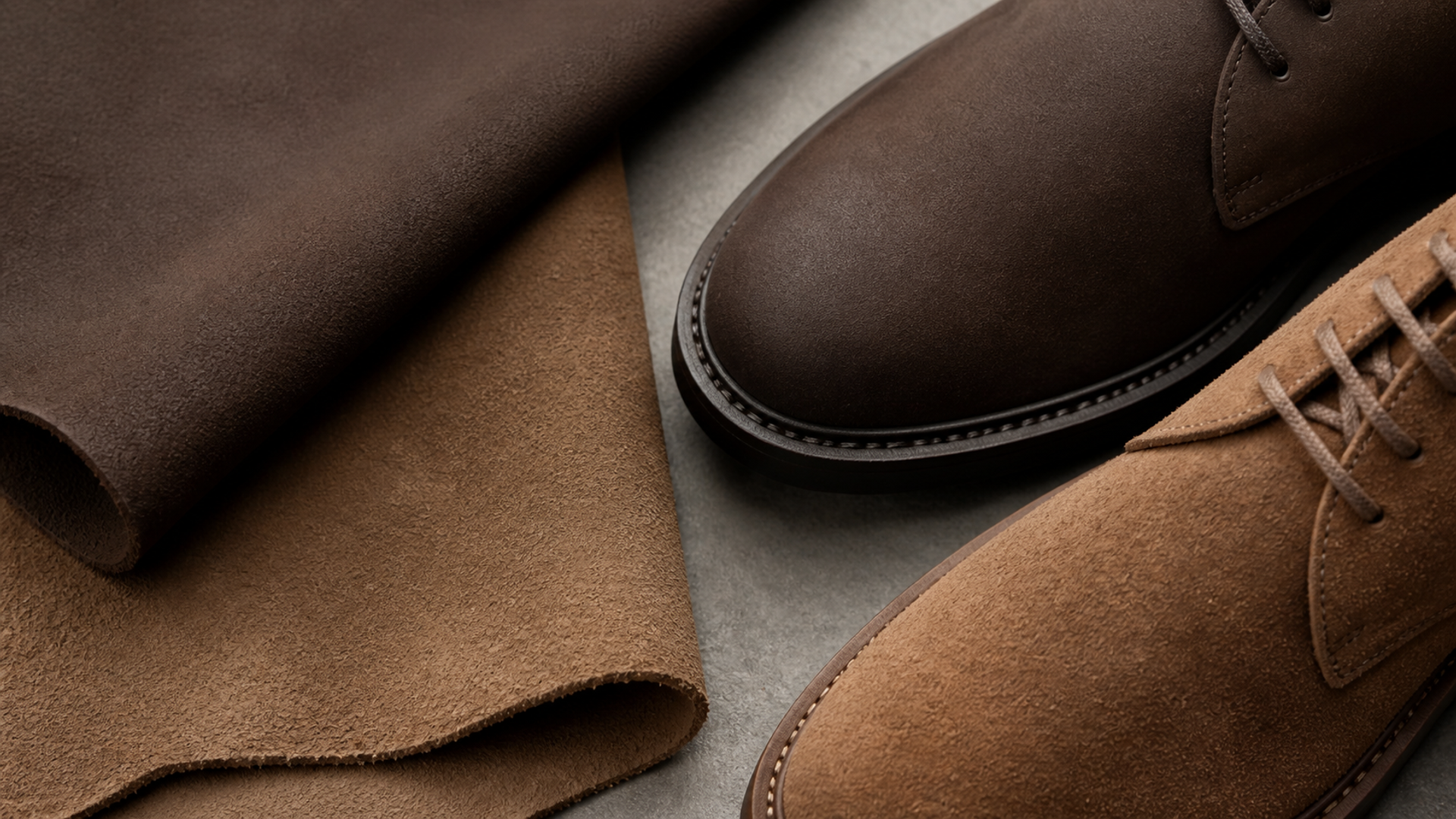
Nubuck and suede both have a tactile nap, but the surface usually comes from different sides of the hide. Nubuck is commonly made by lightly buffing the outer grain surface; suede is made from the flesh side or a split. The result is not a universal ranking. Hide quality, thickness, colour, construction, finish and care determine whether either suits a shoe, bag or jacket.
Choose by surface and use
Choose nubuck when a fine velvety surface with grain-side structure and developing patina fits the product. Choose suede when a softer, open nap, drape and colour expression suit the design. Choose another material when frequent rain, grease, abrasion or low-maintenance use conflicts with either surface.
| Decision factor | Nubuck | Suede | Choose smooth leather or textile |
|---|---|---|---|
| Surface | Fine grain-side buffing gives dense velvet feel | Flesh-side or split nap gives softer texture | Smooth leather resists surface marking |
| Structure | Exact hide and thickness support the product | Backing and construction provide body | Textile may suit severe exposure |
| Water | Owner accepts darkening risk and approved care | Owner protects nap and avoids saturation | Choose a weather-focused material |
| Stains | Dry brushing and specialist cleaning are realistic | Nap restoration and colour care are realistic | Avoid pale nap in high-soil use |
| Ageing | Patina and tonal variation are desirable | Flattening and directional shade are acceptable | Choose a more uniform finish |
| Repair | Specialist can recolour and restore nap | Specialist can clean and re-raise surface | Select replaceable panels |
This nubuck vs suede matrix is the article's working value object. Read the nubuck vs suede rows together: the decisive failure mode depends on this topic's evidence, operating context and reader objective.
Where the nap comes from
Evidence 1. Leather Naturally describes leather as hide or skin transformed to resist putrefaction, while surface, split and finish choices create different products.
Evidence 2. Nubuck is generally associated with a buffed grain-side surface, whereas suede usually exposes the flesh side or a split.
Evidence 3. Nap direction changes how light reflects, so apparent colour variation can be normal rather than inconsistent dye.
Evidence 4. Sprays, brushes and cleaners must be approved for the exact leather; an unsuitable product can darken or flatten it.
Reader-visible sources checked for this article:
leathernaturally.org — reader-visible current or official evidence
birkenstock.com — reader-visible current or official evidence
For nubuck vs suede, these sources establish only the claims inside their documented scope. Recheck every changeable specification, availability condition, price, policy or service term in the relevant market before acting.
Test colour, water and care
On surface, popularity is not enough. The evidence for option one is that fine grain-side buffing gives dense velvet feel. Option two means flesh-side or split nap gives softer texture. Option three is rational where smooth leather resists surface marking. Recheck any changeable term immediately before commitment.
The decision changes at structure. Choose the first path only if exact hide and thickness support the product; move to the second when backing and construction provide body; use the third when textile may suit severe exposure. Save the downside that would make this row fail.
For water, the first route works when owner accepts darkening risk and approved care; the second requires owner protects nap and avoids saturation. The control for the third is choose a weather-focused material. Verify this row against the exact product, property, account or environment before it can reverse the decision.
The stains row exposes a practical boundary. Route one assumes dry brushing and specialist cleaning are realistic, while route two is defensible only when nap restoration and colour care are realistic. Route three depends on avoid pale nap in high-soil use. If that evidence is absent, keep the more reversible option.
Read ageing as a stop/go test: patina and tonal variation are desirable supports the first option; flattening and directional shade are acceptable supports the second; and choose a more uniform finish supports the third. Record which source proves the condition and when it was checked.
A buyer can resolve repair without starting from a brand preference. Ask whether specialist can recolour and restore nap; compare that with whether specialist can clean and re-raise surface; then use select replaceable panels as the third route's safeguard. An unknown condition stays unknown.
Facts that would reverse the current choice
Reversal control 1 — Surface. Before choosing Nubuck, write down how the decision changes if “Fine grain-side buffing gives dense velvet feel” proves false. Do the same for Suede and “Flesh-side or split nap gives softer texture”. Keep the Choose smooth leather or textile route available until “Smooth leather resists surface marking” is verified. This control belongs to nubuck vs suede; update it from the cited source or exact supplier rather than copying a generic checklist.
Reversal control 2 — Structure. Before choosing Nubuck, write down how the decision changes if “Exact hide and thickness support the product” proves false. Do the same for Suede and “Backing and construction provide body”. Keep the Choose smooth leather or textile route available until “Textile may suit severe exposure” is verified. This control belongs to nubuck vs suede; update it from the cited source or exact supplier rather than copying a generic checklist.
Reversal control 3 — Water. Before choosing Nubuck, write down how the decision changes if “Owner accepts darkening risk and approved care” proves false. Do the same for Suede and “Owner protects nap and avoids saturation”. Keep the Choose smooth leather or textile route available until “Choose a weather-focused material” is verified. This control belongs to nubuck vs suede; update it from the cited source or exact supplier rather than copying a generic checklist.
Reversal control 4 — Stains. Before choosing Nubuck, write down how the decision changes if “Dry brushing and specialist cleaning are realistic” proves false. Do the same for Suede and “Nap restoration and colour care are realistic”. Keep the Choose smooth leather or textile route available until “Avoid pale nap in high-soil use” is verified. This control belongs to nubuck vs suede; update it from the cited source or exact supplier rather than copying a generic checklist.
Reversal control 5 — Ageing. Before choosing Nubuck, write down how the decision changes if “Patina and tonal variation are desirable” proves false. Do the same for Suede and “Flattening and directional shade are acceptable”. Keep the Choose smooth leather or textile route available until “Choose a more uniform finish” is verified. This control belongs to nubuck vs suede; update it from the cited source or exact supplier rather than copying a generic checklist.
Reversal control 6 — Repair. Before choosing Nubuck, write down how the decision changes if “Specialist can recolour and restore nap” proves false. Do the same for Suede and “Specialist can clean and re-raise surface”. Keep the Choose smooth leather or textile route available until “Select replaceable panels” is verified. This control belongs to nubuck vs suede; update it from the cited source or exact supplier rather than copying a generic checklist.
Inspect more than the name
Handle a full product or large swatch in daylight. Look at nap density, backing, edges, thickness, flex points and whether the material is grain-side nubuck, split suede or an imitation. Ask which panels use which material. A marketing swatch cannot reveal how seams, reinforcement and lining determine structure.
Run a controlled care test
On an offcut or hidden area, follow the maker's sequence for dry brushing, protector and spot cleaning. Allow full drying, then compare colour, hand and nap. Never saturate the surface to prove resistance. Household detergents or creams intended for smooth grain can permanently alter a napped finish.
Match exposure to colour
Map rain, road salt, denim transfer, skin oils, food and floor contact. Pale suede on a handled bag faces different risk from dark nubuck on an occasional boot. Decide whether visible marks add character or frustrate the owner before purchase rather than treating all patina as desirable.
Verify restoration access
Ask the maker about brushing, recolouring, panel replacement, resoling and warranty exclusions. Locate a specialist before severe cleaning is attempted. Save care cards and photographs. A material earns premium value when construction and service allow coherent ageing, not merely rich appearance on day one.
Three products, three answers
Structured weekend boot
Nubuck may suit when dense feel, support and visible patina are welcomed. Define the fact that would reverse this recommendation before committing.
Soft unlined loafer
Suede can deliver flexibility and colour depth when abrasion and rain stay controlled. Define the fact that would reverse this recommendation before committing.
Daily bag in heavy rain
A smooth or weather-resistant surface may be the honest ownership choice. Define the fact that would reverse this recommendation before committing.
Action checklist
Confirm construction.
Inspect edges and backing.
Check nap density.
Test daylight colour.
Map water exposure.
Map dye transfer.
Use approved brush.
Test protector hidden.
Find specialist cleaner.
Save instructions.
Continue the decision
The linked VERTU articles expand adjacent parts of the nubuck vs suede decision. They do not substitute for the external evidence above.
The nubuck-suede verdict
Choose nubuck when a fine velvety surface with grain-side structure and developing patina fits the product. Choose suede when a softer, open nap, drape and colour expression suit the design. Choose another material when frequent rain, grease, abrasion or low-maintenance use conflicts with either surface.
Keep the nubuck vs suede decision reversible until its material cost, safety, access, privacy and compatibility facts are verified. Unknown evidence stays unknown; it is never silently scored as favourable.