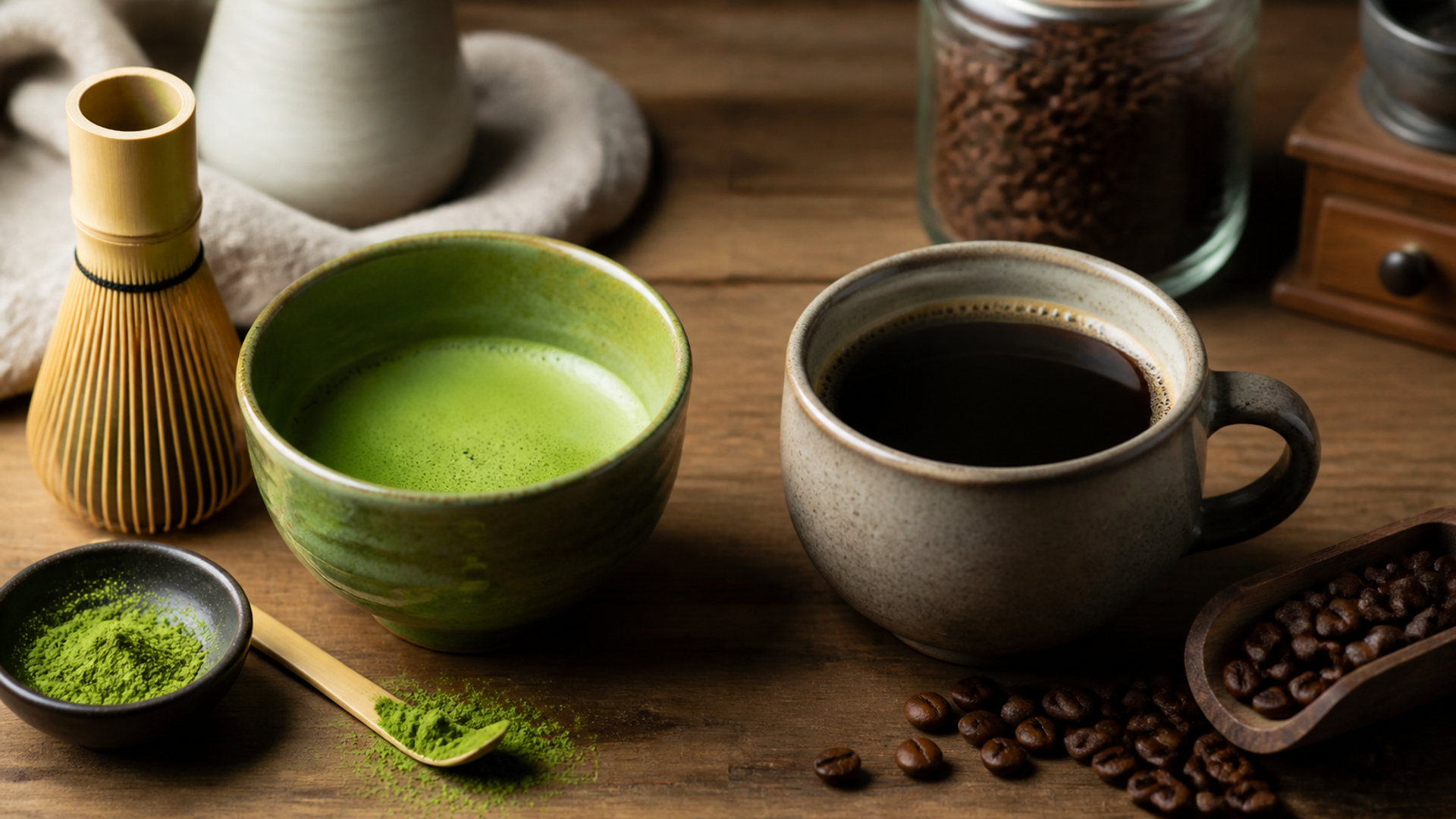
Matcha and coffee are both caffeinated drinks, but they are prepared from different plants and measured in very different servings. Matcha suspends finely milled tea leaf in water; coffee extracts soluble material from roasted beans. Dose, grade, roast, brew ratio, cup size, milk, sugar and personal sensitivity can outweigh broad category averages. Wellness claims also need restraint: the practical choice should begin with a measured serving, taste, preparation time, sleep and the reader's own medical context.
Compare servings, not category mythology
Choose matcha when its vegetal flavour, whisked texture and measured tea ritual fit the day. Choose coffee when roasted aroma, brew variety and the preferred serving strength fit better. Alternate or reduce the serving when caffeine sensitivity, sleep, medication, pregnancy guidance or unwanted additions make either standard drink a poor fit.
| Decision factor | Matcha | Coffee | Alternate or reduce the serving |
|---|---|---|---|
| Preparation | Powder is whisked into the drink | Ground beans are extracted then removed | Measure the actual dose |
| Caffeine | Varies with powder and serving | Varies with bean, method and cup size | Do not compare unnamed cups |
| Flavour | Vegetal, savoury and umami range | Roasted, fruit, chocolate and bitter range | Taste without excess sweetener first |
| Texture | Suspended leaf gives body | Filter and espresso methods differ | Choose for the normal recipe |
| Time | Sifting and whisking can be brief but deliberate | Methods range from instant to long manual brews | Map the real morning |
| Evidence | Avoid cure or detox promises | Avoid productivity or health guarantees | Use dietary and medical guidance where relevant |
This matcha vs coffee matrix is the article's working value object. Read the matcha vs coffee rows together: the decisive failure mode depends on this topic's evidence, operating context and reader objective.
Preparation changes dose and flavour
Evidence 1. Japan's Ministry of Agriculture describes Uji tea traditions and the production context behind Japanese green teas, providing cultural context without proving universal health outcomes.
Evidence 2. The U.S. FDA states that caffeine content varies across products and that sensitivity and safe intake considerations differ among individuals.
Evidence 3. Preparation dose and serving size are necessary for a meaningful caffeine comparison between matcha and coffee.
Evidence 4. Neither drink should be described as a treatment, detox or guaranteed performance aid on the basis of category alone.
Reader-visible sources checked for this article:
maff.go.jp — reader-visible current or official evidence
fda.gov — reader-visible current or official evidence
pmc.ncbi.nlm.nih.gov — reader-visible current or official evidence
For matcha vs coffee, these sources establish only the claims inside their documented scope. Recheck every changeable specification, availability condition, price, policy or service term in the relevant market before acting.
Run a measured morning trial
For preparation, the first route works when powder is whisked into the drink; the second requires ground beans are extracted then removed. The control for the third is measure the actual dose. Verify this row against the exact product, property, account or environment before it can reverse the decision.
The caffeine row exposes a practical boundary. Route one assumes varies with powder and serving, while route two is defensible only when varies with bean, method and cup size. Route three depends on do not compare unnamed cups. If that evidence is absent, keep the more reversible option.
Read flavour as a stop/go test: vegetal, savoury and umami range supports the first option; roasted, fruit, chocolate and bitter range supports the second; and taste without excess sweetener first supports the third. Record which source proves the condition and when it was checked.
A buyer can resolve texture without starting from a brand preference. Ask whether suspended leaf gives body; compare that with whether filter and espresso methods differ; then use choose for the normal recipe as the third route's safeguard. An unknown condition stays unknown.
On time, popularity is not enough. The evidence for option one is that sifting and whisking can be brief but deliberate. Option two means methods range from instant to long manual brews. Option three is rational where map the real morning. Recheck any changeable term immediately before commitment.
The decision changes at evidence. Choose the first path only if avoid cure or detox promises; move to the second when avoid productivity or health guarantees; use the third when use dietary and medical guidance where relevant. Save the downside that would make this row fail.
Facts that would reverse the current choice
Reversal control 1 — Preparation. Before choosing Matcha, write down how the decision changes if “Powder is whisked into the drink” proves false. Do the same for Coffee and “Ground beans are extracted then removed”. Keep the Alternate or reduce the serving route available until “Measure the actual dose” is verified. This control belongs to matcha vs coffee; update it from the cited source or exact supplier rather than copying a generic checklist.
Reversal control 2 — Caffeine. Before choosing Matcha, write down how the decision changes if “Varies with powder and serving” proves false. Do the same for Coffee and “Varies with bean, method and cup size”. Keep the Alternate or reduce the serving route available until “Do not compare unnamed cups” is verified. This control belongs to matcha vs coffee; update it from the cited source or exact supplier rather than copying a generic checklist.
Reversal control 3 — Flavour. Before choosing Matcha, write down how the decision changes if “Vegetal, savoury and umami range” proves false. Do the same for Coffee and “Roasted, fruit, chocolate and bitter range”. Keep the Alternate or reduce the serving route available until “Taste without excess sweetener first” is verified. This control belongs to matcha vs coffee; update it from the cited source or exact supplier rather than copying a generic checklist.
Reversal control 4 — Texture. Before choosing Matcha, write down how the decision changes if “Suspended leaf gives body” proves false. Do the same for Coffee and “Filter and espresso methods differ”. Keep the Alternate or reduce the serving route available until “Choose for the normal recipe” is verified. This control belongs to matcha vs coffee; update it from the cited source or exact supplier rather than copying a generic checklist.
Reversal control 5 — Time. Before choosing Matcha, write down how the decision changes if “Sifting and whisking can be brief but deliberate” proves false. Do the same for Coffee and “Methods range from instant to long manual brews”. Keep the Alternate or reduce the serving route available until “Map the real morning” is verified. This control belongs to matcha vs coffee; update it from the cited source or exact supplier rather than copying a generic checklist.
Reversal control 6 — Evidence. Before choosing Matcha, write down how the decision changes if “Avoid cure or detox promises” proves false. Do the same for Coffee and “Avoid productivity or health guarantees”. Keep the Alternate or reduce the serving route available until “Use dietary and medical guidance where relevant” is verified. This control belongs to matcha vs coffee; update it from the cited source or exact supplier rather than copying a generic checklist.
Measure the serving
Weigh matcha powder or coffee dose, water, milk and sweetener and record the final beverage volume. Use the same time of day and avoid adding another caffeine source during the trial. In this matcha versus coffee comparison, preserve the exact item, setting, date and test condition in the evidence log. Keep measured results separate from category shorthand and repeat the check in the intended environment. If the real doses differ substantially, correct them before attributing an effect to the drink type. When that reversal condition appears, reopen the choice instead of defending the original preference.
Test preparation friction
Time heating, grinding or sifting, whisking, brewing and cleaning. Repeat on a rushed weekday and a slower weekend. In this matcha versus coffee comparison, preserve the exact item, setting, date and test condition in the evidence log. Keep measured results separate from category shorthand and repeat the check in the intended environment. If a ritual is repeatedly skipped or outsourced to a sugary version, choose the sustainable routine. When that reversal condition appears, reopen the choice instead of defending the original preference.
Score the cup
Taste aroma, bitterness, sweetness, acidity, savoury notes, texture and aftertaste separately. Then add the milk or sweetener normally used and record how the result changes. In this matcha versus coffee comparison, preserve the exact item, setting, date and test condition in the evidence log. Keep measured results separate from category shorthand and repeat the check in the intended environment. If additions dominate both drinks, reformulate the serving before paying for premium ingredients. When that reversal condition appears, reopen the choice instead of defending the original preference.
Track response and sleep
Record intake time, alertness, jitteriness, stomach comfort and sleep without presenting self-observation as medical evidence. Seek qualified advice where health conditions, medicines or pregnancy make caffeine material. In this matcha versus coffee comparison, preserve the exact item, setting, date and test condition in the evidence log. Keep measured results separate from category shorthand and repeat the check in the intended environment. If adverse effects recur, reduce, delay or avoid the drink rather than defending a preferred category. When that reversal condition appears, reopen the choice instead of defending the original preference.
Buy and store well
Check origin, pack size, roast or packing date where available and storage instructions. Buy an amount that can be used while flavour remains acceptable. In this matcha versus coffee comparison, preserve the exact item, setting, date and test condition in the evidence log. Keep measured results separate from category shorthand and repeat the check in the intended environment. If premium stock repeatedly goes stale, reduce pack size or frequency. When that reversal condition appears, reopen the choice instead of defending the original preference.
Four routines, four answers
Quiet morning ritual
Matcha can reward a measured whisking routine and savoury flavour preference. Define the fact that would reverse this recommendation before committing.
Fast espresso habit
Coffee can deliver the familiar concentrated format with repeatable equipment. Define the fact that would reverse this recommendation before committing.
Caffeine-sensitive afternoon
A smaller serving or caffeine-free alternative can beat either standard cup. Define the fact that would reverse this recommendation before committing.
Milk-and-sweetener drink
Recipe totals should be compared before making claims about the base ingredient. Define the fact that would reverse this recommendation before committing.
Action checklist
Weigh the dose.
Measure final volume.
Record caffeine timing.
Time preparation.
Taste without additions.
Record milk and sugar.
Track sleep.
Avoid health promises.
Check storage.
Buy a realistic pack.
Seek medical guidance when relevant.
Write the stop condition.
Continue the decision
The linked VERTU articles expand adjacent parts of the matcha vs coffee decision. They do not substitute for the external evidence above.
The matcha-versus-coffee verdict
Choose matcha when its vegetal flavour, whisked texture and measured tea ritual fit the day. Choose coffee when roasted aroma, brew variety and the preferred serving strength fit better. Alternate or reduce the serving when caffeine sensitivity, sleep, medication, pregnancy guidance or unwanted additions make either standard drink a poor fit.
Keep the matcha vs coffee decision reversible until its material cost, safety, access, privacy and compatibility facts are verified. Unknown evidence stays unknown; it is never silently scored as favourable.