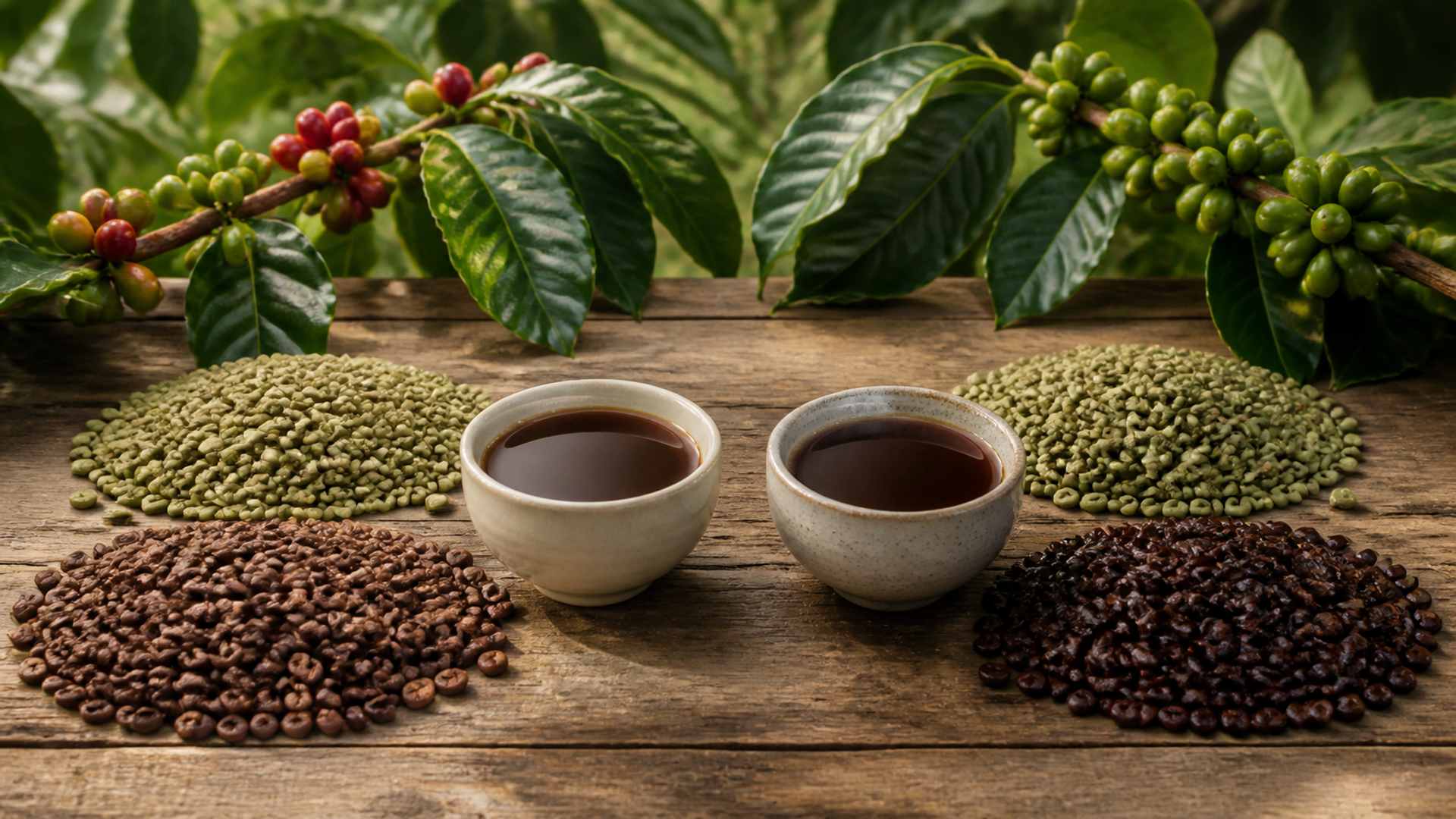
Arabica and Robusta are commercial names tied mainly to Coffea arabica and Coffea canephora, but the cup is never produced by species alone. Genetics, elevation, climate, ripeness, processing, storage, roast development, grind, water and recipe all shape flavour. Robusta is often associated with higher bitterness, body and caffeine; Arabica with wider aromatic narratives. Those tendencies can guide a tasting, but they should not become a quality verdict before the exact lot is brewed blind.
Species is one variable in the cup
Choose an Arabica-led coffee when aromatic complexity, acidity and traceable lot character fit the drink. Choose a Robusta-led coffee when body, crema, intensity or a particular traditional style is desired and the lot is cleanly processed. Use a deliberate blend when each species has a defined role and the roaster discloses enough information to repeat the result.
| Decision factor | Arabica-led coffee | Robusta-led coffee | Use a deliberate blend |
|---|---|---|---|
| Species identity | Usually Coffea arabica | Usually Coffea canephora or Robusta variety | Verify label and lot information |
| Flavour tendency | Often selected for aromatic range and acidity | Often selected for body, bitterness and intensity | Processing and roast can reverse expectations |
| Caffeine | Typically lower than Robusta by comparable basis | Typically higher by comparable basis | Check serving size and laboratory basis |
| Espresso behaviour | Can deliver clarity and sweetness | Can contribute crema and weight | Blend ratio must serve the recipe |
| Brewing | Recipe should suit roast and density | Recipe may need different grind and ratio | Run controlled brews |
| Value | Price reflects origin, quality and market factors | Lower price does not prove poor preparation | Judge the exact lot blind |
This arabica vs robusta matrix is the article's working value object. Read the arabica vs robusta rows together: the decisive failure mode depends on this topic's evidence, operating context and reader objective.
Origin and processing can outweigh shorthand
Evidence 1. FAO identifies Arabica and Robusta as the two chief commercial coffee species and describes their different growing environments.
Evidence 2. International Coffee Organization statistics separate Arabica and Robusta market data, showing that the distinction has real production and trade meaning.
Evidence 3. Species does not determine roast, processing quality or freshness; those variables can dominate a consumer tasting.
Evidence 4. Caffeine comparisons must use a consistent basis because bean mass, roast loss, extraction and serving size change the amount in a cup.
Reader-visible sources checked for this article:
ico.org — reader-visible current or official evidence
worldcoffeeresearch.org — reader-visible current or official evidence
fao.org — reader-visible current or official evidence
For arabica vs robusta, these sources establish only the claims inside their documented scope. Recheck every changeable specification, availability condition, price, policy or service term in the relevant market before acting.
Run a blind brew with controlled recipes
On species identity, popularity is not enough. The evidence for option one is that usually Coffea arabica. Option two means usually Coffea canephora or Robusta variety. Option three is rational where verify label and lot information. Recheck any changeable term immediately before commitment.
The decision changes at flavour tendency. Choose the first path only if often selected for aromatic range and acidity; move to the second when often selected for body, bitterness and intensity; use the third when processing and roast can reverse expectations. Save the downside that would make this row fail.
For caffeine, the first route works when typically lower than Robusta by comparable basis; the second requires typically higher by comparable basis. The control for the third is check serving size and laboratory basis. Verify this row against the exact product, property, account or environment before it can reverse the decision.
The espresso behaviour row exposes a practical boundary. Route one assumes can deliver clarity and sweetness, while route two is defensible only when can contribute crema and weight. Route three depends on blend ratio must serve the recipe. If that evidence is absent, keep the more reversible option.
Read brewing as a stop/go test: recipe should suit roast and density supports the first option; recipe may need different grind and ratio supports the second; and run controlled brews supports the third. Record which source proves the condition and when it was checked.
A buyer can resolve value without starting from a brand preference. Ask whether price reflects origin, quality and market factors; compare that with whether lower price does not prove poor preparation; then use judge the exact lot blind as the third route's safeguard. An unknown condition stays unknown.
Facts that would reverse the current choice
Reversal control 1 — Species identity. Before choosing Arabica-led coffee, write down how the decision changes if “Usually Coffea arabica” proves false. Do the same for Robusta-led coffee and “Usually Coffea canephora or Robusta variety”. Keep the Use a deliberate blend route available until “Verify label and lot information” is verified. This control belongs to arabica vs robusta; update it from the cited source or exact supplier rather than copying a generic checklist.
Reversal control 2 — Flavour tendency. Before choosing Arabica-led coffee, write down how the decision changes if “Often selected for aromatic range and acidity” proves false. Do the same for Robusta-led coffee and “Often selected for body, bitterness and intensity”. Keep the Use a deliberate blend route available until “Processing and roast can reverse expectations” is verified. This control belongs to arabica vs robusta; update it from the cited source or exact supplier rather than copying a generic checklist.
Reversal control 3 — Caffeine. Before choosing Arabica-led coffee, write down how the decision changes if “Typically lower than Robusta by comparable basis” proves false. Do the same for Robusta-led coffee and “Typically higher by comparable basis”. Keep the Use a deliberate blend route available until “Check serving size and laboratory basis” is verified. This control belongs to arabica vs robusta; update it from the cited source or exact supplier rather than copying a generic checklist.
Reversal control 4 — Espresso behaviour. Before choosing Arabica-led coffee, write down how the decision changes if “Can deliver clarity and sweetness” proves false. Do the same for Robusta-led coffee and “Can contribute crema and weight”. Keep the Use a deliberate blend route available until “Blend ratio must serve the recipe” is verified. This control belongs to arabica vs robusta; update it from the cited source or exact supplier rather than copying a generic checklist.
Reversal control 5 — Brewing. Before choosing Arabica-led coffee, write down how the decision changes if “Recipe should suit roast and density” proves false. Do the same for Robusta-led coffee and “Recipe may need different grind and ratio”. Keep the Use a deliberate blend route available until “Run controlled brews” is verified. This control belongs to arabica vs robusta; update it from the cited source or exact supplier rather than copying a generic checklist.
Reversal control 6 — Value. Before choosing Arabica-led coffee, write down how the decision changes if “Price reflects origin, quality and market factors” proves false. Do the same for Robusta-led coffee and “Lower price does not prove poor preparation”. Keep the Use a deliberate blend route available until “Judge the exact lot blind” is verified. This control belongs to arabica vs robusta; update it from the cited source or exact supplier rather than copying a generic checklist.
Read the coffee label
Record species, variety, origin, process, roast date, roast level and intended brew method. Ask the roaster what is known and what is not. For this Arabica versus Robusta coffee decision, keep the exact item, setting, date and test condition in one evidence log. Separate a measured result from category shorthand and repeat the check in the intended environment. If species is unverified, stop making species-specific claims. If that reversal condition appears, reopen the decision instead of defending the earlier preference.
Control the water and grinder
Use the same water, calibrated grinder, dose, yield, temperature and contact time. Purge retained grounds and randomise cup labels. For this Arabica versus Robusta coffee decision, keep the exact item, setting, date and test condition in one evidence log. Separate a measured result from category shorthand and repeat the check in the intended environment. If recipe mismatch explains the difference, adjust before choosing species. If that reversal condition appears, reopen the decision instead of defending the earlier preference.
Taste blind in two methods
Brew a cupping-style evaluation and the actual daily method. Score aroma, acidity, sweetness, bitterness, body, aftertaste and defects separately. For this Arabica versus Robusta coffee decision, keep the exact item, setting, date and test condition in one evidence log. Separate a measured result from category shorthand and repeat the check in the intended environment. If preference changes by method, choose for the method rather than a universal hierarchy. If that reversal condition appears, reopen the decision instead of defending the earlier preference.
Test caffeine assumptions
Use declared or credible analytical data when caffeine matters. Compare equal beverage volumes and realistic doses. For this Arabica versus Robusta coffee decision, keep the exact item, setting, date and test condition in one evidence log. Separate a measured result from category shorthand and repeat the check in the intended environment. If sensitivity is material and data is unavailable, choose a lower or controlled intake plan. If that reversal condition appears, reopen the decision instead of defending the earlier preference.
Model freshness and repeatability
Buy quantities that fit consumption and record storage and dial-in drift. Repeat with a second lot before generalising. For this Arabica versus Robusta coffee decision, keep the exact item, setting, date and test condition in one evidence log. Separate a measured result from category shorthand and repeat the check in the intended environment. If the preferred result cannot be reproduced, value the stable blend or supplier. If that reversal condition appears, reopen the decision instead of defending the earlier preference.
Four coffee uses, four answers
Filter coffee focused on florals
A traceable Arabica lot may align with the target profile. Define the fact that would reverse this recommendation before committing.
Traditional high-intensity espresso
A clean Robusta component can contribute body and crema. Define the fact that would reverse this recommendation before committing.
Milk-based morning drink
A blend may retain presence after dilution. Define the fact that would reverse this recommendation before committing.
Caffeine-sensitive afternoon cup
Serving size and measured caffeine matter more than prestige language. Define the fact that would reverse this recommendation before committing.
Action checklist
Verify species.
Record origin.
Record process.
Record roast date.
Control water.
Calibrate grinder.
Use equal dose.
Blind the cups.
Score attributes.
Test daily method.
Record caffeine basis.
Repeat another lot.
Continue the decision
The linked VERTU articles expand adjacent parts of the arabica vs robusta decision. They do not substitute for the external evidence above.
The Arabica-versus-Robusta verdict
Choose an Arabica-led coffee when aromatic complexity, acidity and traceable lot character fit the drink. Choose a Robusta-led coffee when body, crema, intensity or a particular traditional style is desired and the lot is cleanly processed. Use a deliberate blend when each species has a defined role and the roaster discloses enough information to repeat the result.
Keep the arabica vs robusta decision reversible until its material cost, safety, access, privacy and compatibility facts are verified. Unknown evidence stays unknown; it is never silently scored as favourable.