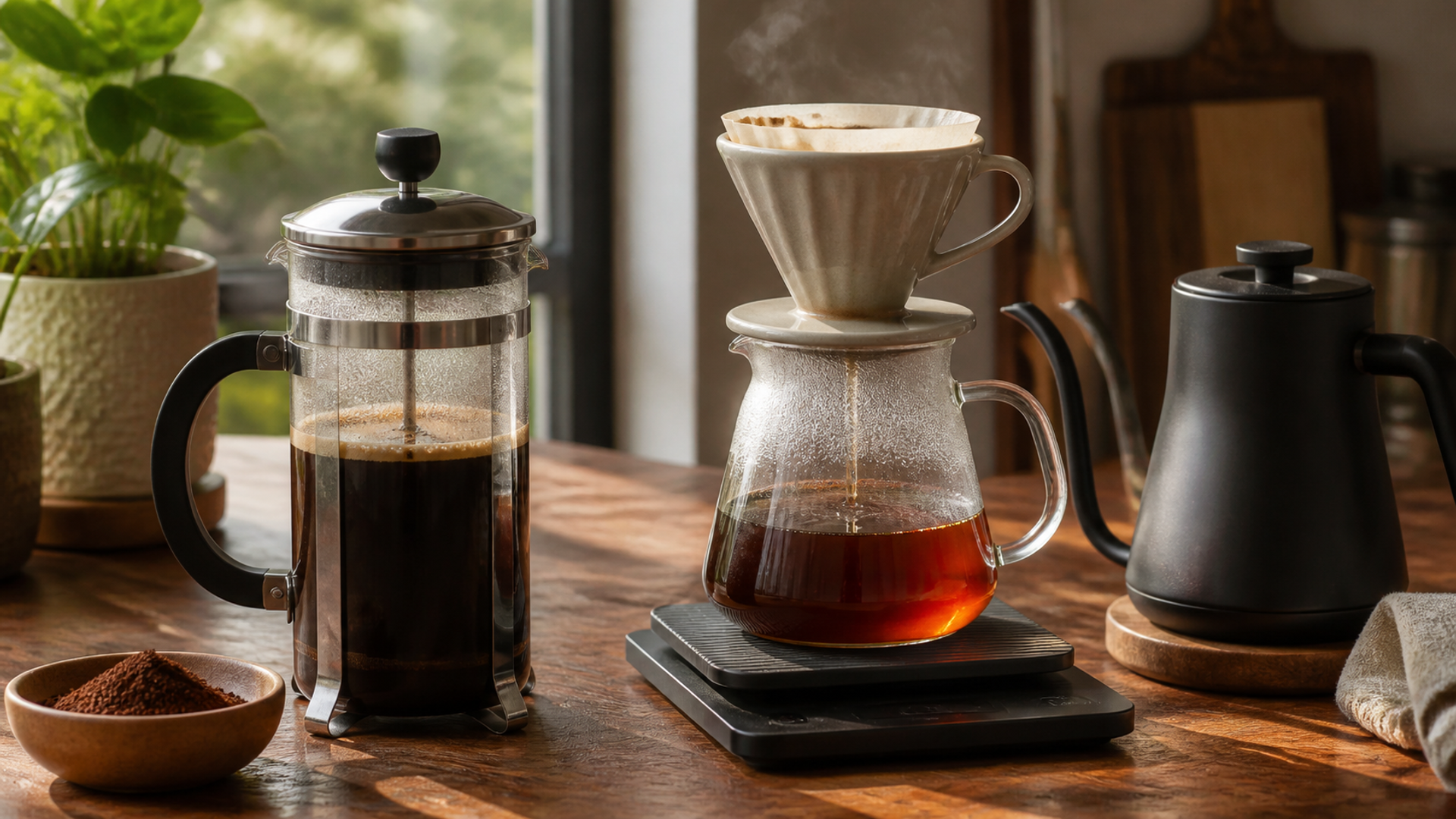
French press and pour over can use the same coffee and water yet produce noticeably different cups because extraction and filtration are organised differently. A French press immerses the grounds for a set time before a mesh separates the brew; pour over moves water through a bed of coffee and a filter. Immersion is often forgiving of pouring technique and preserves more oils and fine particles, while pour over can emphasise clarity but makes grind, flow and pouring more visible. Neither method compensates for stale coffee or unsuitable water.
Choose the cup profile before the brewer
Choose French press when body, batch brewing and a relaxed immersion workflow matter. Choose pour over when clarity, separation of flavours and hands-on control are the attraction. Keep a simpler steep-and-strain method when equipment, scales and repeatability would turn a pleasant morning into maintenance; the right ritual is the one you can reproduce before the coffee cools.
| Decision factor | French press | Pour over | Keep a simpler immersion method |
|---|---|---|---|
| Cup profile | Fuller body with more oils and fines | Cleaner cup through paper filtration | Use a metal-filter dripper for a middle path |
| Technique | Time and grind dominate after wetting | Pour rate, bed shape and drawdown add variables | Simplify to one repeatable recipe |
| Batch size | Carafe serves several cups together | Many drippers favour one or two cups | Use a larger brewer only with a tested recipe |
| Temperature | Closed immersion retains heat but can continue extracting | Open dripper loses heat through vessel and pour | Preheat and measure both systems |
| Cleanup | Wet grounds and mesh require careful disposal | Paper lifts most grounds cleanly | Choose reusable filtration if waste is decisive |
| Repeatability | Consistent steep and plunge can be stable | Consistent pouring needs practice and kettle control | Record dose, water, grind and time |
This french press vs pour over matrix is the article's working value object. Read the french press vs pour over rows together: the decisive failure mode depends on this topic's evidence, operating context and reader objective.
Immersion and percolation expose different variables
Evidence 1. Specialty Coffee Association standards provide a common language for brewing variables, but taste remains dependent on coffee, roast, water and recipe.
Evidence 2. SCA brewing-water guidance explicitly covers both drip and immersion coffee and gives 60 g/L as a commonly used starting brew ratio, giving both methods a fair baseline before technique changes.
Evidence 3. The same SCA guidance separates brewing ratio from beverage ratio, a useful distinction when comparing the water used with the liquid ultimately served.
Evidence 4. SCA explains that pH, hardness and alkalinity are separate water properties, so water chemistry can change a cup enough to overwhelm a casual brewer comparison.
Reader-visible sources checked for this article:
sca.coffee — reader-visible current or official evidence
sca.coffee — reader-visible current or official evidence
For french press vs pour over, these sources establish only the claims inside their documented scope. Recheck every changeable specification, availability condition, price, policy or service term in the relevant market before acting.
Run one controlled coffee test
The decision changes at cup profile. Choose the first path only if fuller body with more oils and fines; move to the second when cleaner cup through paper filtration; use the third when use a metal-filter dripper for a middle path. Save the downside that would make this row fail.
For technique, the first route works when time and grind dominate after wetting; the second requires pour rate, bed shape and drawdown add variables. The control for the third is simplify to one repeatable recipe. Verify this row against the exact product, property, account or environment before it can reverse the decision.
The batch size row exposes a practical boundary. Route one assumes carafe serves several cups together, while route two is defensible only when many drippers favour one or two cups. Route three depends on use a larger brewer only with a tested recipe. If that evidence is absent, keep the more reversible option.
Read temperature as a stop/go test: closed immersion retains heat but can continue extracting supports the first option; open dripper loses heat through vessel and pour supports the second; and preheat and measure both systems supports the third. Record which source proves the condition and when it was checked.
A buyer can resolve cleanup without starting from a brand preference. Ask whether wet grounds and mesh require careful disposal; compare that with whether paper lifts most grounds cleanly; then use choose reusable filtration if waste is decisive as the third route's safeguard. An unknown condition stays unknown.
On repeatability, popularity is not enough. The evidence for option one is that consistent steep and plunge can be stable. Option two means consistent pouring needs practice and kettle control. Option three is rational where record dose, water, grind and time. Recheck any changeable term immediately before commitment.
Facts that would reverse the current choice
Reversal control 1 — Cup profile. Before choosing French press, write down how the decision changes if “Fuller body with more oils and fines” proves false. Do the same for Pour over and “Cleaner cup through paper filtration”. Keep the Keep a simpler immersion method route available until “Use a metal-filter dripper for a middle path” is verified. This control belongs to french press vs pour over; update it from the cited source or exact supplier rather than copying a generic checklist.
Reversal control 2 — Technique. Before choosing French press, write down how the decision changes if “Time and grind dominate after wetting” proves false. Do the same for Pour over and “Pour rate, bed shape and drawdown add variables”. Keep the Keep a simpler immersion method route available until “Simplify to one repeatable recipe” is verified. This control belongs to french press vs pour over; update it from the cited source or exact supplier rather than copying a generic checklist.
Reversal control 3 — Batch size. Before choosing French press, write down how the decision changes if “Carafe serves several cups together” proves false. Do the same for Pour over and “Many drippers favour one or two cups”. Keep the Keep a simpler immersion method route available until “Use a larger brewer only with a tested recipe” is verified. This control belongs to french press vs pour over; update it from the cited source or exact supplier rather than copying a generic checklist.
Reversal control 4 — Temperature. Before choosing French press, write down how the decision changes if “Closed immersion retains heat but can continue extracting” proves false. Do the same for Pour over and “Open dripper loses heat through vessel and pour”. Keep the Keep a simpler immersion method route available until “Preheat and measure both systems” is verified. This control belongs to french press vs pour over; update it from the cited source or exact supplier rather than copying a generic checklist.
Reversal control 5 — Cleanup. Before choosing French press, write down how the decision changes if “Wet grounds and mesh require careful disposal” proves false. Do the same for Pour over and “Paper lifts most grounds cleanly”. Keep the Keep a simpler immersion method route available until “Choose reusable filtration if waste is decisive” is verified. This control belongs to french press vs pour over; update it from the cited source or exact supplier rather than copying a generic checklist.
Reversal control 6 — Repeatability. Before choosing French press, write down how the decision changes if “Consistent steep and plunge can be stable” proves false. Do the same for Pour over and “Consistent pouring needs practice and kettle control”. Keep the Keep a simpler immersion method route available until “Record dose, water, grind and time” is verified. This control belongs to french press vs pour over; update it from the cited source or exact supplier rather than copying a generic checklist.
Set the target cup
Taste the same coffee in a clean cupping or reference brew and name the desired body, acidity, sweetness and finish. Write sensory targets before choosing grind or pouring style. For this French press versus pour over decision, record the exact room, garment, vehicle, drink, device or configuration and the time of the check. Separate measured behaviour from category shorthand, then repeat the comparison in the intended setting rather than an ideal demonstration. If neither brewer produces the target with sound technique, change coffee or water first. Preserve the evidence that would reverse the choice: a material change in fit, specification, maintenance, safety, cost or environment must reopen the decision rather than inherit an old conclusion.
Control dose and water
Weigh coffee and water, preheat equipment and use the same water source and starting temperature. Record brew ratio, temperature loss and total contact time for every trial. For this French press versus pour over decision, record the exact room, garment, vehicle, drink, device or configuration and the time of the check. Separate measured behaviour from category shorthand, then repeat the comparison in the intended setting rather than an ideal demonstration. If a temperature difference explains the cup, retest before crediting the brewer. Preserve the evidence that would reverse the choice: a material change in fit, specification, maintenance, safety, cost or environment must reopen the decision rather than inherit an old conclusion.
Dial the grinder
Use fresh burrs and inspect the spread of coarse pieces and fines at each setting. Change one grind step at a time while holding ratio and water constant. For this French press versus pour over decision, record the exact room, garment, vehicle, drink, device or configuration and the time of the check. Separate measured behaviour from category shorthand, then repeat the comparison in the intended setting rather than an ideal demonstration. If excessive fines make the press muddy or stall the dripper, the grinder may be the real purchase. Preserve the evidence that would reverse the choice: a material change in fit, specification, maintenance, safety, cost or environment must reopen the decision rather than inherit an old conclusion.
Measure workflow
Time grinding, heating, pouring or steeping, serving and full cleanup. Run the test on a workday and a slow weekend rather than only in a tasting session. For this French press versus pour over decision, record the exact room, garment, vehicle, drink, device or configuration and the time of the check. Separate measured behaviour from category shorthand, then repeat the comparison in the intended setting rather than an ideal demonstration. If the preferred method is routinely abandoned, its sensory advantage is not operational value. Preserve the evidence that would reverse the choice: a material change in fit, specification, maintenance, safety, cost or environment must reopen the decision rather than inherit an old conclusion.
Serve and clean promptly
Decant French-press coffee after plunging and dispose of grounds without blocking drains. Rinse dripper, carafe and filter holder before oils dry and become stale. For this French press versus pour over decision, record the exact room, garment, vehicle, drink, device or configuration and the time of the check. Separate measured behaviour from category shorthand, then repeat the comparison in the intended setting rather than an ideal demonstration. If cleaning residue taints the next cup, maintenance quality can reverse the choice. Preserve the evidence that would reverse the choice: a material change in fit, specification, maintenance, safety, cost or environment must reopen the decision rather than inherit an old conclusion.
Four morning rituals, four answers
Two large morning cups
French press can deliver body and one coordinated batch. Define the fact that would reverse this recommendation before committing.
Single-origin tasting ritual
Pour over can make flavour separation easier to inspect. Define the fact that would reverse this recommendation before committing.
Shared office counter
Cleanup and user consistency may matter more than theoretical quality. Define the fact that would reverse this recommendation before committing.
Travel kit
A robust lightweight immersion brewer may be more forgiving. Define the fact that would reverse this recommendation before committing.
Action checklist
Choose flavour target.
Weigh coffee.
Weigh water.
Check water quality.
Preheat brewer.
Record temperature.
Adjust one variable.
Measure drawdown or steep.
Decant promptly.
Time cleanup.
Taste when cooler.
Keep a brew log.
Continue the decision
The linked VERTU articles expand adjacent parts of the french press vs pour over decision. They do not substitute for the external evidence above.
The French-press-versus-pour-over verdict
Choose French press when body, batch brewing and a relaxed immersion workflow matter. Choose pour over when clarity, separation of flavours and hands-on control are the attraction. Keep a simpler steep-and-strain method when equipment, scales and repeatability would turn a pleasant morning into maintenance; the right ritual is the one you can reproduce before the coffee cools.
Keep the french press vs pour over decision reversible until its material cost, safety, access, privacy and compatibility facts are verified. Unknown evidence stays unknown; it is never silently scored as favourable.