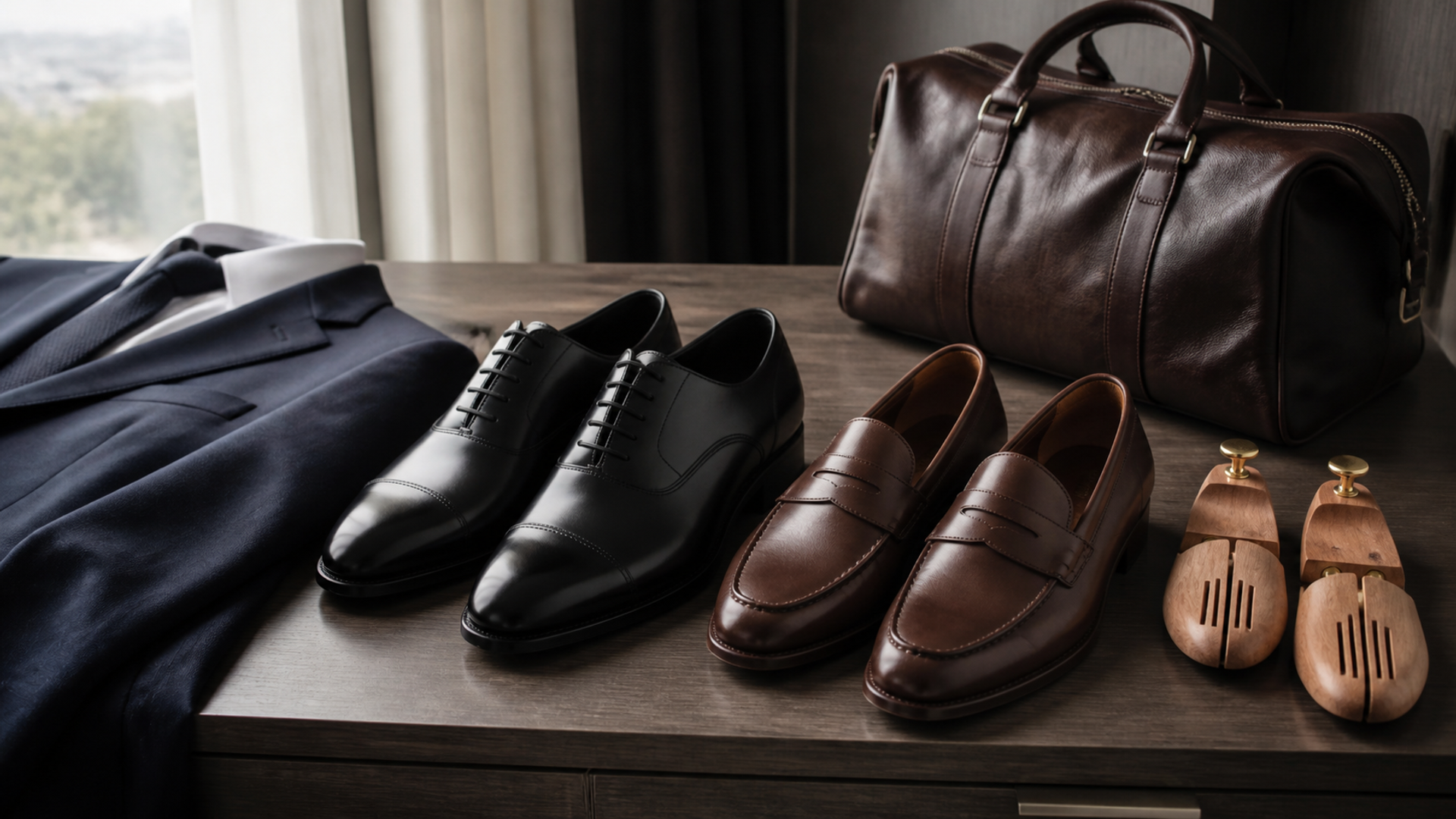
Oxfords and loafers solve different wardrobe and fit problems. The Oxford's closed lacing creates a cleaner formal line and allows some adjustment over the instep. A loafer removes laces for convenience and relaxed elegance, which makes last shape, heel hold and instep contact especially important. Neither category guarantees comfort or quality.
Let the occasion and foot decide
Choose Oxfords when formal business dress, adjustable lacing and a disciplined silhouette dominate. Choose loafers when smart-casual range, airport convenience and warm-weather use matter, provided heel and instep fit are secure. Carry one and wear the other only when the itinerary genuinely spans both dress codes.
| Decision factor | Oxford shoes | Loafers | Carry one and wear the other |
|---|---|---|---|
| Dress code | Formal tailoring and ceremonies dominate | Smart business and leisure dominate | The trip genuinely needs both |
| Instep fit | Laces adjust the closure comfortably | The last holds without pressure | Different lasts solve different outfits |
| Heel hold | Quarter and lacing secure the heel | Heel stays seated without gripping toes | Both pass a walking test |
| Airport use | Security convenience is secondary | Slip-on use saves repeated friction | One pair is worn and one packed |
| Weather | Sole and upper suit formal conditions | Sole and upper suit the route | Rotation allows drying |
| Repair | Construction supports the planned repair | Construction supports the planned repair | A local repair route exists for both |
This loafers vs oxfords matrix is the article's working value object. Read the loafers vs oxfords rows together: the decisive failure mode depends on this topic's evidence, operating context and reader objective.
What Oxford and loafer construction changes
Evidence 1. Crockett & Jones describes the Oxford as a closed-lacing style associated with formal English footwear.
Evidence 2. A loafer has no laces for adjustment, so last shape, heel fit and instep fit carry more responsibility.
Evidence 3. Goodyear-welted construction may support resoling, but repairability still depends on wear, materials, maker and cobbler assessment.
Evidence 4. Leather, lining, sole, last and break-in vary within both categories; a category label is not a comfort guarantee.
Reader-visible sources checked for this article:
crockettandjones.com — reader-visible current or official evidence
row.crockettandjones.com — reader-visible current or official evidence
For loafers vs oxfords, these sources establish only the claims inside their documented scope. Recheck every changeable specification, availability condition, price, policy or service term in the relevant market before acting.
Test fit after a real walking interval
Read dress code as a stop/go test: formal tailoring and ceremonies dominate supports the first option; smart business and leisure dominate supports the second; and the trip genuinely needs both supports the third. Record which source proves the condition and when it was checked.
A buyer can resolve instep fit without starting from a brand preference. Ask whether laces adjust the closure comfortably; compare that with whether the last holds without pressure; then use different lasts solve different outfits as the third route's safeguard. An unknown condition stays unknown.
On heel hold, popularity is not enough. The evidence for option one is that quarter and lacing secure the heel. Option two means heel stays seated without gripping toes. Option three is rational where both pass a walking test. Recheck any changeable term immediately before commitment.
The decision changes at airport use. Choose the first path only if security convenience is secondary; move to the second when slip-on use saves repeated friction; use the third when one pair is worn and one packed. Save the downside that would make this row fail.
For weather, the first route works when sole and upper suit formal conditions; the second requires sole and upper suit the route. The control for the third is rotation allows drying. Verify this row against the exact product, property, account or environment before it can reverse the decision.
The repair row exposes a practical boundary. Route one assumes construction supports the planned repair, while route two is defensible only when construction supports the planned repair. Route three depends on a local repair route exists for both. If that evidence is absent, keep the more reversible option.
Facts that would reverse the current choice
Reversal control 1 — Dress code. Before choosing Oxford shoes, write down how the decision changes if “Formal tailoring and ceremonies dominate” proves false. Do the same for Loafers and “Smart business and leisure dominate”. Keep the Carry one and wear the other route available until “The trip genuinely needs both” is verified. This control belongs to loafers vs oxfords; update it from the cited source or exact supplier rather than copying a generic checklist.
Reversal control 2 — Instep fit. Before choosing Oxford shoes, write down how the decision changes if “Laces adjust the closure comfortably” proves false. Do the same for Loafers and “The last holds without pressure”. Keep the Carry one and wear the other route available until “Different lasts solve different outfits” is verified. This control belongs to loafers vs oxfords; update it from the cited source or exact supplier rather than copying a generic checklist.
Reversal control 3 — Heel hold. Before choosing Oxford shoes, write down how the decision changes if “Quarter and lacing secure the heel” proves false. Do the same for Loafers and “Heel stays seated without gripping toes”. Keep the Carry one and wear the other route available until “Both pass a walking test” is verified. This control belongs to loafers vs oxfords; update it from the cited source or exact supplier rather than copying a generic checklist.
Reversal control 4 — Airport use. Before choosing Oxford shoes, write down how the decision changes if “Security convenience is secondary” proves false. Do the same for Loafers and “Slip-on use saves repeated friction”. Keep the Carry one and wear the other route available until “One pair is worn and one packed” is verified. This control belongs to loafers vs oxfords; update it from the cited source or exact supplier rather than copying a generic checklist.
Reversal control 5 — Weather. Before choosing Oxford shoes, write down how the decision changes if “Sole and upper suit formal conditions” proves false. Do the same for Loafers and “Sole and upper suit the route”. Keep the Carry one and wear the other route available until “Rotation allows drying” is verified. This control belongs to loafers vs oxfords; update it from the cited source or exact supplier rather than copying a generic checklist.
Reversal control 6 — Repair. Before choosing Oxford shoes, write down how the decision changes if “Construction supports the planned repair” proves false. Do the same for Loafers and “Construction supports the planned repair”. Keep the Carry one and wear the other route available until “A local repair route exists for both” is verified. This control belongs to loafers vs oxfords; update it from the cited source or exact supplier rather than copying a generic checklist.
Try at the end of the day
Wear the intended socks and walk on hard flooring after feet have expanded normally. Check heel lift, instep pressure, toe contact and flex point.
Test with the actual trouser break
View each shoe with the suit, separates and travel trousers it must support. A beautiful shoe that breaks the wardrobe is not versatile.
Inspect construction and care route
Ask about upper leather, lining, sole, last, welt and authorised repair. Buy shoe trees and weather care suitable for the exact materials.
Pack by dress-code consequence
If an event rejects casual footwear, the Oxford earns luggage space. If the schedule is flexible, one properly fitted loafer may cover more hours.
Three business wardrobes
Conservative boardroom and formal dinner
A dark Oxford is the safer foundation when dress-code error carries a consequence. Define the fact that would reverse this recommendation before committing.
Warm-weather business travel
A well-fitted loafer can move from airport to smart meetings with less friction. Define the fact that would reverse this recommendation before committing.
Mixed ceremony and leisure itinerary
Wearing one pair and packing the other can be rational when both are used repeatedly. Define the fact that would reverse this recommendation before committing.
Action checklist
Confirm event dress codes.
Wear intended socks.
Test late in the day.
Walk on hard flooring.
Check heel lift.
Check instep pressure.
Inspect sole grip.
Map repair access.
Pack shoe trees.
Allow drying time.
Continue the decision
The linked VERTU articles expand adjacent parts of the loafers vs oxfords decision. They do not substitute for the external evidence above.
The dress-shoe verdict
Choose Oxfords when formal business dress, adjustable lacing and a disciplined silhouette dominate. Choose loafers when smart-casual range, airport convenience and warm-weather use matter, provided heel and instep fit are secure. Carry one and wear the other only when the itinerary genuinely spans both dress codes.
Keep the loafers vs oxfords decision reversible until its material cost, safety, access, privacy and compatibility facts are verified. Unknown evidence stays unknown; it is never silently scored as favourable.
Final loafers vs oxfords pre-commitment control
For loafers vs oxfords, record the exact option and the one matrix row that actually decides the purchase. Repeat that topic's own test using the intended wrist, room, bag load, road, software, stone, garment or itinerary. Name the evidence that would reverse the loafers vs oxfords conclusion, then date the manufacturer, programme, jeweller or maker source used for that evidence.
Save the specific loafers vs oxfords configuration assessed, including its market, seller, warranty and return route. If a material dimension, movement, benefit, accessory, setting, construction detail or specification changes, reopen the comparison. The final log must explain why the rejected option lost on this reader's decisive constraint rather than on brand familiarity or one attractive image.