Choose the leather Gucci Jordaan when the priority is a sharper, more formal surface that can sit consistently with tailoring. Choose suede when a softer texture and less severe transition into smart-casual clothes matter more. That is a wardrobe answer, not a durability promise: weather, rotation, gait and care can outweigh the upper material.
Fit needs the same restraint. The Jordaan's elongated toe describes its silhouette, not spare room for every foot. Length, forefoot width, instep volume and heel retention must all work together. There is no responsible universal instruction to size down, and a loose heel cannot always be solved by shortening the shoe. The useful decision combines material, a controlled fitting and a realistic plan for exposure and maintenance.
Decide on material before judging the silhouette
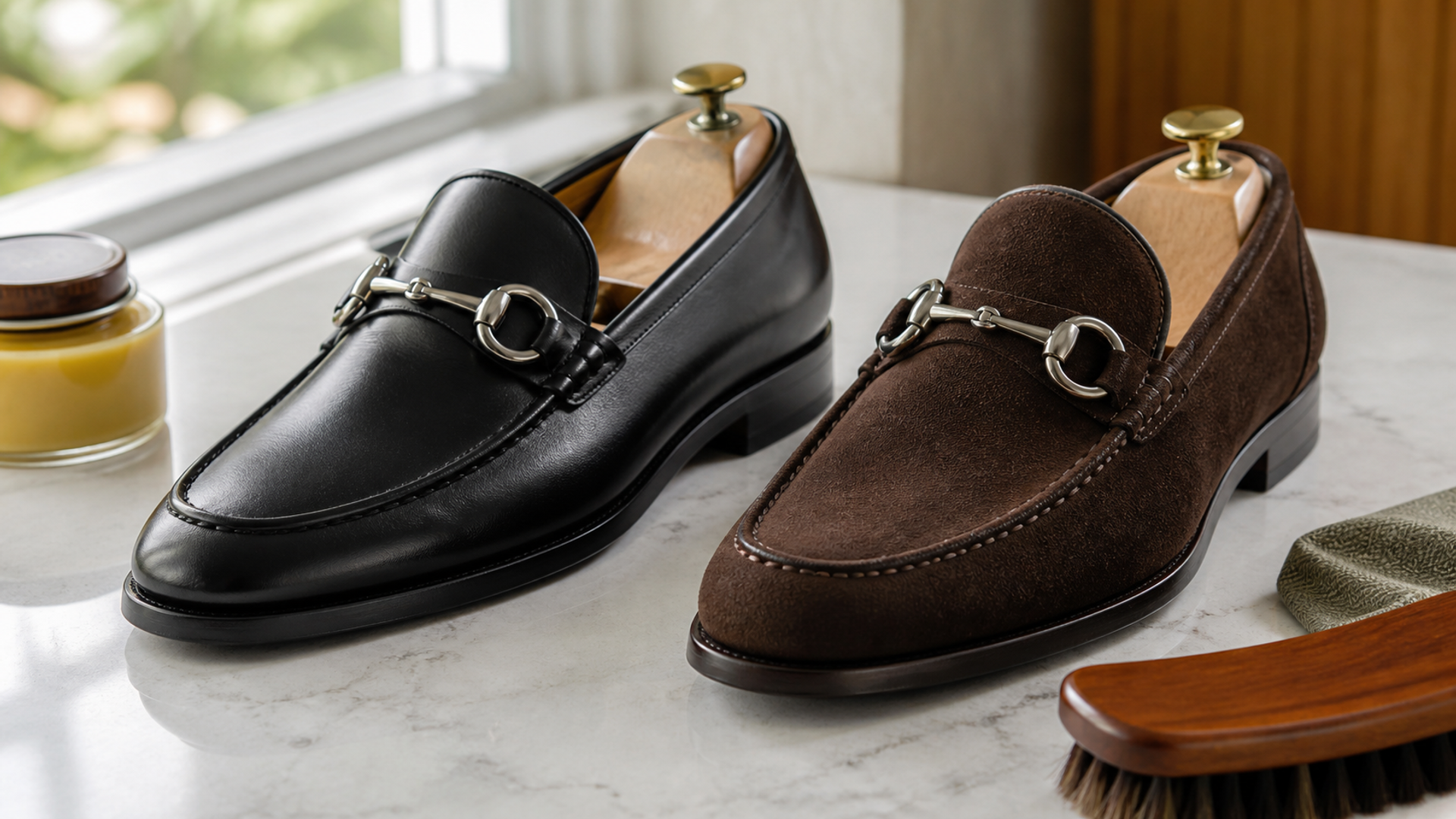
Gucci currently documents the Jordaan in the two materials required for this comparison. The dark brown suede Jordaan and black leather Jordaan share an elongated, streamlined outline, horsebit detail, Blake construction and leather sole on those specific pages. This gives the comparison a controlled base: the visible change is not simply a different colour placed on an unrelated shoe.
Smooth black leather creates a continuous surface with a clearer edge against tailored trousers. It tends to read as the more formal of these two specific variants because colour, shine and surface are restrained. Dark brown suede diffuses light and makes the same long shape feel less severe. It often connects more naturally with flannel, brushed cotton, denim and other textured fabrics.
Neither description establishes a winner. If most wears begin in a formal office, evening room or business setting, the leather option may cover more of the calendar. If the wardrobe is built around unstructured jackets, knitwear and relaxed trousers, suede may look intentional more often. Count the outfits and environments you actually use; do not buy a material for an imagined life.
Leather and suede change the ownership equation
The right comparison is not “Which upper is better?” It is “Which upper produces fewer conflicts in my use?” The table treats each answer as a test to run rather than a universal property.
| Decision factor | Smooth black leather Jordaan | Dark brown suede Jordaan | Evidence or test before buying |
|---|---|---|---|
| Visual register | Cleaner, sharper surface; easier to place at the formal end of smart dress | Softer, more textured surface; naturally relaxed | Try each under the trousers and lighting you use most |
| Product-page construction | Blake construction, horsebit, leather lining and leather sole on the cited style | Blake construction, horsebit and leather sole on the cited style | Confirm the exact regional style page at purchase |
| Weather planning | Still requires protection from rain under Gucci's guidance | Still requires protection from rain; visible nap adds another appearance variable | Check forecast and carry an alternative on exposed days |
| Marks and ageing | Creasing and surface marks can become prominent under reflected light | Nap can flatten, shade or show directional disturbance | Decide which form of visible change you accept |
| Routine care | Soft, dry cloth or brush within Gucci's stated guidance | Soft, dry brush is the conservative route within the same guidance | Do not improvise with water, creams or solvents |
| Wardrobe breadth | Strong with dark tailoring, formal separates and polished evening clothing | Strong with brown, cream, grey, denim and textured tailoring | Build at least five complete outfits before choosing |
| Travel role | Best when indoor formality justifies careful packing and dry routes | Best when relaxed texture justifies the same careful packing | Pack away from crushing and wet-weather exposure |
| Fit judgement | Must pass heel, instep and forefoot tests | Must pass the same tests; material does not waive poor hold | Compare equivalent sizes and socks in one session |
| Long-term value | Depends on actual wears, care and acceptable appearance change | Depends on the same variables, with a different ageing pattern | Keep a wear log rather than forecasting lifespan |
The table deliberately avoids “most durable” and “most comfortable”. Those conclusions require the buyer's foot, use and observation over time. A material can be theoretically practical yet become poor value if it rarely leaves the wardrobe.
Read fit as a three-point hold, not a size rule
A loafer has no laces to compensate for a weak match. The fit must therefore be read at three points: heel, instep and forefoot. The toes need usable space, but toe-room alone does not prove that the shoe is the correct size.
At the heel, distinguish slight movement in a new slip-on from obvious loss of control. Walk normally, turn, climb a step if the shop permits it and note whether the heel follows the foot or lifts independently. At the instep, the upper should hold the foot without concentrated pressure or numbness. At the forefoot, there should be no hard compression across the widest part of either foot.
Gucci's page tells buyers to wear the socks or tights intended for the shoe, stand on a flat surface, measure from heel to longest toe and measure both feet, using the longer foot as the size-guide reference. That is useful preparation, not a substitute for a fitting. Two feet with the same measured length can differ in width, volume and heel shape.
Do not shorten the shoe merely because the elongated toe looks visually empty. The design can extend beyond the toes while still fitting correctly at the ball and instep. Conversely, do not accept excessive heel movement because someone says all loafers do it. The observed hold matters more than internet folklore.
Perform a controlled fitting in five passes
First, measure both feet late enough in the day to reflect normal expansion, then use the brand's current regional chart. Record the larger length; do not silently convert between regional sizes.
Second, bring the socks you expect to wear. A fine dress sock and a thicker casual sock change volume. If both matter, test both and decide which use is dominant rather than averaging two poor fits.
Third, try the same candidate size in both materials where stock permits. Stand for several minutes, then walk on a clean indoor surface. Compare pressure, heel control and toe freedom; do not infer that suede or leather will necessarily solve a mismatch through break-in.
Fourth, test each foot independently. A comfortable left shoe does not cancel a pinched right forefoot. Reject pressure that is sharp, localised or alters your gait.
Fifth, recheck after removing and replacing the shoes. A loafer that only feels secure after unusually careful positioning may become irritating in ordinary use. If the result remains ambiguous, use an in-store appointment or a returnable fitting route and preserve the outsole condition and packaging under the applicable terms.
Expect different signs of wear
Long-term wear is a record of use, not an inherent ranking. Smooth leather commonly shows flex lines where the forefoot bends, plus scuffs at exposed edges. Suede can show changes in nap direction, flattened areas or colour variation. These are different visual languages of wear; the one you dislike most should influence the purchase before any claim about longevity.
The cited versions both use leather soles. Sole wear depends on gait, walking surface, moisture and frequency. Inspect the toe and heel after the first few outdoor wears, then at regular intervals. Uneven abrasion, loss of grip or damage should prompt a professional assessment. Do not assume that a construction label alone guarantees a particular repair, cost or number of resoles; Gucci states that care and repair enquiries begin with an evaluation.
Rotation matters because repeated wear exposes the same upper, lining and sole before moisture can dissipate. Alternating shoes also reveals whether the Jordaan is genuinely the best choice for the day instead of becoming the default through convenience. Record actual wears and interventions in a note: date, conditions, distance category, visible change, comfort and any professional work. That evidence is more useful than a promised lifespan.
Build care around exposure, not cosmetic panic
Gucci's shoe-care guide recommends a soft, dry cloth and warns against water, alcohol, acetone, corrosive substances, creams and soaps, including products marketed for the material. The product pages also advise protection from direct light, heat and rain; if the shoes become wet, they should be dried immediately with a soft cloth.
This makes prevention the sensible routine. Check the weather, avoid storing the shoes while damp and remove loose surface dust without aggressive rubbing. Gucci advises filling them with tissue paper to help preserve shape and absorb humidity, placing them in the supplied flannel bag and original box, and avoiding weight on top. Follow the instructions for the exact item rather than importing a generic internet treatment.
For suede, use the soft, dry brush conservatively and follow the nap rather than attacking one mark repeatedly. For leather, a soft, dry cloth is the bounded default in Gucci's published guidance. If a stain, finish change or structural problem persists, seek the brand's assessment instead of escalating through unverified chemicals.
Match the loafer to the wardrobe job
Create two columns of real outfits. Put suits, formal separates and evening combinations on one side; put flannel trousers, chinos, denim, knitwear and unstructured jackets on the other. Photograph the hem and shoe together from standing height. The correct material should make more complete outfits look deliberate, not merely look attractive on a product page.
The broader wardrobe principle is developed in this quiet-luxury and old-money style guide: coherence comes from proportion, material and repetition, not a single recognised object. The same ownership discipline appears in the cashmere-versus-wool comparison, where care and wearing conditions matter as much as a premium label.
If both Jordaan materials cover the same number of outfits, use environment as the tie-break. Frequent rain exposure, long outdoor routes or rough surfaces may make either leather-soled option a poor everyday default. A beautiful loafer that requires constant exception-making will struggle to earn wears.
Use cost per wear without predicting the future
Cost per wear should be calculated from evidence after purchase, not advertised as a promise beforehand:
Observed cost per wear = documented acquisition cost + actual care and repair spending − any realised recovery, divided by recorded wears.
Use the amount on the buyer's receipt and only costs that actually occur. Do not enter an assumed resale value, fixed repair schedule or optimistic lifetime. Review after 10, 25 and 50 wears if those milestones are reached. Alongside the number, note whether the shoe still serves its intended dress code and whether visible ageing remains acceptable.
This method can overturn the apparent material hierarchy. A suede pair worn twice as often may be the better ownership result despite a more delicate-looking surface. A leather pair that replaces several formal shoes may justify its role through breadth. Equally, either can be poor value if fit anxiety or weather concern keeps it boxed.
The material verdict
Choose smooth black leather for the more formal surface and clearer relationship with tailoring. Choose dark brown suede for texture, tonal dressing and a relaxed transition into smart-casual clothes. Then make both candidates pass the same fit test: secure heel, held instep, uncompressed forefoot and a stable walk in the intended socks.
Do not buy either on a universal size rule, a promise that one material lasts longer or an invented cost-per-wear projection. Confirm the exact style details, follow Gucci's dry-care and storage guidance, observe sole and upper wear, and let actual wardrobe use decide which Jordaan earns its place.