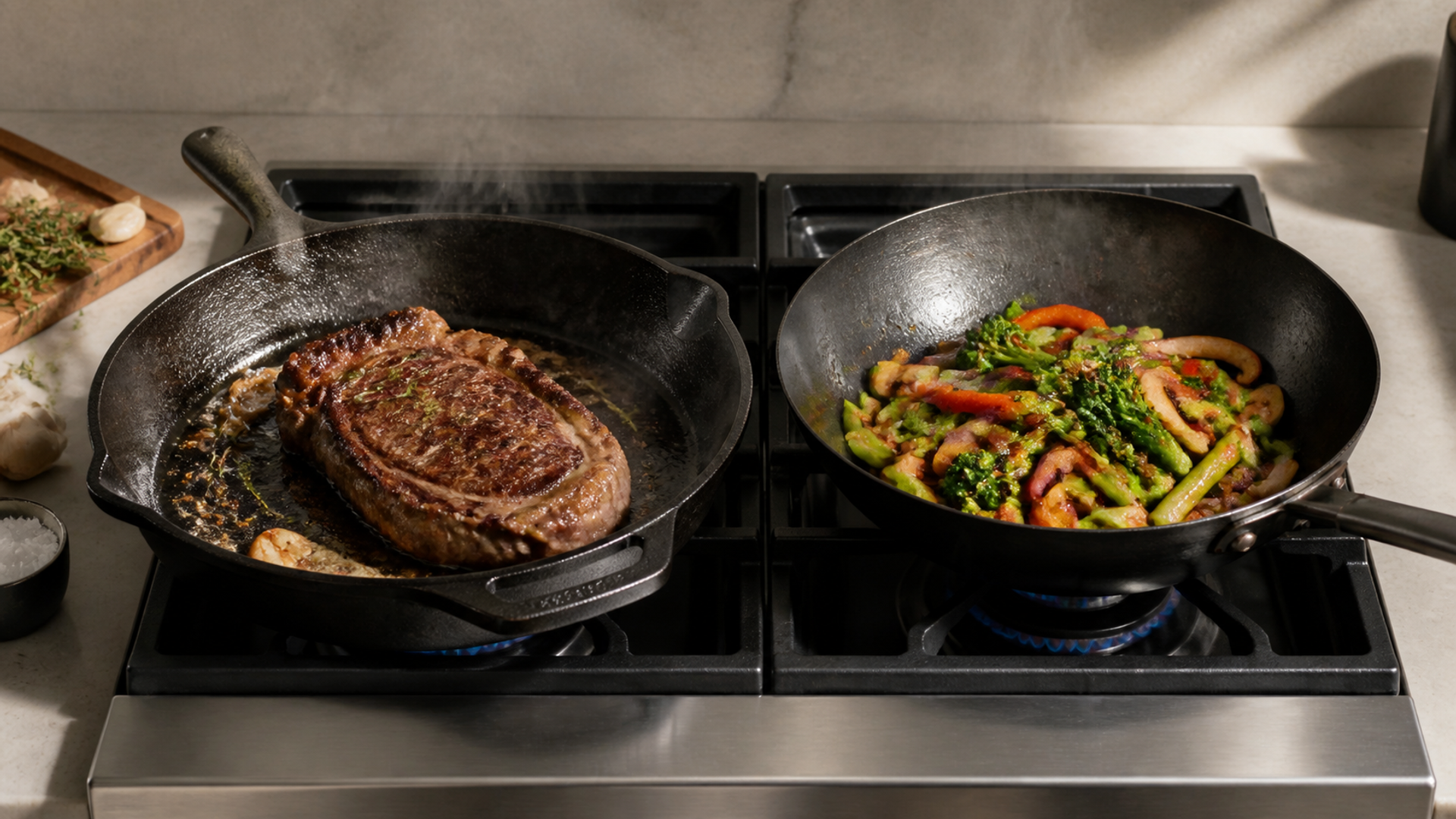
Cast iron and carbon steel skillets are both iron-rich cookware that can develop a seasoned surface, move from hob to oven and last for decades. Their most visible difference is usually construction and mass. Cast iron is commonly thicker and slower to respond but stores heat well; spun or stamped carbon steel is commonly thinner, lighter and quicker to change temperature. Those tendencies interact with diameter, handle, hob power, oven clearance and the cook's technique. The best pan is not the one with the strongest online mythology, but the one whose thermal behaviour and maintenance fit the food made most often.
Mass and response shape the cooking
Choose cast iron when heat storage, baking, hard searing and stability matter more than weight and speed. Choose carbon steel when quicker response, lower mass and active pan movement fit the cooking style. Keep both when one pan can own stationary high-heat and oven tasks while the other handles eggs, fish, crepes and rapid temperature changes after its seasoning is established.
| Decision factor | Cast iron | Carbon steel | Keep both for distinct jobs |
|---|---|---|---|
| Heat storage | High mass holds heat through a cold load | Lower mass recovers and changes faster | Match burner power and food mass |
| Weight | Can be heavy at useful diameter | Usually easier to lift and toss | Test one-handed handling |
| Seasoning | Builds with thin polymerised oil layers | Also needs thin, even seasoning | Follow the maker's care |
| Acidic food | Long acidic cooks can strip seasoning and add flavour | The same caution applies | Use another pan when necessary |
| Oven work | Excellent when handle and size fit | Often capable at rated temperature | Verify handle and coating |
| Response | Slow changes reward preheating control | Faster changes reward active heat control | Cook the same recipe twice |
This cast iron vs carbon steel skillet matrix is the article's working value object. Read the cast iron vs carbon steel skillet rows together: the decisive failure mode depends on this topic's evidence, operating context and reader objective.
Seasoning is a working surface
Evidence 1. Seasoning is a polymerised oil film built in thin layers; sticky, thick oil is not a stronger surface.
Evidence 2. Cast iron's greater mass commonly gives it more heat capacity, while thinner carbon steel commonly changes temperature faster.
Evidence 3. Both materials can rust when left wet and both need drying and a light protective film according to maker guidance.
Evidence 4. Surface condition, pan thickness, burner output and technique can matter more than the generic material name.
Reader-visible sources checked for this article:
fda.gov — reader-visible current or official evidence
lodgecastiron.com — reader-visible current or official evidence
For cast iron vs carbon steel skillet, these sources establish only the claims inside their documented scope. Recheck every changeable specification, availability condition, price, policy or service term in the relevant market before acting.
Use food tasks instead of folklore
On heat storage, popularity is not enough. The evidence for option one is that high mass holds heat through a cold load. Option two means lower mass recovers and changes faster. Option three is rational where match burner power and food mass. Recheck any changeable term immediately before commitment.
The decision changes at weight. Choose the first path only if can be heavy at useful diameter; move to the second when usually easier to lift and toss; use the third when test one-handed handling. Save the downside that would make this row fail.
For seasoning, the first route works when builds with thin polymerised oil layers; the second requires also needs thin, even seasoning. The control for the third is follow the maker's care. Verify this row against the exact product, property, account or environment before it can reverse the decision.
The acidic food row exposes a practical boundary. Route one assumes long acidic cooks can strip seasoning and add flavour, while route two is defensible only when the same caution applies. Route three depends on use another pan when necessary. If that evidence is absent, keep the more reversible option.
Read oven work as a stop/go test: excellent when handle and size fit supports the first option; often capable at rated temperature supports the second; and verify handle and coating supports the third. Record which source proves the condition and when it was checked.
A buyer can resolve response without starting from a brand preference. Ask whether slow changes reward preheating control; compare that with whether faster changes reward active heat control; then use cook the same recipe twice as the third route's safeguard. An unknown condition stays unknown.
Facts that would reverse the current choice
Reversal control 1 — Heat storage. Before choosing Cast iron, write down how the decision changes if “High mass holds heat through a cold load” proves false. Do the same for Carbon steel and “Lower mass recovers and changes faster”. Keep the Keep both for distinct jobs route available until “Match burner power and food mass” is verified. This control belongs to cast iron vs carbon steel skillet; update it from the cited source or exact supplier rather than copying a generic checklist.
Reversal control 2 — Weight. Before choosing Cast iron, write down how the decision changes if “Can be heavy at useful diameter” proves false. Do the same for Carbon steel and “Usually easier to lift and toss”. Keep the Keep both for distinct jobs route available until “Test one-handed handling” is verified. This control belongs to cast iron vs carbon steel skillet; update it from the cited source or exact supplier rather than copying a generic checklist.
Reversal control 3 — Seasoning. Before choosing Cast iron, write down how the decision changes if “Builds with thin polymerised oil layers” proves false. Do the same for Carbon steel and “Also needs thin, even seasoning”. Keep the Keep both for distinct jobs route available until “Follow the maker's care” is verified. This control belongs to cast iron vs carbon steel skillet; update it from the cited source or exact supplier rather than copying a generic checklist.
Reversal control 4 — Acidic food. Before choosing Cast iron, write down how the decision changes if “Long acidic cooks can strip seasoning and add flavour” proves false. Do the same for Carbon steel and “The same caution applies”. Keep the Keep both for distinct jobs route available until “Use another pan when necessary” is verified. This control belongs to cast iron vs carbon steel skillet; update it from the cited source or exact supplier rather than copying a generic checklist.
Reversal control 5 — Oven work. Before choosing Cast iron, write down how the decision changes if “Excellent when handle and size fit” proves false. Do the same for Carbon steel and “Often capable at rated temperature”. Keep the Keep both for distinct jobs route available until “Verify handle and coating” is verified. This control belongs to cast iron vs carbon steel skillet; update it from the cited source or exact supplier rather than copying a generic checklist.
Reversal control 6 — Response. Before choosing Cast iron, write down how the decision changes if “Slow changes reward preheating control” proves false. Do the same for Carbon steel and “Faster changes reward active heat control”. Keep the Keep both for distinct jobs route available until “Cook the same recipe twice” is verified. This control belongs to cast iron vs carbon steel skillet; update it from the cited source or exact supplier rather than copying a generic checklist.
Run a cold-load sear
Preheat each pan to the same measured surface temperature and add the same mass of food. Record temperature drop, recovery, crust and sticking. For this cast iron versus carbon steel skillet decision, record the exact item, environment, date, measurement and source in an evidence log. Separate observed behaviour from category shorthand, repeat the check under the conditions that matter, and price the downside of a wrong choice. If the lighter pan recovers on the actual burner just as well, reduce the value assigned to mass. When that condition appears, reopen the choice instead of defending the original preference.
Test active control
Cook eggs or delicate fish while changing heat at fixed times. Observe how quickly each pan responds and whether residual heat overcooks the food. For this cast iron versus carbon steel skillet decision, record the exact item, environment, date, measurement and source in an evidence log. Separate observed behaviour from category shorthand, repeat the check under the conditions that matter, and price the downside of a wrong choice. If the cook prefers slower stability, choose cast iron despite the weight. When that condition appears, reopen the choice instead of defending the original preference.
Build seasoning correctly
Clean, dry and apply extremely thin oil before controlled heating. Photograph the surface after several normal cooking cycles rather than chasing a cosmetic black finish. For this cast iron versus carbon steel skillet decision, record the exact item, environment, date, measurement and source in an evidence log. Separate observed behaviour from category shorthand, repeat the check under the conditions that matter, and price the downside of a wrong choice. If care is inconsistent across users, select cookware with a less demanding surface. When that condition appears, reopen the choice instead of defending the original preference.
Audit ergonomics
Lift, tilt, pour and transfer the loaded pan with the normal hand and oven glove. Check helper handle, edge, balance and cabinet storage. For this cast iron versus carbon steel skillet decision, record the exact item, environment, date, measurement and source in an evidence log. Separate observed behaviour from category shorthand, repeat the check under the conditions that matter, and price the downside of a wrong choice. If safe handling fails when full, choose the lighter or smaller pan. When that condition appears, reopen the choice instead of defending the original preference.
Separate pan roles
List searing, frying, baking, sauces, acidic braises and delicate foods by weekly frequency. Assign each task to the most suitable existing vessel. For this cast iron versus carbon steel skillet decision, record the exact item, environment, date, measurement and source in an evidence log. Separate observed behaviour from category shorthand, repeat the check under the conditions that matter, and price the downside of a wrong choice. If another pan already solves the task, avoid buying a duplicate material story. When that condition appears, reopen the choice instead of defending the original preference.
Four kitchens reveal four answers
Steak for several diners
Cast iron's stored heat can help when the burner is modest and food load is high. Define the fact that would reverse this recommendation before committing.
Crepes and rapid sauteing
Carbon steel's lower mass can make movement and heat changes easier. Define the fact that would reverse this recommendation before committing.
Outdoor cooking
Durability matters, but handle length, wind and uneven heat still need testing. Define the fact that would reverse this recommendation before committing.
Shared household kitchen
The pan whose care routine everyone follows will outperform the theoretically ideal surface. Define the fact that would reverse this recommendation before committing.
Action checklist
Measure diameter.
Check pan mass.
Check hob compatibility.
Check oven rating.
Inspect handle.
Test loaded lifting.
Run a sear.
Run a delicate-food test.
Learn thin seasoning.
Avoid soaking.
Plan acidic recipes.
Assign distinct pan roles.
Continue the decision
The linked VERTU articles expand adjacent parts of the cast iron vs carbon steel skillet decision. They do not substitute for the external evidence above.
The skillet-material verdict
Choose cast iron when heat storage, baking, hard searing and stability matter more than weight and speed. Choose carbon steel when quicker response, lower mass and active pan movement fit the cooking style. Keep both when one pan can own stationary high-heat and oven tasks while the other handles eggs, fish, crepes and rapid temperature changes after its seasoning is established.
Keep the cast iron vs carbon steel skillet decision reversible until its material cost, safety, access, privacy and compatibility facts are verified. Unknown evidence stays unknown; it is never silently scored as favourable.