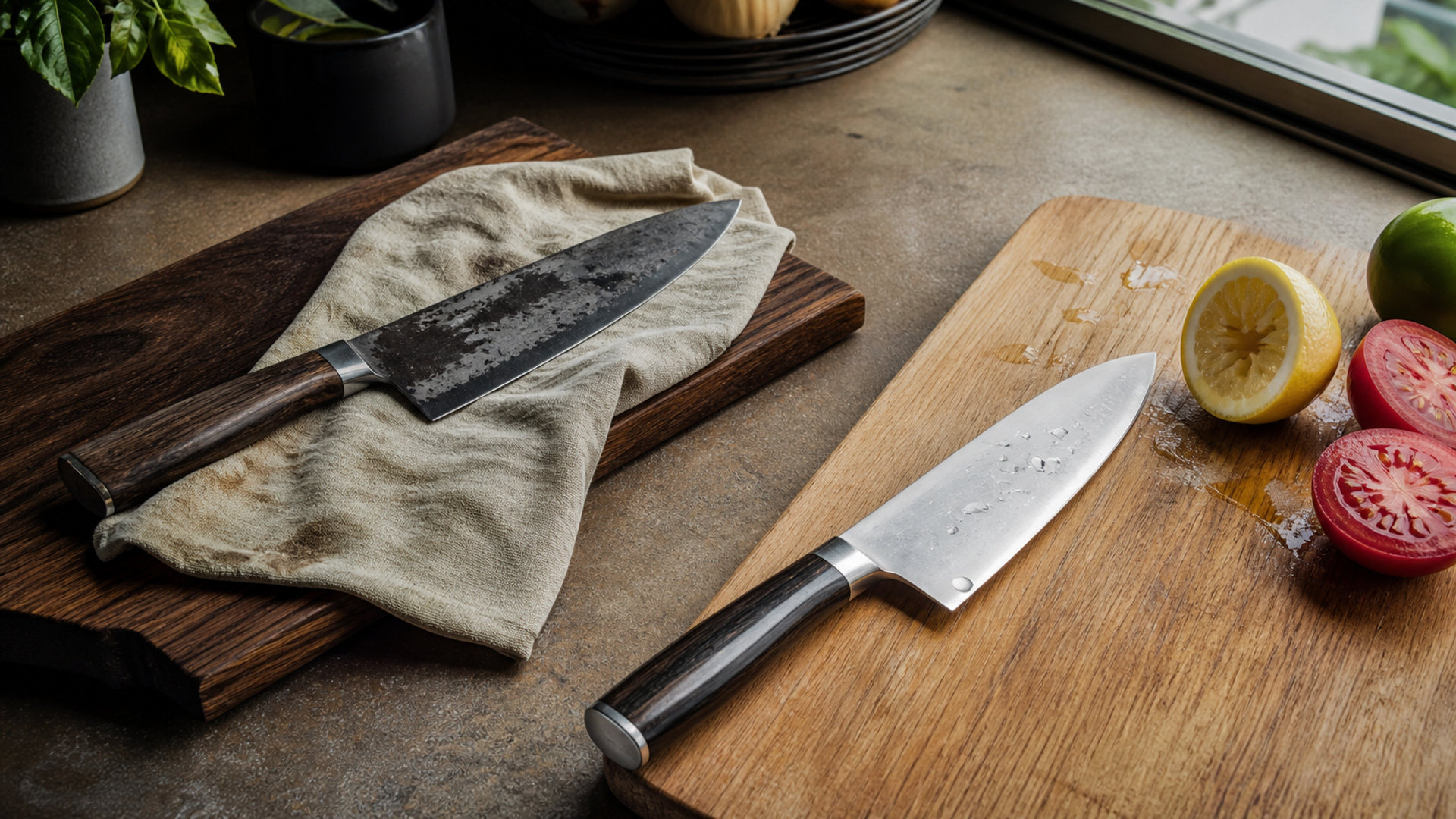
Carbon steel and stainless steel describe broad alloy families, not one hardness, edge angle or level of quality. A carbon blade can take a keen edge and develop a protective patina, yet it also asks for prompt cleaning and drying. A stainless blade contains enough chromium to resist corrosion more effectively, but stainless does not mean stain-proof or maintenance-free. Heat treatment, geometry, grind, hardness, handle, balance and sharpening matter at least as much as the family name.
Steel family is not the whole blade
Choose carbon steel when edge feel and straightforward sharpening justify immediate care and visible patina. Choose stainless steel when corrosion resistance, mixed users or a wet and acidic workflow matters more. Choose the exact alloy and geometry when performance is the priority, because a well-made stainless blade can outperform a poor carbon blade and vice versa.
| Decision factor | Carbon steel knife | Stainless steel knife | Choose the exact alloy and geometry |
|---|---|---|---|
| Corrosion | Needs prompt cleaning and drying | Resists corrosion more effectively | Verify the exact alloy |
| Edge | Can support a fine responsive edge | Range spans tough to highly wear-resistant | Judge heat treatment and geometry |
| Sharpening | Often straightforward by exact steel | Some alloys can be slower to abrade | Match stones and skill |
| Patina | Normal controlled patina can develop | Usually changes less visibly | Distinguish patina from active rust |
| Workflow | Rewards one careful owner | Can suit shared busy kitchens | Set a maintenance routine |
| Value | Craft and steel story may carry a premium | Broad price and quality range | Inspect fit, grind and repairability |
This carbon steel vs stainless steel knife matrix is the article's working value object. Read the carbon steel vs stainless steel knife rows together: the decisive failure mode depends on this topic's evidence, operating context and reader objective.
Corrosion resistance trades against care
Evidence 1. Stainless steel is an alloy family whose chromium content creates improved corrosion resistance; it is not absolutely immune to staining or rust.
Evidence 2. Knife manufacturers distinguish blade types by use, geometry and construction in addition to steel family.
Evidence 3. Hardness alone does not establish edge quality because heat treatment, carbide structure, thickness and sharpening angle affect use.
Evidence 4. Dishwashers, prolonged moisture, harsh chemicals and poor storage can damage both blade families and handles.
Reader-visible sources checked for this article:
zwilling.com — reader-visible current or official evidence
zwilling.com — reader-visible current or official evidence
britannica.com — reader-visible current or official evidence
For carbon steel vs stainless steel knife, these sources establish only the claims inside their documented scope. Recheck every changeable specification, availability condition, price, policy or service term in the relevant market before acting.
Test edge and maintenance together
On corrosion, popularity is not enough. The evidence for option one is that needs prompt cleaning and drying. Option two means resists corrosion more effectively. Option three is rational where verify the exact alloy. Recheck any changeable term immediately before commitment.
The decision changes at edge. Choose the first path only if can support a fine responsive edge; move to the second when range spans tough to highly wear-resistant; use the third when judge heat treatment and geometry. Save the downside that would make this row fail.
For sharpening, the first route works when often straightforward by exact steel; the second requires some alloys can be slower to abrade. The control for the third is match stones and skill. Verify this row against the exact product, property, account or environment before it can reverse the decision.
The patina row exposes a practical boundary. Route one assumes normal controlled patina can develop, while route two is defensible only when usually changes less visibly. Route three depends on distinguish patina from active rust. If that evidence is absent, keep the more reversible option.
Read workflow as a stop/go test: rewards one careful owner supports the first option; can suit shared busy kitchens supports the second; and set a maintenance routine supports the third. Record which source proves the condition and when it was checked.
A buyer can resolve value without starting from a brand preference. Ask whether craft and steel story may carry a premium; compare that with whether broad price and quality range; then use inspect fit, grind and repairability as the third route's safeguard. An unknown condition stays unknown.
Facts that would reverse the current choice
Reversal control 1 — Corrosion. Before choosing Carbon steel knife, write down how the decision changes if “Needs prompt cleaning and drying” proves false. Do the same for Stainless steel knife and “Resists corrosion more effectively”. Keep the Choose the exact alloy and geometry route available until “Verify the exact alloy” is verified. This control belongs to carbon steel vs stainless steel knife; update it from the cited source or exact supplier rather than copying a generic checklist.
Reversal control 2 — Edge. Before choosing Carbon steel knife, write down how the decision changes if “Can support a fine responsive edge” proves false. Do the same for Stainless steel knife and “Range spans tough to highly wear-resistant”. Keep the Choose the exact alloy and geometry route available until “Judge heat treatment and geometry” is verified. This control belongs to carbon steel vs stainless steel knife; update it from the cited source or exact supplier rather than copying a generic checklist.
Reversal control 3 — Sharpening. Before choosing Carbon steel knife, write down how the decision changes if “Often straightforward by exact steel” proves false. Do the same for Stainless steel knife and “Some alloys can be slower to abrade”. Keep the Choose the exact alloy and geometry route available until “Match stones and skill” is verified. This control belongs to carbon steel vs stainless steel knife; update it from the cited source or exact supplier rather than copying a generic checklist.
Reversal control 4 — Patina. Before choosing Carbon steel knife, write down how the decision changes if “Normal controlled patina can develop” proves false. Do the same for Stainless steel knife and “Usually changes less visibly”. Keep the Choose the exact alloy and geometry route available until “Distinguish patina from active rust” is verified. This control belongs to carbon steel vs stainless steel knife; update it from the cited source or exact supplier rather than copying a generic checklist.
Reversal control 5 — Workflow. Before choosing Carbon steel knife, write down how the decision changes if “Rewards one careful owner” proves false. Do the same for Stainless steel knife and “Can suit shared busy kitchens”. Keep the Choose the exact alloy and geometry route available until “Set a maintenance routine” is verified. This control belongs to carbon steel vs stainless steel knife; update it from the cited source or exact supplier rather than copying a generic checklist.
Reversal control 6 — Value. Before choosing Carbon steel knife, write down how the decision changes if “Craft and steel story may carry a premium” proves false. Do the same for Stainless steel knife and “Broad price and quality range”. Keep the Choose the exact alloy and geometry route available until “Inspect fit, grind and repairability” is verified. This control belongs to carbon steel vs stainless steel knife; update it from the cited source or exact supplier rather than copying a generic checklist.
Identify the exact blade
Record maker, model, alloy, hardness range, grind, edge angle, thickness, weight and handle. Reject comparisons that name only carbon or stainless. For this carbon steel versus stainless steel knife decision, record the exact item, place, date, measurement and source in the evidence log. Keep observations separate from category shorthand, repeat the check in the environment that matters, and price the downside of a wrong choice. If the specification is vague but carries a premium, lower confidence in the purchase. When that condition appears, reopen the choice instead of defending the original preference.
Run a prep trial
Use the foods actually prepared: herbs, onions, squash, meat and acidic produce. Score steering, wedging, release, comfort and fatigue instead of sharpness alone. For this carbon steel versus stainless steel knife decision, record the exact item, place, date, measurement and source in the evidence log. Keep observations separate from category shorthand, repeat the check in the environment that matters, and price the downside of a wrong choice. If geometry causes poor cutting, changing steel family will not fix the blade. When that condition appears, reopen the choice instead of defending the original preference.
Test the care routine
Clean and dry immediately for a week and observe patina, spotting and handle behaviour. Store so the edge stays dry and protected. For this carbon steel versus stainless steel knife decision, record the exact item, place, date, measurement and source in the evidence log. Keep observations separate from category shorthand, repeat the check in the environment that matters, and price the downside of a wrong choice. If the household cannot maintain the routine, choose the more forgiving blade. When that condition appears, reopen the choice instead of defending the original preference.
Sharpen and deburr
Use suitable abrasives, keep angle consistent and test for a clean apex and burr removal. Record time, stone wear and edge retention in normal use. For this carbon steel versus stainless steel knife decision, record the exact item, place, date, measurement and source in the evidence log. Keep observations separate from category shorthand, repeat the check in the environment that matters, and price the downside of a wrong choice. If sharpening support is unavailable, choose a serviceable local ecosystem. When that condition appears, reopen the choice instead of defending the original preference.
Inspect condition and repair
Check chips, bends, overgrinding, handle gaps and active rust before buying used. Price thinning, rehandling and professional sharpening. For this carbon steel versus stainless steel knife decision, record the exact item, place, date, measurement and source in the evidence log. Keep observations separate from category shorthand, repeat the check in the environment that matters, and price the downside of a wrong choice. If repair erases the value advantage, choose a sounder knife. When that condition appears, reopen the choice instead of defending the original preference.
Four kitchens, four answers
Enthusiast home cook
Carbon steel can reward a careful owner who enjoys sharpening and patina. Define the fact that would reverse this recommendation before committing.
Shared family kitchen
A robust stainless blade can tolerate inconsistent handling better. Define the fact that would reverse this recommendation before committing.
Professional wet station
Corrosion resistance and easy sanitation may dominate the decision. Define the fact that would reverse this recommendation before committing.
Collector purchase
Maker, heat treatment, grind and provenance matter more than a generic steel label. Define the fact that would reverse this recommendation before committing.
Action checklist
Identify exact alloy.
Check heat treatment.
Measure blade geometry.
Test handle fit.
Cut real ingredients.
Inspect corrosion.
Plan cleaning.
Plan storage.
Choose abrasives.
Test sharpening.
Check repair access.
Write the maintenance failure point.
Continue the decision
The linked VERTU articles expand adjacent parts of the carbon steel vs stainless steel knife decision. They do not substitute for the external evidence above.
The carbon-versus-stainless knife verdict
Choose carbon steel when edge feel and straightforward sharpening justify immediate care and visible patina. Choose stainless steel when corrosion resistance, mixed users or a wet and acidic workflow matters more. Choose the exact alloy and geometry when performance is the priority, because a well-made stainless blade can outperform a poor carbon blade and vice versa.
Keep the carbon steel vs stainless steel knife decision reversible until its material cost, safety, access, privacy and compatibility facts are verified. Unknown evidence stays unknown; it is never silently scored as favourable.