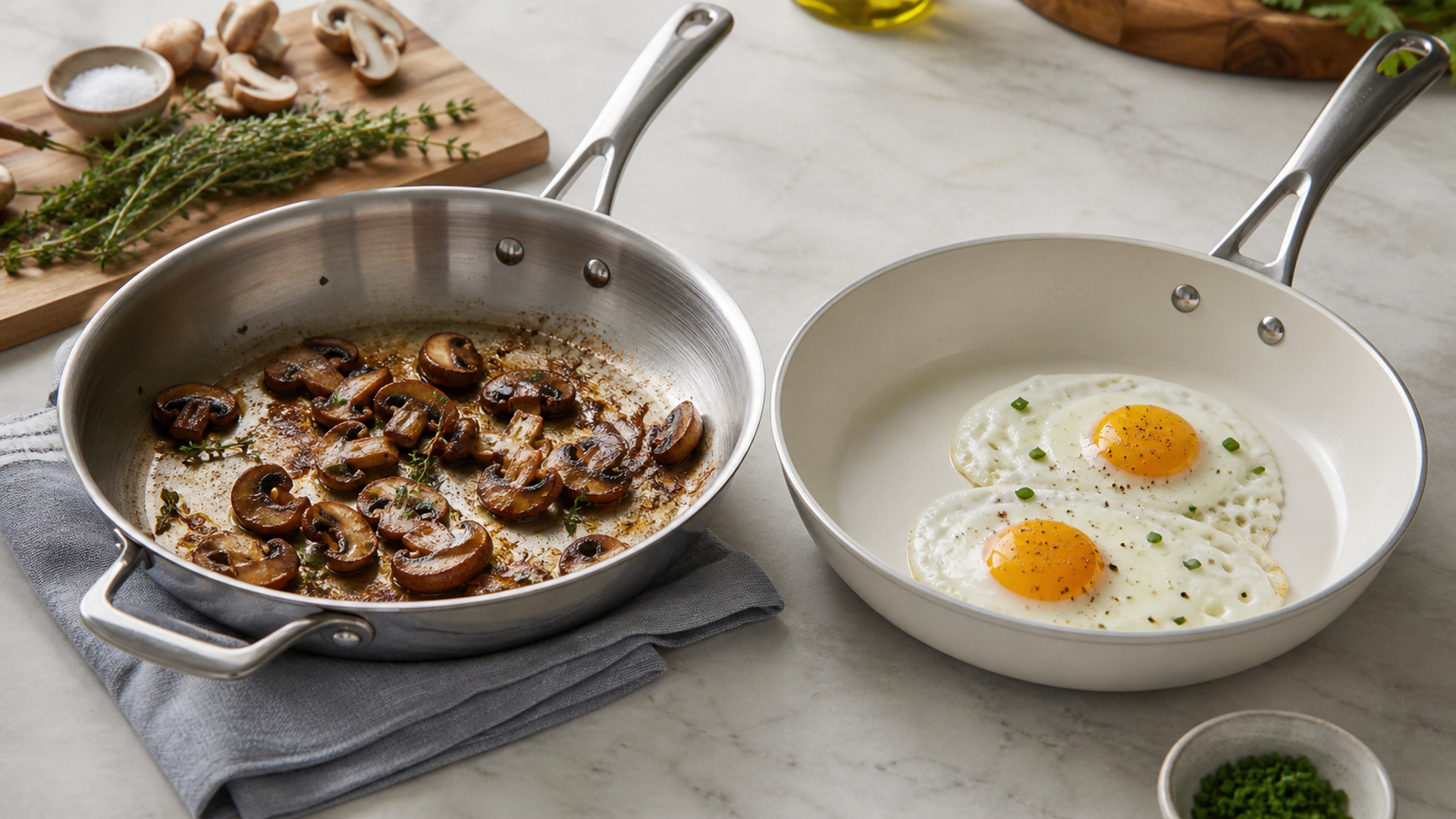
Stainless steel versus ceramic cookware is not a simple durable-versus-non-stick contest. Stainless cooking surfaces can tolerate browning, deglazing and long ownership when construction is sound, but they demand heat and fat control. Ceramic-coated pans can release delicate food easily when new and used at suitable temperatures, yet the coating is a consumable surface whose performance depends on care. Base construction, handle, weight, oven limit and service matter alongside the top layer.
Start with cooking technique
Choose stainless steel for searing, fond, oven versatility and a surface intended for long use. Choose ceramic-coated cookware for lower-stick tasks when gentle heat and careful utensils fit the routine. Use a mixed set when one stainless sauté pan and one replaceable ceramic skillet cover distinct jobs better than a single material promise.
| Decision factor | Stainless steel | Ceramic-coated cookware | Use a mixed set |
|---|---|---|---|
| Searing | High-heat browning and fond are priorities | Delicate release is the priority | Use separate pans |
| Learning curve | Preheat and fat control are acceptable | Easy initial release reduces friction | Practise one recipe |
| Durability | A non-coated surface suits long ownership | Coating replacement is budgeted | Limit ceramic to gentle work |
| Care | Deglazing and approved scrubbing fit | Low heat and soft utensils fit | Follow each manual |
| Weight | Clad construction remains manageable | A lighter pan is easier | Test filled weight |
| Value | Service life justifies purchase | Convenience justifies periodic replacement | Buy fewer task-specific pieces |
This stainless steel vs ceramic cookware matrix is the article's working value object. Read the stainless steel vs ceramic cookware rows together: the decisive failure mode depends on this topic's evidence, operating context and reader objective.
How the surfaces behave
Evidence 1. Made In distinguishes uncoated stainless steel from ceramic cookware that uses a non-stick coating over a metal body.
Evidence 2. The maker advises low-to-medium heat, suitable utensils and careful cleaning for ceramic-coated pans.
Evidence 3. Stainless steel performance depends on construction, preheating, food moisture and fat rather than the alloy name alone.
Evidence 4. A damaged or worn coating cannot be restored by aggressive seasoning or cleaning; follow the exact maker's replacement guidance.
Reader-visible sources checked for this article:
madeincookware.com — reader-visible current or official evidence
madeincookware.com — reader-visible current or official evidence
For stainless steel vs ceramic cookware, these sources establish only the claims inside their documented scope. Recheck every changeable specification, availability condition, price, policy or service term in the relevant market before acting.
Test care, heat and replacement risk
A buyer can resolve searing without starting from a brand preference. Ask whether high-heat browning and fond are priorities; compare that with whether delicate release is the priority; then use use separate pans as the third route's safeguard. An unknown condition stays unknown.
On learning curve, popularity is not enough. The evidence for option one is that preheat and fat control are acceptable. Option two means easy initial release reduces friction. Option three is rational where practise one recipe. Recheck any changeable term immediately before commitment.
The decision changes at durability. Choose the first path only if a non-coated surface suits long ownership; move to the second when coating replacement is budgeted; use the third when limit ceramic to gentle work. Save the downside that would make this row fail.
For care, the first route works when deglazing and approved scrubbing fit; the second requires low heat and soft utensils fit. The control for the third is follow each manual. Verify this row against the exact product, property, account or environment before it can reverse the decision.
The weight row exposes a practical boundary. Route one assumes clad construction remains manageable, while route two is defensible only when a lighter pan is easier. Route three depends on test filled weight. If that evidence is absent, keep the more reversible option.
Read value as a stop/go test: service life justifies purchase supports the first option; convenience justifies periodic replacement supports the second; and buy fewer task-specific pieces supports the third. Record which source proves the condition and when it was checked.
Facts that would reverse the current choice
Reversal control 1 — Searing. Before choosing Stainless steel, write down how the decision changes if “High-heat browning and fond are priorities” proves false. Do the same for Ceramic-coated cookware and “Delicate release is the priority”. Keep the Use a mixed set route available until “Use separate pans” is verified. This control belongs to stainless steel vs ceramic cookware; update it from the cited source or exact supplier rather than copying a generic checklist.
Reversal control 2 — Learning curve. Before choosing Stainless steel, write down how the decision changes if “Preheat and fat control are acceptable” proves false. Do the same for Ceramic-coated cookware and “Easy initial release reduces friction”. Keep the Use a mixed set route available until “Practise one recipe” is verified. This control belongs to stainless steel vs ceramic cookware; update it from the cited source or exact supplier rather than copying a generic checklist.
Reversal control 3 — Durability. Before choosing Stainless steel, write down how the decision changes if “A non-coated surface suits long ownership” proves false. Do the same for Ceramic-coated cookware and “Coating replacement is budgeted”. Keep the Use a mixed set route available until “Limit ceramic to gentle work” is verified. This control belongs to stainless steel vs ceramic cookware; update it from the cited source or exact supplier rather than copying a generic checklist.
Reversal control 4 — Care. Before choosing Stainless steel, write down how the decision changes if “Deglazing and approved scrubbing fit” proves false. Do the same for Ceramic-coated cookware and “Low heat and soft utensils fit”. Keep the Use a mixed set route available until “Follow each manual” is verified. This control belongs to stainless steel vs ceramic cookware; update it from the cited source or exact supplier rather than copying a generic checklist.
Reversal control 5 — Weight. Before choosing Stainless steel, write down how the decision changes if “Clad construction remains manageable” proves false. Do the same for Ceramic-coated cookware and “A lighter pan is easier”. Keep the Use a mixed set route available until “Test filled weight” is verified. This control belongs to stainless steel vs ceramic cookware; update it from the cited source or exact supplier rather than copying a generic checklist.
Reversal control 6 — Value. Before choosing Stainless steel, write down how the decision changes if “Service life justifies purchase” proves false. Do the same for Ceramic-coated cookware and “Convenience justifies periodic replacement”. Keep the Use a mixed set route available until “Buy fewer task-specific pieces” is verified. This control belongs to stainless steel vs ceramic cookware; update it from the cited source or exact supplier rather than copying a generic checklist.
Audit actual dishes
Review a month of eggs, fish, pancakes, sauces, steaks and acidic braises. Mark which need easy release and which benefit from browning and deglazing. Record the exact model, recipe, room, climate, material or operating condition and the time of the check. Separate observed behaviour from a marketing label, and repeat the test in the intended setting rather than under ideal showroom conditions. If most tasks are gentle, one ceramic pan may help; if fond drives flavour, stainless should lead. Save the evidence that would reverse the choice, because a change in fit, specification, maintenance, service, price or environment must reopen the decision rather than inherit an old conclusion.
Test thermal control
Preheat the exact pan gradually and learn the burner setting that avoids scorching. Use equal food temperature, dryness and fat before judging sticking. Record the exact model, recipe, room, climate, material or operating condition and the time of the check. Separate observed behaviour from a marketing label, and repeat the test in the intended setting rather than under ideal showroom conditions. If the stove has hot spots or an oversized element, correct that system before replacing cookware. Save the evidence that would reverse the choice, because a change in fit, specification, maintenance, service, price or environment must reopen the decision rather than inherit an old conclusion.
Model surface life
Inspect coating instructions, utensil limits, dishwasher advice and signs that require retirement. Price expected replacement and keep metal tools away where prohibited. Record the exact model, recipe, room, climate, material or operating condition and the time of the check. Separate observed behaviour from a marketing label, and repeat the test in the intended setting rather than under ideal showroom conditions. If the household will use high heat and abrasive cleaning, do not assume ceramic performance will persist. Save the evidence that would reverse the choice, because a change in fit, specification, maintenance, service, price or environment must reopen the decision rather than inherit an old conclusion.
Assess construction
Check flatness, induction compatibility, handle security, oven limits, lid fit and filled balance. Compare warranty scope for warping, handle failure and coating wear rather than relying on a lifetime headline. Record the exact model, recipe, room, climate, material or operating condition and the time of the check. Separate observed behaviour from a marketing label, and repeat the test in the intended setting rather than under ideal showroom conditions. If the complete pan is awkward or unsupported, the surface advantage will not produce daily use. Save the evidence that would reverse the choice, because a change in fit, specification, maintenance, service, price or environment must reopen the decision rather than inherit an old conclusion.
Three cooks, three answers
Frequent steak and pan sauce
Stainless steel supports searing and deglazing. Define the fact that would reverse this recommendation before committing.
Morning eggs on moderate heat
A cared-for ceramic pan can reduce sticking. Define the fact that would reverse this recommendation before committing.
Small premium kitchen
A mixed two-pan strategy can outperform a large matching set. Define the fact that would reverse this recommendation before committing.
Action checklist
List dishes.
Check stove type.
Test filled weight.
Read heat limit.
Verify utensils.
Compare warranties.
Budget replacement.
Practise preheating.
Inspect flatness.
Buy task by task.
Continue the decision
The linked VERTU articles expand adjacent parts of the stainless steel vs ceramic cookware decision. They do not substitute for the external evidence above.
The cookware verdict
Choose stainless steel for searing, fond, oven versatility and a surface intended for long use. Choose ceramic-coated cookware for lower-stick tasks when gentle heat and careful utensils fit the routine. Use a mixed set when one stainless sauté pan and one replaceable ceramic skillet cover distinct jobs better than a single material promise.
Keep the stainless steel vs ceramic cookware decision reversible until its material cost, safety, access, privacy and compatibility facts are verified. Unknown evidence stays unknown; it is never silently scored as favourable.