The most luxurious towel is not automatically the heaviest or softest one on a shop shelf. A useful bath towel has to absorb water, release it again, survive repeated laundering and fit the climate, bathroom ventilation and household routine. Fibre disclosure and construction explain more than invented collection names, while weight is only meaningful when considered with pile, size and drying conditions.
Define the towel's daily job
Choose a dense, well-finished cotton terry towel when plush hand feel and absorbency matter and the bathroom has enough time and airflow to dry it. Choose a lighter towel when rapid drying, frequent washing, humid weather or limited ventilation dominates. Verify the named fibre and percentage, inspect loop consistency and hems, and compare the laundering burden of the full towel—not a fabric swatch.
| Decision factor | Plush cotton terry | Fast-drying lighter towel | Purpose-specific mixed set |
|---|---|---|---|
| Fibre disclosure | Named cotton fibre and percentage are clear | Generic fibre and percentage are still explicit | Each towel type is labelled rather than implied |
| Finished weight | Bathroom and laundry can handle a heavier wet item | Moderate mass supports quicker water release | Weight changes by bath, hair and guest role |
| Pile construction | Dense, even loops survive normal snag risk | Shorter or lower pile favours throughput | Construction is selected by use rather than matched decor |
| Drying route | Wide rail and ventilation are available | Hook, travel or humid-room constraints dominate | Heavy towels stay in the ventilated bathroom only |
| Laundry load | Fewer towels per cycle is acceptable | Frequent efficient loads are required | Household separates everyday and occasion use |
| Ownership evidence | Sample remains stable after several washes | Sample releases odour and dries predictably | Each type has a measured replacement trigger |
| Claim control | Place and quality terms are supported by disclosure | Bamboo-derived fibre is named accurately | No set relies on unverified sustainability language |
This best bath towels matrix is the article's working value object. Read the best bath towels rows together: the decisive failure mode depends on this topic's evidence, operating context and reader objective.
Read the fibre claim before the marketing story
Evidence 1. The US Federal Trade Commission Textile Fiber Products Identification Act rules require covered textile products to disclose generic fibre names and percentages, the responsible business identity and country of origin within the rule's scope.
Evidence 2. The FTC warns that textiles described as bamboo are commonly rayon or viscose made from bamboo unless the fibre itself is directly made from bamboo, so an environmental or fibre claim should be read precisely.
Evidence 3. GSM expresses mass per square metre, but two towels with the same GSM can feel and perform differently because yarn, twist, loop height, density, finishing and size differ.
Evidence 4. Drying performance is a system outcome involving towel mass, room humidity, airflow, hanging area and washing extraction; a single absorbency claim cannot predict it.
Reader-visible sources checked for this article:
ftc.gov — reader-visible current or official evidence
consumer.ftc.gov — reader-visible current or official evidence
For best bath towels, these sources establish only the claims inside their documented scope. Recheck every changeable specification, availability condition, price, policy or service term in the relevant market before acting.
Balance water pickup with water release
Read fibre disclosure as a stop/go test: named cotton fibre and percentage are clear supports the first option; generic fibre and percentage are still explicit supports the second; and each towel type is labelled rather than implied supports the third. Record which source proves the condition and when it was checked.
A buyer can resolve finished weight without starting from a brand preference. Ask whether bathroom and laundry can handle a heavier wet item; compare that with whether moderate mass supports quicker water release; then use weight changes by bath, hair and guest role as the third route's safeguard. An unknown condition stays unknown.
On pile construction, popularity is not enough. The evidence for option one is that dense, even loops survive normal snag risk. Option two means shorter or lower pile favours throughput. Option three is rational where construction is selected by use rather than matched decor. Recheck any changeable term immediately before commitment.
The decision changes at drying route. Choose the first path only if wide rail and ventilation are available; move to the second when hook, travel or humid-room constraints dominate; use the third when heavy towels stay in the ventilated bathroom only. Save the downside that would make this row fail.
For laundry load, the first route works when fewer towels per cycle is acceptable; the second requires frequent efficient loads are required. The control for the third is household separates everyday and occasion use. Verify this row against the exact product, property, account or environment before it can reverse the decision.
The ownership evidence row exposes a practical boundary. Route one assumes sample remains stable after several washes, while route two is defensible only when sample releases odour and dries predictably. Route three depends on each type has a measured replacement trigger. If that evidence is absent, keep the more reversible option.
Read claim control as a stop/go test: place and quality terms are supported by disclosure supports the first option; bamboo-derived fibre is named accurately supports the second; and no set relies on unverified sustainability language supports the third. Record which source proves the condition and when it was checked.
Facts that would reverse the current choice
Reversal control 1 — Fibre disclosure. Before choosing Plush cotton terry, write down how the decision changes if “Named cotton fibre and percentage are clear” proves false. Do the same for Fast-drying lighter towel and “Generic fibre and percentage are still explicit”. Keep the Purpose-specific mixed set route available until “Each towel type is labelled rather than implied” is verified. This control belongs to best bath towels; update it from the cited source or exact supplier rather than copying a generic checklist.
Reversal control 2 — Finished weight. Before choosing Plush cotton terry, write down how the decision changes if “Bathroom and laundry can handle a heavier wet item” proves false. Do the same for Fast-drying lighter towel and “Moderate mass supports quicker water release”. Keep the Purpose-specific mixed set route available until “Weight changes by bath, hair and guest role” is verified. This control belongs to best bath towels; update it from the cited source or exact supplier rather than copying a generic checklist.
Reversal control 3 — Pile construction. Before choosing Plush cotton terry, write down how the decision changes if “Dense, even loops survive normal snag risk” proves false. Do the same for Fast-drying lighter towel and “Shorter or lower pile favours throughput”. Keep the Purpose-specific mixed set route available until “Construction is selected by use rather than matched decor” is verified. This control belongs to best bath towels; update it from the cited source or exact supplier rather than copying a generic checklist.
Reversal control 4 — Drying route. Before choosing Plush cotton terry, write down how the decision changes if “Wide rail and ventilation are available” proves false. Do the same for Fast-drying lighter towel and “Hook, travel or humid-room constraints dominate”. Keep the Purpose-specific mixed set route available until “Heavy towels stay in the ventilated bathroom only” is verified. This control belongs to best bath towels; update it from the cited source or exact supplier rather than copying a generic checklist.
Reversal control 5 — Laundry load. Before choosing Plush cotton terry, write down how the decision changes if “Fewer towels per cycle is acceptable” proves false. Do the same for Fast-drying lighter towel and “Frequent efficient loads are required”. Keep the Purpose-specific mixed set route available until “Household separates everyday and occasion use” is verified. This control belongs to best bath towels; update it from the cited source or exact supplier rather than copying a generic checklist.
Reversal control 6 — Ownership evidence. Before choosing Plush cotton terry, write down how the decision changes if “Sample remains stable after several washes” proves false. Do the same for Fast-drying lighter towel and “Sample releases odour and dries predictably”. Keep the Purpose-specific mixed set route available until “Each type has a measured replacement trigger” is verified. This control belongs to best bath towels; update it from the cited source or exact supplier rather than copying a generic checklist.
Reversal control 7 — Claim control. Before choosing Plush cotton terry, write down how the decision changes if “Place and quality terms are supported by disclosure” proves false. Do the same for Fast-drying lighter towel and “Bamboo-derived fibre is named accurately”. Keep the Purpose-specific mixed set route available until “No set relies on unverified sustainability language” is verified. This control belongs to best bath towels; update it from the cited source or exact supplier rather than copying a generic checklist.
Start with fibre disclosure
Read the sewn label and product specification for the generic fibre name and percentage. 'Cotton feel', 'hotel quality' and place names do not replace disclosure. Long-staple claims may describe a cotton source or grade, but they still do not reveal loop density, twist or finishing. If a product is sold as bamboo, distinguish the source plant from the manufactured fibre name. This is not pedantry: fibre chemistry affects care, hand feel and how honestly competing towels can be compared.
Use GSM as a load indicator, not a quality score
A high-GSM bath sheet contains much more wet textile than a moderate-GSM bath towel. That can feel enveloping, but it also occupies more washer volume, takes longer to tumble and holds more water in a humid bathroom. Compare finished dimensions and estimate the number of towels per laundry load. A lighter, tightly made towel may outlast a very lofty towel whose loops snag and whose borders distort after repeated hot cycles.
Inspect loops, ground cloth and edges
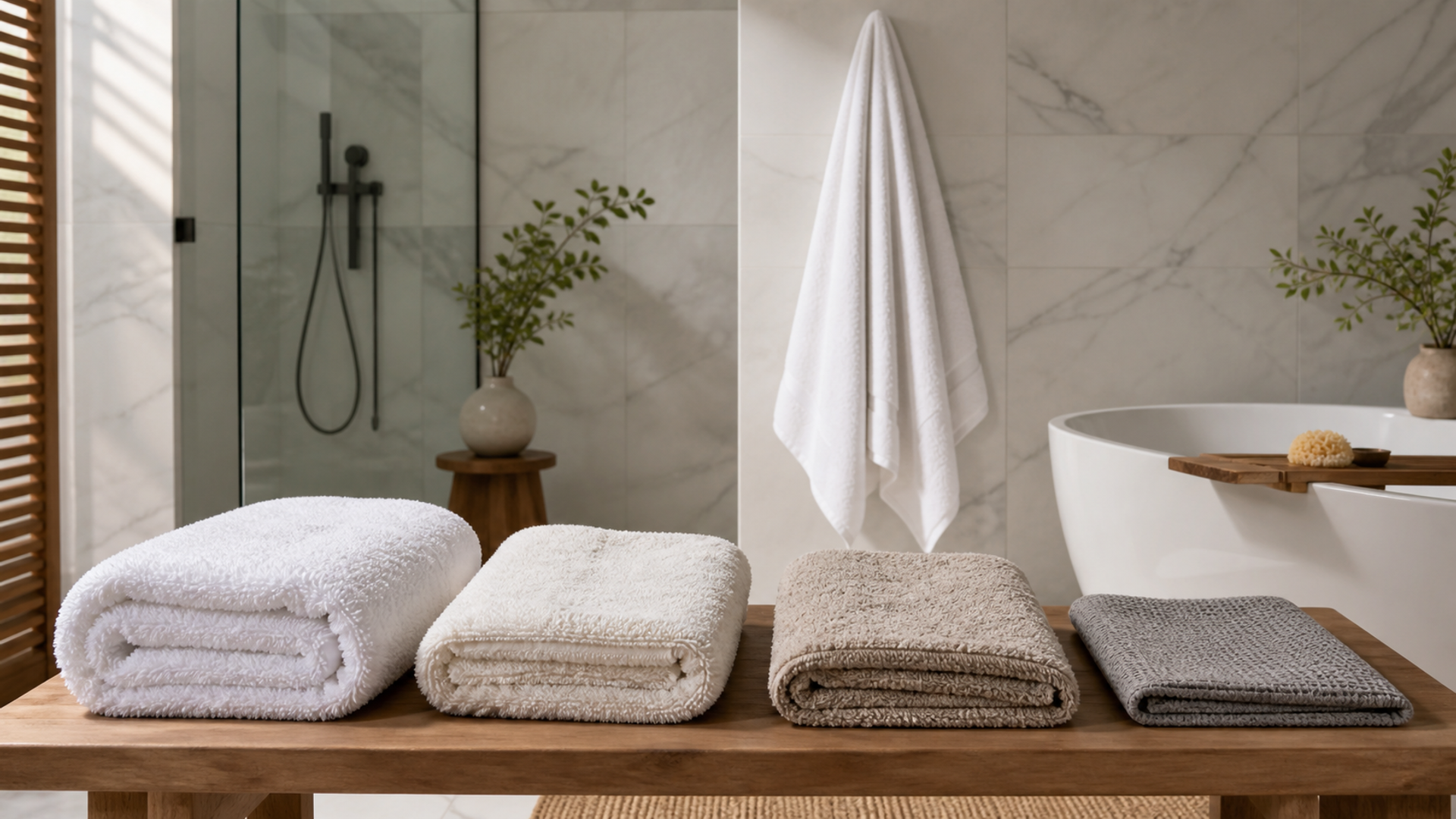
Terry loops create surface area for water pickup. Look for uniform coverage, a stable woven ground, straight borders and hems that do not feel disproportionately stiff. Very long loops may feel plush but are easier to pull on jewellery, hooks or rough surfaces. A well-made towel should not depend on heavy softener for its showroom hand. Inspect both faces, corners and the transition between pile and decorative border.
Design the drying route
A folded towel on a narrow hook dries differently from one opened across a rail. In a humid bathroom, leaving space between towels may matter more than buying extra pile. If the household washes after every use, machine capacity and energy become central. If towels are reused, airflow and full drying reduce musty odour. Test a single towel in the actual room before committing to an entire matching set.
Judge durability after care, not before
Initial softness can come from finishing that changes after washing. Follow the label for temperature and drying, avoid overloading and be cautious with products that need elaborate care for an everyday role. Fabric softeners can alter absorbency. Track lint, pulled loops, edge shrinkage and odour retention after several cycles. Replacement is justified when the ground cloth thins, hems fail or the towel no longer cleans and dries reliably—not merely when fashion changes.
Three bathroom and laundry profiles
Humid flat with limited airflow
Prioritise moderate weight, open hanging space and a size that the washer can extract effectively. A plush bath sheet may remain damp too long even if it absorbs brilliantly. Define the fact that would reverse this recommendation before committing.
Cool, well-ventilated primary bathroom
A denser cotton terry towel can make sense when drying time is generous and the household values a substantial feel. Inspect hems and loop stability before buying a set. Define the fact that would reverse this recommendation before committing.
High-turnover guest or gym use
Choose fast drying, clear care instructions and consistent dimensions. Laundry throughput, odour release and replacement cost matter more than maximal pile height. Define the fact that would reverse this recommendation before committing.
Action checklist
Read generic fibre names and percentages.
Check country-of-origin and responsible-business labelling.
Compare dimensions before comparing GSM.
Inspect loop uniformity on both faces.
Examine hems, corners and decorative borders.
Estimate washer and dryer load per set.
Test drying on the actual rail or hook.
Wash one sample before buying multiples.
Track lint, snagging and edge distortion.
Reject unsupported bamboo or performance language.
Continue the decision
The linked VERTU articles expand adjacent parts of the best bath towels decision. They do not substitute for the external evidence above.
The durable towel verdict
Choose a dense, well-finished cotton terry towel when plush hand feel and absorbency matter and the bathroom has enough time and airflow to dry it. Choose a lighter towel when rapid drying, frequent washing, humid weather or limited ventilation dominates. Verify the named fibre and percentage, inspect loop consistency and hems, and compare the laundering burden of the full towel—not a fabric swatch.
Keep the best bath towels decision reversible until its material cost, safety, access, privacy and compatibility facts are verified. Unknown evidence stays unknown; it is never silently scored as favourable.