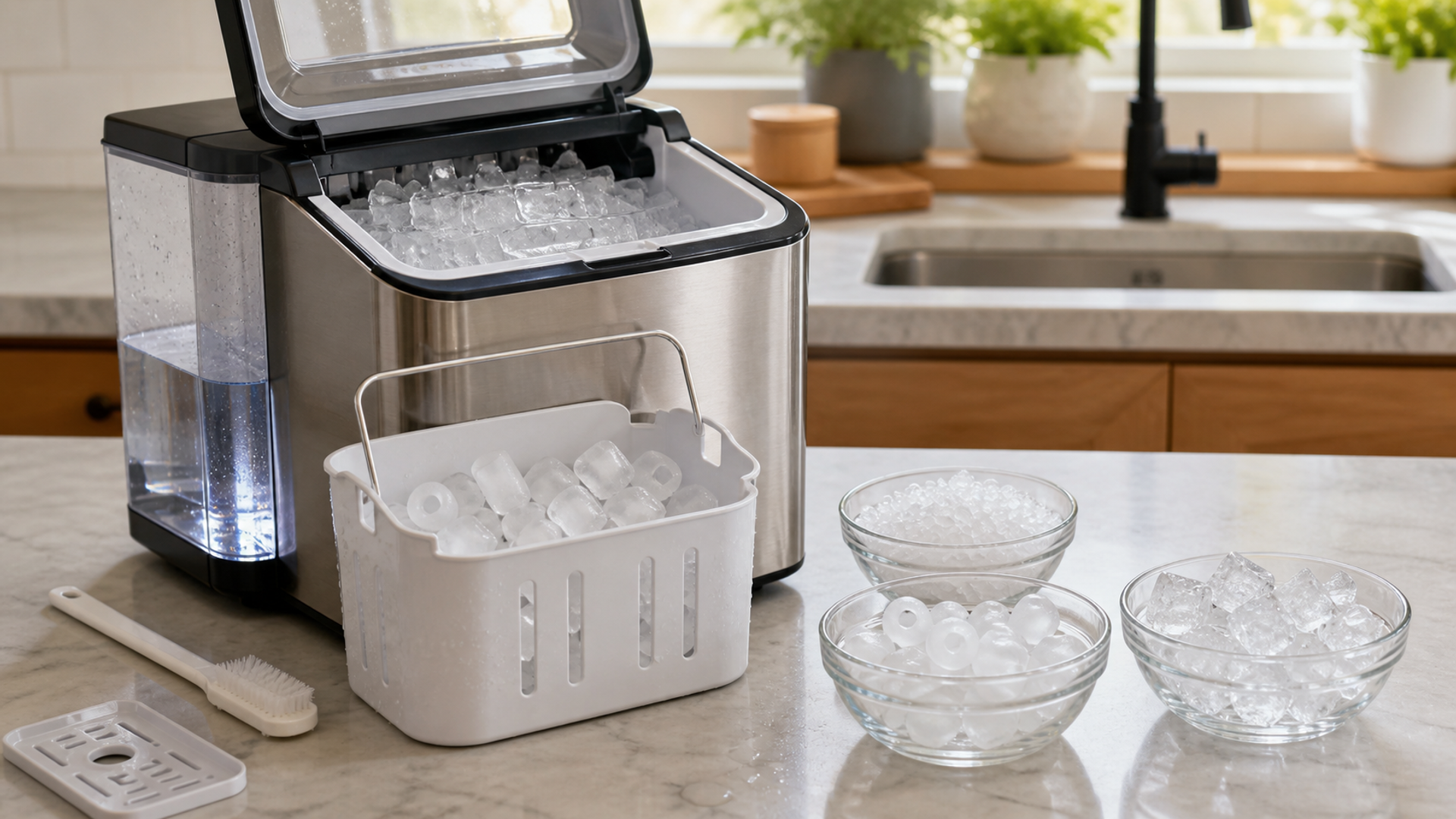
Countertop ice makers produce ice quickly, but most do not preserve it like a freezer. Meltwater can recirculate, advertised daily output assumes defined conditions and the machine still needs cleaning and airflow. The best model is the one whose ice style, batch rhythm and maintenance fit the household.
Match the machine to the event
Choose a compact bullet-ice machine for fast everyday drinks, a nugget-ice machine when texture is the main value, or a plumbed or high-capacity route when repeated entertaining justifies installation and cleaning. Compare usable hourly production and storage rather than the largest daily-output claim.
| Decision factor | Compact bullet-ice maker | Nugget-ice machine | High-capacity or plumbed unit |
|---|---|---|---|
| Ice texture | Hard hollow pieces suit rapid chilling | Chewable porous ice is the objective | Consistent volume matters more than texture |
| Event rhythm | Small batches are transferred regularly | Continuous household use justifies the wait | Large gatherings need planned storage |
| Water | Manual refill is convenient | Filtered refill and frequent cleaning are accepted | A safe water connection is available |
| Cleaning | Reservoir and surfaces are easy to reach | Descaling and sanitising are scheduled | Service access and drainage are planned |
| Space | Ventilation fits a small counter | A larger permanent footprint is acceptable | Dedicated utility space exists |
| Ownership | Low cost and simple parts win | Texture justifies higher maintenance | Capacity and service justify installation |
This best countertop ice maker matrix is the article's working value object. Read the best countertop ice maker rows together: the decisive failure mode depends on this topic's evidence, operating context and reader objective.
What food-safety and product evidence prove
Evidence 1. The FDA Food Code treats ice used as food as subject to sanitary handling, which makes clean water, food-contact surfaces and hygienic transfer material to ownership.
Evidence 2. Countertop units commonly recirculate meltwater and may keep ice in an insulated bin rather than a freezer, so finished ice should be transferred according to the exact manual.
Evidence 3. Daily-output ratings are measured under specified water and ambient conditions; warm rooms, warm refill water and repeated lid opening can change production.
Evidence 4. Manufacturer cleaning and descaling instructions are model-specific and should govern chemical choice, rinse cycles, drainage and periods of non-use.
Reader-visible sources checked for this article:
fda.gov — reader-visible current or official evidence
products.geappliances.com — reader-visible current or official evidence
geappliances.com — reader-visible current or official evidence
products.geappliances.com — reader-visible current or official evidence
For best countertop ice maker, these sources establish only the claims inside their documented scope. Recheck every changeable specification, availability condition, price, policy or service term in the relevant market before acting.
Calculate real output and cleaning effort
For ice texture, the first route works when hard hollow pieces suit rapid chilling; the second requires chewable porous ice is the objective. The control for the third is consistent volume matters more than texture. Verify this row against the exact product, property, account or environment before it can reverse the decision.
The event rhythm row exposes a practical boundary. Route one assumes small batches are transferred regularly, while route two is defensible only when continuous household use justifies the wait. Route three depends on large gatherings need planned storage. If that evidence is absent, keep the more reversible option.
Read water as a stop/go test: manual refill is convenient supports the first option; filtered refill and frequent cleaning are accepted supports the second; and a safe water connection is available supports the third. Record which source proves the condition and when it was checked.
A buyer can resolve cleaning without starting from a brand preference. Ask whether reservoir and surfaces are easy to reach; compare that with whether descaling and sanitising are scheduled; then use service access and drainage are planned as the third route's safeguard. An unknown condition stays unknown.
On space, popularity is not enough. The evidence for option one is that ventilation fits a small counter. Option two means a larger permanent footprint is acceptable. Option three is rational where dedicated utility space exists. Recheck any changeable term immediately before commitment.
The decision changes at ownership. Choose the first path only if low cost and simple parts win; move to the second when texture justifies higher maintenance; use the third when capacity and service justify installation. Save the downside that would make this row fail.
Facts that would reverse the current choice
Reversal control 1 — Ice texture. Before choosing Compact bullet-ice maker, write down how the decision changes if “Hard hollow pieces suit rapid chilling” proves false. Do the same for Nugget-ice machine and “Chewable porous ice is the objective”. Keep the High-capacity or plumbed unit route available until “Consistent volume matters more than texture” is verified. This control belongs to best countertop ice maker; update it from the cited source or exact supplier rather than copying a generic checklist.
Reversal control 2 — Event rhythm. Before choosing Compact bullet-ice maker, write down how the decision changes if “Small batches are transferred regularly” proves false. Do the same for Nugget-ice machine and “Continuous household use justifies the wait”. Keep the High-capacity or plumbed unit route available until “Large gatherings need planned storage” is verified. This control belongs to best countertop ice maker; update it from the cited source or exact supplier rather than copying a generic checklist.
Reversal control 3 — Water. Before choosing Compact bullet-ice maker, write down how the decision changes if “Manual refill is convenient” proves false. Do the same for Nugget-ice machine and “Filtered refill and frequent cleaning are accepted”. Keep the High-capacity or plumbed unit route available until “A safe water connection is available” is verified. This control belongs to best countertop ice maker; update it from the cited source or exact supplier rather than copying a generic checklist.
Reversal control 4 — Cleaning. Before choosing Compact bullet-ice maker, write down how the decision changes if “Reservoir and surfaces are easy to reach” proves false. Do the same for Nugget-ice machine and “Descaling and sanitising are scheduled”. Keep the High-capacity or plumbed unit route available until “Service access and drainage are planned” is verified. This control belongs to best countertop ice maker; update it from the cited source or exact supplier rather than copying a generic checklist.
Reversal control 5 — Space. Before choosing Compact bullet-ice maker, write down how the decision changes if “Ventilation fits a small counter” proves false. Do the same for Nugget-ice machine and “A larger permanent footprint is acceptable”. Keep the High-capacity or plumbed unit route available until “Dedicated utility space exists” is verified. This control belongs to best countertop ice maker; update it from the cited source or exact supplier rather than copying a generic checklist.
Reversal control 6 — Ownership. Before choosing Compact bullet-ice maker, write down how the decision changes if “Low cost and simple parts win” proves false. Do the same for Nugget-ice machine and “Texture justifies higher maintenance”. Keep the High-capacity or plumbed unit route available until “Capacity and service justify installation” is verified. This control belongs to best countertop ice maker; update it from the cited source or exact supplier rather than copying a generic checklist.
Convert daily output into an event timeline
Estimate drinks per hour, ice per serving and the time available before guests arrive. Measure the first batch and sustained production separately. Because the basket is not necessarily frozen storage, plan freezer containers and transfer intervals. A machine rated for a large daily total can still fall behind a two-hour party if its basket is small or first-batch time is long.
Inspect every wet surface
Remove the basket and look for seams, tubes, sensors and areas that cannot be wiped. Confirm whether parts are dishwasher safe and how the drain is reached. Follow the manual for sanitising and descaling; do not mix chemicals. If the machine will sit unused, drain and dry it fully so stagnant water does not become the next batch's starting point.
Choose water deliberately
Use potable water and follow the manufacturer's mineral guidance. Very hard water can increase scale, while water that is too warm slows production. Filters need replacement schedules and do not excuse cleaning. If a plumbed model is considered, include an accessible shut-off, leak control and installation that follows local requirements.
Listen and measure the footprint
Check operating noise during freezing, harvest and pumping, not only standby. Leave the specified ventilation clearance and allow the lid to open under cabinets. Include the scoop, drain route and freezer containers in the footprint. A machine that blocks preparation space is likely to be stored away and used less often.
Three countertop ice-maker decisions
Daily cold drinks
A compact bullet-ice machine wins when small batches are moved regularly and cleaning is simple. Define the fact that would reverse this recommendation before committing.
Texture-first household
A nugget machine makes sense when chewable ice is used enough to justify cost and maintenance. Define the fact that would reverse this recommendation before committing.
Frequent entertaining
A higher-capacity or plumbed route works only with storage, drainage and service access. Define the fact that would reverse this recommendation before committing.
Action checklist
Estimate ice per hour, not only per day.
Measure first-batch time.
Check whether the bin is refrigerated.
Inspect all wet surfaces.
Read sanitising and descaling steps.
Plan potable water and filter changes.
Measure lid and ventilation clearance.
Listen through a full harvest cycle.
Plan freezer transfer containers.
Confirm drain, warranty and parts support.
Continue the decision
The linked VERTU articles expand adjacent parts of the best countertop ice maker decision. They do not substitute for the external evidence above.
The ice-maker verdict
Choose a compact bullet-ice machine for fast everyday drinks, a nugget-ice machine when texture is the main value, or a plumbed or high-capacity route when repeated entertaining justifies installation and cleaning. Compare usable hourly production and storage rather than the largest daily-output claim.
Keep the best countertop ice maker decision reversible until its material cost, safety, access, privacy and compatibility facts are verified. Unknown evidence stays unknown; it is never silently scored as favourable.