


Key takeaways
Treat official hospitality as an authenticity and operations decision, not just a seat upgrade—your risk profile changes when you’re moving across three countries.
Build your plan around three anchors: fixtures you care about, border crossings you can control, and a single operations lead who owns timing.
In private aviation, the “luxury” is predictability: correct filings, the right ports of entry, and a pre-briefed ground chain.
Security is mostly unglamorous: document hygiene, controlled sharing, and disciplined on-site movement.
Introduction
The 2026 tournament is different in a way that matters for high-end travel: it’s spread across the United States, Canada, and Mexico. That scale can be exhilarating—or it can quietly compound risk and friction if you treat it like a normal city-break.
This is your roadmap to a luxury World Cup experience that feels deliberate: the right official VIP hospitality, the right routing, and a travel plan that holds up under real-world constraints.
We’ll cover what official VIP hospitality typically includes (and what it doesn’t), how to select a package that fits your profile, and how to align private aviation, stays, and security so the tournament feels cohesive rather than chaotic.
Official VIP Hospitality Map
Official matters here. It’s the difference between a premium experience that’s predictable, and an expensive unknown that can fail at the gate.
FIFA has published official hospitality-package availability information and sells the program as FIFA World Cup 26™ Hospitality, with On Location appointed as the Official Hospitality Provider (see FIFA’s hospitality packages announcement and On Location’s official appointment note).
This section is your decision framework for World Cup 2026 VIP hospitality—what you’re actually buying, how tiers differ, and how to select without guesswork.
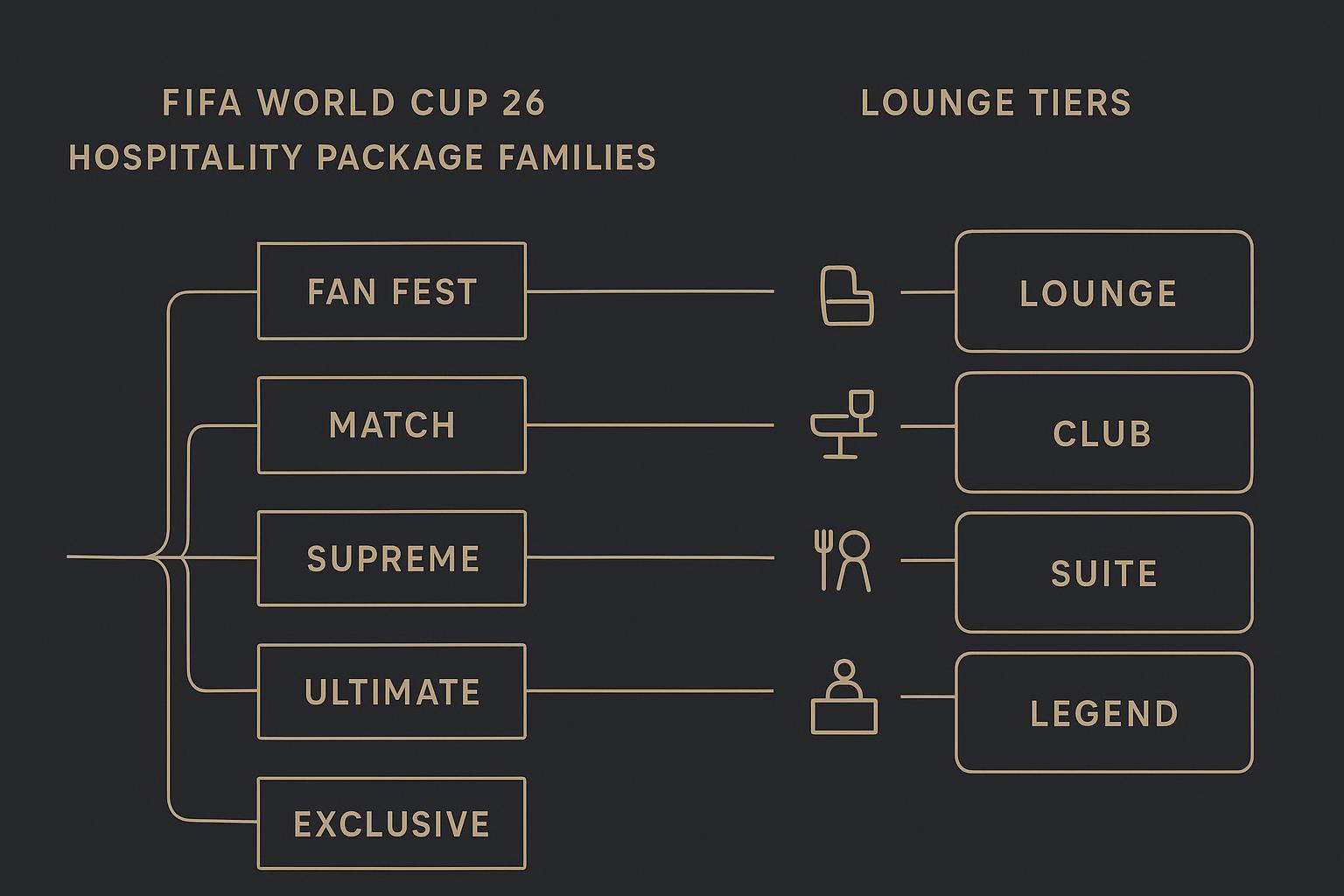
Package Families Decoded
Think of “package family” as the structure of what you’re buying—how many matches, and how those matches relate to a venue or a team. Official hospitality commonly appears in formats such as:
- Single matchone fixture, one city.
- Match seriesa curated set of matches (useful if you want a multi-city arc without committing to one stadium).
- Venue seriesmultiple matches at one stadium (useful if you prefer one operational base).
- Follow-my-team style bundlesbuilt around a specific team’s progression (availability varies).
Your choice here is less about glamour and more about control: fewer moves equals fewer failure points.
Tiers and Lounges Explained
Within each package family, the “tier” is the hospitality environment: where you enter, what lounge you access, what food and beverage service looks like, and how close your seats are.
At a high level, FIFA World Cup 26 hospitality packages tend to separate by:
Seat location and access routing (sideline vs. other premium categories)
Lounge intimacy (shared club vs. smaller, higher-touch spaces)
Service depth (from premium self-serve to hosted dining and more structured on-site support)
Key TakeawayFor a multi-country World Cup, choose your tier as an operations tool. The more predictable the entry and lounge experience, the less you’ll feel the city’s pressure on matchday.
Choosing for Your Profile
A practical way to choose is to start with your constraints, not your preferences.
If your priority is certainty (tight schedule, multiple cities, security-sensitive):
Favor packages that simplify entry and reduce time in public queues.
Favor fewer city changes—even one extra border crossing can add unpredictable hours.
If your priority is hosting (clients, partners, or a private group):
A private environment can be less about spectacle and more about controlled flow: arrivals, seating, and departures that you can brief.
Optimize for seat location and your ability to move in and out without friction.
How to verify: Start at official channels and verify you are on the legitimate FIFA domain before you do anything else. The FTC’s World Cup scam guidance (2026) is blunt for a reason: most losses happen before matchday.
Private Aviation & Transfers
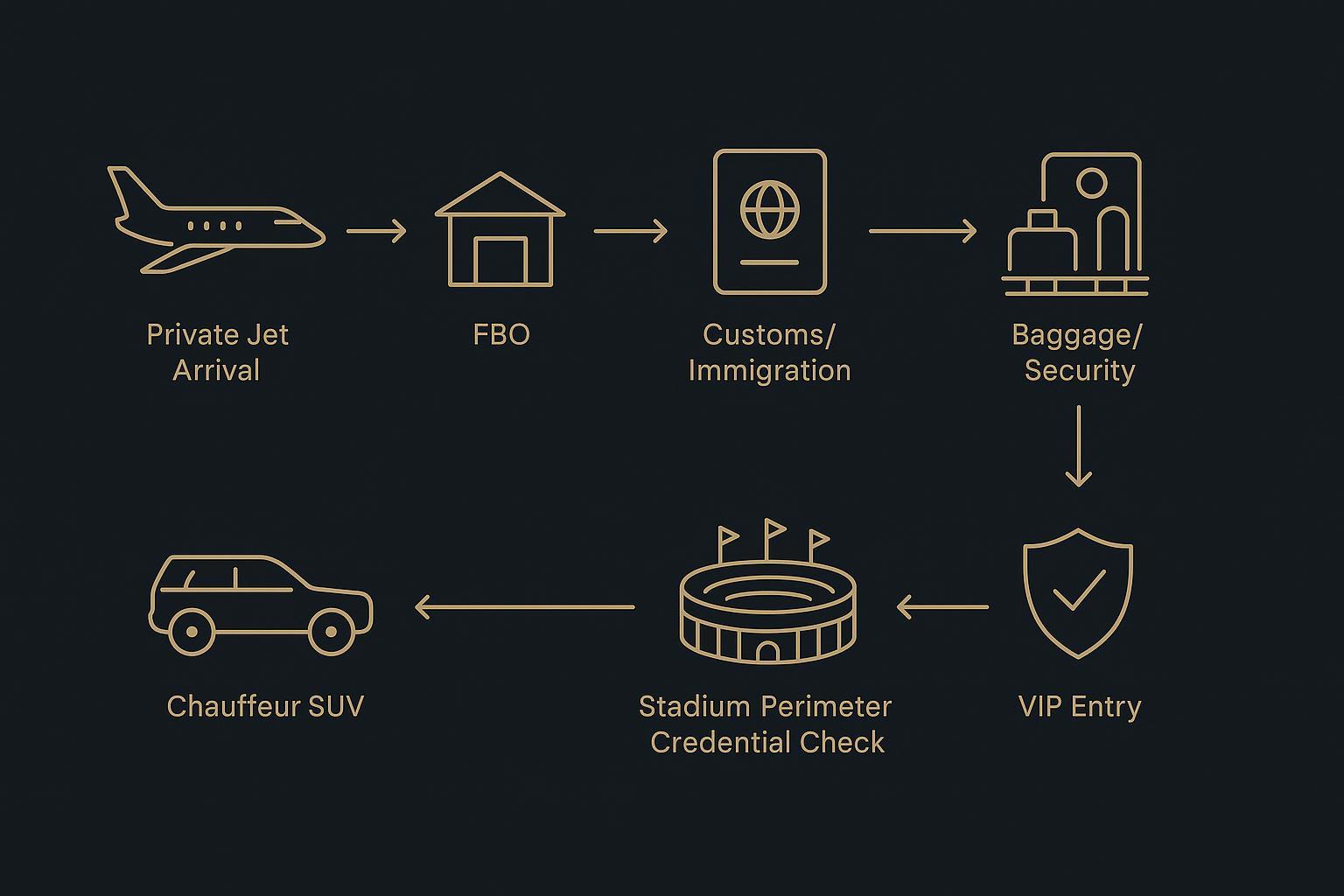
Private aviation can make a World Cup itinerary feel effortless—if you respect the administrative layer. Across the USA, Canada, and Mexico, the luxury is not speed; it’s predictable processing.
If you’re considering private jet World Cup travel, treat every border crossing as a project with named owners.
Cross-Border Compliance Essentials
In general, private flights require advance passenger/crew information submissions, and you’ll typically need to route through appropriate airports for customs and immigration processing.
For U.S. arrivals, U.S. Customs and Border Protection publishes guidance for general aviation processing and entry requirements (see CBP’s General Aviation Processing guidance). For Mexico-specific general aviation requirements, AOPA maintains updated operational notes including APIS-related updates (see AOPA’s Mexico international travel guidance).
Two operational rules prevent most problems:
- Land where you’re supposed to landuse appropriate ports of entry for international arrival processing.
- File early, brief earlierpassenger lists, passport details, and schedules should be stable well before wheels up.
FBO Hotspots in Key Host Cities
An FBO is effectively your private terminal—handling aircraft services and passenger-side flow. The National Air Transportation Association describes what FBOs are and the services they provide in NATA’s “Get to Know FBOs” explainer.
Rather than naming “best” FBOs (which changes by availability, airport constraints, and event-week load), use this selection method:
Proximity to your true destination (hotel or stadium corridor—not just the city name)
Customs/immigration handling experience (especially when you’re timing matchday moves)
Vehicle staging capacity (SUVs, secure meet-and-greet, luggage control)
Discretion practices (no visible passenger lists, controlled arrivals)
For major events, the “hotspot” is often the FBO that can still execute on time under pressure—not the one with the most polished lounge.
Helicopter and Last-Mile Options
Helicopter and last-mile solutions are best viewed as pressure valves:
airport → hotel when road congestion is the bottleneck
hotel → stadium perimeter when access lanes are constrained
post-match extraction when everyone leaves at once
But they introduce their own constraints: slot availability, weather, temporary flight restrictions, and landing permissions. Plan them as optional layers, not single points of failure.
Itinerary Design & Stays
A coherent World Cup itinerary is built around anchors. FIFA’s official host city list makes the scale clear across all three countries (see FIFA’s host cities page). Your goal is to turn that geography into a route that feels calm.
Host-City Anchors and Routing
Start with one of three anchoring strategies:
- One-base strategypick a city and maximize matches there.
- Two-hub strategyone hub for early rounds, one hub for later rounds.
- Narrative routea small number of cities chosen for fixtures plus lifestyle (the riskiest operationally, but the most cinematic).
In every case, limit border crossings unless they’re doing real work for you.
Hotels, Residences, and Partners
At this level, lodging is not only about comfort. It’s about operational control:
- Arrival disciplineprivate check-in, controlled lobby exposure, late-night logistics.
- Back-of-house reliabilitydiscreet vehicle access, staff continuity, and the ability to execute special handling.
- Partner networkdrivers, security teams, and venue-side support who can work from the same run-of-show.
Ground Movements and Security Layers
Security should be designed as layers, not as a single “security detail.”
- Layer 1 — Information controlwho sees the itinerary, in what detail, and when.
- Layer 2 — Movement controlstaged departures, alternate routes, and a clear extraction plan.
- Layer 3 — Communications controlsecure, reliable channels that keep changes off public apps.
This is where a discreet concierge-and-communications layer can matter. For example, using a device-and-service ecosystem like VERTU Concierge Service for VIP luxury travel can support coordination across hotels, drivers, and security partners—while maintaining a privacy-first posture. If you’re privacy-sensitive, the principle is straightforward: keep sensitive details out of group chats, minimize forwarding, and use a controlled channel for itinerary changes (see VERTU’s positioning on executive privacy).
The point is not branding. It’s governance: one operator, one chain of custody for updates, and fewer places where plans leak.
Security, Authenticity & Risk
Luxury travel collapses fast when authenticity or privacy fails. Treat this section as a risk register.
Buy Official, Avoid Secondary
The safest baseline is simple: start from official sources, and don’t let urgency make decisions for you.
Begin at official FIFA pages for ticketing/hospitality.
Avoid paid ads and forwarded links; type the domain directly.
Pay with methods that preserve dispute rights.
⚠️ WarningIf someone can’t demonstrate legitimacy inside the official ecosystem, you’re not buying a ticket—you’re buying a story.
Privacy and Data Hygiene
Event travel creates predictable privacy failures:
too many people receiving itinerary PDFs
IDs and passport photos shared casually
hotel names posted in group chats
devices connecting to unknown networks
Your baseline should be boring and strict:
Keep itinerary details on a need-to-know basis.
Share access through controlled channels.
Assume your device will be lost, searched, or copied—then design for that scenario.
If you want a device-oriented checklist, VERTU’s guide on a privacy phone for executives is a useful starting point for travel posture and communications discipline.
On-Site Security Protocols
On-site security is about predictable choke points:
arrivals and departures (crowds + cameras)
VIP entry lanes (credential checks)
post-match movement (everyone leaving at once)
Brief your team like an operation:
fixed rally points and alternate rally points
pre-arranged comms rules (“if X, then Y”)
controlled photo policy
Booking Strategy & Timeline
The most expensive mistake is not overspending. It’s waiting until your options narrow into compromises.
Demand Waves and Availability
Expect demand to move in waves:
early demand when hospitality/ticketing options open
spikes around draws and fixture clarity
last pushes as group-stage stories emerge
Book the pieces that create optionality first: official hospitality access and the movement spine (air + ground). Then refine stays.
Budgeting by Match and Tier
Budgeting is mostly driven by two factors:
match importance (finals and high-demand fixtures compress supply)
tier depth (how much service and controlled access you’re purchasing)
Avoid building the budget around headline promises. Build it around what you’ll actually use: routing, entry control, lounge time, and staff.
Venue vs. Team vs. Match Series
Choose the purchase structure that matches how you travel:
Venue-focused if you want one base and minimal operational complexity.
Team-focused if your itinerary is emotionally anchored to one storyline.
Match-series if you want variety but still need a coherent route.
A final note for World Cup 2026 travel planning: the most resilient itinerary is the one with fewer handoffs. Fewer moves, fewer unknowns.
Conclusion
Lock in official hospitality early and align travel with the fixtures that matter most to you.
Prioritize compliance, authenticity, and a concierge-led operations plan.
If you’re building a high-discretion itinerary, consider formalizing a single “ops owner” for the tournament: one point of control for schedule changes, access details, and secure coordination.
Disclosure: This article references VERTU pages. Editorial judgment remains the priority.



![Top 10 Tourbillon Watches for Men [2026 Latest]](https://cdn.sanity.io/images/e0gp1l2g/production/8cb6bc45133cf9453382fc7d074465af588bb610-1800x1080.webp?w=800&h=450&q=82&auto=format&fit=crop)