

Modern smartphones are astonishing. They’re also exhausting.
For a certain kind of owner, the question isn’t “What can my phone do?” It’s “What does my phone demand?” Attention. Updates. Noise. A thousand tiny decisions per day.
That’s why classic luxury phones have quietly stayed relevant. Not as nostalgia. As a boundary.
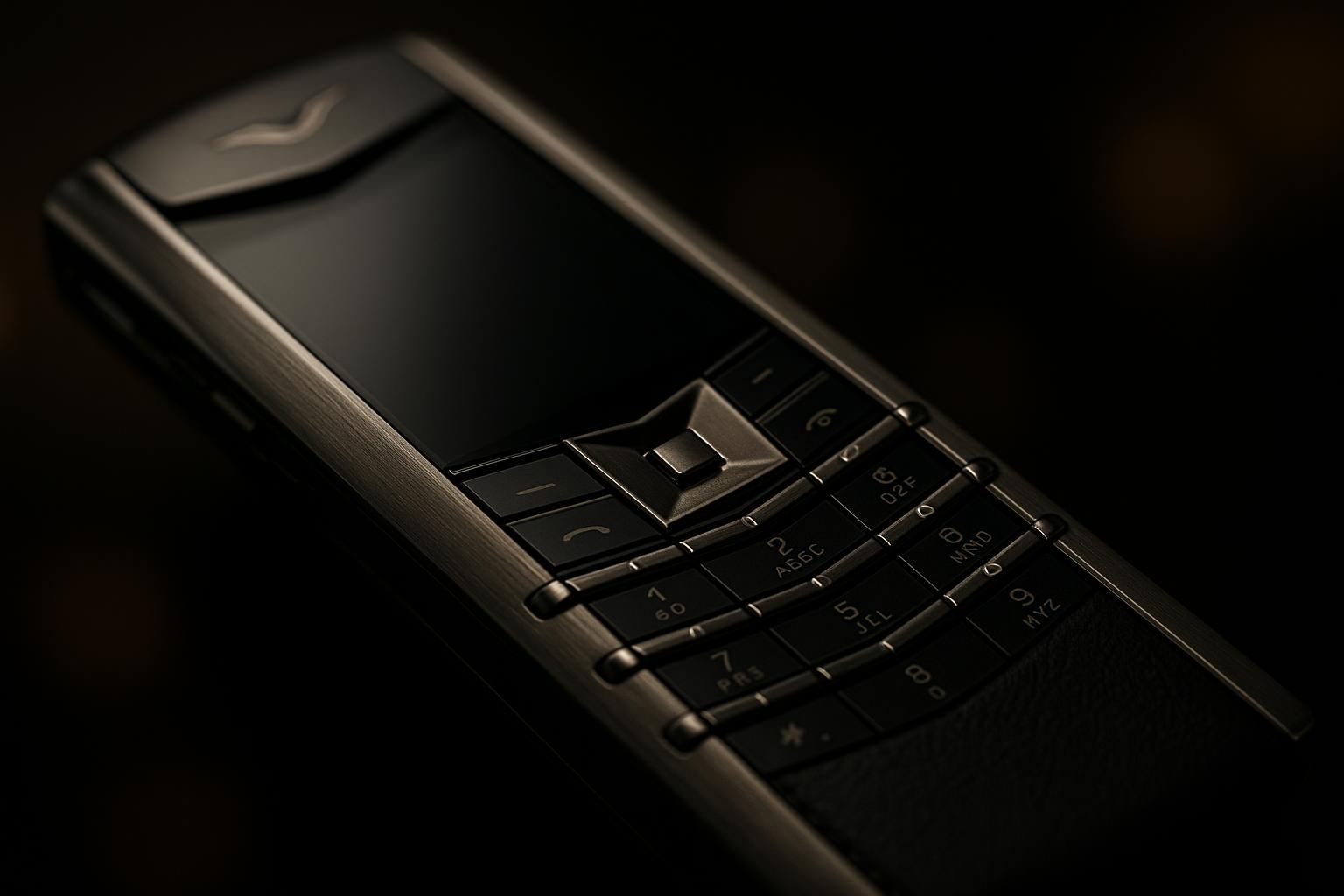
And that’s where VERTU Signature sits today: a luxury object built for people who want communication to feel deliberate again.
Key TakeawayA classic luxury phone matters when you want your phone to be a tool you own, not a feed that owns you.
The quiet return of the “real phone”
If you’ve noticed people flirting with simpler devices again, you’re not imagining it.
Mainstream coverage has framed the “dumbphone” comeback as a response to smartphone fatigue: fewer apps, fewer alerts, less temptation to disappear into a scroll hole. CBC’s report on the flip phone resurgence describes users switching to feature phones for a digital detox, including younger buyers trying to reduce screen time and parents choosing simpler devices for their kids (CBC’s report on the flip phone comeback (2024)). CNBC similarly covered how dumb phones have risen in the U.S. as Gen Z tries to limit screen time (CNBC’s report on dumb phones rising as Gen Z limits screen time (2023)).
But the classic luxury phone buyer usually isn’t trying to “quit tech.” They’re trying to put tech back in its place.
A good luxury keypad phone does that in three ways:
It changes the default behavior. You can still communicate, but the device doesn’t beg you to browse.
It restores tactility. You can operate it by feel, not by sight.
It treats ownership as a long game. Materials, aftercare, and service matter as much as specs.
That third point is where luxury phone craftsmanship stops being marketing copy and becomes the core of the category.
Why physical buttons still win in high-attention moments
Touchscreens are great at one thing: giving you infinite options.
In real life, infinite options are a tax.
There’s a reason cars are slowly walking back the “everything on glass” experiment. Human-factors research continues to find that touchscreens often increase distraction and reduce usability for common tasks. A 2026 review of in-vehicle touchscreen safety and usability notes that physical controls tend to perform better than touchscreens in many center-stack tasks (a 2026 review of in-vehicle touchscreen safety and usability).
A U.S. DOT report on touchscreen and physical controls explains one mechanism clearly: without rich tactile and auditory feedback, touchscreen interaction can require more visual attention as compensation, while physical controls provide natural cues through shape and feel (a U.S. DOT report on touchscreen vs physical control feedback).
That’s driving. Now translate the principle.
When you’re walking through an airport, stepping out of a meeting, or trying to handle a sensitive call without looking down every three seconds, the value of a physical keypad isn’t “retro.” It’s ergonomic.
A keypad gives you:
Affordances you can feel (shape, travel, click)
Muscle memory (you learn it)
Lower visual demand (you don’t have to stare at glass)
And in a life where attention is the most expensive asset you own, that’s a serious feature.
The luxury phone isn’t a spec race. It’s an ownership model
A mainstream smartphone is designed around a cadence: yearly upgrades, new camera tricks, new AI features, new reasons to switch.
A luxury phone is designed around something else: ownership value.
That doesn’t mean specs don’t matter. They do. Baselines matter.
But the category’s differentiators sit in a different place, and VERTU is unusually direct about this framing. In its guide on how to think about luxury phone specifications, VERTU argues that the real decision criteria are privacy posture, service layer, materials, and aftercare—not a spec-sheet arms race (which specifications matter on a luxury phone).
Here’s the simplest way to think about it.
1) Attention discipline
The most expensive thing about your smartphone isn’t the device. It’s the attention it consumes.
Research in the Journal of the Association for Consumer Research found that the mere presence of your smartphone can reduce available cognitive capacity, even when you aren’t actively using it, because part of your attention is spent resisting it (the Journal of the Association for Consumer Research ‘Brain Drain’ study (2017)).
That doesn’t mean you should throw your smartphone away.
It means the device environment matters. What it invites you to do. What it makes too easy.
A classic luxury phone—especially a keypad-first device—creates a different default. Communication stays. The rest gets quieter.
2) Materials and tactility
Luxury is physical.
If you wear a mechanical watch, you already understand this: you’re not buying the “most accurate time.” You’re buying the feeling of the object, the craft, the ritual.
A VERTU Signature is built to be that kind of object.
3) Service layer
Luxury isn’t only what you touch. It’s what shows up when you need help.
For high-profile owners, a phone can be a portal to support: travel, reservations, urgent logistics, and the kind of human escalation that doesn’t fit neatly into an app.
That’s why the category keeps coming back to concierge.
VERTU Signature, explained: what you’re actually buying
So what is a VERTU Signature phone, in plain language?
It’s a crafted communications device built around three pillars:
A physical keypad experience designed to be deliberate
Luxury materials and finish chosen for longevity and tactility
A human service layer you can reach instantly
VERTU’s own definition of what a VERTU phone is emphasizes that it’s luxury technology ownership: craft and materials, personalization, and a concierge service layer as a key differentiator (what a VERTU phone is).
If you want the clearest “current lineup” view of the modern Signature family, start with the official collection page and treat it as your map of editions and materials (VERTU Signature V series).
Collector’s note: the point isn’t to compete with iPhone
The Signature isn’t trying to win the mainstream spec war.
It’s trying to make communication feel like a choice again.
That’s why the object details matter: the click of the keys, the weight, the finish, the way the device sits in your hand. Those are daily-use features, not showroom features.
The modern relevance: privacy posture + calm by design
The word “privacy” gets thrown around.
In practice, privacy is a posture: how the device behaves by default, how much it tries to connect everything to everything, and how often it invites you to leak attention.
A phone that does fewer things can make one thing clearer: what you’re doing right now.
That clarity is part of the appeal.
How to evaluate a classic luxury phone (and avoid counterfeits)
If you’re evaluating a luxury keypad phone—whether it’s VERTU or any other collectible-grade brand—there are two separate questions:
Is it authentic?
Is it the right fit for how you actually live?
Step 1: Verify authenticity before you fall in love
Counterfeits exist because luxury value attracts imitation.
VERTU publishes a practical checklist to verify an original device before you pay, including asking for IMEI/serial identifiers up front and confirming them through official channels (VERTU authenticity checklist).
You can also use the official checker here: VERTU Check Authenticity.
How to verifyDon’t send a deposit until you’ve verified IMEI/serial identifiers. If a seller won’t share them, treat that as the answer.
Step 2: Evaluate the phone like a luxury object, not a gadget
If you read luxury watches, you know the drill. You’re checking the details that don’t photograph well.
For a VERTU Signature (or any luxury keypad phone), focus on:
- Keypad feelconsistent travel, clean click, no wobble
- Materials and join linesprecise edges, no uneven seams
- Glass clarityreflections are normal; distortion shouldn’t be
- Documentation and provenancethe paper trail matters
- Aftercarewhat happens if you need service in a year?
VERTU’s own framework for “specs that matter” in luxury phones is useful here because it treats the phone as an ownership system: privacy posture, service layer, materials, and support (which specifications matter on a luxury phone).
Step 3: Decide what “classic” means for you
Classic can mean different things:
A device that helps you be harder to reach.
A device that makes you easier to reach, but only on purpose.
A device that feels like a collectible you use daily.
If you’re honest about which one you want, the right model becomes easier to recognize.
Common misconceptions (and what’s true instead)
Misconception 1: “A luxury keypad phone is just nostalgia.”
Nostalgia is sentiment.
This is ergonomics and attention design. Physical controls reduce visual demand, and simpler device defaults reduce behavioral pull. The same human-factors logic that’s pushing cars back toward buttons applies here too (a U.S. DOT report on touchscreen vs physical control feedback).
Misconception 2: “Luxury phones are about showing off.”
Some are.
But the mature version of the category is about discretion: owning something excellent without turning it into an announcement.
Misconception 3: “If it doesn’t have every app, it’s not practical.”
That depends on what you call practical.
If your smartphone is quietly turning every idle moment into a feed, a simpler device can be practical in a deeper way. It gives you your time back.
And if you want proof that a lot of people are at least experimenting with that trade, look at the feature-phone comeback narrative in mainstream reporting (CBC’s report on the flip phone comeback (2024)).
FAQ
Is VERTU Signature still a smartphone?
Certain models incorporate smartphone capabilities, but the Signature line is best understood as a communications-first luxury device. The point isn’t to maximize apps; it’s to maximize discretion, tactility, and ownership experience.
What makes the VERTU Signature V different?
The Signature V is positioned as a modern expression of the classic VERTU idea: a crafted phone with a service layer. VERTU describes it as a luxury lifestyle device anchored by materials, the iconic Ruby Key, and concierge access (how the Signature V fits a modern luxury lifestyle).
Why would anyone choose a luxury keypad phone in 2026?
Because the friction is the feature.
A keypad-first device makes communication feel intentional, and it doesn’t invite constant browsing. In a world of notification overload, that’s a meaningful choice.
How do I avoid buying a fake luxury phone?
Verify identifiers before payment, match identifiers across device and documentation, and use official tools where available. Start with the brand’s own steps: VERTU authenticity checklist.
Next steps
If you’re exploring VERTU Signature today, start with the official collection to understand editions and materials (VERTU Signature V series). Then read the due-diligence steps before you buy pre-owned (VERTU authenticity checklist).
Disclosure: This article references VERTU pages. Editorial judgment remains the priority.
![Top 10 Luxury Smartwatches for Business Travel [2026]](https://cdn.sanity.io/images/e0gp1l2g/production/8b5e5b21db42a1c5f040e828bd041857353a8eb2-2560x1382.webp?w=800&h=450&q=82&auto=format&fit=crop)