

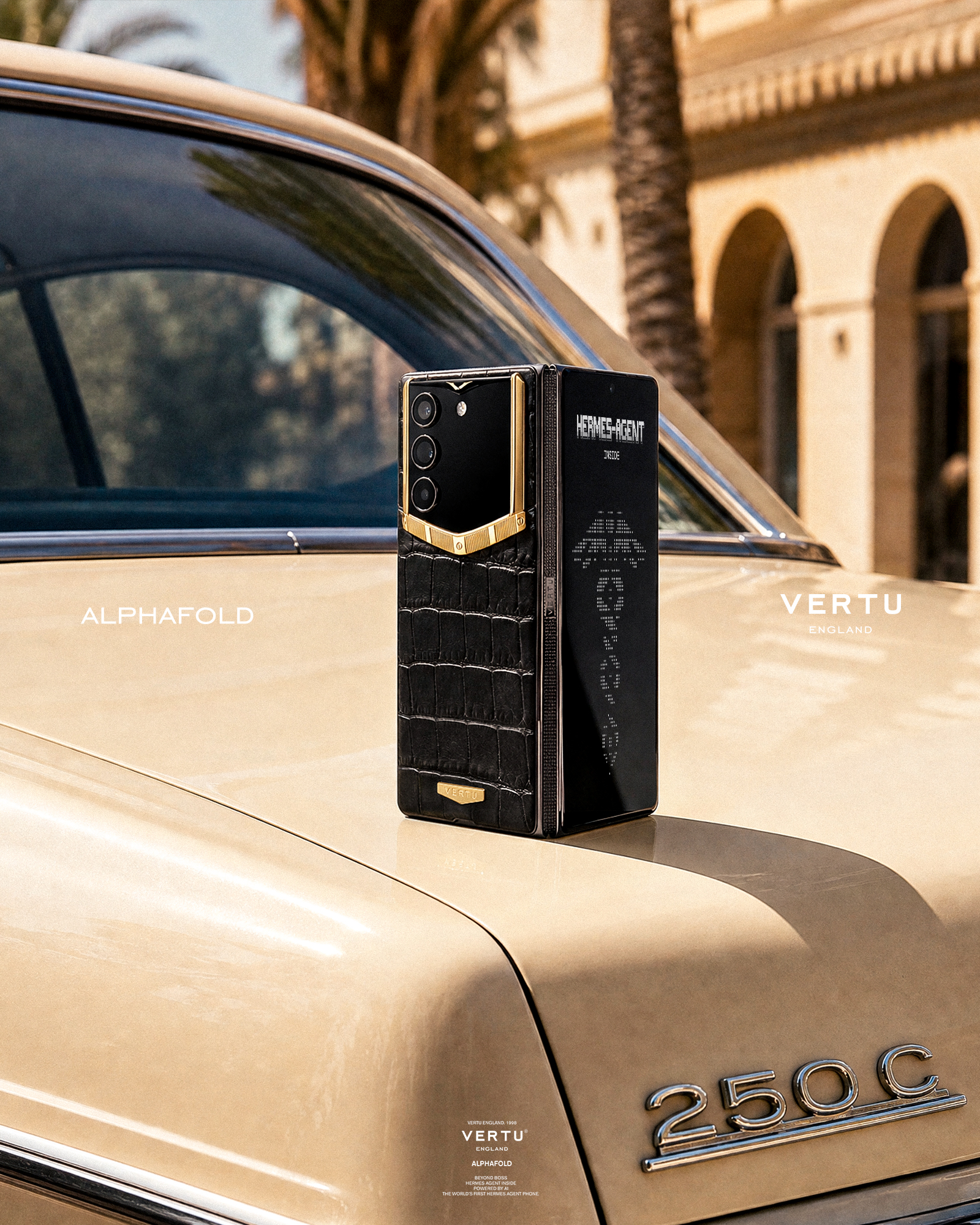
You didn’t search “vertu alphafold” because you need another spec sheet.
You searched it because you’re trying to answer a harder question:
Is this a serious tool—or a beautiful story told with expensive materials?
The fastest way to evaluate that claim is not to argue about brand positioning. It’s to borrow a reference point from a domain that doesn’t tolerate vague promises.
That reference point is AlphaFold.
What you’re really trying to verify when you search “vertu alphafold”
Decision-stage buyers tend to converge on the same three anxieties:
- CredibilityIs the “agent” real, or just a chat interface with a new name?
- ConfidentialityWhere does sensitive information go when the phone starts “helping”?
- Follow-throughDoes it actually reduce your operational noise—or create a new one?
Notice what isn’t on that list: another 0–100 number.
What you want is a way to pressure-test AI claims—without becoming an AI engineer.
AlphaFold as the gold standard for credible AI claims
AlphaFold is useful here because it’s an example of what happens when AI is held to a brutal standard: predict the structure of proteins accurately enough to be genuinely useful to science.
Google DeepMind’s own overview describes AlphaFold as an AI system that predicts protein structures and highlights how it changed the pace of research in this area (Google DeepMind — AlphaFold).
More importantly, AlphaFold is not just “a demo”:
The model and its performance are described in peer-reviewed research, including the 2021 Nature paper, “Highly accurate protein structure prediction with AlphaFold” (Nature, 2021).
The next generation extends beyond proteins toward broader biomolecular interactions, described in “Accurate structure prediction of biomolecular interactions with AlphaFold 3” (Nature, 2024).
Its limitations are openly discussed. EMBL-EBI’s training materials are explicit about where AlphaFold 2 is strong and where it can mislead you (EMBL-EBI — Strengths and limitations of AlphaFold 2).
Key TakeawayAlphaFold’s lesson for buyers is simple: credible AI ships with measurable scope, documented limits, and clear evaluation methods.
That’s the lens to use when you evaluate any luxury AI foldable phone—including a “Hermes Agent phone” narrative.
The evaluation framework: 7 questions that separate signal from marketing
These seven questions are designed for buyers. Not developers.
1) What is the AI system actually trying to do—predict, recommend, or execute?
AlphaFold is a prediction system with a sharply defined output: a structure prediction, with confidence signals.
By contrast, a phone-level “agent” usually claims it can:
interpret intent
access apps and data
perform actions (schedule, book, send, file)
Execution is where buyers get hurt. Execution changes state.
Ask for a plain-language description of the agent’s scope:
What actions can it take?
What actions can it never take?
What requires explicit approval every time?
If the vendor can’t define that cleanly, the “agent” is probably not a system. It’s a story.
2) Where does your data go during “help” moments?
AI on a phone lives or dies on the “handoff” moments: attachments, transcripts, calendar invites, contact sync.
Ask for clarity on:
whether analysis happens on-device, in a private cloud, or via third-party endpoints
retention policies (especially for transcripts and summaries)
whether any data is used to train public models
Then cross-check this against your own operational standard for sensitive work.
If you’re serious about confidentiality, you’ll likely also want to compare how the device fits into your wider posture—permissions, lock-screen leakage, network hygiene.
A pragmatic benchmark is the decision framework in privacy phone for executives.
3) What are the failure modes—and are they acknowledged without defensiveness?
AlphaFold’s ecosystem is unusually honest about limits, because science requires it.
You should expect the same maturity from an executive device:
hallucinations and misinterpretations
overconfident summarization
mistaken contact selection
bad calendar math across time zones
A vendor that promises “seamless” execution without discussing failure modes is not selling reliability. They’re selling reassurance.
Collector’s note: In luxury, perfection is usually claimed in materials and finishing—not in software. Software credibility is earned through limits, audits, and behavior under stress.
4) Can you verify outcomes without trusting the AI’s narrative?
Your validation mechanism should not be “the agent said it did the thing.”
Ask:
Is there a clear audit trail?
Can you see exactly what changed (what email was sent, what event was created, what vendor was contacted)?
Can you revert actions?
AlphaFold’s credibility comes from reproducibility and evaluation. A phone agent’s credibility should come from traceable execution.
5) Does the design reduce your cognitive load—or add more “management UI”?
A foldable form factor can be real leverage for decision-stage work: triage, review, approve.
But the question is: what friction is removed?
Are you reducing app-switching?
Are you reducing copy/paste between messages, docs, and calendar?
Are you reducing vendor back-and-forth through better briefs?
If the phone is simply “bigger + AI,” you will end up managing the AI.
6) What is the service model when the stakes are high?
In high-net-worth contexts, the real differentiator is rarely the hardware alone. It’s the combination of:
device
security posture
support relationship
escalation path when something breaks at the worst possible time
If you’re evaluating a luxury device that includes a concierge element, you’re not just buying help. You’re buying follow-through.
Use the concierge offering as an evaluation signal:
What requests are in scope?
What does the handoff look like?
How is confidentiality handled operationally?
You can start with the baseline definition and expectations in Vertu Concierge Service.
7) Does the product name “borrow credibility” from AlphaFold—or earn its own?
Here’s the uncomfortable truth: the term “AlphaFold” already has meaning in the world.
It’s associated with a rigorous, validated breakthrough. That association can be used responsibly—or opportunistically.
Your job as a buyer is not to punish branding. It’s to test whether the product earns the association.
Ask:
Is there a clear explanation for the name?
Are there measurable claims attached to it?
Are there published constraints and limits?
If the name is the most concrete thing in the pitch, you’re not in “decision-stage evaluation.” You’re in “narrative-stage buying.”
Red flags (even if the hardware is exquisite)
This is the short list of signals that should slow you down.
Red flag 1: The demo is smooth, but the boundaries are fuzzy
A polished demo can hide a fragile system.
If the vendor won’t define permissions and constraints clearly, assume the boundaries are weaker than you want.
Red flag 2: No serious discussion of privacy tradeoffs
If the pitch treats privacy as a tagline rather than an operational posture, don’t rely on it.
Red flag 3: No audit trail
If you can’t verify what changed, you can’t trust execution.
Red flag 4: Hard claims with no evidence
In luxury tech, you’ll hear a lot of “unmatched” language. Ignore it.
For decision-stage buying, insist on what AlphaFold culture normalizes: evidence, scope, limitations.
A single video worth watching (before you decide)
To calibrate what “credible AI” sounds like when the claims are anchored in real scientific work, this is a useful reference:
It’s not a product video. That’s the point. It’s a way to reset your standards before you assess an agent narrative.
Where VERTU is relevant—without overclaiming
If your decision criteria includes privacy posture, discretion, and a service relationship (not just a device), then it’s rational to at least consider the category VERTU plays in.
The simplest way to keep the evaluation honest is to frame it as: a private phone for business leaders is a tool designed around confidentiality and operational pace, not mass-market engagement loops (private phone for business leaders).
That’s a category fit statement—not a performance claim.
Next steps: shortlist, verify, pressure-test
If you’re deciding whether to shortlist “vertu alphafold,” use a three-step discipline:
Write your non-negotiables (privacy boundaries, audit trail, offline/airplane realities).
Request a boundary-first walkthrough (permissions, approvals, logs) before any glamour demo.
Pressure-test one real scenario you run weekly—board pack review, travel changes, vendor coordination—then judge outcomes.
How to verify: If a device is positioned as privacy-forward, treat it like a security program, not a lifestyle accessory. Verify settings, permissions, lock-screen exposure, and update posture before you trust it with sensitive work.
Disclosure: This article references VERTU pages. Editorial judgment remains the priority.
![Top 10 Tourbillon Watches for Men [2026 Latest]](https://cdn.sanity.io/images/e0gp1l2g/production/8cb6bc45133cf9453382fc7d074465af588bb610-1800x1080.webp?w=180&h=180&q=78&auto=format&fit=crop)
![Top 10 Tourbillon Watches for Men [2026 Latest]](https://cdn.sanity.io/images/e0gp1l2g/production/8cb6bc45133cf9453382fc7d074465af588bb610-1800x1080.webp?w=800&h=450&q=82&auto=format&fit=crop)

![Top 10 Anniversary Gift Watches for Men [Full Guide]](https://cdn.sanity.io/images/e0gp1l2g/production/00dfa030a876edbe6ea7b146f6b1d8197c7656b0-3840x1860.webp?w=800&h=450&q=82&auto=format&fit=crop)