


Note: For market context, see Chrono24’s Secondary Watch Market Report (H1 2025).
Introduction
2026 matters because the ultra-luxury end of watchmaking is behaving like its own market. If you’re comparing luxury watch brands 2026, access is still tight for the household names, certified pre-owned (CPO) is becoming more institutional, and the independent tier is drawing serious attention from buyers who want something rarer than the familiar icons.
This guide is written for speed. Use it the way you’d use a jeweler’s loupe: to filter noise, spot quality signals quickly, and decide where to spend your time (and where not to).
The lenses are simple:
- Heritagenot just age, but continuity of design language and watchmaking discipline.
- Craftsmanshipfinishing, engineering choices, and what’s actually executed by hand.
- Accesshow allocation and relationship dynamics affect your path to purchase.
- Long-term ownershipserviceability, documentation, and exit optionality.
Key takeaways (quick read)
In 2026, ultra luxury watch brands divide into “icons,” “heritage complication houses,” and “independent makers,” and each category demands a different access strategy.
Treat certified pre-owned watches as a risk-managed way to buy time and certainty, not a bargain bin.
Plan ownership first: service path, insurance, and documentation determine how enjoyable the watch remains.
The 2026 landscape at a glance
Ultra luxury watch brands are easiest to navigate when you separate them by what you’re really buying: liquidity and recognition, complication heritage, or maker-led rarity.
Blue-chip icons and liquidity
The “blue-chip” tier is still the closest thing this category has to liquidity. You’re not buying a guarantee, but you’re buying a market that stays active.
In practice, that means two things in 2026:
If you want predictable demand later, you bias toward the most legible icons.
If you want the best “watch for the money,” you often look outside the most obvious pieces.
Heritage and grand complications
Heritage matters most when it expresses a consistent philosophy: restraint in design, continuity in movement development, and finishing standards that don’t drift when trends change.
Grand complications remain a separate conversation. They’re less about “upside” and more about whether you value the engineering, the rarity, and the long-term service relationship you’re committing to. In 2026, the smartest move is to treat complications as an ownership project, not a flex.
Avant-garde independents
Independents are where taste signals loudest, even when you keep the purchase discreet. You’re often buying:
a specific maker’s aesthetic and finishing signature,
scarcity that’s structural (limited capacity), not manufactured,
and, occasionally, a community that trades and discusses the work seriously.
In this tier, pricing is less standardized. Condition and provenance swing outcomes more than they do in mainstream blue-chip pieces.
Craftsmanship that signals quality
In 2026, the fastest way to separate ultra luxury watch brands is to look past the dial and learn a handful of finishing signals.
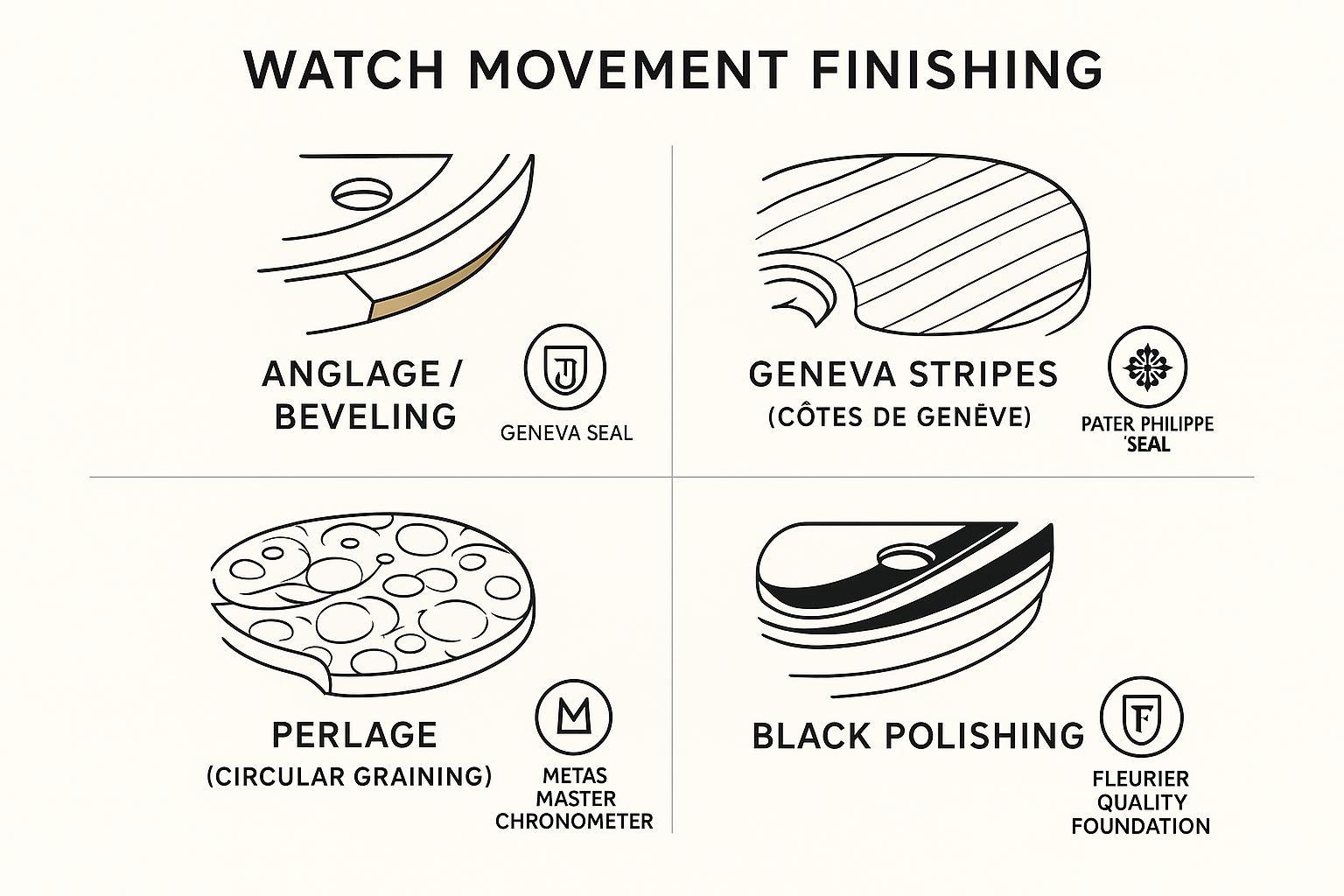
Watch movement finishing decoded
“Finishing” is not one thing. It’s a cluster of small, expensive decisions that are hard to fake convincingly.
- Anglage (bevelling)look for clean, even bevels that catch the light; “mirror” anglage is a higher bar and usually indicates more hand work. Analog:Shift’s guide to movement finishing is a collector-friendly breakdown.
- Geneva stripes (Côtes de Genève)the stripes should align cleanly across bridges; sloppy alignment is a tell.
- Perlage (circular graining)should be consistent and purposeful, not shallow “stamping.” Cortina Watch’s overview of perlage and Geneva stripes shows what the technique is meant to do.
- Black polishing (poli noir)a mirror polish that turns “black” at certain angles because the surface is perfectly flat; it’s labor-intensive and a strong signal when executed well.
Complications that matter in 2026
Complications matter when they fit your life and your tolerance for service complexity.
A practical way to think about it:
Daily-wear complications (useful, relatively serviceable): a well-executed date, dual time, or annual calendar.
Collector complications (high joy, higher ownership overhead): perpetual calendars, chronographs with pedigree movements, minute repeaters.
In 2026, a watch that’s hard to service is not “more special” by default. It’s just a watch that demands a better ownership plan.
Seals and certifications
Seals don’t replace judgment, but they can raise the floor.
- Geneva Seal (Poinçon de Genève)historically tied to Geneva origin and finishing standards.
- Patek Philippe Sealan in-house standard that covers both finishing and functional criteria.
- METAS Master Chronometerknown for real-world performance testing, including anti-magnetism.
- FQF / Fleuritestamong the more demanding labels.
Brand spotlights for 2026
These ultra luxury watch brands share one thing: demand is high, and access is managed. The differences are how it’s managed, and what ownership looks like after you get the watch.
Rolex: access and stability
Rolex is still the reference point for “access and stability,” even when access is the hard part.
If you want to buy at retail, your reality is relationship-led allocation. The practical approach is to be clear, consistent, and realistic about which references you want, and to focus on the long game. If you want speed, certified pre-owned and reputable secondary dealers can deliver it, but you pay for immediacy.
The watch itself is rarely the problem. The purchase path is.
Patek Philippe: heritage and scarcity
Patek’s scarcity isn’t a marketing slogan; it’s central to the brand’s positioning. In 2026, the key is to separate what you want emotionally from what you can support as an owner.
Heritage here is expressed in restraint and finishing discipline. The buying decision is less about “is it good?” and more about whether you want to enter a long-term relationship with the brand and its ecosystem (service, documentation, and collector expectations).
Audemars Piguet: design and allocation
Audemars Piguet remains one of the clearest examples of design that became an asset class of its own. The Royal Oak is the obvious center of gravity, and that has consequences.
Allocation is tight, boutique dynamics matter, and your experience can vary dramatically depending on how you approach the relationship. If the watch you want is the watch everyone wants, your plan needs to include time, patience, and alternatives.
Prices, allocation, and secondary trends
Indicative tiers and budgets
In ultra luxury, “budget” is less about what you can afford and more about what you’re willing to tie up.
Think in tiers rather than numbers:
Entry into serious collecting: high-quality pieces from major maisons, often in steel, with strong service infrastructure.
High-complication and precious metal: higher ownership costs and more diligence.
Independent haute horlogerie: the premium is often scarcity plus finishing; resale behavior depends heavily on maker reputation.
This avoids false precision. Specific prices shift, and the spread between retail and secondary can change faster than most buyers expect.
U.S. boutique and AD dynamics
In the U.S., allocation tends to reward clarity and consistency. In 2026, watch allocation 2026 is rarely a true “line”; it’s closer to a relationship-based matching process.
Practical moves that respect how the system works:
Prefer one or two relationships you build over time rather than “spraying” interest everywhere.
Communicate what you’ll actually wear and why; it helps the boutique place the right pieces with the right clients.
Keep a paper trail: emails, invoices, warranty cards, service receipts.
CPO and auction signals
CPO is the “risk-managed” middle ground: you often pay more than a private-party deal, but you get authentication, standards, and a warranty framework. That’s why certified pre-owned watches have become a mainstream path for buyers who value certainty.
If you’re using auctions as a signal, use them for education, not reassurance. Learn what condition and provenance do to outcomes, and how quickly tastes shift. The market is more efficient than it used to be, but it still punishes laziness.
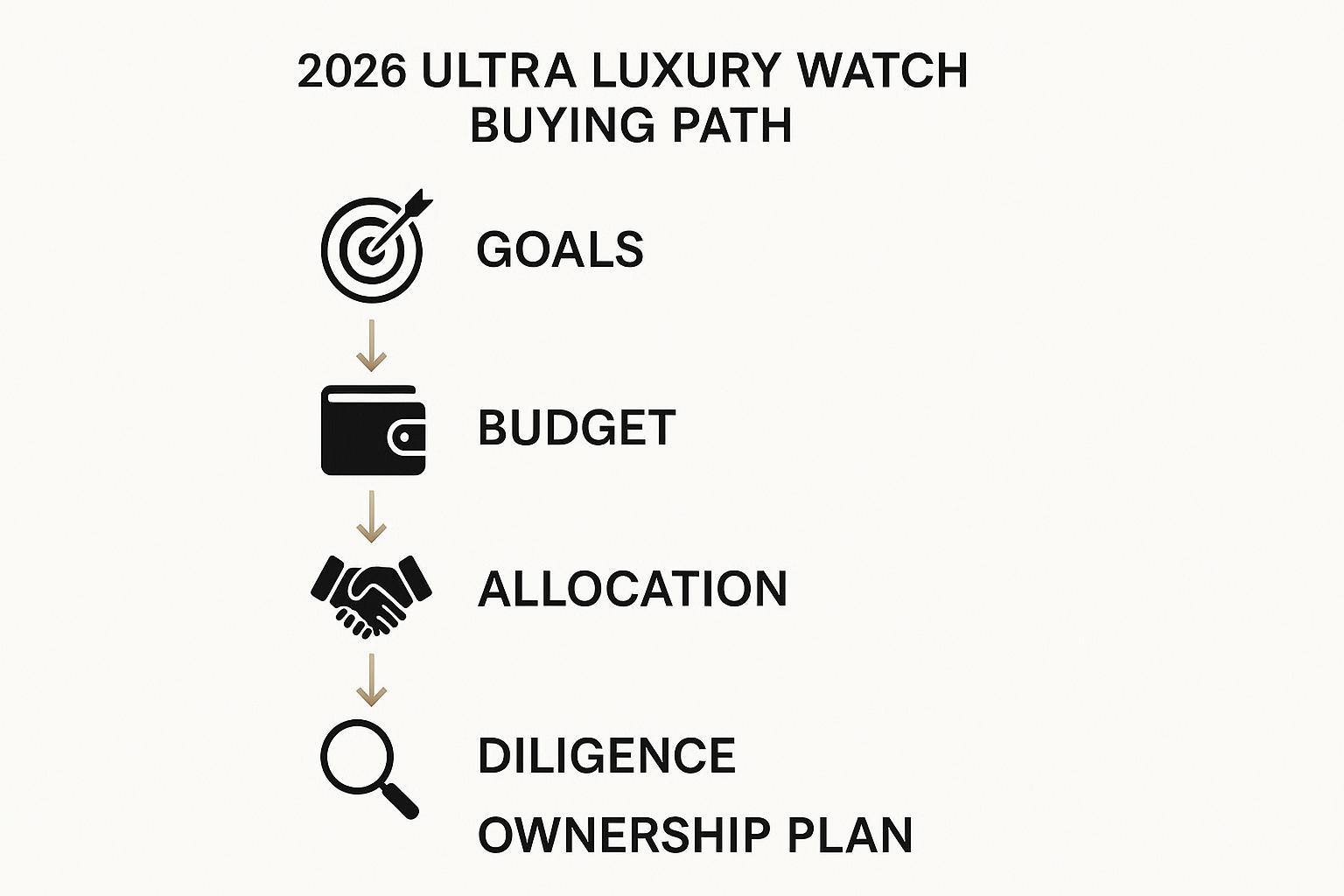
Your 2026 buying framework
Define goals and budget
Start with one honest question: What role will this watch play in your life?
Possible answers that lead to different buys:
A daily-wear signature piece you’ll travel with.
A rotation anchor for a small, disciplined collection.
A collector’s object (finishing, maker, complication) that you’ll wear less but value more.
Once you know that, your “budget” becomes a structure: purchase price plus a reserve for service, insurance, storage, and the occasional surprise.
Secure access and authenticate
Access is a strategy, and authentication is a habit.
How to verify: Don’t rely on one signal. Match serials and paperwork, scrutinize case and movement details, verify service history where possible, and buy from sellers who can explain provenance calmly.
Plan service, insurance, and exit
If you can’t explain how you’ll service and insure a watch, you’re not ready to buy it.
Know the service path (brand service center vs respected independent).
Insure for replacement risk, not nostalgia.
Keep your exit optional: preserve boxes, papers, receipts, and service documentation.
Ownership, protection, and risk
Service and warranty norms
Service intervals vary by brand and usage, but the principle is stable: oils age, seals degrade, and water resistance is not permanent.
As a baseline, guidance in pieces like Fratello’s best practices for watch ownership and Bob’s Watches’ guide to caring for a luxury watch supports a practical rhythm: service proactively, and test water resistance if you actually expose the watch to water.
Warranty is documentation-dependent. Keep cards, receipts, and service records together. Avoid unauthorized work if you care about manufacturer coverage.
Insurance and U.S. tax basics
Insurance is straightforward when you treat your watch like what it is: a portable, high-value object.
Schedule pieces properly (or use specialized coverage) and keep up-to-date photos and valuations.
Understand the policy’s exclusions; “mysterious disappearance” language matters.
On taxes: treat any specifics as situation-dependent. If you import or purchase abroad, use official guidance from U.S. Customs and Border Protection and the IRS and speak with your advisor.
Provenance and documentation
In 2026, provenance is part of the product.
At minimum, keep:
original box and papers,
the full receipt trail,
service records,
and any auction/catalog references tied to the piece.
For high-mobility owners, risk management is also logistical. This is one place where a discreet support layer can be useful.
VERTU’s model is relevant here in a non-watch-specific way: a 24/7 concierge can help coordinate time-sensitive logistics (travel changes, secure pickups, last-minute appointments), and its security tooling is positioned around protected communications and device-level safeguards. If you want to explore that side objectively, VERTU outlines its concierge scope in VERTU’s guide to the Vertu Concierge Service and its security support approach in VERTU’s overview of information security protection services.
Conclusion
What to prioritize in 2026 comes down to one disciplined idea: buy what you can service, document, and access.
If you want stability, focus on the icons, but accept that access is part of the price.
If you want craftsmanship you can feel, learn finishing, and let execution drive decisions.
If you want the most interesting collecting, look at independents, and be more demanding about provenance.
Next steps before Watches & Wonders and Geneva Watch Days:
Decide which brands you’ll pursue through boutiques vs CPO.
Prepare your documentation and insurance plan before you commit.
Book viewings with enough time to walk away.
Disclosure: This article references VERTU pages. Editorial judgment remains the priority.
![Top 10 Tourbillon Watches for Men [2026 Latest]](https://cdn.sanity.io/images/e0gp1l2g/production/8cb6bc45133cf9453382fc7d074465af588bb610-1800x1080.webp?w=180&h=180&q=78&auto=format&fit=crop)
![Top 10 Tourbillon Watches for Men [2026 Latest]](https://cdn.sanity.io/images/e0gp1l2g/production/8cb6bc45133cf9453382fc7d074465af588bb610-1800x1080.webp?w=800&h=450&q=82&auto=format&fit=crop)
![Top 10 Anniversary Gift Watches for Men [Full Guide]](https://cdn.sanity.io/images/e0gp1l2g/production/00dfa030a876edbe6ea7b146f6b1d8197c7656b0-3840x1860.webp?w=800&h=450&q=82&auto=format&fit=crop)