

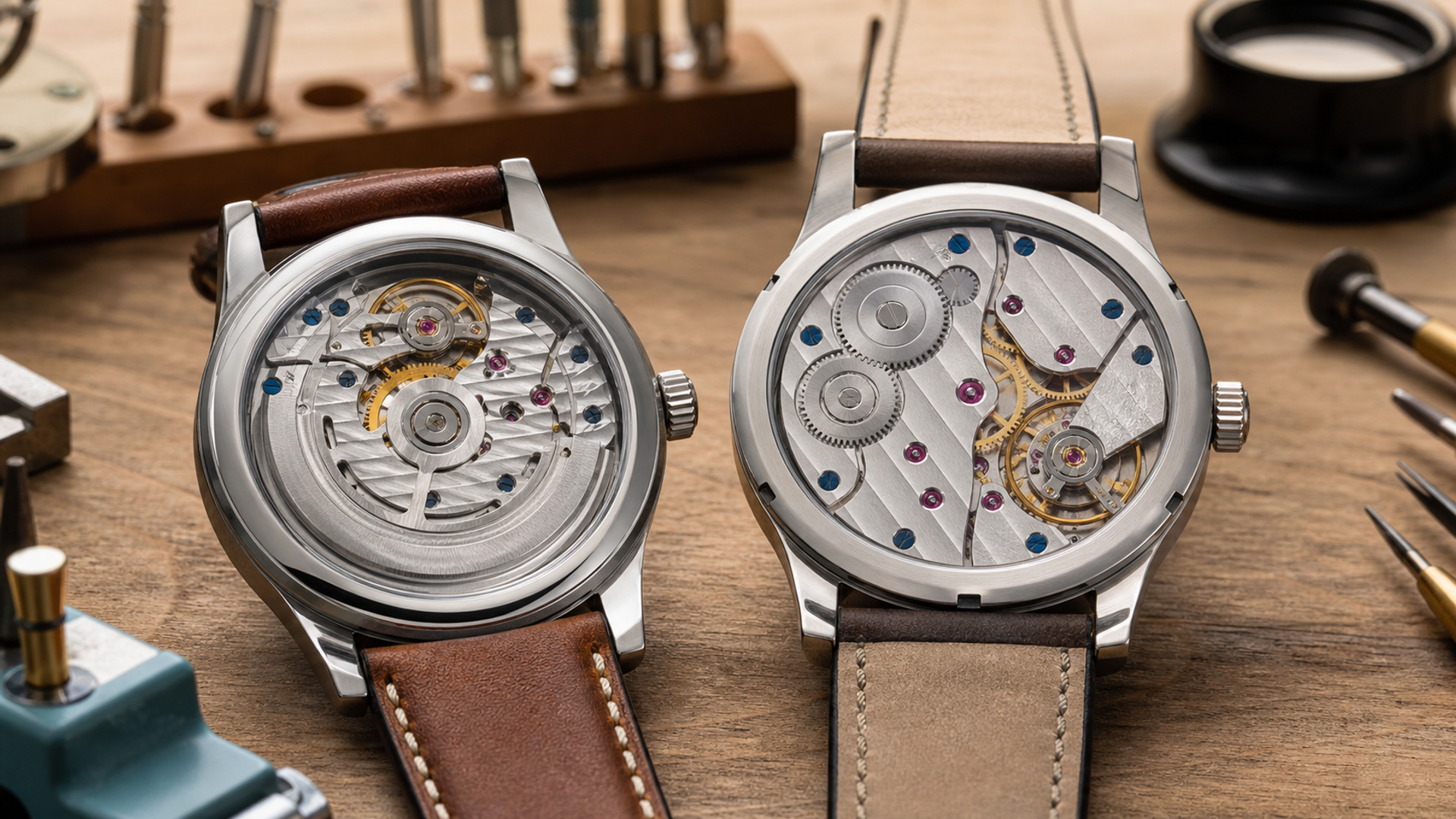
Automatic versus manual-wind watch compares how a mainspring receives energy and how architecture shapes ownership. An automatic movement uses a rotor and wrist motion, often with manual crown winding too. A manual movement removes the rotor and depends on deliberate winding. Thickness, movement view, reserve, crown feel, wearing frequency and service matter more than convenience-versus-purity slogans.
Start with wear pattern and ritual
Choose automatic for frequent wear when self-winding convenience outweighs rotor thickness. Choose manual wind when a thinner profile, unobstructed movement and deliberate ritual fit the owner. Choose another movement when accuracy, shock tolerance or low maintenance matters more.
| Decision factor | Automatic watch | Manual-wind watch | Choose another movement |
|---|---|---|---|
| Wear | Regular wrist time keeps reserve healthy | Daily winding is welcome | Choose quartz for irregular use |
| Profile | Rotor thickness fits the wrist | A hand-wound case improves proportion | Compare complete cases |
| View | Rotor motion is appealing | Unobstructed finishing is priority | Choose closed-back utility |
| Reserve | Reserve covers rotation | Owner winds before expiry | Avoid unnecessary winders |
| Crown | Occasional top-up is comfortable | Frequent winding feel is satisfying | Avoid a difficult crown |
| Service | Automatic works have support | Manual calibre has support | Choose best-supported movement |
This automatic vs manual watch matrix is the article's working value object. Read the automatic vs manual watch rows together: the decisive failure mode depends on this topic's evidence, operating context and reader objective.
What winding architecture changes
Evidence 1. Seiko describes automatic watches as spring-powered movements wound through wrist motion, often with manual winding too.
Evidence 2. Grand Seiko explains that manual movements require crown winding when used.
Evidence 3. Mechanical rate varies with temperature, movement, wear duration and winding state.
Evidence 4. Winding type alone does not determine power reserve, accuracy or service cost.
Reader-visible sources checked for this article:
seikowatches.com — reader-visible current or official evidence
grand-seiko.com — reader-visible current or official evidence
For automatic vs manual watch, these sources establish only the claims inside their documented scope. Recheck every changeable specification, availability condition, price, policy or service term in the relevant market before acting.
Inspect the exact calibre
The wear row exposes a practical boundary. Route one assumes regular wrist time keeps reserve healthy, while route two is defensible only when daily winding is welcome. Route three depends on choose quartz for irregular use. If that evidence is absent, keep the more reversible option.
Read profile as a stop/go test: rotor thickness fits the wrist supports the first option; a hand-wound case improves proportion supports the second; and compare complete cases supports the third. Record which source proves the condition and when it was checked.
A buyer can resolve view without starting from a brand preference. Ask whether rotor motion is appealing; compare that with whether unobstructed finishing is priority; then use choose closed-back utility as the third route's safeguard. An unknown condition stays unknown.
On reserve, popularity is not enough. The evidence for option one is that reserve covers rotation. Option two means owner winds before expiry. Option three is rational where avoid unnecessary winders. Recheck any changeable term immediately before commitment.
The decision changes at crown. Choose the first path only if occasional top-up is comfortable; move to the second when frequent winding feel is satisfying; use the third when avoid a difficult crown. Save the downside that would make this row fail.
For service, the first route works when automatic works have support; the second requires manual calibre has support. The control for the third is choose best-supported movement. Verify this row against the exact product, property, account or environment before it can reverse the decision.
Facts that would reverse the current choice
Reversal control 1 — Wear. Before choosing Automatic watch, write down how the decision changes if “Regular wrist time keeps reserve healthy” proves false. Do the same for Manual-wind watch and “Daily winding is welcome”. Keep the Choose another movement route available until “Choose quartz for irregular use” is verified. This control belongs to automatic vs manual watch; update it from the cited source or exact supplier rather than copying a generic checklist.
Reversal control 2 — Profile. Before choosing Automatic watch, write down how the decision changes if “Rotor thickness fits the wrist” proves false. Do the same for Manual-wind watch and “A hand-wound case improves proportion”. Keep the Choose another movement route available until “Compare complete cases” is verified. This control belongs to automatic vs manual watch; update it from the cited source or exact supplier rather than copying a generic checklist.
Reversal control 3 — View. Before choosing Automatic watch, write down how the decision changes if “Rotor motion is appealing” proves false. Do the same for Manual-wind watch and “Unobstructed finishing is priority”. Keep the Choose another movement route available until “Choose closed-back utility” is verified. This control belongs to automatic vs manual watch; update it from the cited source or exact supplier rather than copying a generic checklist.
Reversal control 4 — Reserve. Before choosing Automatic watch, write down how the decision changes if “Reserve covers rotation” proves false. Do the same for Manual-wind watch and “Owner winds before expiry”. Keep the Choose another movement route available until “Avoid unnecessary winders” is verified. This control belongs to automatic vs manual watch; update it from the cited source or exact supplier rather than copying a generic checklist.
Reversal control 5 — Crown. Before choosing Automatic watch, write down how the decision changes if “Occasional top-up is comfortable” proves false. Do the same for Manual-wind watch and “Frequent winding feel is satisfying”. Keep the Choose another movement route available until “Avoid a difficult crown” is verified. This control belongs to automatic vs manual watch; update it from the cited source or exact supplier rather than copying a generic checklist.
Reversal control 6 — Service. Before choosing Automatic watch, write down how the decision changes if “Automatic works have support” proves false. Do the same for Manual-wind watch and “Manual calibre has support”. Keep the Choose another movement route available until “Choose best-supported movement” is verified. This control belongs to automatic vs manual watch; update it from the cited source or exact supplier rather than copying a generic checklist.
Map the rotation
Record days worn, daily activity and how long each watch sits. Test crown size, resistance and turns because a large collection can stop an automatic and a manual ritual can be ignored. Record the exact model, material, room, recipe or operating condition and the time of the check. Keep the observation separate from a marketing promise, and repeat the test under the intended use rather than an ideal showroom condition. If the routine is unrealistic, change movement or rotation. Save the result and the evidence that would reverse it, because a change in fit, specification, service, price or environment must reopen this decision rather than inherit an old conclusion.
Compare the case
Measure diameter, thickness, lug length, caseback shape and weight. Try both under the intended cuff because removing a rotor does not guarantee a thin finished watch. Record the exact model, material, room, recipe or operating condition and the time of the check. Keep the observation separate from a marketing promise, and repeat the test under the intended use rather than an ideal showroom condition. If the complete case wears poorly, calibre elegance does not solve it. Save the result and the evidence that would reverse it, because a change in fit, specification, service, price or environment must reopen this decision rather than inherit an old conclusion.
Read calibre documents
Identify winding direction, reserve, recommended method, rate, magnetism and service guidance. Decide whether a rotor adds interest or hides finishing, and follow instructions near full wind. Record the exact model, material, room, recipe or operating condition and the time of the check. Keep the observation separate from a marketing promise, and repeat the test under the intended use rather than an ideal showroom condition. If documentation is vague, do not infer durability or performance. Save the result and the evidence that would reverse it, because a change in fit, specification, service, price or environment must reopen this decision rather than inherit an old conclusion.
Price service
Ask who can service the calibre, parts policy, water testing and transport. Separate automatic components from complications and proprietary parts that may dominate cost. Record the exact model, material, room, recipe or operating condition and the time of the check. Keep the observation separate from a marketing promise, and repeat the test under the intended use rather than an ideal showroom condition. If no plausible long-term route exists, ownership risk outweighs ritual. Save the result and the evidence that would reverse it, because a change in fit, specification, service, price or environment must reopen this decision rather than inherit an old conclusion.
Three collectors, three answers
One-watch daily collection
Automatic winding can preserve convenience. Define the fact that would reverse this recommendation before committing.
Slim planned dress watch
Manual winding can add ritual and movement view. Define the fact that would reverse this recommendation before committing.
Watch worn quarterly
Quartz or careful resetting may be more practical. Define the fact that would reverse this recommendation before committing.
Action checklist
Map wear.
Count rotation.
Test crown.
Check reserve.
Measure case.
Inspect back.
Read manual.
Verify rate.
Confirm service.
Save instructions.
Continue the decision
The linked VERTU articles expand adjacent parts of the automatic vs manual watch decision. They do not substitute for the external evidence above.
The winding verdict
Choose automatic for frequent wear when self-winding convenience outweighs rotor thickness. Choose manual wind when a thinner profile, unobstructed movement and deliberate ritual fit the owner. Choose another movement when accuracy, shock tolerance or low maintenance matters more.
Keep the automatic vs manual watch decision reversible until its material cost, safety, access, privacy and compatibility facts are verified. Unknown evidence stays unknown; it is never silently scored as favourable.
![How to Scan Receipts and Documents with Your Phone [Full Guide]](https://cdn.sanity.io/images/e0gp1l2g/production/0db13feec1d5e72b8a8a5f976d1f3e86619c9228-3840x1860.webp?w=180&h=180&q=78&auto=format&fit=crop)
![How to Scan Receipts and Documents with Your Phone [Full Guide]](https://cdn.sanity.io/images/e0gp1l2g/production/0db13feec1d5e72b8a8a5f976d1f3e86619c9228-3840x1860.webp?w=800&h=450&q=82&auto=format&fit=crop)
![Top 10 Two-Tone Carbon-Fibre Watches for Men [2026 List]](https://cdn.sanity.io/images/e0gp1l2g/production/18870799ba33fab0e038968359cd5772d7d7db30-1024x576.webp?w=800&h=450&q=82&auto=format&fit=crop)
![Top 10 Luxury Watches with Digital Complication Displays for Men [Latest]](https://cdn.sanity.io/images/e0gp1l2g/production/c4f6bf8c080f291c39f7cc85c7344ecff2fd3799-1024x553.webp?w=800&h=450&q=82&auto=format&fit=crop)