

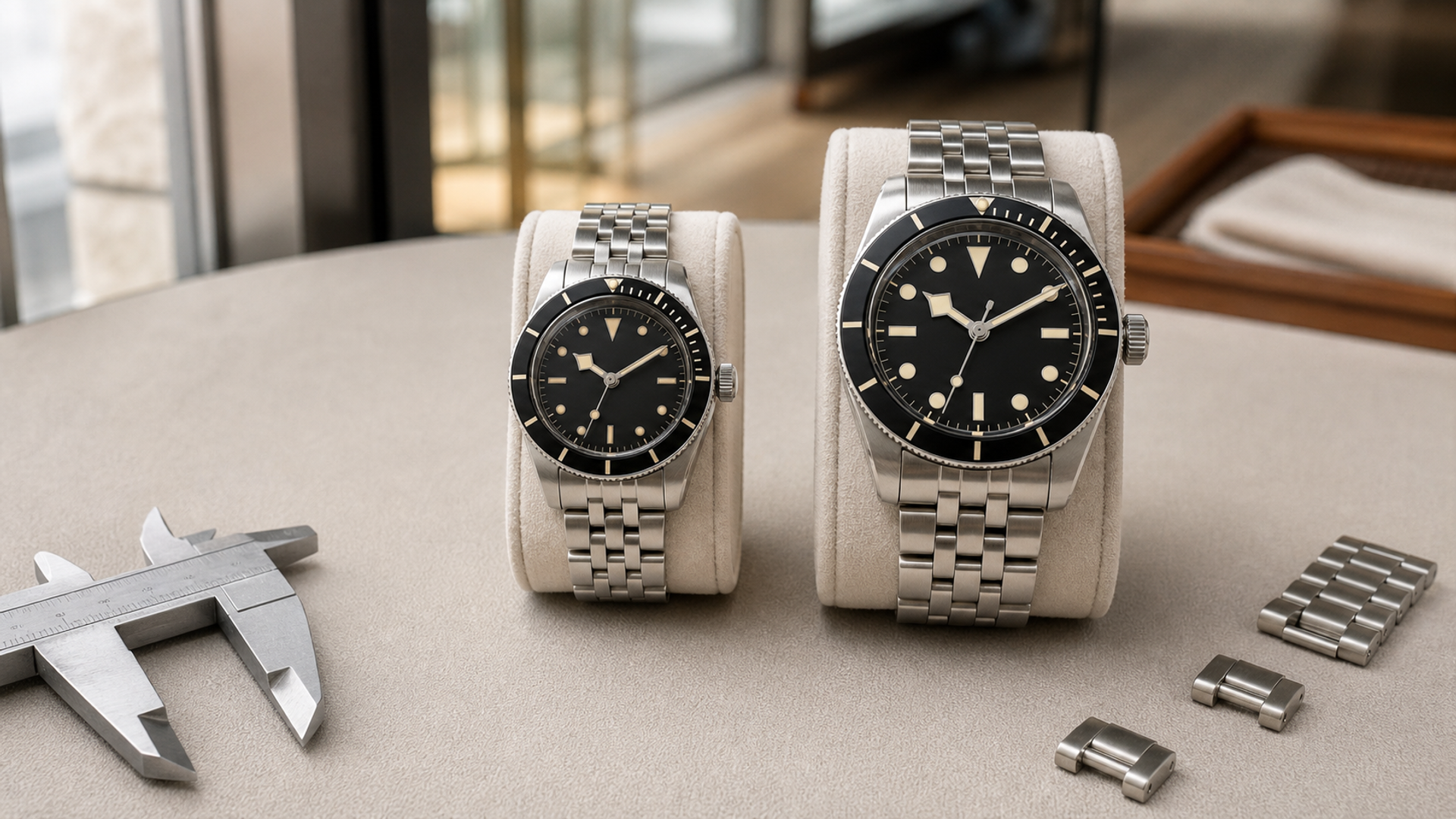
The Tudor Black Bay 54 and Black Bay 58 look close in a product grid, yet they behave differently on the wrist. The 54 uses a 37mm case and strips the dive-watch idea back to compact proportion. The familiar 58 uses a 39mm case, bringing more dial and bezel presence without becoming a large modern diver. Both are serious mechanical watches; the choice is fit, visual weight and collection role rather than hierarchy.
Dimensions alone are insufficient because bezel width, dial opening, lug shape, bracelet taper and wrist geometry affect perceived size. This guide turns the comparison into a fitting process and avoids claiming one reference is universally more collectible or better.
Quick answer
Choose the Black Bay 54 if you prefer compact vintage proportion, a watch that disappears under a cuff and less visual mass on wrists around the smaller-to-medium range. Choose the Black Bay 58 if you want stronger dive-watch presence, easier at-a-glance reading and a more conventional modern fit. Try both on the same wrist before deciding.
Decision matrix
| Decision factor | Option A | Option B | Practical edge |
|---|---|---|---|
| Case diameter | 37mm | 39mm | Wrist-dependent |
| Visual character | Compact and restrained | More assertive diver | Taste-dependent |
| Water resistance | 200m | 200m on core references | Tie |
| Power reserve | About 70 hours | About 70 hours on core references | Tie |
| Cuff fit | Easier | Still manageable | 54 |
| Dial legibility | Compact display | Larger visual field | 58 |
| Collection role | Understated daily or vintage slot | Primary everyday sports watch | Depends |
| Purchase test | Comfort and proportion | Presence and readability | Try both |
Case diameter is only the first measurement
The two-millimetre difference is visible, but it does not predict comfort by itself.
Lug-to-lug length, case thickness, bezel width and bracelet articulation decide whether the watch sits within the wrist or overhangs.
Use this test: Ask the retailer for the complete dimensions and photograph both watches from the same distance.
The 54 changes the design's visual density
Answer 37mm case makes the dial, bezel and markers feel more concentrated.
That density creates a period-correct impression and reduces visual dominance. Some owners read it as elegant; others find the dial too compact.
Use this test: Judge the watch at normal conversation distance, not only through a macro phone image.
The 58 is not simply the large option
At 39mm, the Black Bay 58 remains moderate by contemporary dive-watch standards.
Its advantage is familiar presence: the bezel is easier to grip visually and the watch balances with casual clothing or a larger frame.
Use this test: Compare it with your current everyday watch to understand whether the added presence fills a gap or duplicates a role.
Wrist shape matters more than circumference
A flat wrist can support a longer watch than a round wrist with the same measured circumference.
Bone position and bracelet fit determine where the case settles. Published wrist-size rules are therefore approximations.
Use this test: Fit both watches above the wrist bone and move the hand through a full range before choosing.
Bracelet sizing changes the verdict
A poorly sized bracelet can make the better case size feel wrong.
The number of removable links, clasp adjustment and taper affect weight distribution. Rubber or fabric alternatives alter the visual scale again.
Use this test: Request a near-final bracelet fit during the comparison rather than balancing a loose display watch.
Power reserve is effectively a draw
Core versions of both models provide weekend-capable reserve around 70 hours.
That means the decision should not be distorted by a specification they broadly share. Actual reserve also depends on state of wind and condition.
Use this test: Choose on fit and use; test reserve only if the watch later performs materially below specification.
Water resistance does not make either a maintenance-free tool
Answer 200-metre rating supports serious water use when seals and crown are in specification.
Age, impact and service history can change the real risk. Vintage-inspired styling does not remove routine pressure testing.
Use this test: Have water resistance checked before swimming if the service history is uncertain.
Legibility is personal
The 58 offers a larger visual field, while the 54 may feel cleaner because its elements are tightly composed.
Vision, lighting and contrast preferences vary. Photographs exaggerate differences and display lighting can hide reflections.
Use this test: Read each watch at dusk, indoors and from an oblique angle if the retailer permits.
Collection context should break the tie
A compact 54 can diversify a collection dominated by 40–42mm sports watches.
The 58 can serve as the only mechanical watch more easily for an owner who wants one versatile sports reference.
Use this test: Use the existing collection as a constraint: buy the role that is absent, not the version receiving more attention online.
Resale forecasts should not choose the size
Demand and secondary prices change with colour, reference, condition and fashion.
Buying an uncomfortable watch because a market observer predicts appreciation converts ownership into speculation.
Use this test: Prioritise fit, provenance and condition; treat any future value as uncertain.
Who should choose what
| Traveller or owner | Better fit | Why |
|---|---|---|
| Small, flat wrist and formal wardrobe | Black Bay 54 | Compact case and cuff clearance. |
| Medium-to-large wrist and one-watch use | Black Bay 58 | Greater presence and familiar sports proportion. |
| Collection already full of 40mm divers | Black Bay 54 | Adds a genuinely different scale. |
| Low-light reading is the priority | Try both; often 58 | Larger display may help, but contrast must be tested. |
Common mistakes
Using circumference alone to prescribe a case size.
Comparing a correctly fitted watch with a loose display bracelet.
Treating equal power reserve as a reason to ignore movement condition.
Buying for a predicted resale premium rather than repeat wear.
How to measure personal value
The useful value of Tudor Black Bay 54 vs 58 is the change it produces in a repeated, observable situation. Start with the article's value object—the wrist-size, case, movement, bracelet and collection-role matrix—and mark which rows affect your own behaviour. In the Tudor Black Bay 54 vs 58 decision, a feature that never changes a journey, security decision or ownership routine has little practical value even when technically impressive.
Use case diameter as the first controlled comparison: one side is 37mm, while the other is 39mm. Then add the frequency of the relevant trip or use, the cost of Tudor Black Bay 54 vs 58 mistakes, and the friction introduced by the more demanding option. For a Tudor Black Bay 54 vs 58 purchase, divide the meaningful premium by expected uses rather than calendar years; for privacy, include the time and support required to keep controls correctly configured.
Create a minimum-success condition for Tudor Black Bay 54 vs 58. For this Tudor Black Bay 54 vs 58 decision, success might be a full night's sleep, a watch still running on Monday, a phone policy that survives travel, or a bag carrying the real daily load without distortion. If neither Tudor Black Bay 54 vs 58 option meets that condition, defer the purchase, choose another configuration or redesign the trip.
How to verify a changing specification
Facts surrounding Tudor Black Bay 54 vs 58 can change after publication: airlines swap aircraft, manufacturers update references, software support terms move, and pre-owned condition differs from a catalogue description. Treat the current operator or manufacturer page as the Tudor Black Bay 54 vs 58 starting point, not as a guarantee that every individual booking or object matches the general description.
Capture the exact date, model, route, configuration, material, firmware or fare family used for Tudor Black Bay 54 vs 58. Save the official Tudor Black Bay 54 vs 58 specification and ask the seller or operator to resolve contradictions in writing. If a material Tudor Black Bay 54 vs 58 feature is not identified at transaction level, assign it zero value until confirmed rather than assuming the best possible version.
For Tudor Black Bay 54 vs 58, repeat the check immediately before the cancellation, return or change window closes. That second Tudor Black Bay 54 vs 58 check protects against substitutions and reveals whether the original decision relied on a benefit that is no longer available. Where Tudor Black Bay 54 vs 58 involves authenticity, law, safety or security, independent specialist verification remains more important than an editorial comparison.
Keep an evidence-backed decision record
A short decision record makes Tudor Black Bay 54 vs 58 auditable. Write the selected Tudor Black Bay 54 vs 58 option, the rejected alternative, the three decisive facts, the sources checked and the condition that would reverse the choice. Attach a Tudor Black Bay 54 vs 58 seat map, reference number, support policy, condition report or packing photograph where relevant. A Tudor Black Bay 54 vs 58 record is especially useful when an assistant, travel coordinator, buyer or family member must act later without reconstructing the reasoning.
Separate measured Tudor Black Bay 54 vs 58 facts from estimates. For Tudor Black Bay 54 vs 58, published dimensions, official benefits and documented support dates are facts for the referenced configuration; predicted sleep, resale, comfort and future availability are estimates. Label Tudor Black Bay 54 vs 58 uncertainty openly and avoid converting one reviewer's experience into a universal claim.
The decision record for Tudor Black Bay 54 vs 58 should also name an exit path: cancellation, return, service inspection, account suspension or resale review. A Tudor Black Bay 54 vs 58 option with a clear, affordable correction path can be safer than a theoretically superior option whose failure is difficult to reverse.
Review the outcome after real use
Review Tudor Black Bay 54 vs 58 after one representative trip or 30 days of ownership. Record which Tudor Black Bay 54 vs 58 benefits were used, what created friction, what failed to matter and what new constraint appeared. Do not ask only whether Tudor Black Bay 54 vs 58 felt premium; ask whether it solved the problem named in the decision record.
For the Tudor Black Bay 54 vs 58 review, travel decisions should note sleep, delays, connection effort and useful hours after arrival; watch decisions should note comfort, timing, reserve and frequency of wear. For Tudor Black Bay 54 vs 58 mobile privacy, review updates, permissions, account events and recovery readiness; for bags, inspect load, access, shape, marks and how often the object stayed at home.
That review turns Tudor Black Bay 54 vs 58 into evidence for the next decision instead of an isolated opinion. If the Tudor Black Bay 54 vs 58 outcome was weak, change one variable at a time—route, configuration, size, material, policy or use pattern—so the next comparison produces a clear lesson.
A verification checklist before you commit
For Tudor Black Bay 54 vs 58, confirm the exact reference, aircraft, fare, leather, device or service configuration rather than relying on a category label. Read the current Tudor Black Bay 54 vs 58 manufacturer or operator page, preserve the quoted specification, and identify which facts can change before delivery or departure. Where Tudor Black Bay 54 vs 58 involves money, safety or a high-value object, use a qualified seller, carrier, security team or specialist to verify the individual transaction.
Write the Tudor Black Bay 54 vs 58 decision in one sentence: the option, the problem it solves and the condition that would change the choice. This keeps prestige, scarcity or one Tudor Black Bay 54 vs 58 headline feature from replacing the actual use case. After Tudor Black Bay 54 vs 58 ownership or travel, record what happened so the next decision uses evidence rather than memory.
![How to Scan Receipts and Documents with Your Phone [Full Guide]](https://cdn.sanity.io/images/e0gp1l2g/production/0db13feec1d5e72b8a8a5f976d1f3e86619c9228-3840x1860.webp?w=180&h=180&q=78&auto=format&fit=crop)
![How to Scan Receipts and Documents with Your Phone [Full Guide]](https://cdn.sanity.io/images/e0gp1l2g/production/0db13feec1d5e72b8a8a5f976d1f3e86619c9228-3840x1860.webp?w=800&h=450&q=82&auto=format&fit=crop)
![Top 10 Two-Tone Carbon-Fibre Watches for Men [2026 List]](https://cdn.sanity.io/images/e0gp1l2g/production/18870799ba33fab0e038968359cd5772d7d7db30-1024x576.webp?w=800&h=450&q=82&auto=format&fit=crop)
![Top 10 Luxury Watches with Digital Complication Displays for Men [Latest]](https://cdn.sanity.io/images/e0gp1l2g/production/c4f6bf8c080f291c39f7cc85c7344ecff2fd3799-1024x553.webp?w=800&h=450&q=82&auto=format&fit=crop)