Tropical Storm Bertha formed in the Gulf of Mexico on 20 July 2026, with official warnings and forecasts changing as the system moves. The weather authority—not this article—controls the track, hazard and evacuation advice. The useful technology question is whether your phone still helps when power, mobile data or familiar routes fail. That can be tested before conditions deteriorate.
A modern phone combines alerts, maps, identity, payment, contacts, weather and sometimes satellite emergency features. Concentration creates fragility. Spend 30 minutes proving the essentials offline, then add paper and battery fallbacks. Do not drive, delay evacuation or move into exposed ground merely to obtain signal.
> The short answer: Charge the phone and power banks, enable authoritative alerts, download the relevant map, print key contacts and routes, and test every offline or satellite feature before the storm—not during an emergency.
The evidence boundary
The National Weather Service issued local Bertha watch information on 20 July. FEMA preparedness material recommends receiving alerts, preserving emergency contacts and including a mobile phone and extra battery. Apple states that Emergency SOS via satellite requires a supported iPhone, compatible region and clear view of the sky; it is not a general replacement for cellular service. Google notes that offline maps omit live traffic and some route modes.
At-a-glance decision matrix
| Check | Current signal | Decision use |
|---|---|---|
| Authoritative alerts | Emergency alerts enabled and local authority bookmarked | Test sound and access |
| Offline map | Home, shelter, hospital and inland route saved | Verify in airplane mode |
| Power budget | Phone, banks, cables and vehicle charging | Assign watt-hours |
| Emergency contacts | Numbers and meeting points available off-device | Print and share |
| Satellite limits | Supported device, region, software and clear-sky practice | Run the demo |
| Identity and payment | Critical documents and one physical payment fallback | Minimise exposure |
| Weatherproofing | Case, dry pouch and accessible port | Protect without overheating |
The matrix is deliberately asymmetric: a hard failure in identity, safety, compatibility or policy wording cannot be cancelled by several attractive features. Work from the controlling source to the practical test, and date every fact that can change.
Authoritative alerts
Follow the National Hurricane Center, National Weather Service and local emergency management for location-specific direction. Remove notification settings that silence emergency alerts, but do not rely on social reposts for evacuation zones or timing.
Decision: Test sound and access. Evidence to retain: Emergency alerts enabled and local authority bookmarked.
Offline map
Download a region large enough to include alternatives. Switch off Wi-Fi and mobile data, then search and route. Remember that live traffic, closures and walking or transit modes may be unavailable offline; the map is a base layer, not a live safety authority.
Decision: Verify in airplane mode. Evidence to retain: Home, shelter, hospital and inland route saved.
Power budget
Charge early and label each bank. Reduce screen brightness, background refresh and nonessential radios only when needed. Do not store lithium batteries in floodwater, direct sun or a hot vehicle, and do not use damaged or swollen packs.
Decision: Assign watt-hours. Evidence to retain: Phone, banks, cables and vehicle charging.
Emergency contacts
Write local emergency numbers, insurers, medical contacts and two meeting points on paper. Use short text check-ins when networks are congested. Decide who outside the affected area will relay family status.
Decision: Print and share. Evidence to retain: Numbers and meeting points available off-device.
Satellite limits
Apple provides a satellite demonstration that does not contact emergency services. Try it in safe weather. Satellite connection can be blocked by foliage or structures and shares specific emergency information; it is a last-resort feature, not a reason to remain in danger.
Decision: Run the demo. Evidence to retain: Supported device, region, software and clear-sky practice.
Identity and payment
Keep encrypted copies of essential documents but avoid a gallery full of unprotected IDs. Carry a physical card and some local cash where appropriate. If the phone is lost, account recovery must not depend solely on the same device.
Decision: Minimise exposure. Evidence to retain: Critical documents and one physical payment fallback.
Weatherproofing
A water-resistant rating is not flood insurance. Use a dry pouch, keep charging ports clean and dry, and avoid sealing a hot charging phone without ventilation. Back up before the storm in case water damage makes the device irrecoverable.
Decision: Protect without overheating. Evidence to retain: Case, dry pouch and accessible port.
Put the framework into a real decision
A family expects to shelter at home but may need to reach a relative inland. Mobile data fails while roads begin closing. The driver has an offline map, yet it cannot show flooding or a new closure. The safer plan combines the downloaded base map with official evacuation instructions received before departure, a printed route, local radio and a rule to stop rather than improvise through water. One person preserves battery and monitors alerts; another handles navigation and check-ins.
The 30-minute offline-readiness drill
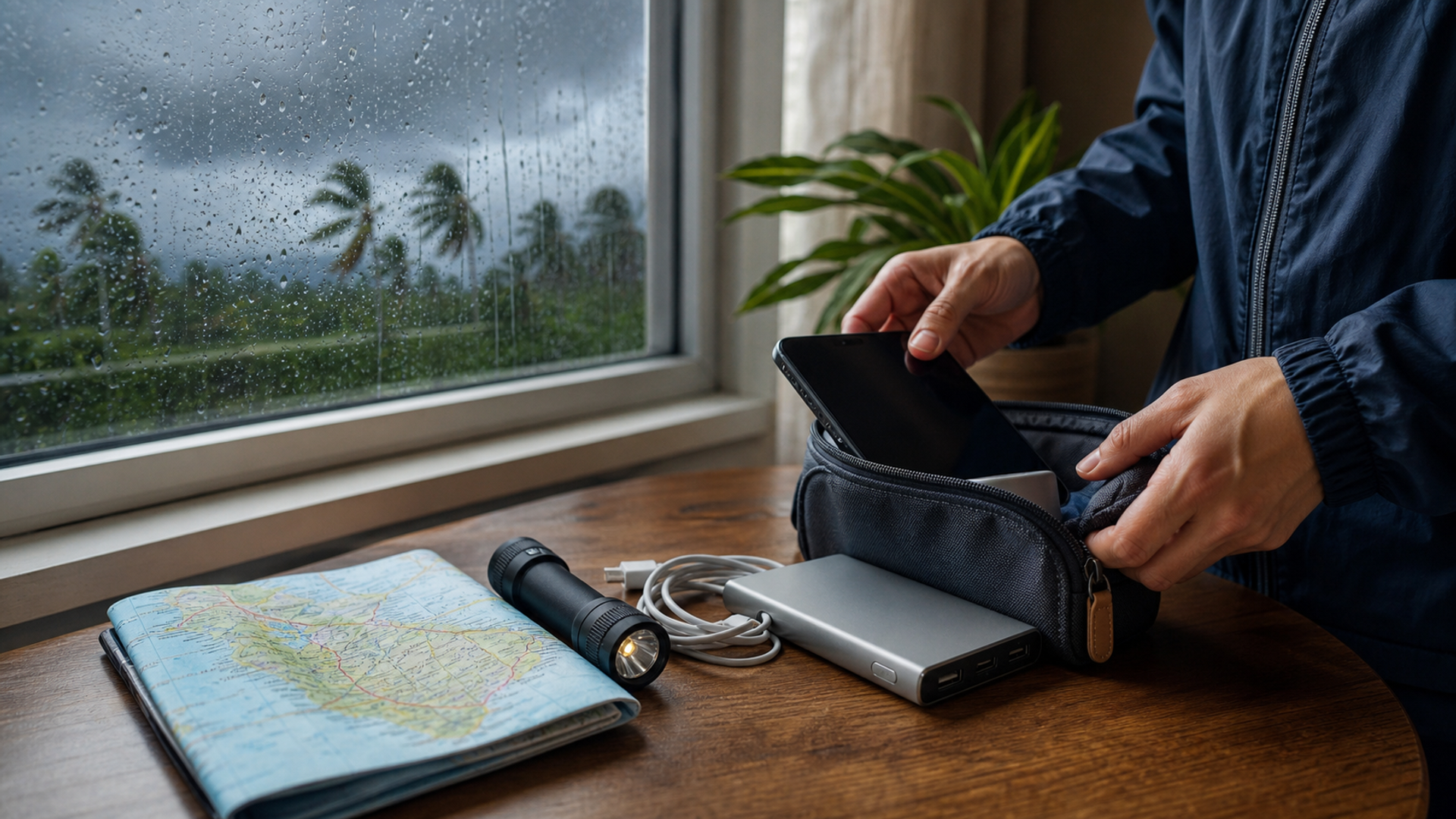
Spend five minutes on power. Charge the phone and power bank, enable battery percentage, identify low-power mode and find the cable that actually fits the bank. If people share one charger, agree priorities. Keep equipment away from water and follow local safety advice around generators and damaged electrical systems.
Use ten minutes on information. Save emergency numbers, household contacts, insurer details and the address of the shelter or meeting point. Download the relevant map area and test it in airplane mode. Save official weather and local-government pages, but remember that an old screenshot becomes dangerous as conditions change. When service exists, return to current official alerts.
Use ten minutes on communication. Send a test message to the out-of-area contact, agree a short status format and reduce unnecessary group traffic. Check emergency alerts and learn the device’s satellite emergency feature if supported in the region. Availability and conditions vary, so consult Apple or Google’s current instructions. Satellite service supplements planning and cannot guarantee a connection under every sky, terrain or device condition.
In the final five minutes, prove the offline kit works. Open the downloaded map, a saved contact card and one critical document without data. Keep identity documents encrypted and share only what a trusted delegate needs. Photograph property condition if safe, then conserve the battery. Bertha is the trigger for this drill, but local National Weather Service and emergency-management instructions control; evacuation and life-safety advice always outrank device optimisation.
Keep a dated decision record
A useful record for this specific decision contains the following fields: Authoritative alerts: Emergency alerts enabled and local authority bookmarked; Offline map: Home, shelter, hospital and inland route saved; Power budget: Phone, banks, cables and vehicle charging; Emergency contacts: Numbers and meeting points available off-device; Satellite limits: Supported device, region, software and clear-sky practice; Identity and payment: Critical documents and one physical payment fallback; Weatherproofing: Case, dry pouch and accessible port. Add the source URL, access date, market or account, person responsible for the check and the point at which the answer would change the decision. Do not overwrite an earlier observation when the facts move; append a new dated entry so the sequence remains visible.
Finish with one of four outcomes: proceed, wait, request evidence or decline. State the reason in one sentence and name the unresolved risk that remains. If another person must review the choice, they should be able to reconstruct it without relying on a screenshot detached from its source. This short record also makes later performance review more honest: the team can see whether the article's recommendation was based on facts available at publication or on information learned afterwards.
The useful outcome may be to wait, narrow the configuration, request written confirmation or decline the transaction. That is not indecision. It is the point of turning a volatile headline or complex ownership question into evidence that another person can review.
Action checklist
Follow official local alerts.
Download and airplane-mode test the map.
Charge and label every power bank.
Print contacts and two routes.
Try the satellite demo if supported.
Prepare physical payment and radio fallback.
Back up and protect the phone from water.
Complete the checklist before transferring money, erasing a device, changing a tenant-wide setting or exposing an irreplaceable object. Where a source is market-specific, repeat the check for the country, account and configuration that actually applies.
Related VERTU reading
These internal links answer adjacent decisions; they do not replace the current primary source for this article.
Sources and verification
Sources were accessed on 21 July 2026. Product availability, prices, software settings, weather guidance, insurance wording and event details can change. Recheck the live source before acting. Health, legal, insurance and emergency references are general information, not individual professional advice.
Final view
The phone is most useful before failure: while alerts can be checked, maps downloaded, batteries charged and recovery routes tested. Bertha's forecast will change, so follow official local instructions and evacuate when directed. A 30-minute offline test reveals which functions are real on your device and which depend on the network. Pair that technology with paper, radio, power and a family plan.