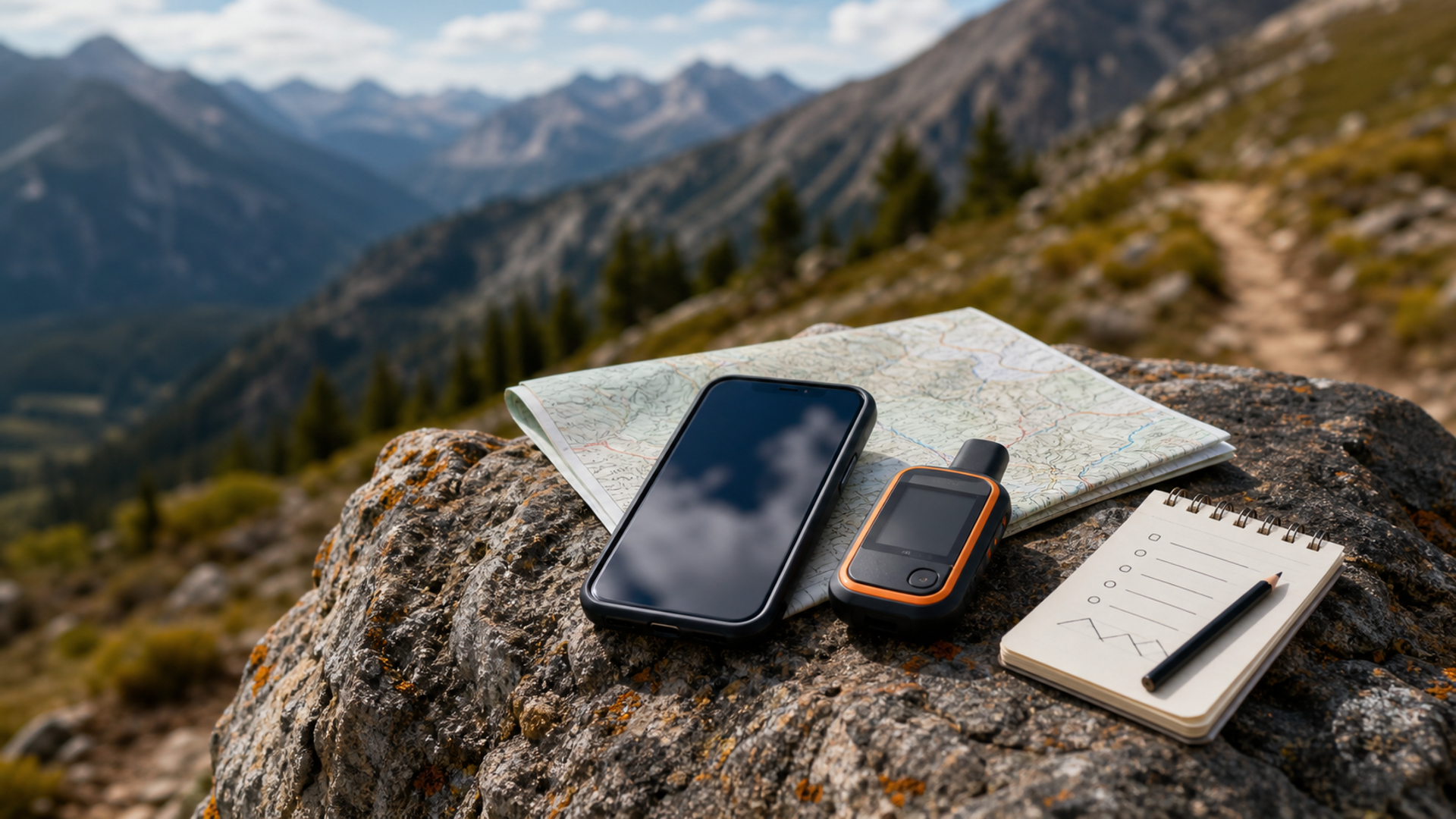
Satellite messaging on a modern phone can turn an ordinary handset into a valuable emergency tool. It does not automatically turn that phone into a complete off-grid communications system. The right choice depends on where you travel, whether you need routine two-way contact or only emergency assistance, how long you may be without power, and whether one damaged or lost device would remove both navigation and communication.
For a weekend drive through intermittent coverage, a supported phone feature may be enough. For a remote expedition, marine passage or team operating for days beyond mobile networks, a dedicated communicator can provide a more deliberate system. Some travellers should carry both—not because more gadgets are always better, but because the devices can remove different single points of failure.
The off-grid decision matrix
| Scenario | Phone satellite feature | Dedicated inReach communicator | Better starting choice |
|---|---|---|---|
| Road trip with occasional dead zones | Convenient; already carried; regional services vary | Extra device and plan may be unnecessary | Supported phone, after testing the demo |
| Day hike near populated areas | Emergency contact may be sufficient | Useful if route tracking and check-ins matter | Phone for low-risk routes; inReach if conditions are uncertain |
| Multi-day backcountry trip | Phone battery also serves camera, map and boarding tools | Separate battery and purpose; messaging and tracking plan | Dedicated communicator plus phone |
| International travel across many jurisdictions | Availability depends on model, purchase region, carrier and approvals | Broad service footprint, but devices can be regulated or prohibited | Research every destination before departure |
| Executive continuity during network outage | Useful for brief status messages where supported | Can create an independent channel and team tracking | Depends on continuity objective, not prestige |
| Life-critical expedition | One phone is a concentration of risk | Dedicated controls, plan and rehearsed SOS process | Redundant system with trained contacts |
The table is a planning tool, not a promise of connection. Buildings, terrain, foliage, weather, device position, network status and local regulation can affect service. Satellite contact should complement route planning, weather judgement and emergency preparation—not justify a risk you would otherwise avoid.
What a supported phone can do
Apple says iPhone 14 or later can use Messages via satellite in supported markets when mobile and Wi-Fi coverage are unavailable. Its current Messages via satellite support page distinguishes routine messages from Emergency SOS, lists market and model constraints, and recommends practising with the Satellite Connection Demo before going off-grid. Availability can differ for devices purchased in particular countries and regions.
Google’s Pixel Satellite SOS guidance focuses on emergency contact, supported Pixel models and listed countries. It also makes the physical requirement clear: the user needs a suitable view of the sky and may have to move away from trees, terrain or buildings.
Those services solve an important problem: the phone you already have can reach help or selected contacts where ordinary coverage disappears. The strongest advantages are convenience and low packing burden. The weaknesses are concentration and variability. The same phone may be your map, identity wallet, camera, hotel key, authenticator and battery-hungry entertainment device. If it is crushed, soaked, lost or flat, every function can disappear together.
What a dedicated communicator changes
A Garmin inReach device uses a separate device and service plan for satellite messaging, SOS, tracking and selected weather functions. Garmin’s subscription and availability guidance says an active subscription is required for communication features and warns that some jurisdictions regulate or prohibit satellite communication devices.
The dedicated device changes the architecture:
It has its own battery, controls and satellite radio.
It can remain attached to the person or pack while the phone is used for other tasks.
Preset check-ins and tracking can create a predictable communication rhythm.
A team at home can monitor a planned route when that feature and plan are configured.
The phone may still be used as a richer interface, but it is not always the only way to initiate an SOS.
The trade-off is operational overhead. The device must be charged, activated, paired if required, updated and included in the plan. Message allowances and overage charges vary. A communicator left in a drawer because its subscription lapsed is not redundancy.
Emergency SOS is not ordinary messaging
Keep three use cases separate:
Emergency SOS: a structured request for emergency assistance.
Routine two-way messaging: status, coordination and changes of plan.
Tracking or check-ins: periodic evidence that the traveller is following the route or is safe.
A phone may support one or more of these, depending on country and service. A dedicated communicator may support all three under an active plan. Do not infer that a device capable of sending one satellite text can provide continuous broadband, instant delivery or universal emergency dispatch.
Write the communications plan before choosing hardware. If the objective is “tell family I am delayed by two hours”, routine messaging matters. If it is “summon rescue after an injury”, the SOS workflow and response centre matter. If it is “allow an operations team to notice a missed checkpoint”, scheduled tracking and escalation matter.
Coverage is a chain, not a map colour
Marketing maps can show a theoretical service footprint. A successful message also requires a supported device, current software, active plan or entitlement, permitted jurisdiction, usable sky view and a functioning service at that moment.
Before departure:
Confirm the exact phone model and purchase region.
Check the service’s current country list, not an old review.
Verify the carrier requirement for SMS where relevant.
Activate the dedicated plan and send a real test message.
Download maps and emergency information for offline use.
Practise pointing or positioning the device outdoors.
Tell contacts what a normal check-in looks like and when silence becomes an escalation.
Do not test the SOS button casually. Use the manufacturer’s training or demo mode where provided.
Battery and physical resilience
Battery claims are measured under defined conditions. Cold, frequent tracking, poor sky view, screen use and repeated transmission attempts can shorten endurance. Build a power budget instead of relying on the headline number.
For a phone-only setup, reserve power for communication. Use downloaded maps, reduce screen brightness, avoid unnecessary video and carry a compliant power bank. Our 2026 flight-safe power-bank guide helps separate airline carriage rules from useful capacity.
For a two-device setup, decide which device stays on the body. A communicator buried in checked luggage or a pack swept downstream does not provide redundancy. Use a secure tether where appropriate and protect charging ports from grit and water according to the actual device rating.
International travel can change the answer
Satellite equipment is not treated identically in every country. Garmin explicitly tells users that some jurisdictions regulate or prohibit the use of satellite communications devices. Phone features can also be restricted by model origin, regulation or market approval.
This is not a detail to investigate at customs. Check official destination guidance, transit countries and any permit requirement before packing a dedicated device. If you use a corporate travel provider or concierge, ask for a written confirmation tied to the itinerary. Keep the ordinary connectivity layer ready as well; our eSIM, physical SIM and hotspot guide covers the part of the trip where terrestrial networks exist.
A five-minute pre-departure test
| Test | Pass condition | If it fails |
|---|---|---|
| Account and plan | Service shows active and current | Resolve before leaving coverage |
| Software | Device and companion app are updated | Update on trusted Wi-Fi, then retest |
| Outdoor connection | Demo or normal test connects with clear sky | Recheck region, setup and positioning |
| Contact loop | Named contact receives and recognises the message | Fix contact details and escalation wording |
| Power | Devices and backup supply cover the planned interval | Reduce load or add compliant capacity |
| Physical carry | Device remains accessible after a fall or pack separation | Change tether or carry position |
Which should you buy?
Choose a supported phone feature when the route is low to moderate risk, off-grid periods are brief, travel stays inside confirmed service markets and convenience is the priority. It is a meaningful safety improvement when configured and rehearsed.
Choose a dedicated inReach-style communicator when routine off-grid messaging, tracking, longer endurance, team coordination or separation from the phone is operationally important. Budget for the service plan and the discipline to keep it active.
Carry both when the consequences of losing communication justify redundancy. Separate the devices physically, define which one is primary for each task and give contacts a written escalation plan. The goal is not to own the most impressive satellite feature. It is to make a message, location or request for help more likely to get through when the ordinary network is gone.
Re-check the plan whenever the itinerary, season, device software or service terms change. A setup proven on one route is not automatically proven for another country, mountain range or operating team.