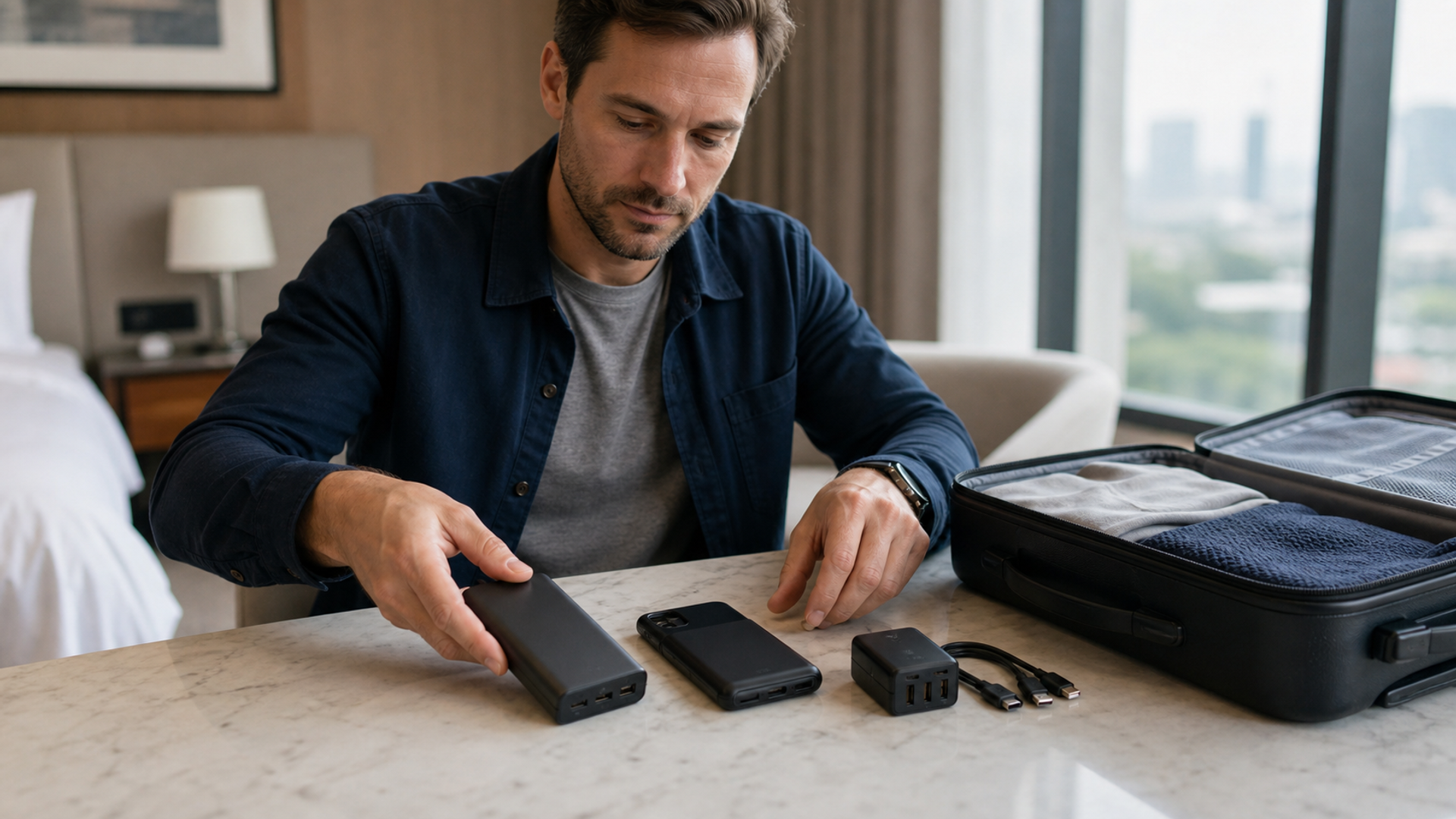
A power bank, a battery case and a compact wall charger solve three different failures. The power bank helps when there is no socket. The battery case removes cables from short bursts of charging. The wall charger restores several devices quickly when an outlet finally appears. Treating them as interchangeable leads to extra weight, slow charging or a flat phone during the one transfer that matters.
For most international travellers, the balanced kit is a reputable sub-100Wh power bank plus a compact multi-port charger and one short cable. A battery case makes sense when one-handed continuity matters more than weight and heat. The choice should follow the day’s dependency map, not the largest capacity printed on a box.
Flight-day power matrix
| Travel pattern | Best primary tool | Why | Main compromise |
|---|---|---|---|
| Airport, lounge and hotel with known outlets | Compact charger | Fastest reset with least carried battery | Useless away from a socket |
| Long economy flight or road transfer | Power bank | Flexible, shares power across devices | Another object and cable to manage |
| Constant mobile ticketing and messaging | Battery case | Integrated, quick top-ups without a loose pack | Heat, bulk and model-specific fit |
| Phone, watch, earbuds and laptop | Multi-port charger plus power bank | Covers both outlet and no-outlet periods | Requires cable discipline |
| Minimal overnight trip | Small charger only | Lowest weight when phone endurance is proven | No recovery if sockets fail |
The FAA’s current PackSafe lithium-battery guidance says spare lithium batteries, including power banks and charging cases, belong in carry-on baggage rather than checked baggage. It also says terminals must be protected and notes that airlines can impose stricter limits. IATA’s passenger baggage guidance is a useful international starting point, but the operating airline’s rule remains the final pre-trip check.
Convert marketing capacity into a usable estimate
Power banks advertise milliamp-hours, while airline rules often use watt-hours. The label should state watt-hours or enough voltage and capacity information to calculate it. A 20,000mAh pack at a nominal 3.7V is roughly 74Wh before conversion losses. It will not deliver its entire printed capacity to the phone: voltage conversion, cable resistance, heat and charging overhead consume part of it.
Instead of promising a precise number of recharges, estimate conservatively. Divide usable energy by the phone battery’s energy, then discount for losses and the fact that you rarely charge from exactly zero to exactly 100 per cent. A smaller, trustworthy pack with clear certification and a readable Wh label is more useful at security than an anonymous “ultra capacity” device with vague specifications.
Why a battery case is a specialist choice
A battery case excels when the phone must remain in hand: event ticketing, live translation, messaging a driver or shooting short video clips. It reduces cable tangles and cannot be left in a seat pocket as easily as a separate pack. Yet it adds weight every minute, can trap heat around the phone and becomes obsolete when the phone model changes.
Heat matters because charging, navigation, poor signal and bright displays can all raise device temperature. If the phone becomes unusually hot, stop charging, move it out of direct sun and remove the case if safe. Never use a swollen, damaged or recalled battery accessory. The FAA advises passengers to alert cabin crew immediately if a battery is overheating, expanding, smoking or burning.
The compact charger is the reset tool
A modern multi-port charger can replace several power bricks, but only if its output allocation matches the devices. The headline wattage may be shared across ports. When a laptop is connected, the phone port may receive less power; when three devices are attached, every port may step down. Read the actual port combinations rather than the single-port maximum.
Pack one cable that supports the intended power level and a second short cable for the phone. A high-wattage charger with a damaged or charge-only cable is not a resilient setup. Keep the essential cable in the personal item, not the overhead bag, so a gate check does not separate it from the battery.
A six-step pre-flight check
Photograph the battery label, including Wh and manufacturer details.
Check the operating airline’s battery and in-seat charging rules.
Inspect the pack and case for swelling, cracks, heat or damaged ports.
Charge all devices at home; a power bank is a fallback, not permission to depart empty.
Put spare batteries and power banks in the cabin bag with protected ports.
Download tickets and addresses offline so a flat battery does not erase the plan.
If the phone is already behaving abnormally, use the 10-minute unresponsive-screen triage before travel. More stored energy does not fix a failing display, damaged port or unstable operating system.
Match capacity to the actual itinerary
Run one rehearsal day before departure. Use navigation, camera, translation and hotspot functions as planned, and note the battery percentage at each transfer. This reveals whether the problem is capacity, charging speed or simply an undisciplined departure routine.
Repeat the test with the screen brightness and mobile signal conditions expected on the trip. Weak coverage can consume more energy than a quiet home test, while cold or heat can alter performance. Record the result instead of extrapolating from a manufacturer’s ideal laboratory figure.
Do not optimise only for the phone. A watch that holds a boarding credential, earbuds needed for a call and a laptop used for rebooking may compete for the same ports. Assign priority in advance: identity and communication first, navigation second, entertainment last.
Size the kit with a worked energy budget
Start with the lowest battery percentage you are willing to reach, not a promise of “two full charges”. Suppose a phone normally finishes a demanding travel day at 20 per cent, earbuds need one case top-up and the laptop must survive a one-hour call. The power bank does not need to replace every device battery. It needs enough usable energy to bridge the longest period without a reliable socket while preserving a reserve for identity, boarding and communication.
Write a simple budget before buying:
| Device or task | Minimum reserve | Why it matters | Preferred source |
|---|---|---|---|
| Phone | 30% at final transfer | Tickets, messages, maps and authentication | Power bank first |
| Earbuds | One call or translation session | Communication in a noisy environment | Charger when stationary |
| Watch | Enough for journey plus delay | Boarding or identity convenience | Charge before departure |
| Laptop | One essential work session | Rebooking, documents or meeting | Wall charger where possible |
If the calculation requires a very large battery simply to support entertainment, reduce demand before adding weight. Download media, lower unnecessary screen brightness, turn off background sync and carry documents offline. Energy efficiency is part of capacity planning.
Match ports, cables and charging protocols
A USB-C connector does not guarantee that every charger, cable and device will negotiate the same power. A cable intended for basic phone charging may limit a laptop. A multi-port charger may advertise its maximum only when one particular port is used alone. A battery case may accept power slowly even when connected to a high-output source.
Test the exact combination at home: charger, cable, power bank and each priority device. Connect devices in the order you expect to use them and watch whether charging begins, pauses or slows when another port is occupied. Label cables by role rather than trusting appearance. Retire any cable with bent connectors, exposed insulation or intermittent charging.
Avoid building a kit around adapters stacked into adapters. Every connection adds leverage and another point of failure in a loose aircraft or hotel socket. A small regional plug adapter plus a correctly rated charger is generally cleaner than a chain of converters, but voltage compatibility and local requirements must still be checked on the equipment label.
Plan for delay, damage and confiscation
The power plan should survive losing one item. Keep the compact charger and power bank in different accessible compartments, while both remain in cabin baggage as required. Save the model and Wh rating in the travel brief so airline staff can verify it without waiting for a dead phone to display a receipt.
If a pack is dropped, crushed, swollen, unusually hot or smells chemical, stop using it. Do not “use up the last charge” on an aircraft. Isolate it from metal objects and follow crew or local disposal instructions. If security refuses an unlabelled or non-compliant pack, accept the decision and switch to the prepared low-power routine; an argument at screening is not a charging strategy.
During a substantial delay, recharge whenever a verified outlet is available, but keep the phone within sight and disconnect before it reaches damaging heat. Public USB ports can introduce uncertainty; a trusted charger in an ordinary power outlet keeps the power and data paths separate.
The considered kit
Choose the wall charger for rapid overnight and lounge recovery, the power bank for long gaps between sockets, and the battery case only when integrated mobility outweighs heat and bulk. For a demanding travel day, carry two complementary tools rather than one oversized compromise: a clear-labelled power bank under the airline limit and a compact charger capable of restoring the phone, earbuds and computer when power returns.
The best travel charger is not the one with the biggest number. It is the one you can legally carry, verify at a glance and use without adding a new failure to the journey.


![Top 10 Tourbillon Watches for Men [2026 Latest]](https://cdn.sanity.io/images/e0gp1l2g/production/8cb6bc45133cf9453382fc7d074465af588bb610-1800x1080.webp?w=800&h=450&q=82&auto=format&fit=crop)