

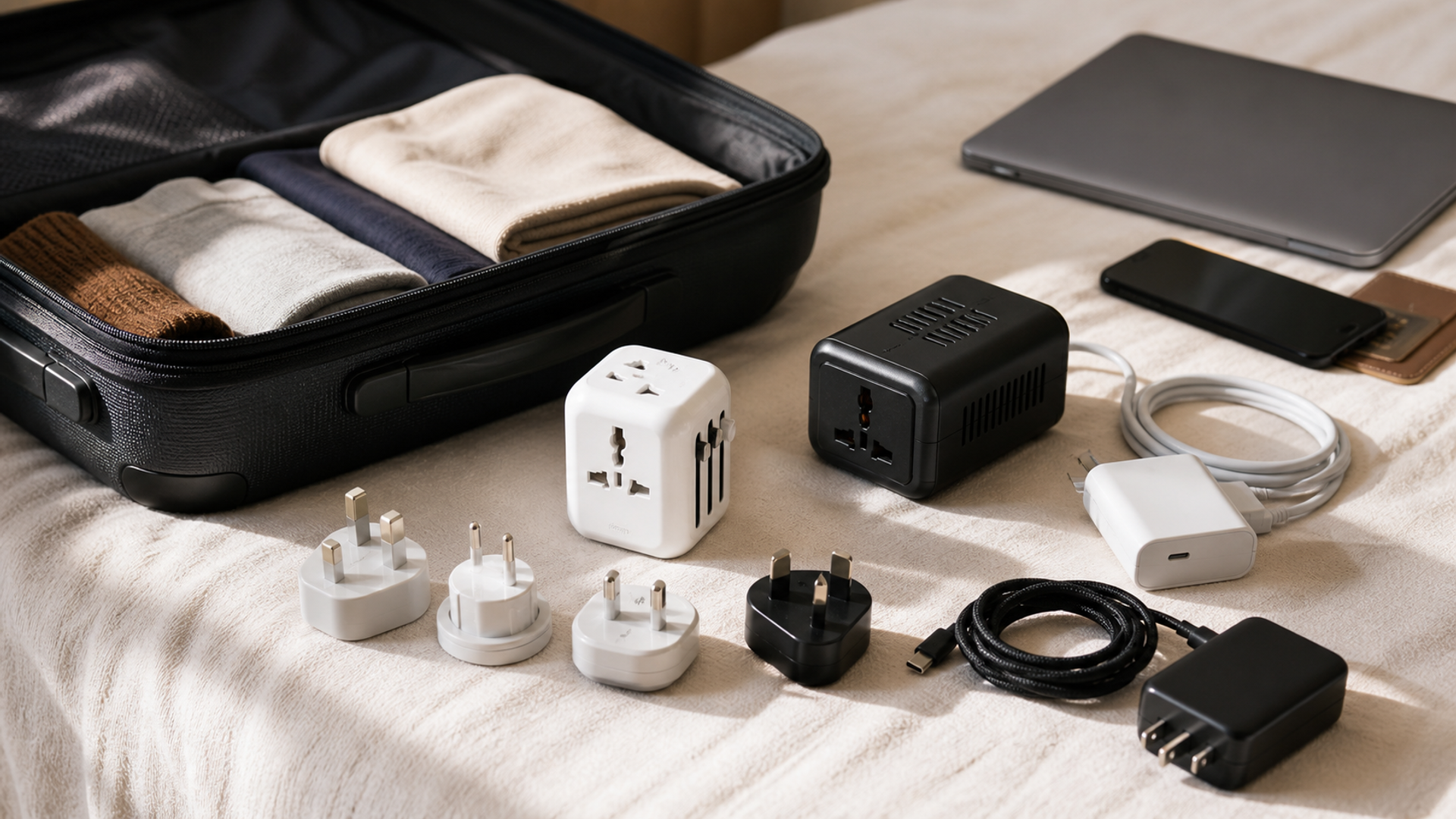
A travel adapter changes the physical plug connection; it normally does not change voltage. A voltage converter changes electrical voltage within defined input, output, wattage and duration limits. Confusing the two can damage equipment or create a fire risk. The decision starts with destination supply and every device's input label, not connector shape alone.
Read the device label before packing
Use a plug adapter when every device explicitly accepts destination voltage and frequency. Use a suitable converter only when a necessary single-voltage device falls within documented load and duty limits. Leave incompatible high-heat equipment at home when safe conversion cannot be verified.
| Decision factor | Travel plug adapter | Voltage converter | Use compatible local or dual-voltage equipment |
|---|---|---|---|
| Input label | Device accepts the destination voltage range | Device needs a different supported voltage | Do not connect equipment with unreadable ratings |
| Plug type | Adapter fits socket and grounded pins | Converter still needs the correct plug interface | Buy a certified local charger |
| Wattage | Adapter rating exceeds connected load | Converter continuous and surge rating exceeds load | Exclude heating or motor loads over limits |
| Frequency | Device tolerates local frequency | Converter documentation addresses the actual need | Avoid frequency-sensitive equipment without approval |
| Earth and protection | Grounding and shutters remain functional | Converter preserves required protection | Never defeat an earth pin |
| Travel use | Compact adapter supports chargers | Converter is justified for one essential appliance | Use destination equipment instead |
This travel adapter vs converter matrix is the article's working value object. Read the travel adapter vs converter rows together: the decisive failure mode depends on this topic's evidence, operating context and reader objective.
Plug shape and voltage solve different problems
Evidence 1. The IEC World Plugs resource documents national plug, socket, nominal-voltage and frequency conventions, showing that connector shape and supply are separate attributes.
Evidence 2. Many modern phone and laptop supplies accept 100-240 V, but the exact label must be checked rather than assumed.
Evidence 3. Simple travel adapters do not normally transform voltage; connecting a single-voltage appliance through one can be unsafe.
Evidence 4. Hair dryers, kettles and other heating appliances often draw wattage beyond compact converter and adapter ratings.
Reader-visible sources checked for this article:
iec.ch — reader-visible current or official evidence
travel.state.gov — reader-visible current or official evidence
For travel adapter vs converter, these sources establish only the claims inside their documented scope. Recheck every changeable specification, availability condition, price, policy or service term in the relevant market before acting.
Calculate the complete electrical chain
Read input label as a stop/go test: device accepts the destination voltage range supports the first option; device needs a different supported voltage supports the second; and do not connect equipment with unreadable ratings supports the third. Record which source proves the condition and when it was checked.
A buyer can resolve plug type without starting from a brand preference. Ask whether adapter fits socket and grounded pins; compare that with whether converter still needs the correct plug interface; then use buy a certified local charger as the third route's safeguard. An unknown condition stays unknown.
On wattage, popularity is not enough. The evidence for option one is that adapter rating exceeds connected load. Option two means converter continuous and surge rating exceeds load. Option three is rational where exclude heating or motor loads over limits. Recheck any changeable term immediately before commitment.
The decision changes at frequency. Choose the first path only if device tolerates local frequency; move to the second when converter documentation addresses the actual need; use the third when avoid frequency-sensitive equipment without approval. Save the downside that would make this row fail.
For earth and protection, the first route works when grounding and shutters remain functional; the second requires converter preserves required protection. The control for the third is never defeat an earth pin. Verify this row against the exact product, property, account or environment before it can reverse the decision.
The travel use row exposes a practical boundary. Route one assumes compact adapter supports chargers, while route two is defensible only when converter is justified for one essential appliance. Route three depends on use destination equipment instead. If that evidence is absent, keep the more reversible option.
Facts that would reverse the current choice
Reversal control 1 — Input label. Before choosing Travel plug adapter, write down how the decision changes if “Device accepts the destination voltage range” proves false. Do the same for Voltage converter and “Device needs a different supported voltage”. Keep the Use compatible local or dual-voltage equipment route available until “Do not connect equipment with unreadable ratings” is verified. This control belongs to travel adapter vs converter; update it from the cited source or exact supplier rather than copying a generic checklist.
Reversal control 2 — Plug type. Before choosing Travel plug adapter, write down how the decision changes if “Adapter fits socket and grounded pins” proves false. Do the same for Voltage converter and “Converter still needs the correct plug interface”. Keep the Use compatible local or dual-voltage equipment route available until “Buy a certified local charger” is verified. This control belongs to travel adapter vs converter; update it from the cited source or exact supplier rather than copying a generic checklist.
Reversal control 3 — Wattage. Before choosing Travel plug adapter, write down how the decision changes if “Adapter rating exceeds connected load” proves false. Do the same for Voltage converter and “Converter continuous and surge rating exceeds load”. Keep the Use compatible local or dual-voltage equipment route available until “Exclude heating or motor loads over limits” is verified. This control belongs to travel adapter vs converter; update it from the cited source or exact supplier rather than copying a generic checklist.
Reversal control 4 — Frequency. Before choosing Travel plug adapter, write down how the decision changes if “Device tolerates local frequency” proves false. Do the same for Voltage converter and “Converter documentation addresses the actual need”. Keep the Use compatible local or dual-voltage equipment route available until “Avoid frequency-sensitive equipment without approval” is verified. This control belongs to travel adapter vs converter; update it from the cited source or exact supplier rather than copying a generic checklist.
Reversal control 5 — Earth and protection. Before choosing Travel plug adapter, write down how the decision changes if “Grounding and shutters remain functional” proves false. Do the same for Voltage converter and “Converter preserves required protection”. Keep the Use compatible local or dual-voltage equipment route available until “Never defeat an earth pin” is verified. This control belongs to travel adapter vs converter; update it from the cited source or exact supplier rather than copying a generic checklist.
Reversal control 6 — Travel use. Before choosing Travel plug adapter, write down how the decision changes if “Compact adapter supports chargers” proves false. Do the same for Voltage converter and “Converter is justified for one essential appliance”. Keep the Use compatible local or dual-voltage equipment route available until “Use destination equipment instead” is verified. This control belongs to travel adapter vs converter; update it from the cited source or exact supplier rather than copying a generic checklist.
Build a device label sheet
Photograph the input plate on every charger and appliance. Record voltage range, frequency, watts or amps, connector and earth requirement. Do not group all USB, hair-care or medical devices together; each exact model controls. If the rating belongs to a removable power brick, document both brick output and device input.
Map the destination supply
Use IEC country data and current accommodation information to record socket types, nominal voltage and frequency. A country may use more than one socket. Include transit countries when equipment will be used during a stop. Carry only the interfaces actually needed and never treat a hotel shaver outlet as a general supply.
Audit ratings and protection
Check adapter current, voltage, total wattage and per-port limits, plus fuse, shutter and earth continuity. For a converter, check continuous versus short-duration duty, load type and thermal protection. A multiport charger may divide its stated output when several devices are connected.
Create a safer fallback
Prefer manufacturer USB-C supplies, destination-certified chargers or hotel appliances over carrying a converter for non-essential heat devices. For medical equipment, contact the manufacturer well before departure. Label the adapter bag, inspect for heat damage and discard loose or scorched hardware rather than improvising abroad.
Three travel kits
Phone, tablet and laptop trip
A rated grounded adapter may be enough when every supply accepts destination input. Define the fact that would reverse this recommendation before committing.
Single-voltage low-power device
A converter may work only after voltage, frequency, load type and continuous rating are verified. Define the fact that would reverse this recommendation before committing.
High-power hair dryer
Using destination equipment is often safer and lighter than a compact converter near its limits. Define the fact that would reverse this recommendation before committing.
Action checklist
Photograph input labels.
Check voltage.
Check frequency.
Identify plug types.
Record watts and amps.
Verify grounding.
Check total port load.
Exclude unsuitable heaters.
Pack a charger fallback.
Inspect hardware.
Continue the decision
The linked VERTU articles expand adjacent parts of the travel adapter vs converter decision. They do not substitute for the external evidence above.
The adapter-converter verdict
Use a plug adapter when every device explicitly accepts destination voltage and frequency. Use a suitable converter only when a necessary single-voltage device falls within documented load and duty limits. Leave incompatible high-heat equipment at home when safe conversion cannot be verified.
Keep the travel adapter vs converter decision reversible until its material cost, safety, access, privacy and compatibility facts are verified. Unknown evidence stays unknown; it is never silently scored as favourable.
![How to Scan Receipts and Documents with Your Phone [Full Guide]](https://cdn.sanity.io/images/e0gp1l2g/production/0db13feec1d5e72b8a8a5f976d1f3e86619c9228-3840x1860.webp?w=180&h=180&q=78&auto=format&fit=crop)
![How to Scan Receipts and Documents with Your Phone [Full Guide]](https://cdn.sanity.io/images/e0gp1l2g/production/0db13feec1d5e72b8a8a5f976d1f3e86619c9228-3840x1860.webp?w=800&h=450&q=82&auto=format&fit=crop)
![Top 10 Two-Tone Carbon-Fibre Watches for Men [2026 List]](https://cdn.sanity.io/images/e0gp1l2g/production/18870799ba33fab0e038968359cd5772d7d7db30-1024x576.webp?w=800&h=450&q=82&auto=format&fit=crop)
![Top 10 Luxury Watches with Digital Complication Displays for Men [Latest]](https://cdn.sanity.io/images/e0gp1l2g/production/c4f6bf8c080f291c39f7cc85c7344ecff2fd3799-1024x553.webp?w=800&h=450&q=82&auto=format&fit=crop)