Introduction
An executive phone in 2026 is no longer “the nicest flagship.” It is an endpoint in your security perimeter, a travel tool, and a productivity console that can’t go down mid‑day.
What executives and IT leaders need from the top 10 business phones in 2026:
- Predictable security posturefast patches, long support windows, and verifiable device integrity.
- Endurance that survives real workhotspot days, travel days, and conferencing—without a battery cliff.
- Operational fitfleet enrollment, policy control, and a workflow that doesn’t fight the rest of your stack.
This list balances enterprise phone security, battery life, and day‑to‑day productivity—while staying honest about what can be verified today (no rumor‑driven specs).
Models considered must be broadly available in the US with proven support windows. Where “2026 model” naming is ahead of confirmed hardware detail, the ranking leans on the factors that survive procurement: update policy, enterprise tooling, and ecosystem maturity.
Key TakeawayThe best secure business phone is the one your IT team can keep patched, enrolled, and compliant—without exhausting the executive carrying it.
How we ranked and tested
Security and update policy weighting
Security is the primary filter. For an executive smartphone, “secure” is not a checkbox feature—it’s the combination of:
Long software updates you can plan around (and a vendor that publishes scope clearly)
Enterprise management primitives (work/personal separation, allowlists, remote wipe, compliance)
Device integrity signals (hardware-backed trust) so your systems can verify the endpoint
On Samsung, the policy language that matters lives on Samsung’s Security Updates Scope. For Pixel, Google’s long-term commitment for newer generations is summarized in Google’s Pixel security updates commitment (Pixel 8+).
Battery endurance and charging metrics
“Battery beasts” means more than capacity. Battery scoring focused on practical endurance drivers:
long conferencing blocks
hotspot usage
travel-day roaming + background sync
always-on security controls (policy checks, authentication, VPN)
Charging matters too—not as a spec race, but as a recovery plan. Rapid top-ups are valuable when you have 20 minutes between meetings and no ability to be offline.
Productivity workflows and enterprise manageability
Productivity is measured by how quickly the phone lets you return to “decision mode”:
fast capture (voice notes, photos to PDF, scan and sign)
multitasking and document handling
secure authentication UX (biometrics, passkeys)
reliable device deployment and management
On iOS, zero-touch deployment depends on enterprise enrollment workflows described in Apple’s device deployment guide. In practice, this is the difference between “a great phone” and “a manageable fleet.”
Tier 1: Elite executive picks
Apple iPhone 17 Pro Max — longevity and seamless ecosystem
If your organization is standardized on Apple, the Pro Max tier remains the safe executive default: strong identity UX, mature management tooling, and minimal friction for executive-grade communication.
Why it earns Tier 1:
- Operational stabilityiOS fleets are predictable to run at scale when enrollment and policy are handled correctly.
- Ecosystem cohesioncontinuity across Mac/iPad and consistent enterprise app behavior.
- Low behavioral overheadexecutives are more likely to stay compliant when security doesn’t feel like work.
Battery context: the Pro Max class tends to suit long travel days where the phone becomes the hotspot, authenticator, boarding pass, and meeting device—often simultaneously.
Who it’s best for: leaders who live in calendar + email + docs and want the lowest-risk choice for enterprise support.
Samsung Galaxy S26 Ultra — Knox security, S Pen, and DeX power
Samsung’s Ultra line is built for executives who genuinely do work on a phone—reviewing documents, annotating, and running a desktop-like workflow when needed.
Why it earns Tier 1:
- Clear security maintenance postureSamsung publishes its security update scope and cadence publicly.
- Workflow advantageS Pen for review/approval moments; DeX for heavier work.
- Fleet friendlinessstrong enterprise ecosystem (especially valuable when you have multiple carriers and regions).
Battery context: the productivity features only matter if the phone stays alive through the day; Ultra-class devices tend to be chosen by people who spend hours in docs, calls, and messaging.
Who it’s best for: execs who need Android flexibility but want enterprise-grade control.
OnePlus 15 — endurance champion with rapid top‑ups
Not every executive wants the heaviest enterprise stack—some want a fast, durable daily driver that doesn’t die at 4 p.m.
Why it earns Tier 1:
- Battery life business phone profilethis slot is reserved for devices that prioritize day-long endurance under real workloads.
- Charging as resiliencequick top-ups reduce downtime between meetings and flights.
- Clean productivityfor many leaders, speed and reliability beat novelty features.
Who it’s best for: founders and operators who value battery + speed first, and whose IT policy allows a smaller OEM footprint.
Tier 2: AI and ecosystem standouts
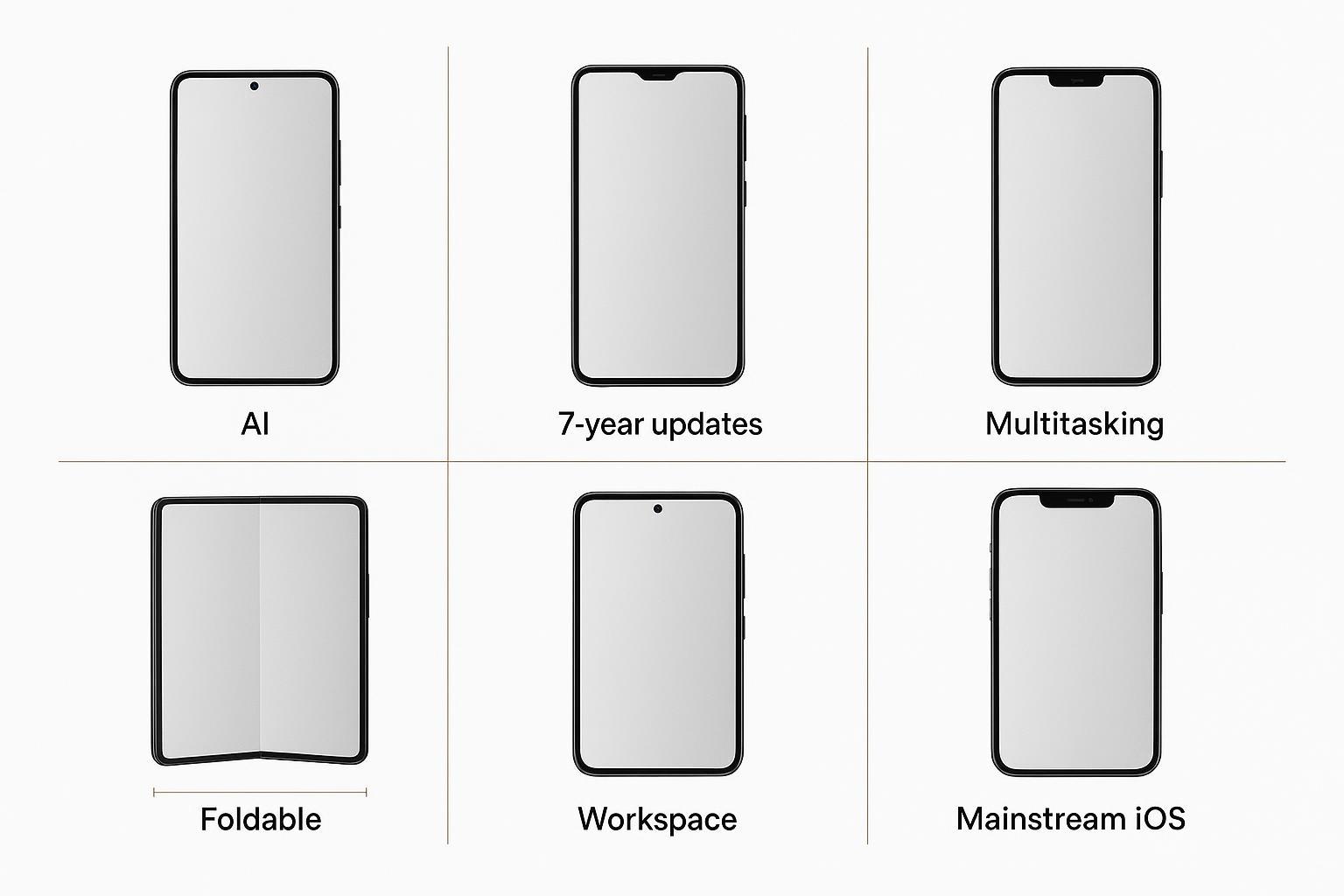
Google Pixel 10 Pro — 7‑year updates and native Workspace AI
Pixels are the clearest “Google-native” choice for organizations living inside Workspace.
Why it’s here:
- Long support commitment (newer generations)Google’s seven-year framing for newer Pixel lines is explicit in its public update messaging.
- Security + usability alignmentPixel’s value is often the balance—secure defaults without turning the device into a daily negotiation.
- Ecosystem advantagewhen your documents, identity, and communication live in Google’s world, the “native” experience reduces friction.
Samsung Galaxy Z Fold 7 — multitasking canvas for power users
Foldables make sense for a specific executive profile: the person who reads, reviews, and decides—constantly.
Why it’s here:
- True multitasking surfacesplit-screen email + document + chat is materially better on a foldable.
- Decision velocitya larger canvas can shorten review cycles—less zooming, fewer missed details.
- Mature enterprise toolingSamsung’s ecosystem reduces operational risk for a less common form factor.
Apple iPhone 17 — mainstream iOS option with long support
Not every business phone needs to be a Max or Ultra. For many organizations, the best fleet phone is the one that can be standardized widely with minimal exceptions.
Why it’s here:
- Standardizationsimpler procurement, accessories, and support.
- Lower variancefewer model types means fewer edge cases for IT.
- Executive UXit gets out of the way and stays consistent—valuable when your day is already fragmented.
VERTU offers discreet, concierge-led ownership for leaders: VERTU Concierge.
Tier 3: Balanced performers for fleets
Samsung Galaxy S26+ — cost‑savvy with full Knox stack
For fleets, the “plus” size is often the sweet spot: big enough for productivity, easier to carry than the Ultra, and typically friendlier for large rollouts.
Why it’s here:
- Enterprise manageabilitystrong support for provisioning, policy enforcement, and lifecycle operations.
- Balanced usabilityenough screen for real work without requiring a foldable.
- Procurement realisma device you can actually standardize beats a device your team can’t source consistently.
Google Pixel 10 Pro XL — larger display, same 7‑year policy
If your team likes the Pixel experience but wants more screen real estate, the XL size option is about visibility and review speed.
Why it’s here:
- Decision speedbigger canvas helps with documents and dashboards.
- Same update philosophythe value is policy + predictability, not a spec sheet.
- Executive ergonomicsfor some leaders, less squinting means fewer mistakes.
Tier 4: Alternatives to fit standards
Samsung Galaxy S26 — core flagship with broad carrier support
Sometimes the “best business phone” is the one with the least procurement friction. Core flagships tend to have the widest accessory compatibility and carrier availability.
Why it’s here:
- Standards-friendlyeasier to standardize across a mixed leadership team.
- Security postureestablished enterprise ecosystem and transparent update scope.
- Support realitybroad carrier support reduces the chance you’re forced into exceptions.
Google Pixel 10 — compact option for standardization
Compact phones still matter for executives who travel constantly or prefer minimal carry weight.
Why it’s here:
- Same enterprise modelmanaged-device controls still apply.
- Fleet simplicitya compact baseline can reduce exceptions if most users don’t need “Ultra” class hardware.
- Travel comforta phone you actually keep on you is a phone you can use.
Conclusion
A clean way to read this list:
Tier 1 is for executives who need maximum confidence (ecosystem + security posture) and maximum work output.
Tier 2 rewards organizations leaning into AI workflows and ecosystem fit—without turning the article into a spec sheet.
Tiers 3 and 4 exist for procurement reality: fleets need predictable rollouts and a consistent support story.
Guidance on lifecycle planning, management tooling, and procurement next steps:
Start with your policy posture (MDM/UEM, compliance checks), then pick the devices that fit it.
Audit which roles truly require exceptions (foldable, stylus) and keep that list short.
Treat battery as a security factor: dead phones produce risky workarounds.
Note on updating this list as 2026 models and policies evolve:
Re-check support promises annually.
Re-test battery under your real executive workload (hotspot + conferencing + travel).
Refresh procurement standards as carrier availability changes.
Disclosure: This article references VERTU pages. Editorial judgment remains the priority.
For discreet support around travel and coordination (beyond the handset), see a luxury phone with 24/7 concierge service and VERTU’s official luxury phone store.