Introduction
A luxury button phone in 2026 isn’t a nostalgic reaction against smartphones. It’s a deliberate choice: a device that treats communication as a controlled ritual, built like a personal object rather than a disposable slab.
In practical terms, “luxury” now means three things at once:
Network certainty (it must actually work on U.S. carriers, including voice).
Material truth (what you touch all day matters, and you can usually tell when it’s real).
Ownership continuity (service access, aftercare, and privacy posture matter as much as the handset).
This guide is written for U.S.-based HNWIs, collectors, and global entrepreneurs who want a keypad phone that feels uncompromising—and who have no patience for compatibility surprises or provenance ambiguity.
How to use this luxury button phone 2026 buying guide:
Start with Network readiness in the U.S. and treat it as a gate. If a device can’t pass the checks, don’t rationalize it.
Use Craftsmanship to judge whether the premium is visible in your hand.
Use Concierge, security, and ownership to decide whether the phone will reduce friction in your life—or become another object you maintain.
Only then look at Top picks, because “best” is contextual.
Network readiness in the U.S.
A luxury button phone can be flawless in build and still fail at the first moment that matters: placing a call on a U.S. network.
In 2026, U.S. carrier compatibility is less about raw signal and more about policy and provisioning: VoLTE requirements, IMEI recognition, and whether the device is treated as “known-good” by the carrier. In other words, buying a luxury feature phone requires the same discipline you’d apply to any mission-critical device: an IMEI whitelist check, verified voice provisioning, and band reality.
VoLTE and LTE bands that actually matter
VoLTE (Voice over LTE) is the baseline requirement. In practice, you’re verifying whether your model behaves like a true VoLTE feature phone US carriers will accept—meaning: voice works over LTE on your network, not just in a spec sheet.
If a phone can’t do VoLTE on your carrier, you may get “data works, calls don’t”—which is the most frustrating failure mode because it looks fine until you need it.
For LTE bands, think in two layers:
- Low-band coverage (reach + indoor reliability)the bands that keep you connected in elevators, hotels, and long drives.
- Mid-band capacity (city performance)the bands that keep data usable in dense areas.
A buyer-friendly way to interpret the U.S. landscape is:
- AT&Tprioritize devices that support Band 12/17 (coverage backbone) plus the common capacity bands.
- VerizonBand 13 still matters for reach.
- T‑Mobilelow-band Band 12 and Band 71 are important for extended range.
If you want a concise reference for what each major carrier tends to use, PhoneArena’s PhoneArena’s LTE band cheat sheet is a useful starting point.
How to verify IMEI and whitelist status (AT&T, Verizon, T‑Mobile)
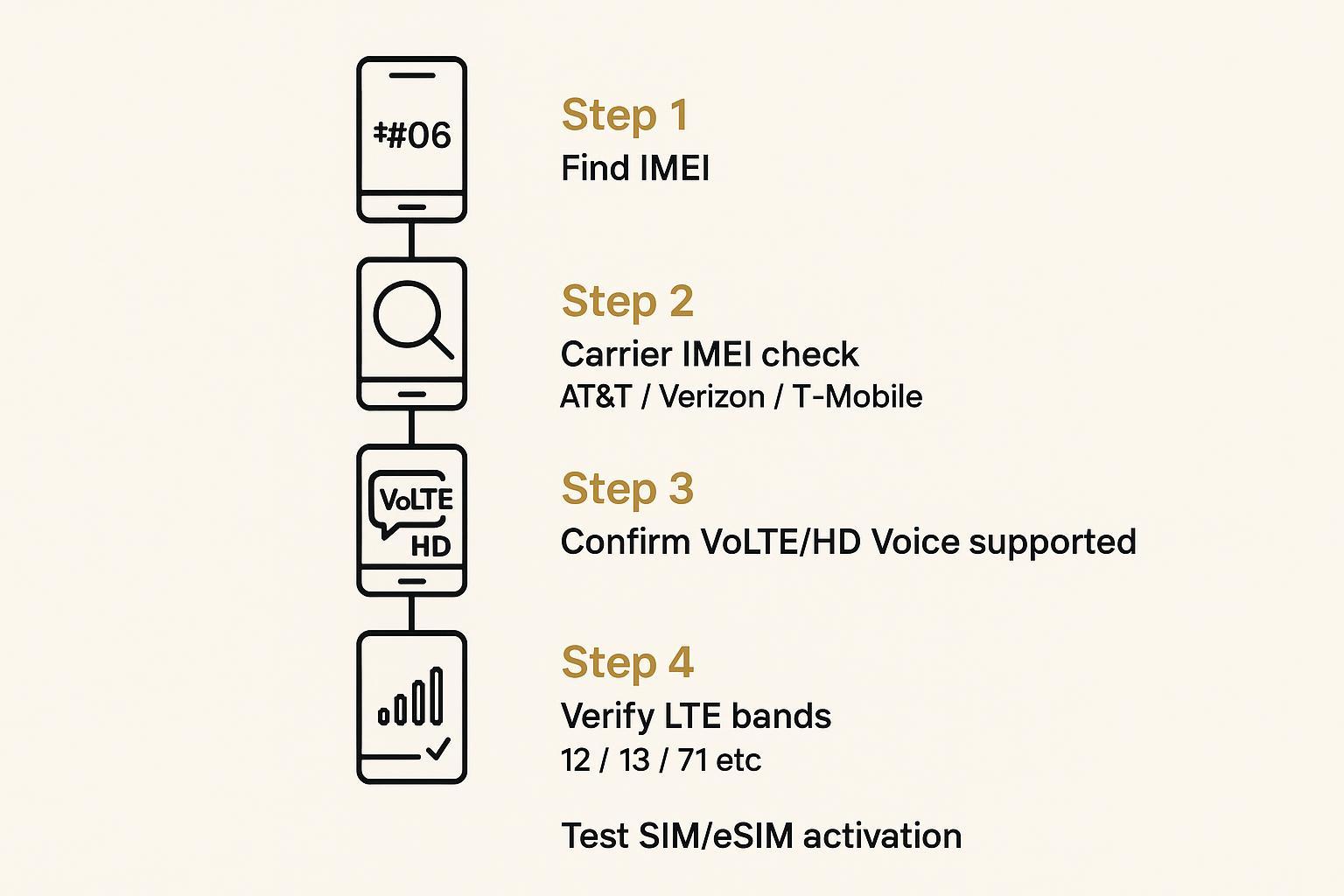
Treat compatibility as a repeatable workflow—think of it as a short audit you repeat every time you buy or activate a new unit.
Ask for the identifiers before money moves, then run the IMEI whitelist check on the carrier tools below.
How to verify
Get the IMEI (on most phones, dial
*#06#or check the device box).Run carrier checks:
AT&T: use the official AT&T IMEI check.
Verizon: use Verizon BYOD compatibility check.
T‑Mobile: verify via T‑Mobile activation flow or support/store lookup; policies can be stricter for uncommon devices.
Confirm voice capability: “LTE data” isn’t the same as “VoLTE voice.” Ask explicitly.
Verify band support against your expected use (home city + frequent travel corridors).
Two practical, non-negotiable notes for luxury buys:
- IMEI cleanlinesseven a genuine device can be blocked if it’s reported lost, tied to unpaid financing, or flagged for fraud. Make “clean IMEI” a condition of purchase.
- Whitelist realitysome carriers behave as if they maintain allowlists for certain devices. If the IMEI checker says no, treat it as a stop sign, not a debate.
Practical eSIM/dual‑SIM advice for travel (USA/Canada/Mexico)
If you travel, the most common failure isn’t technical—it’s operational. People install a travel plan in a rush, mis-route data, and accidentally roam on the wrong line.
A clean setup looks like this:
Keep your home line active for calls/SMS and OTPs.
Use a travel eSIM for data.
Turn data roaming off on your home line to avoid bill shock.
Choose plans that clearly state they cover the U.S., Canada, and Mexico if that’s your pattern. Many providers sell “North America” coverage, but the fine print (speed caps, hotspot rules, and activation windows) is what matters.
Install your travel eSIM profile on stable Wi‑Fi before departure to avoid activation failures on arrival.
Craftsmanship, materials, and durability
A luxury keypad phone is judged the way you’d judge a watch or a leather good: by what can’t be faked easily, and by what still looks correct after years of handling.
Sapphire, titanium, precious metals, and leather grades
Material claims are common. Material execution is rarer.
- Sapphire crystallook for clarity at the edges, clean transitions, and the absence of distortion.
- Titaniumshould feel intentional—light for its strength, with a finish that doesn’t read as painted-on.
- Precious metalsvalue is in both the metal and the finishing; soft edges and inconsistent polish can be a red flag.
- Leatherinspect stitch tension, edge paint (or lack of it), and how the leather is wrapped around curves.
A simple rule: if the “premium” is only visible from three feet away, it’s probably not premium.
Keyboard ergonomics, ruby key, and daily‑wear resilience
Button phones live or die by tactility.
When you test a keypad, pay attention to:
- Key travel and resetdoes the key rebound cleanly, or feel mushy?
- Consistency across the gridone “off” key suggests assembly or wear issues.
- Edge tolerancebuttons that wobble or snag are a durability warning.
For luxury keypad phones that use a dedicated concierge access key (often associated with a ruby-set button), treat it as both a design element and a usability feature: you want it easy to find without looking—but hard to press by accident.
Warranty and authorized service expectations in 2026
In 2026, durability isn’t just “will it survive drops.” It’s also:
Can you get authorized service without friction?
Is there a clear route for battery replacement or core component repair?
What happens if you travel and need support outside your purchase location?
A serious luxury purchase should come with clarity on aftercare—especially if you plan to keep the phone as a long-term object rather than a short-term novelty.
Concierge, security, and ownership experience
A luxury button phone is often bought for what it stops you from doing: constant scrolling, constant notifications, constant exposure.
But the higher-end ownership proposition is about what it enables—quietly.
What 24/7 concierge changes about a phone
A true 24/7 concierge layer changes the phone from “device” to “access point.” The difference is practical:
You’re not just searching—you’re delegating.
You’re not collecting options—you’re asking for a confirmed outcome.
You’re not managing edge cases alone—there is a human escalation path when plans change.
In VERTU’s world, concierge is often discussed as a defining part of ownership, historically associated with a dedicated hardware access button and a service layer designed to handle coordination-heavy requests (travel adjustments, reservations, sourcing, logistics). For readers comparing concierge models, start with the official VERTU Concierge overview to understand how the service is framed.
Hardware security, privacy, and data sovereignty
Security is easy to market and harder to operationalize. For buyers in 2026, the useful questions are specific:
What data is stored (and where)?
Who can access your requests, and is access role-based?
How long is data retained (logs, transcripts, metadata)?
What is shared with third parties to execute requests (venues, airlines, drivers), and can you limit it?
“Data sovereignty” in this context is less a slogan and more a posture: your expectation that sensitive personal and business details aren’t casually replicated across systems you don’t control.
A concierge ecosystem can support that posture when it’s designed with guardrails—clear scopes, minimal disclosure, and an understanding that discretion is part of the product, not an afterthought.
Price bands and what you get in 2026
Luxury keypad phones don’t price like mainstream electronics—and this is where a luxury button phone 2026 buying guide helps you separate materials and scarcity from noise. They price like objects with materials, scarcity, and aftercare.
Typical ranges from $3,500 to $45,000+ (and bespoke beyond)
In 2026, you’ll typically see a broad range—from $3,500 to $45,000+—before bespoke commissions push beyond standard catalog pricing.
At the lower end of luxury, you’re often paying for:
the build and tactile experience
a baseline of service access
a recognizable design language
At the higher end, pricing increasingly reflects:
precious materials and complex finishing
limited editions and provenance
rarity that holds collector interest
Where materials, editions, and provenance drive cost
Three price drivers matter more than spec sheets:
- Material tiersapphire, titanium, precious metals, leather grade.
- Edition logicnumbered runs, regional editions, special executions.
- Provenance strengthpaperwork, service history, and a story that’s verifiable.
If you’re buying as a collector, remember: a device with weak provenance can be expensive and still be a poor asset.
Buying channels—official, boutique, vetted resellers, auctions
Your safest order of operations:
Official and boutique channels when you want clean provenance and straightforward aftercare.
Vetted resellers when you can verify identifiers and return terms.
Auctions only when you’re comfortable treating the purchase like art: condition reports, documentation, and pricing volatility.
If you’re comparing current families and how they’re positioned, the Vertu phone models guide is a practical internal reference.
Top picks: best luxury button phone models for 2026
These picks are presented as archetypes, not as universal winners. Your “best” depends on whether your priority is daily reliability, precious-material ownership, or collector-grade scarcity.
Signature S / S+: trusted classic with 4G/VoLTE and concierge
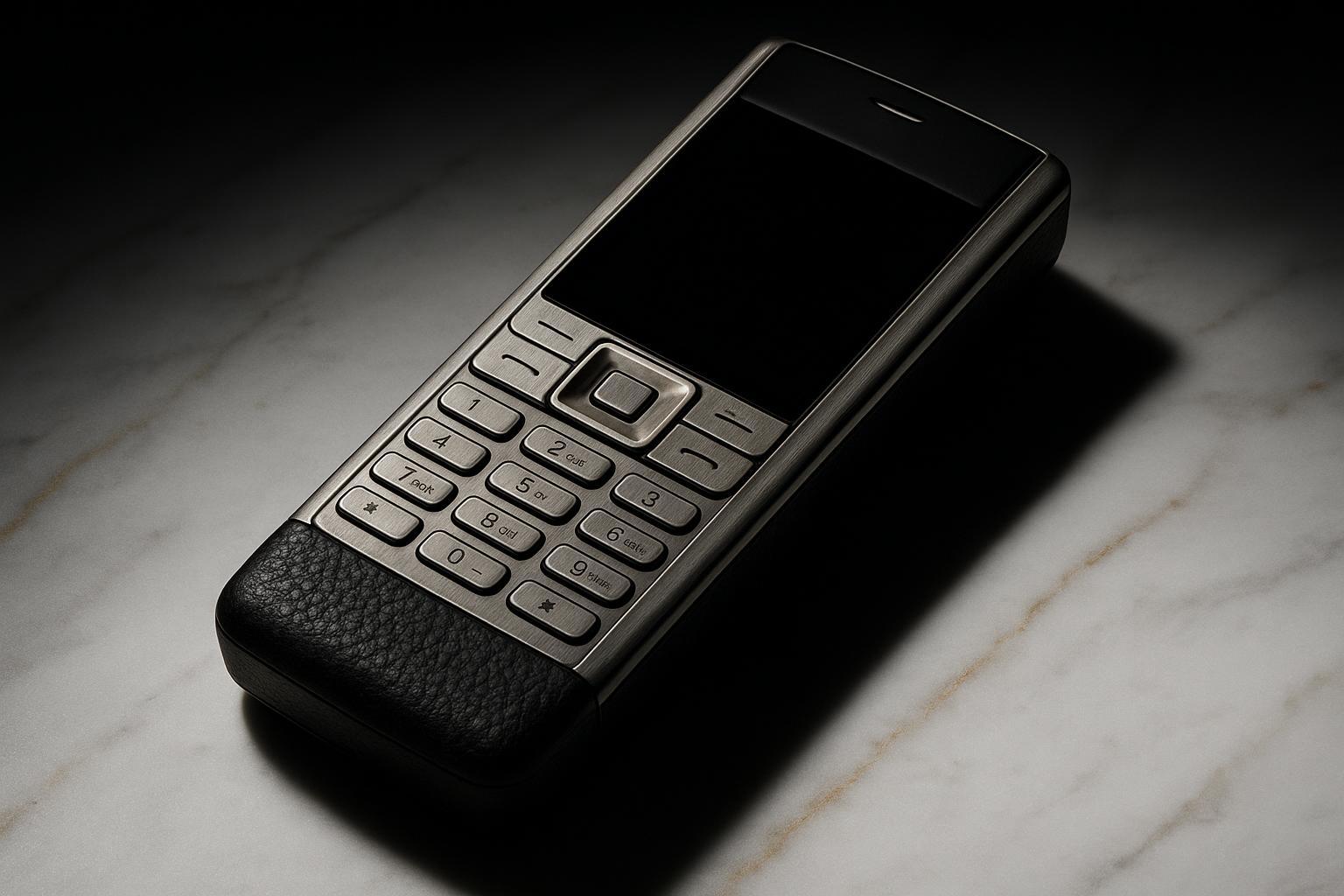
For many buyers, the appeal of a Signature keypad phone is that it’s intentionally narrow: calls, messaging, and a tactile ownership experience—without the cognitive overhead of a full app ecosystem.
When evaluating any “Signature S / S+” style offering for U.S. use in 2026, keep the decision clean:
Confirm VoLTE support on your specific carrier.
Run the IMEI compatibility checks (especially if buying pre-owned).
Validate how service access is provisioned for the device.
For a broader overview of what the Signature line represents (and what to inspect before buying), see Vertu Signature phone explained.
Signature V and precious‑metal editions (incl. Full Gold)
Signature V is often the reference point for modern luxury keypad execution: materials-first, tactile-first, with the phone treated as an object you handle with intention.
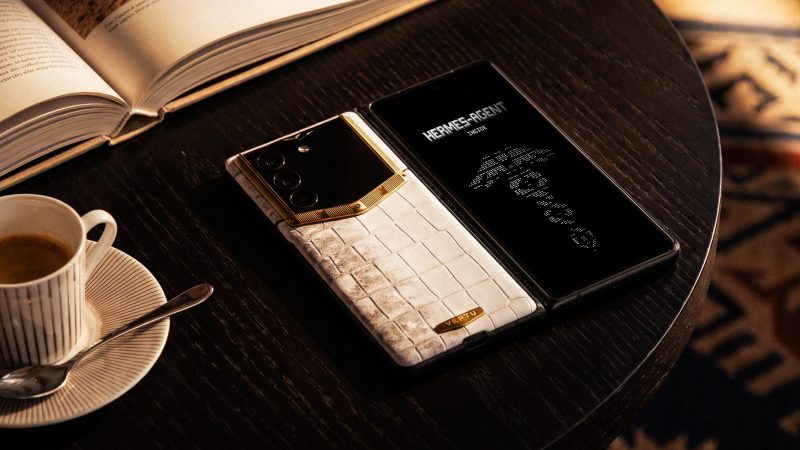
Precious-metal editions—such as Full Gold executions—shift the center of gravity further toward collection logic. In that tier, your diligence should expand beyond “does it work?” to “does the object’s story travel with it?”
Ask for:
identifiers (serial/IMEI) before payment
documentation that matches the identifiers
service and storage history
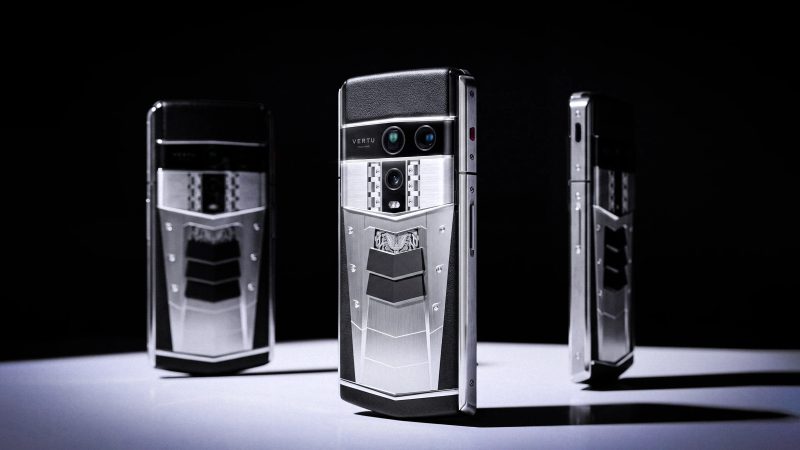
Signature Cobra: ultra‑rare collector commission
Cobra-level pieces sit in a different category: they’re closer to a collector commission than a consumer device.
If you’re evaluating one, start with provenance and verification before you start talking about condition.
VERTU’s own collector-oriented framing in Vertu Signature Cobra: the luxury phone collectors discuss is a useful baseline for how to approach legitimacy, documentation, and seller behavior.
Authenticity and due diligence checklist
Luxury button phones attract counterfeits for the same reason watches do: value concentrates in details.
Serial/IMEI matching, certificates, and provenance
Use a simple rule: identifiers must match everywhere, and the paper trail must make sense.
Check:
IMEI/serial shown in device settings vs on the box vs on certificates
proof of purchase (invoice/receipt)
warranty documentation and whether it’s transferable
service history, if available
Counterfeit red flags and safe return policies
Common red flags that matter more than glamour photos:
seller won’t provide IMEI/serial in advance
inconsistent finishing in close-ups (soft edges, uneven seams, mismatched materials)
“too good to be true” pricing without a clear story
pressure to pay off-platform or refusal of reasonable return terms
Choose channels that offer a return window long enough to complete your checks (carrier compatibility + identity verification) without rushing.
Conclusion
A luxury button phone in 2026 is not a substitute for a flagship smartphone. It’s a different object with a different job: controlled communication, material pleasure, and a quieter relationship with your time.
If you want to make the decision clean, use the framework in this order:
Network readiness (VoLTE + IMEI compatibility + band reality).
Craftsmanship you can verify in hand (materials, keypad feel, finishing).
Ownership confidence (authorized service, warranty clarity, privacy posture).
Provenance strength (especially for precious-metal or collector-grade pieces).
Next steps:
Run the carrier checks (AT&T/Verizon/T‑Mobile) and confirm VoLTE before purchase.
If buying pre-owned, insist on identifiers and documentation, then validate them.
If your model includes a service layer, schedule a calm onboarding moment—set expectations on channels, escalation, and what you consider “sensitive” by default.
Disclosure: This article references VERTU pages. Editorial judgment remains the priority.