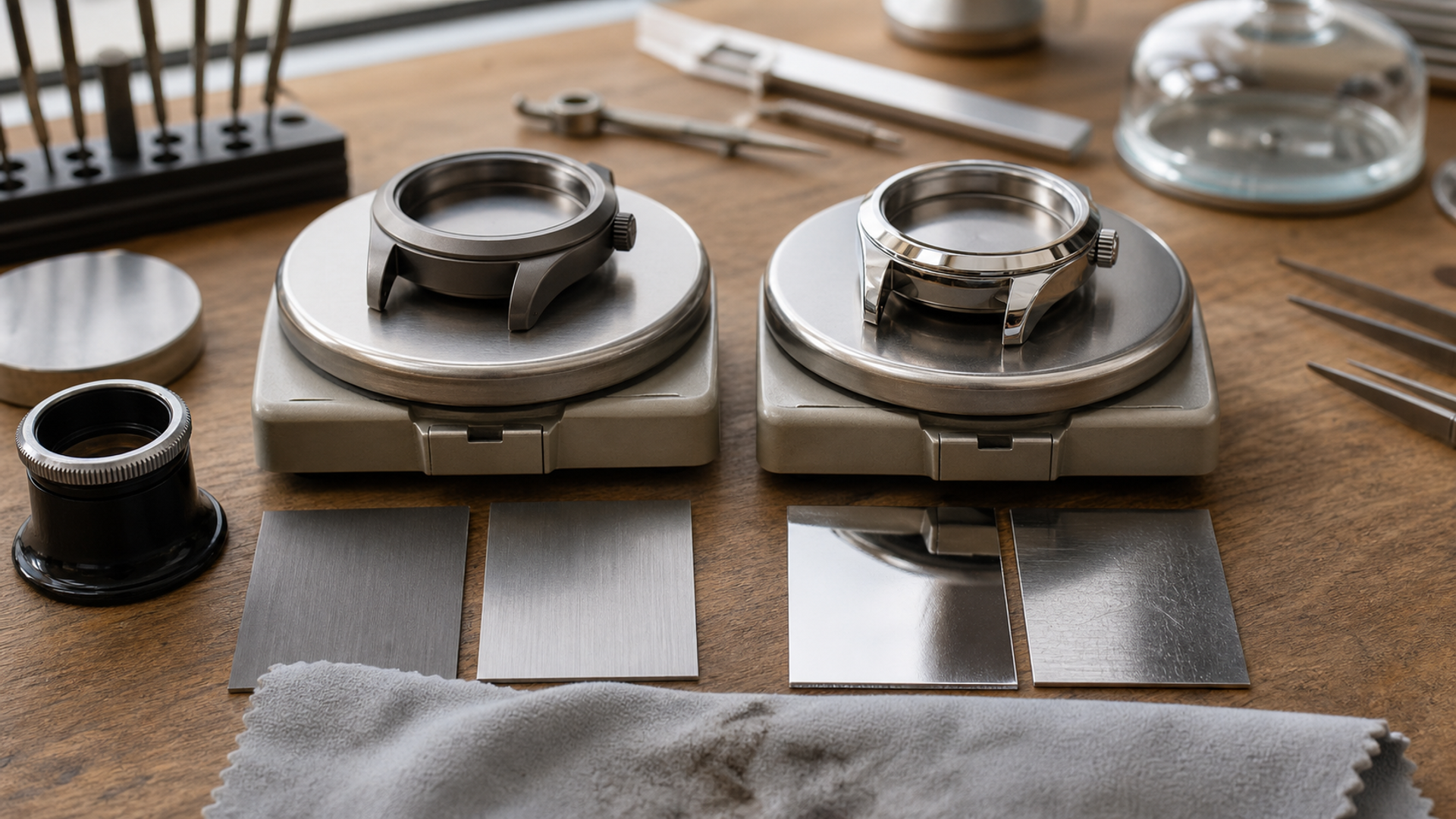
Choose titanium when low weight, corrosion resistance and all-day comfort matter more than a bright, dense-metal feel. Choose stainless steel when you prefer familiar heft, a wider choice of finishes, easier cosmetic refinishing and a case that often shows wear in more predictable ways. Neither material is universally “better.” Alloy, surface treatment, case construction and finishing quality can matter as much as the base metal.
Titanium vs stainless steel at a glance
| Ownership factor | Titanium | Stainless steel |
|---|---|---|
| Density | Roughly 4.4–4.5 g/cm³ for common watchmaking alloys | Roughly 7.9–8.0 g/cm³ for common austenitic grades |
| Wrist feel | Light; large watches can remain comfortable | Dense and substantial |
| Corrosion behaviour | Excellent in many everyday and marine environments | Very good, but grade and exposure matter |
| Surface appearance | Often darker grey and less reflective | Bright silver tone; broad polish and brushing options |
| Scratch behaviour | Depends strongly on alloy and coating; untreated surfaces can mark | Scratches visibly, but many finishes are familiar to refinish |
| Heat sensation | Often feels less cold on first contact | Conducts the “cold metal” sensation more strongly |
| Best buyer | Comfort-first, sport and travel wearer | Traditional feel, formal versatility and serviceability |
The weight difference is physical, not marketing
Material tables published by Nippon Steel list a specific gravity of about 4.43 for Ti-6Al-4V titanium alloy and about 7.9 for 18-8 stainless steel. The same volume of titanium alloy is therefore dramatically lighter. A finished watch will not be lighter by exactly that ratio because movements, crystals, bezels, straps and clasps use other materials, but the case-and-bracelet difference remains obvious.
This can transform a large watch. A 42 or 44 mm titanium sports watch may feel less top-heavy than a smaller steel alternative. That helps during travel, exercise and long days at a desk. It can also feel less luxurious to someone who associates weight with value. Neither response is wrong; it is a tactile preference.
Try the watch for at least ten minutes. Move the wrist, type, put on a jacket and test the clasp. A few seconds at a counter does not reveal whether a light watch disappears comfortably or feels insubstantial.
“Titanium” and “steel” are families, not single recipes
Commercially pure titanium and titanium alloys differ in strength, hardness and finishing behaviour. Grade 2 titanium is widely associated with corrosion resistance and a softer, industrial surface character. Grade 5 titanium—Ti-6Al-4V—is stronger and often supports crisper polishing, but manufacturing and finishing choices vary.
Stainless steel also includes many grades. Watch brands may use 316L, 904L or proprietary variants, each with different composition and processing. A claim that “titanium scratches more” or “steel is harder” is incomplete unless it identifies the alloy, heat treatment, surface hardening and coating.
Ask the manufacturer or authorised retailer:
Which titanium or steel grade is used?
Is the surface untreated, hardened or coated?
Can the brand refinish that surface during service?
Does refinishing remove a coating or alter case geometry?
Are replacement bracelet links and clasps available?
Those questions predict ownership better than the material name on the product page.
Scratches, dents and the character of wear
Both materials scratch. Polished steel shows hairlines quickly because reflections make small marks visible. Brushed steel develops directional wear that can sometimes be restored by a skilled service centre. Repeated aggressive polishing, however, removes material and can soften edges.
Untreated titanium can pick up light surface marks and rubs. Its darker tone may make some marks less conspicuous and others more obvious. Titanium also forms a stable oxide film that contributes to corrosion resistance; a superficial mark is not necessarily structural damage. Hardened treatments and coatings can improve scratch resistance, but a deep mark that penetrates the treated layer may be difficult to blend invisibly.
Do not use household abrasives on either material. A watch case combines polished and brushed planes, sharp transitions, seals and often coatings. Amateur refinishing can cause more permanent visual damage than the original scratch.
The best ownership mindset is to distinguish normal patina from damage. Hairlines on a clasp are inevitable. A dent near a seal, a damaged crown tube or a deep impact on a lug deserves professional inspection.
Corrosion and skin contact
Titanium’s passive oxide layer gives it strong resistance in many environments. Industry material guides commonly cite its performance in seawater and humid conditions. Stainless steel gains corrosion resistance from chromium-rich passive films, but resistance depends on grade, surface condition and exposure. Salt, chlorine, trapped moisture and neglected residue can still create problems.
Rinse a water-rated watch with fresh water after saltwater exposure, following the manufacturer’s instructions, and make sure the crown is secured before contact with water. Clean between bracelet links where sweat and salt accumulate. Water resistance should be tested periodically and after significant impact or service.
People with metal sensitivities often ask whether titanium is safer. Titanium is widely used where biocompatibility matters, but a watch includes other materials in the caseback, crown, clasp and coatings. Skin reactions can also come from trapped moisture, cleaning products or strap materials. Anyone with a known allergy should obtain professional medical advice and exact material information rather than relying on a broad “hypoallergenic” label.
Temperature and travel comfort
Titanium often feels warmer on first contact because of how it transfers heat relative to dense steel. In winter, that can make the watch more pleasant. During long-haul travel, low weight reduces the constant reminder of a large case on the wrist.
Steel’s mass can stabilise a well-fitted watch and communicate solidity. Some owners like the way a steel bracelet drapes and balances the head. A titanium bracelet may produce a different sound and feel because of lower mass. These are experiential differences, not quality rankings.
For frequent travel, include security and practicality. A large bright polished steel watch may attract more attention than a muted titanium case. That does not make titanium invisible, and it should not be treated as a security feature. Choose what you are comfortable wearing in the actual destination.
Finishing and design
Steel is an exceptionally flexible visual material. Brands can create mirror polish, satin brushing, bead blasting and sharply contrasting surfaces. Its bright neutral colour works with formal clothing and jewellery.
Titanium traditionally has a darker, tool-like tone, but Grade 5 alloys and modern finishing can produce polished facets and refined transitions. Some brands use coatings to make titanium black or alter its colour. Coatings can be durable, yet their repairability is a separate question.
The design should exploit the material. Titanium makes the most sense when it enables a larger, more ergonomic or travel-friendly watch. Steel makes sense when mass and reflective finishing are part of the intended character. A titanium watch that is simply a more expensive copy of a steel model may not justify its premium unless comfort matters to you.
Five-year ownership matrix
| Question | If “yes,” lean titanium | If “yes,” lean steel |
|---|---|---|
| Do heavy watches become uncomfortable? | Yes | No |
| Do you want a subdued grey case? | Yes | No |
| Is easy traditional refinishing important? | Maybe; verify brand process | Often |
| Do you enjoy substantial bracelet weight? | No | Yes |
| Will the watch see salt, humidity or active use? | Strong candidate | Also viable with proper care |
| Do you want polished dress versatility? | Possible, model-specific | Broad choice |
| Are coatings involved? | Verify repair path | Verify repair path |
Bracelet, strap and case geometry can overturn the answer
A light case on a poorly fitted bracelet can still be uncomfortable. A heavy steel watch on a flexible strap can feel better than a titanium watch with a stiff clasp. Lug shape determines whether the case hugs or floats above the wrist. Thickness affects cuff clearance and top-heaviness.
When comparing two watches, keep the strap or bracelet type as similar as possible. If one is on rubber and the other on a full metal bracelet, you are evaluating an entire system, not only a metal.
Our broader titanium, ceramic or steel watch-case guide adds ceramic’s hardness and impact trade-offs. For a collection-level decision, the luxury sports watch vs dress watch guide helps decide which role the material needs to perform.
Care checklist
Follow the brand’s water-resistance and cleaning instructions.
Rinse approved water-resistant watches after salt exposure.
Use a soft cloth; avoid abrasive polishing products.
Keep coating and surface-hardening details with the service records.
Ask the service centre before authorising refinishing.
Inspect the crown, pushers and case after a hard impact.
Fit the bracelet correctly so the watch does not slide and strike surfaces.
Final verdict
Titanium wins when comfort, low mass and a subdued technical character improve how often you wear the watch. Stainless steel wins when you value traditional heft, bright finishing and a familiar long-term service path. Compare the exact alloy, treatment and construction. The right material is the one that makes the watch more wearable after five years, not the one that sounds more advanced on launch day.