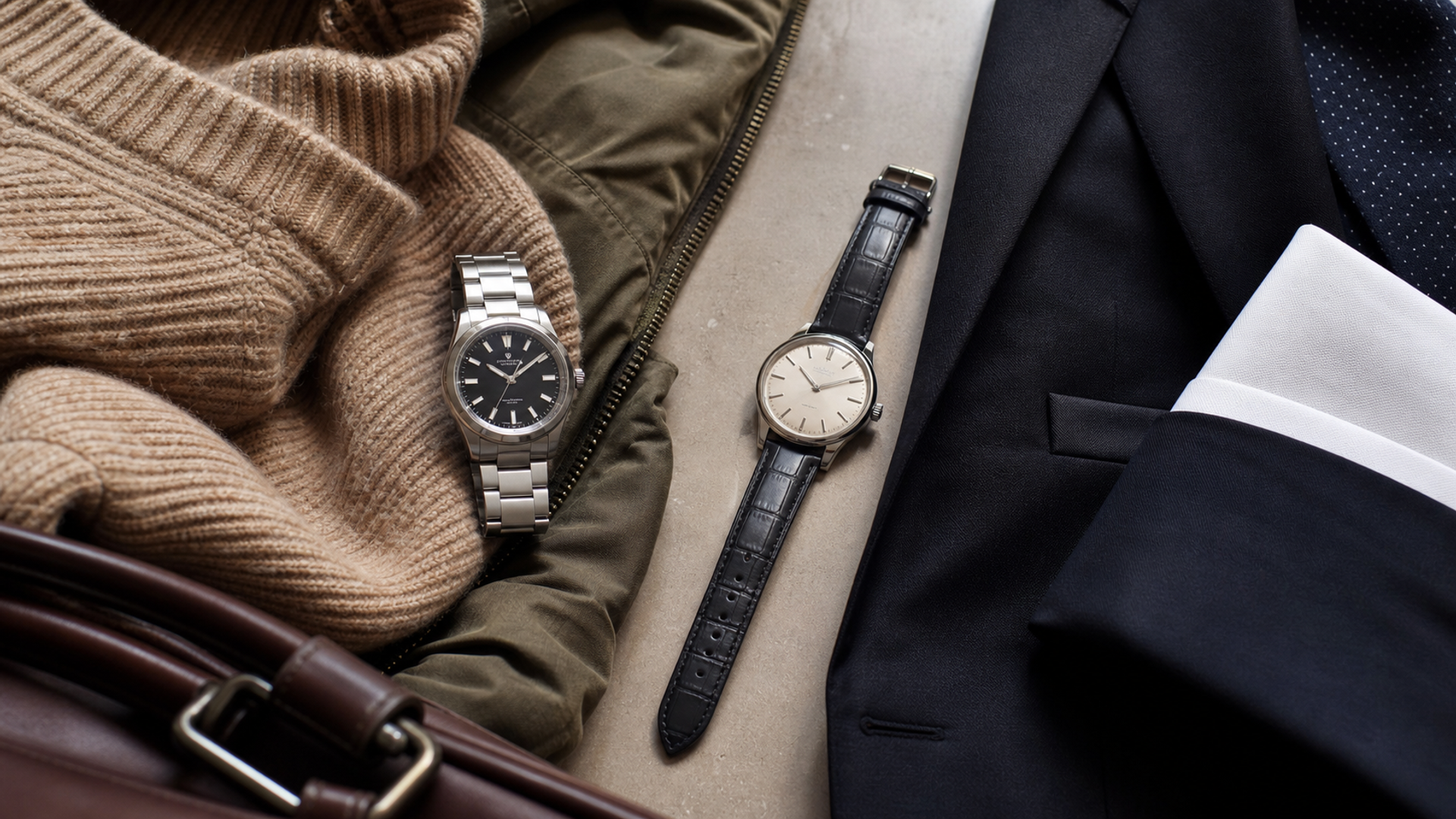
A luxury sports watch is designed to tolerate more of ordinary life: metal bracelet, stronger water resistance, luminous hands and a case with greater physical presence are common. A dress watch prioritises proportion, slimness, a quiet dial and compatibility with formal clothing. The sports watch is usually more versatile; the dress watch can be more emotionally precise.
For a one-watch collection, choose a luxury sports watch if you travel often, live in a warm climate, wear casual or business-casual clothing and want fewer decisions about water or straps. Choose a dress watch if tailoring, dinners and discreet design dominate your week, and you are willing to remove the watch for exercise, water and rough activity. The best answer can also be a restrained sports watch or a robust dress watch that sits between categories.
The terms describe design intentions, not regulated standards. Always verify the exact reference’s water rating, movement, dimensions and warranty.
One-watch decision matrix
| Daily requirement | Luxury sports watch | Dress watch |
|---|---|---|
| Formal tailoring | Can work if thin, restrained and not oversized; bracelet adds visual weight | Natural strength: slim case, simple dial and leather strap usually disappear under a cuff |
| Business casual | Strong; steel and integrated designs move easily between settings | Strong when the strap and dial are not excessively formal |
| Heat and humidity | Bracelet or rubber normally handles sweat better than leather | Leather can age quickly; bracelet dress models are less common but solve the issue |
| Water and travel | Often 10 bar/100m or more, but reference and service condition matter | Frequently lower; some modern examples are more capable than the stereotype |
| Legibility | Lume, stronger hands and markers are common | Thin hands and low contrast can prioritise elegance over speed |
| Physical profile | Often thicker, heavier and visually wider | Usually thinner and lighter |
| Surface wear | Bezel and bracelet collect visible marks; design may accept patina | Polished cases can also scratch, while leather shows sweat and bending |
| Emotional role | A companion for most activities | A deliberate object for chosen moments |
Use this table as a first filter. Then test the exact watch against the seven situations you encounter most, not against a fictional universal wardrobe.
What “sports” should mean in a luxury watch
The modern luxury sports watch emerged from practical ideas: a case and bracelet designed as one, enough water resistance for active use, a legible dial and a movement protected for daily life. The category now includes integrated-bracelet icons, dive watches, travel watches and simpler steel references. Some are genuinely capable; others borrow the visual codes.
Do not infer water resistance from a steel bracelet or screw motif. Read the rating and manufacturer’s permitted-use guidance. A 10 bar watch is not automatically a diving instrument, and a rating established when the watch was new depends on seals that age. Pressure testing after service or case opening is part of ownership.
Bracelet design is equally important. It should articulate around the wrist, allow enough sizing precision and remain serviceable. Integrated bracelets produce visual continuity but can limit strap alternatives and make replacement expensive. Conventional lugs provide flexibility. Try the watch in heat if possible, because a tight bracelet in an air-conditioned boutique can become uncomfortable outdoors.
Cartier’s current Santos collection, for example, combines a recognisable square case with bracelet interchangeability and reference-specific performance claims. It demonstrates why a sports watch can remain elegant, but it also shows why the exact model matters more than the category.
What a dress watch does that specifications miss
A dress watch’s function is visual proportion. A thin case passes beneath a cuff. A quiet dial does not compete with tailoring. Leather can echo shoes, belt or bag without requiring a perfect colour match. The watch can be smaller because it is not trying to remain legible during motion or darkness.
Patek Philippe describes its Calatrava collection through round form and restrained design. Whether or not that collection is in budget, the principle is useful: remove features until proportion carries the object. A seconds hand, date window or automatic rotor may be optional rather than mandatory.
Minimalism creates its own risks. Highly polished cases show marks. Thin movements can be expensive to service. A leather strap is a consumable. Low water resistance requires disciplined behaviour. A dress watch bought as an “investment” but worn twice a year can become a costly object of guilt. Its value comes from how precisely it fits occasions you care about.
The wardrobe audit
Photograph seven representative outfits laid out together: most formal, most casual, standard office, travel day, hot-weather day, weekend dinner and an event outfit. Then place a paper outline or similarly sized watch on the wrist for each. Count the number of outfits in which the watch looks intentional rather than merely acceptable.
Sports watches often win raw count. Dress watches can win intensity: they may transform the three most important outfits. Decide whether your one watch should maximise coverage or significance.
Colour and finish matter more than category. A brushed steel sports watch with a dark dial can be more discreet than a polished gold dress watch. A two-tone bracelet can read as jewellery. A blue dial may be versatile in casual clothing but less quiet with black tie. Do not let “sports” and “dress” replace looking.
Fit decides whether versatility is real
A watch cannot be versatile if it is uncomfortable or will not pass under clothing. Measure case thickness, complete length and bracelet articulation. Try the tightest cuff you own. Check whether the crown touches the hand when the wrist bends and whether clasp position is centred.
Sports watches can wear larger than diameter because fixed first links extend the footprint. Dress watches can wear longer than expected because narrow rectangular cases or long lugs amplify length. Our watch-size guide explains how to use flat wrist width and lug geometry.
Weight also affects habit. A heavy watch may feel reassuring for ten minutes and tiring after ten hours. A very light dress watch can disappear so completely that it becomes the easiest daily choice. Wear each candidate while typing, walking and putting on a jacket before deciding.
Movement choice follows the wearing pattern
An automatic sports watch suits frequent wear because wrist motion maintains power. A manual dress watch can turn occasional use into a ritual. Quartz can make either category more practical, especially in a rotation, and should not be dismissed when slimness and accuracy are priorities.
Power reserve matters only relative to your schedule. A watch that runs through a weekend is useful if you return on Monday. A calendar complication can become inconvenient when an occasional watch stops and requires careful resetting. Simplicity can be a premium feature in a one-watch collection because there is less to correct and service.
Ask for the movement’s published accuracy, service route and warranty. Do not convert a certification or manufacturer claim into the performance of an untested individual watch. Measure over a week after purchase and use the authorised route if it falls outside specification.
Water resistance and the “one-watch” contradiction
The strongest argument for a sports watch is not swimming. It is reduced cognitive load. Rain, handwashing, humidity and sudden travel changes create fewer decisions when the watch has an appropriate tested rating and bracelet. A dress watch owner must be more deliberate.
Yet a one-watch collection does not require wearing a watch during every activity. Removing a dress watch for the gym or pool can be sensible. The contradiction appears only when the owner wants a single object to remain on the wrist continuously. Define “one watch” as one owned watch or one never-removed watch; those are different goals.
No rating is permanent. Have seals and pressure resistance checked according to manufacturer guidance, particularly before travel involving water. Avoid hot showers and saunas unless the manufacturer explicitly permits them; heat and chemicals create conditions not captured by a simple depth equivalence.
Service and appearance after five years
Imagine the watch with scratches. A brushed sports bracelet will show bright lines; a polished bezel will collect swirls; a leather dress strap will darken and crease. Look at pre-owned examples rather than pristine advertising. The future appearance is part of the design.
Budget for movement service, water testing, refinishing only when necessary, replacement strap or bracelet parts and insurance if the value justifies it. Avoid automatic polishing during service. Removing metal can soften case geometry and integrated-bracelet edges. Ask for the work scope in writing.
Keep spare links, buckle, original strap, box, papers and service invoices. They support future fit, maintenance and sale. They do not guarantee appreciation. A one-watch decision should be funded from enjoyment, not a resale forecast.
A weighted scorecard
Score each candidate from zero to five:
fit for ten continuous hours;
compatibility with your five most common outfits;
compatibility with your two most important outfits;
water and climate suitability;
dial legibility;
strap or bracelet adaptability;
service confidence;
five-year cost;
desire to wear it tomorrow.
Double common-outfit compatibility for a coverage-first collection. Double important-outfit compatibility for a significance-first collection. Double water and climate if you travel frequently. Reject any watch that scores below three for fit, regardless of total.
Verdict
A luxury sports watch is the stronger default one-watch collection because it handles more environments, works with a wider casual wardrobe and asks fewer water or strap questions. Choose a restrained size and dial if formal wear is part of the week. A dress watch is the stronger emotional choice when elegance, slimness and ritual matter more than continuous wear.
The best one-watch answer is not the model with the most specifications. It is the watch whose limitations align with the activities you are willing to remove it for. Versatility is not the absence of compromise; it is a compromise you barely notice.