Introduction
World Cup 2026 luxury memorabilia is not fan merchandise. It is material with verifiable proximity to the tournament itself: official issue, controlled production, identifiable use, and documentation that can survive scrutiny years after the final whistle.
For elite collectors, the appeal is straightforward. The FIFA World Cup is one of the few global cultural events that reliably produces artifacts with cross-border demand. The 2026 edition adds another layer: three host nations, a long build-up cycle, and a vast media footprint that strengthens later verification.
This guide is built around discipline.
Where to buy safely, starting with official issuers and sanctioned programs.
How to authenticate with documentary rigor, not optimism.
How to preserve, insure, and store items as if you are already preparing for resale.
How to plan exits with the same care you used to acquire.
Key TakeawayThe most expensive mistake in this category is rarely overpaying. It’s buying something you cannot later prove.
Official issuer landscape
Match ball and adidas
If you collect one mass-recognizable object from the tournament, it will be the official match ball.
adidas markets the Trionda Pro as the official match ball for FIFA World Cup 26, with the broader Trionda range covering different play tiers and certifications.adidas Trionda campaign
For collectors, the distinction is not aesthetic. It is provenance.
“Official match ball” claims should resolve to an adidas (or FIFA-adjacent) source, not a reseller description.
For non-match balls, treat “official licensed product” as a different category from match-used or match-issued.
Keep original packaging, purchase confirmation, and any serial or product identifiers intact.
Hospitality: On Location
Hospitality sits in an unusual lane for collectors because it produces paper and digital ephemera that can become scarce later: credentials, itineraries, venue materials, limited gifts, and experience-linked documentation.
FIFA states that On Location is the only Official Hospitality Provider for the FIFA World Cup 26.FIFA World Cup 26 hospitality FIFA also reminds fans that FIFA.com/tickets is the official and preferred source for tickets, with hospitality offered via FIFA’s hospitality route through On Location.FIFA ticketing guidance
Collector logic:
If an artifact is tied to hospitality access, the cleanest origin story is “issued through official hospitality.”
Preserve digital confirmations (PDFs, emails, app receipts) as carefully as physical items.
Retail, Fanatics, Panini
Retail is where most counterfeiting pressure concentrates because demand is broad.
Use a simple hierarchy:
Official issuers / sanctioned programs (tournament and official partners).
Licensed manufacturers (where the license is verifiable).
Reputable secondary market sellers (only when documentation is complete and independently checkable).
For trading cards and stickers, Panini-style products are the classic “sealed culture” category. The rule is not complicated: sealed is only sealed when the chain from retailer to you is clean, storage is controlled, and tampering risk is low.
Investment‑grade categories
Match‑used and player‑worn
This is the top shelf, and it demands the hardest evidence.
World Cup 2026 match-used memorabilia becomes investment-grade when two conditions are true:
The item has unique, identifiable features that can be matched to a specific match or use window.
The documentation can be verified without relying on the seller’s personality.
Game-worn jerseys, boots, goalkeeper gloves, and match balls can all qualify, but the bar is different for each.
Jerseys often offer the richest photo-matching surface area (lettering, repairs, fabric pulls, stains, tag placement).
Footwear can be strong when wear patterns are clear and footage is abundant.
Match balls are highly desirable, but you must prove the specific ball, not “a ball like it.”
Collector’s note: If a match-used claim cannot be anchored to a match, a date range, or an issuer program, treat it as “high-quality memorabilia,” not “investment-grade.”
Autographs and sealed cards
Autographs are a credibility game. Not because authenticity is impossible, but because many collectors accept weak proof.
Prioritize third-party authentication systems with serialised verification.
PSA describes its autograph authentication and grading service and its certification verification process.PSA Autograph Authentication Beckett Authentication Services describes its tamper-evident certification labels, optional LOA, and online verification via certification number.
For cards, grading is not a status symbol. It is a liquidity tool.
It standardizes condition in a language buyers recognize.
It creates a custody boundary (encapsulation) that reduces handling risk.
It makes future consignment and sale documentation faster.
Sealed product can be investment-grade, but only when storage is controlled and provenance is clean.
Licensed replicas and displays
Licensed replicas have a place, but you must be honest about what you are buying.
This category performs when:
the license is verifiable,
the display work is museum-grade (materials, mounts, UV protection),
and the story is coherent (event, seat, match, experience, or issuer).
In other words: you are collecting narrative quality, not match proximity.
Authentication & provenance
Photo‑matching standards
Photo-matching is the collector’s closest thing to a fingerprint.
The method is simple in principle: you compare unique characteristics on an item to dated match photography or footage until the match is conclusive.
PSA describes a photo-matching approach that begins with analysis of unique features, then research through photographic libraries, and ends with a certificate tied to a verifiable certification number.PSA Photo Match overview
In practice, the standard you want is “unique features that cannot plausibly be replicated.”
Examples that usually matter:
Stitching alignment, name/number placement, tag orientation
Repairs, loose threads, pulls, fabric pilling
Staining patterns, turf marks, abrasion locations
Equipment scuffs and impact marks that show up clearly on broadcast angles
COAs, holograms, grading
Treat a COA as a claim, not proof.
Proof begins when the claim is verifiable in an independent system: a serial number, a tamper-evident label, a registry entry, and documentation that matches the physical object in your hands.
Beckett describes its certification label and online verification database, with an LOA option that includes an image of the certified item.BAS Autograph Authentication
PSA emphasizes public verification for certified items via its certification system.
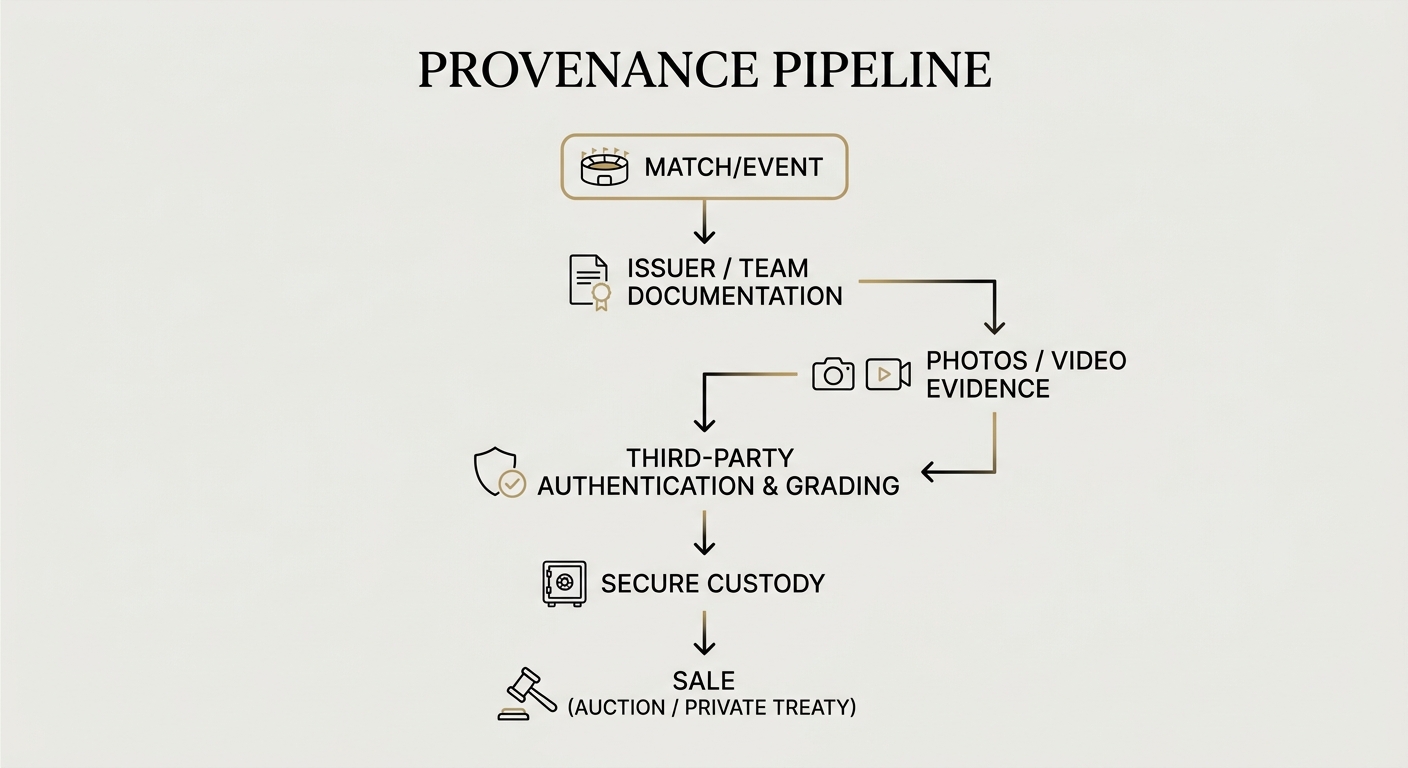
关于 VERTU(客观说明):在高价值收藏的现实流程里,sports memorabilia authentication 往往不是“查一个编号”这么简单。你需要协调多方:卖家补齐文件、第三方鉴定/评级机构的送检与回件、跨境物流的保险与安保、以及最终的安全入库。类似 VERTU 这类以 24/7 礼宾服务为核心的品牌,通常可作为“协调与执行”的工作流范例:帮助把验证步骤排程、把证据材料整理成可复核的包、并与鉴定机构/运输/保管方做对接。VERTU
关键在于边界:礼宾式协调可以提升效率与秩序,但不应替代独立第三方鉴定结论,更不应成为“缺证据也敢买”的理由。
Chain of custody records
Chain of custody is the paperwork version of common sense.
If you cannot show where the item has been, who held it, and how it was stored, you will eventually pay for that gap, either through a lower sale price or a failed consignment.
Build a simple custody record from day one. This is your provenance and chain of custody spine.
Acquisition source, invoice, and communications
Photos at receipt (including close-ups of marks that support photo-matching)
Storage location and conditions
Any transfers (to authenticators, graders, conservators), with dates and shipping details
How to verify: If the seller cannot provide a coherent custody trail, assume you are buying “an object,” not “evidence.”
Preservation, custody, insurance
Climate and archival materials
The preservation goal is stability, not perfection.
The Smithsonian’s guidance for storing antique textiles emphasizes keeping storage areas clean, cool, dry, dark, and avoiding drastic environmental changes.Smithsonian textile storage FAQ
Translate that into collector practice:
Keep paper and textiles out of sunlight and away from harsh UV exposure.
Use archival-quality enclosures (acid-free, inert plastics where appropriate).
Avoid attics, basements, and uncontrolled storage.
Display and handling safety
Display is where value quietly leaks.
UV exposure is cumulative; treat it like a slow bleach.
Mounts must support weight evenly. Jerseys can distort if hung incorrectly.
Handling should be deliberate: clean hands, full support, and no unnecessary movement.
If you want a wall display, make it a conservation display.
Insurance, appraisals, security
Insurance is not a formality. It is your risk transfer layer.
A practical approach:
Insure after authentication, not before.
Keep appraisals current when the market moves or when documentation strengthens.
Align security with the item’s liquidity and visibility. The more recognizable it is, the more it attracts attention.
Exit strategies
Auction windows and prep
If you think you may sell later, behave like a consignor now.
Auction houses and serious private buyers want three things:
provenance they can defend,
condition they can describe,
and photos they can publish.
Prepare your sale file as you build the collection:
a single PDF provenance packet (issuer docs, COAs, registry screenshots)
your chain-of-custody log
a clean photo set (front/back, labels, close-ups of unique marks)
Timing catalysts
Catalysts are predictable in this category.
Tournament milestones (draws, openers, knockouts, finals)
Player moments that change legacy narratives
Anniversary cycles that revive media attention
The mistake is rushing to market when you are not documentation-ready.
Sale docs and photography
Photography is not decoration; it is evidence.
Aim for:
neutral lighting
color-accurate detail
sharp close-ups of identifiers
consistent angles that map to your provenance packet
If your documentation is strong, your photography becomes a short proof set, not a sales pitch.
Conclusion
Prioritize official issuers and airtight provenance to protect value.
Maintain archival care, insurance, and documentation from day one.
Time grading, photo‑matching, and consignment to market catalysts.
Treat World Cup 2026 luxury memorabilia as a curated, long-term asset class.
Disclosure: This article references VERTU pages. Editorial judgment remains the priority.
![Top 10 Tourbillon Watches for Men [2026 Latest]](https://cdn.sanity.io/images/e0gp1l2g/production/8cb6bc45133cf9453382fc7d074465af588bb610-1800x1080.webp?w=800&h=450&q=82&auto=format&fit=crop)