

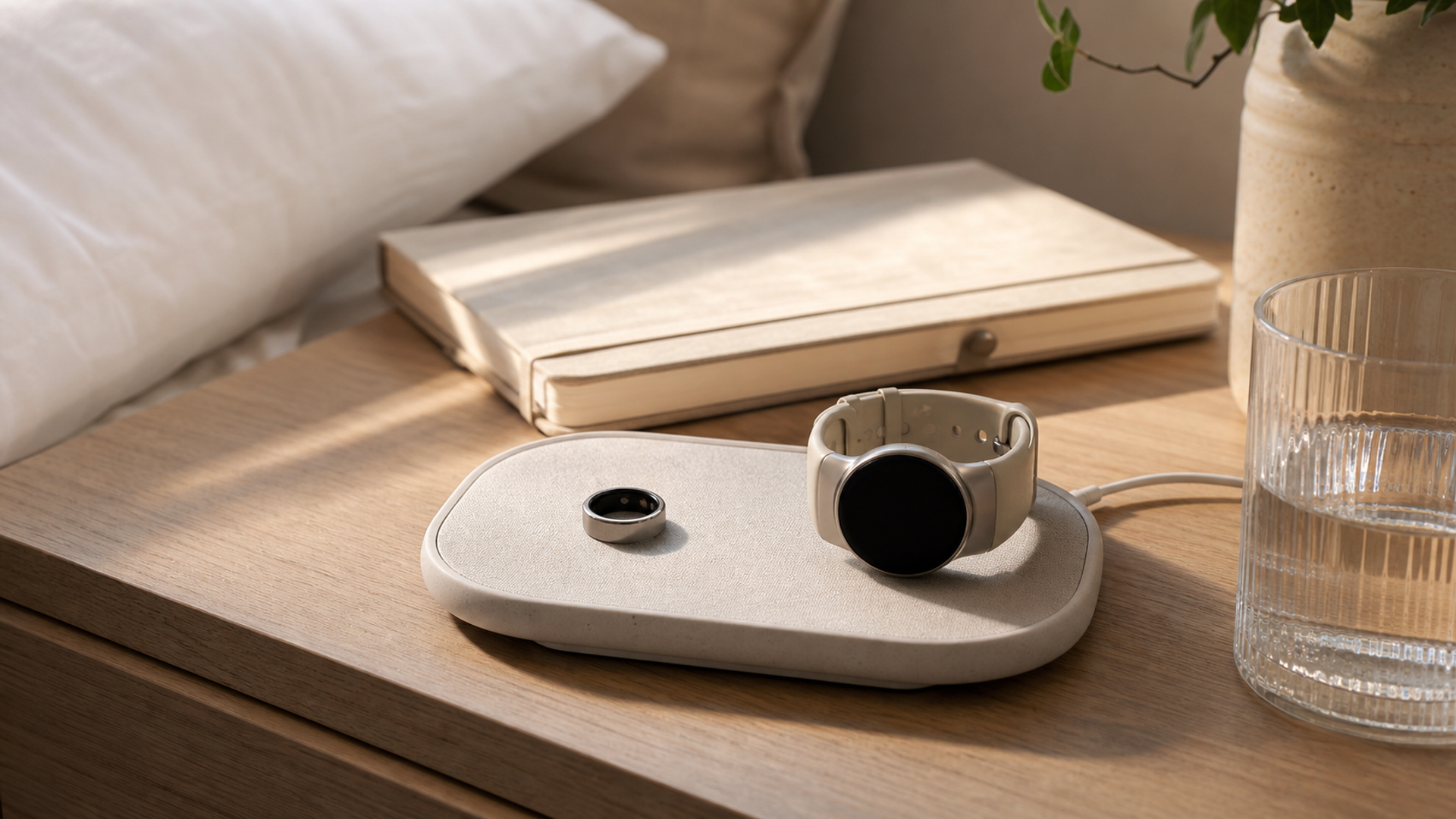
A smart ring can collect beautiful sleep data while being useless for the person who removes it every night. A smartwatch can offer rich training feedback while missing recovery because it spends bedtime on a charger. The best wearable is not the one with the longest feature list. It is the one that fits the body, charging routine and decisions you actually make.
For sleep and recovery, consistency matters more than a single impressive reading. Both form factors use optical and motion sensors to infer patterns such as heart rate, activity and sleep. Neither should be treated as a doctor on the finger or wrist. Their value is in repeated personal trends, sensible prompts and the ability to notice when your normal pattern changes.
Smart ring vs smartwatch: the practical matrix
| Decision factor | Smart ring | Smartwatch | Who should favour it |
|---|---|---|---|
| Overnight comfort | Small, screen-free and often easy to forget | Larger body; strap fit and screen can disturb some sleepers | Ring if wrist wear annoys you at night |
| Workout display | Usually depends on phone app; limited live feedback | Live pace, zones, maps and controls on the wrist | Watch for structured training |
| Recovery continuity | Strong when worn day and night | Strong if charging does not remove the overnight window | The device that fits your charging habit |
| Notifications | Quiet or absent | Calls, messages, timers and alerts | Ring for less distraction; watch for active utility |
| Fit variation | Finger swelling can change comfort and signal | Strap can be adjusted throughout the day | Watch for rapid size changes; ring after a full sizing trial |
| Subscription cost | Some platforms charge; some are subscription-free | Many core features are included, but services vary | Calculate three-year ownership, not retail price |
| Jewellery compatibility | Discreet, but competes with existing rings | Reads clearly as technology or sports equipment | Depends on wardrobe and profession |
| Safety and care | Remove for crushing, chemicals and some lifting | Remove when strap or case could catch or contaminate | Both require activity-specific judgement |
Start with the decision, not the metric
Write down what you expect the wearable to change. “I want more health data” is too vague. Better goals are:
notice whether late meals correlate with restless nights;
keep a stable bedtime during frequent travel;
decide whether to train hard after several poor nights;
reduce phone use in the bedroom;
record workouts without carrying a phone;
share a simple trend with a qualified clinician when appropriate.
A ring is often strongest when passive collection and low distraction are the priorities. A watch is often stronger when the owner needs information and controls during the activity itself. If you want turn-by-turn navigation, live interval timing and music controls, buying a ring for its sleep score will not remove the need for another device. If you already wear a mechanical watch, a discreet ring may add sensing without asking you to replace it.
Sleep tracking: consistency beats one-night precision
Consumer wearables infer sleep from signals rather than observing the brain directly. The exact stages and scores are model outputs, not direct measurements of consciousness. A single night labelled “poor” should not dominate a decision. Look for multi-week trends and changes relative to your own baseline.
Oura describes its ring as combining heart-rate, heart-rate-variability, temperature-trend, activity and sleep monitoring, with multi-day battery life. Its wearables overview and research material is useful evidence about the intended sensing model, but it is also first-party material. Samsung’s Galaxy Ring specifications similarly set out sensors, dimensions, water resistance and compatibility for that product generation.
Use those specifications to define a test, not to crown a universal winner. Wear the shortlisted device for at least seven ordinary nights, including one late dinner, one exercise day and one normal workday. Record comfort, charging gaps and whether the insight led to a sensible action.
Fit is a data-quality issue
Rings need enough contact for the optical sensors to read consistently, but a ring that becomes painfully tight after a flight, hot day or salty meal is the wrong size. Fingers can change through the day. A shop fitting at one moment is not enough.
Use the manufacturer’s sizing kit and wear the sample for a full day and night. Test typing, hand washing, sleep, a warm walk and morning swelling. The ring should not spin freely, yet it should come off without pain. If international travel is normal, our 24-hour smart-ring sizing test adds heat and flight scenarios.
A watch offers more adjustment. The strap can be loosened when swelling occurs and tightened for exercise. That does not guarantee better readings: a loose sensor can move, while an overtight strap can be uncomfortable and discourage overnight wear.
Charging architecture decides whether nights are captured
Do not compare only advertised battery duration. Compare when the device asks to charge and whether that moment conflicts with your measurement goal.
For a ring, short charging sessions during a shower or desk period may preserve overnight continuity. For a watch used for daytime notifications and workouts, bedtime may appear to be the only convenient charging window—exactly when sleep measurement is needed. Faster charging can solve this if the owner builds a routine.
Run a seven-day audit:
| Day | Worn overnight? | Charging gap | Workout recorded? | Comfort issue? | Action taken from insight? |
|---|---|---|---|---|---|
| 1–7 | Yes/No | Start and end time | Yes/No | Note location and cause | One sentence |
At the end, calculate missing nights and abandoned wear periods. A nominal eight-day battery is less valuable than a shorter-life device you reliably top up without losing data.
Workout and recovery form a loop
A smartwatch can display pace, heart-rate zones, elapsed time and navigation while you move. That real-time interface helps runners, cyclists and structured gym users. A ring usually acts more as a passive observer and post-session interpreter. Some rings can import workouts from another platform, but that creates an ecosystem dependency worth testing.
If recovery is the main question, ask whether the platform explains why a score changed. Good interpretation should show the contributing signals and the comparison period. A single coloured number without context can create false confidence.
If performance is the main question, check sensor support, GPS behaviour, physical controls in rain or gloves, and export options. You may ultimately prefer a watch for training and a ring for overnight continuity, but two devices create reconciliation problems: duplicated steps, conflicting sleep records and more charging. Confirm which app becomes the source of truth.
Subscription and three-year ownership
The shelf price is only the beginning. Build a three-year cost sheet:
Device and required sizing kit.
Subscription or membership fees.
Replacement charger or proprietary accessories.
Expected battery degradation and warranty coverage.
Possible resizing or replacement after body change.
The cost of a second device if the first lacks workout or notification functions.
A subscription can fund ongoing interpretation, cloud features and software development; it can also turn a modest purchase into a larger ownership commitment. Subscription-free does not automatically mean every future service is included. Read what is available at purchase and what depends on an app, account, region or future update.
Privacy: map where wellness data goes
Wearable data can reveal sleep times, travel patterns, exercise routines and physiological trends. Before purchase, check:
whether an account is mandatory;
what is processed on the device, phone and cloud;
which third-party services can connect;
whether data can be exported and deleted;
how family or clinician sharing is controlled;
what happens when the subscription ends;
whether workplace wellness programmes receive individual or aggregate data.
Do not grant broad health-data access to every fitness app. Connect one service at a time, verify the benefit and revoke unused access.
When not to wear either device
Remove a ring for tasks where jewellery can catch, be crushed, trap chemicals or interfere with hygiene. Heavy gripping can also make a rigid ring uncomfortable. Remove or protect a watch where its strap can snag or where contamination matters. Follow the manufacturer’s water-resistance and cleaning guidance rather than treating a rating as permission for every chemical, temperature or pressure scenario.
Our smart-ring removal guide covers seven recurring situations. If swelling, numbness, skin injury or persistent irritation occurs, remove the device and seek appropriate advice rather than chasing a complete data streak.
The seven-day purchase test
Score each shortlisted device from 1 to 5:
| Criterion | Weight | Ring score | Watch score |
|---|---|---|---|
| Overnight comfort and data continuity | 25% | ||
| Workout functions you truly use | 20% | ||
| Charging fit | 15% | ||
| Interpretation quality | 15% | ||
| Three-year cost | 10% | ||
| Privacy and export controls | 10% | ||
| Style and social fit | 5% |
Multiply each score by its weight. Do not let a feature you will never use compensate for a device you will not wear.
Verdict
Choose a smart ring when passive overnight continuity, discretion and freedom from notifications matter most. Choose a smartwatch when live workout information, navigation, communication and an adjustable fit are central. Consider both only if each has a distinct role and you are willing to manage duplicate data.
The most useful sleep and recovery wearable is the sensor that disappears into your routine while making its uncertainty visible. Buy the behaviour change and the ownership model—not the highest number of metrics.
If two devices score closely, choose the one with the clearer return window and run the same diary on both rather than relying on memory. Comfort and charging friction are easy to underestimate in a shop; a documented home trial exposes them quickly.
Keep the result.
![Top 10 Tourbillon Watches for Men [2026 Latest]](https://cdn.sanity.io/images/e0gp1l2g/production/8cb6bc45133cf9453382fc7d074465af588bb610-1800x1080.webp?w=800&h=450&q=82&auto=format&fit=crop)