

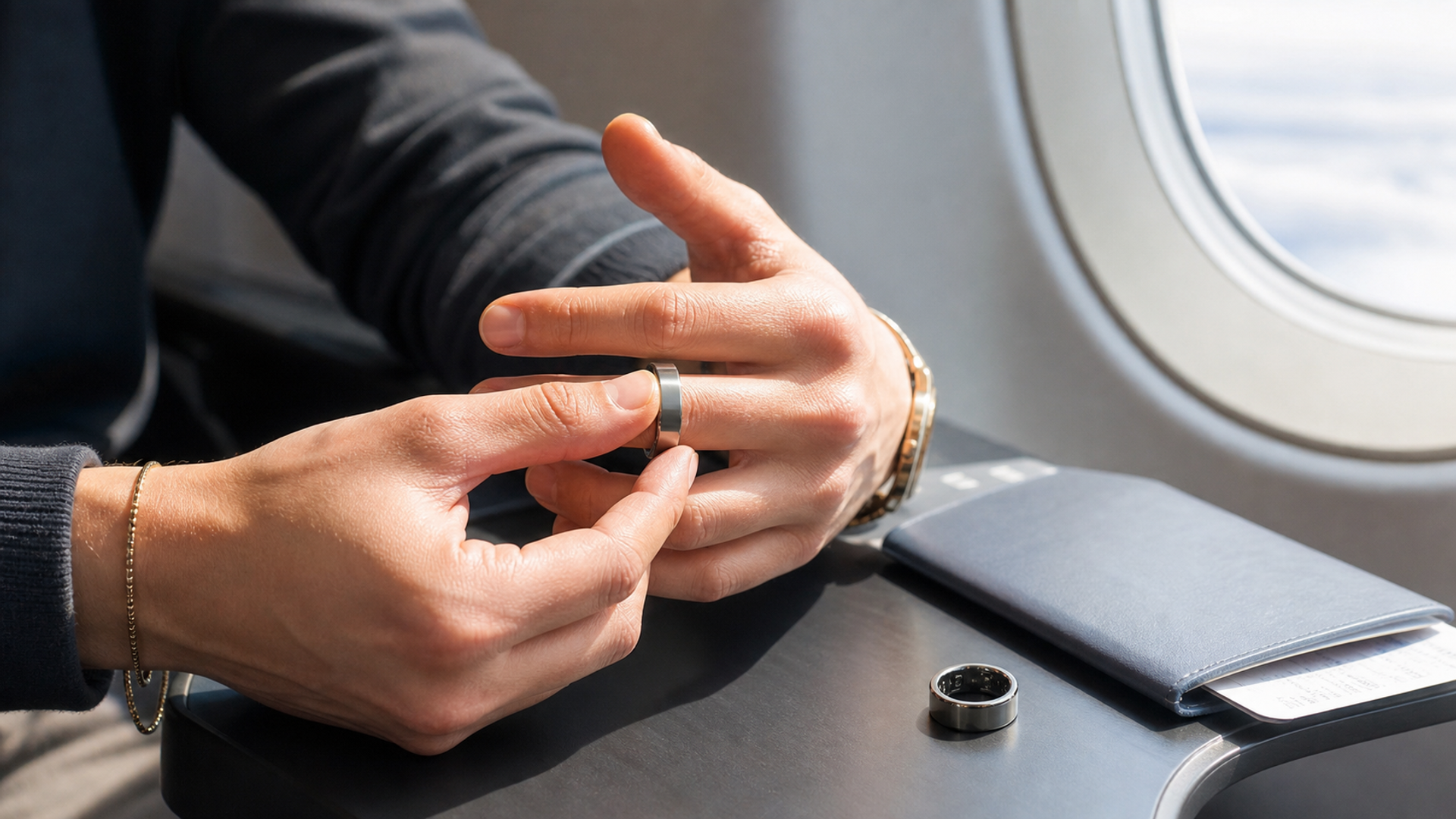
A smart ring should feel snug, stable and forgettable. It should maintain contact with the underside of the finger, resist spinning during ordinary movement and still come off without a struggle. The size that feels perfect for five minutes in an air-conditioned shop may not be the size that works after sleep, exercise, a hot afternoon or a long flight.
That is why the most reliable sizing decision is not a measurement. It is a 24-hour wear test using the exact sizing kit for the exact ring generation you plan to buy.
Oura’s current sizing guidance says its generations can differ, that its sizes do not necessarily match standard US rings and that a sizer should feel snug rather than tight. RingConn likewise advises testing for at least 24 hours, including sleep. Those are not minor checkout instructions. They reflect the basic challenge of a sensor worn around a body part whose size changes throughout the day. This analysis is supported by Samsung Galaxy Ring sizing guidance.
The direct answer: what correct fit feels like
A correctly fitted smart-ring sizer should pass four tests:
| Test | Pass | Warning sign |
|---|---|---|
| Stability | Sensors remain positioned against the palm side of the finger | Ring rotates repeatedly without deliberate movement |
| Fist test | Little or no visible gap appears above the finger | Clear daylight between ring and finger |
| Comfort | Present but not distracting during typing, walking and sleep | Throbbing, tingling, numbness, deep indentation or pain |
| Removal | Comes off with controlled twisting; soap and water may help | Falls off easily, or cannot be removed safely |
Stop the test if the finger becomes numb, changes colour, develops increasing pain or the ring cannot be removed. A buying guide cannot diagnose swelling or circulation problems; persistent or concerning symptoms deserve medical attention.
Why your normal jewellery size is not enough
Smart rings are not ordinary bands with electronics hidden inside. Their internal sensor geometry, width, thickness and generation-specific construction affect fit. Two brands that print the same size number may not fit the same finger in the same way.
Oura’s official guidance explicitly tells buyers to use the correct generation’s kit, notes that its rings use whole sizes and advises against selecting from another ring’s measurement. It also recommends the index finger for best accuracy, with the middle or ring finger as alternatives, while avoiding a finger where the knuckle is much wider than the base.
That last detail matters. A ring must pass over the knuckle but sit securely at the base. If those two dimensions differ greatly, a technically “correct” circumference can still produce a poor wearing experience.
The VERTU Signals 24-hour sizing protocol
Do this on an ordinary day, not only on a day designed to make the ring fit.
Hour 0: establish two candidates
Test at least two adjacent sizes on more than one eligible finger. Do not decide immediately.
For each candidate:
place the sensor orientation where the manufacturer requires it;
open and close the hand several times;
type for five minutes;
wash and dry the hands normally;
remove and replace the sizer once.
Reject a size that slips without resistance or creates obvious discomfort at rest.
Hours 1–4: normal movement
Wear the leading candidate while walking, working and handling everyday objects. Watch for rotation. A ring that constantly turns can interrupt sensor contact; a ring that never moves because it is painfully tight has failed for the opposite reason.
The aim is stable contact, not compression.
Hours 4–8: controlled heat and activity check
Your fingers can feel different after a warm commute, a meal, light exercise or time outdoors. You do not need to manufacture extreme conditions. Simply include the conditions that are normal for your life.
Re-run the comfort and removal tests. A faint temporary mark may occur with a close-fitting band; pain, numbness, colour change or a deep persistent indentation is not a sizing victory.
Overnight: the non-negotiable test
Sleep is one of the reasons many people buy a smart ring, so the sizer must be wearable through the night. RingConn’s current guide recommends at least 24 hours including sleep, and Oura advises a full-day test because finger size changes during day and night.
Before bed, confirm that the ring is comfortable and removable. On waking, check:
whether the ring feels materially tighter;
whether you can rotate it deliberately;
whether removal remains controlled;
whether the skin shows an unusual reaction;
whether the sensor area stayed in position.
Do not force an overnight test with a size already showing warning signs.
Hours 20–24: alternate-finger fallback
If the leading size becomes uncomfortable at one time of day, test whether it works on the same finger of the other hand or on an approved adjacent finger. A useful smart-ring wardrobe has a fallback finger. That flexibility is especially valuable when travelling between climates.
The final size should fit one primary finger well and at least one alternate finger acceptably. If no size does, the ring’s geometry may simply be wrong for your hand.
The flight test: what to simulate before departure
You do not need to board an aircraft to make a better travel decision. Add a “flight-like” block to the 24-hour test:
wear the sizer during several continuous hours of sitting;
include an ordinary salty meal and normal hydration rather than manipulating either;
test it in the morning and late afternoon;
check it after carrying luggage or walking briskly;
practise moving it to the alternate finger.
This does not predict every body response. It reveals whether the fit has enough tolerance for the ordinary variation you already experience.
On an actual flight, comfort takes priority over uninterrupted data. If the ring becomes restrictive, remove it early rather than waiting until removal is difficult. Store it in a dedicated case—not loose in a seat pocket.
Should you size down when between sizes?
There is no universal answer across brands. Oura currently recommends the smaller of two sizes because sensor contact benefits from a snug fit and its final ring may move more smoothly over the skin than the plastic sizer. That advice applies to Oura’s own design and should not be turned into a rule for every smart ring.
Use a decision sequence instead:
Follow the manufacturer’s generation-specific instructions.
Reject any smaller size that becomes restrictive during the 24-hour test.
Reject any larger size that repeatedly rotates or shows a clear fist gap.
Consider a different finger before accepting a poor compromise.
If neither size passes, reconsider the model rather than hoping the sensors will compensate.
The purpose of sizing is not to make the ring stay on at all costs. It is to create reliable contact that you can tolerate every day.
A travel-specific fit scorecard
Score each candidate from 0 to 2 in the following matrix.
| Criterion | 0 | 1 | 2 |
|---|---|---|---|
| Morning comfort | Restrictive or painful | Noticeably tight | Comfortable and stable |
| Afternoon comfort | Loose or restrictive | Small fit change | Comfortable and stable |
| Rotation | Frequent | Occasional | Stays oriented |
| Fist gap | Clear | Slight | None/minimal |
| Removal | Unsafe/difficult or falls off | Requires care | Controlled twist |
| Sleep | Cannot tolerate | Noticeable | Largely forgotten |
| Alternate finger | None | Marginal | One reliable fallback |
A score of 12–14 is a strong fit. Nine to 11 deserves another day of testing. Eight or below suggests trying another size, finger or model. This is an ownership framework, not a medical or accuracy assessment.
What about the VERTU AI Aura Ring?
The current VERTU product knowledge base describes the AI Aura Ring collection as a subscription-free wellness wearable made from crystal glass and resin, starting from 5.7g, with 5 ATM water resistance and up to ten days of battery life. Those specifications do not remove the need to confirm fit for the current model and size.
VERTU’s approved claims cover wellness-oriented sleep, heart-rate, body-tension and activity tracking. They do not support medical diagnosis or prohibited blood-glucose, blood-pressure or blood-oxygen claims in this workflow. Fit helps a sensor remain positioned; it does not convert a wellness wearable into a medical device.
Buying a smart ring as a gift
A surprise ring in the wrong size is less luxurious than a sizing process handled well. The better gift is the selection experience:
present the model or a symbolic object;
arrange the official sizing kit;
let the recipient complete the full-day test;
confirm the exact generation and finish only after sizing;
check the exchange policy before ordering.
Do not rely on a jewellery ring borrowed from the recipient. Even if the circumference appears similar, finger choice and internal geometry can make the smart ring fit differently.
The final decision
Choose the size that is stable at its loosest point and comfortable at its tightest point. It should pass the fist test, remain oriented, survive sleep and move to a fallback finger when needed.
Most importantly, treat the sizing kit as part of the product—not as packaging that delays delivery. Twenty-four hours of testing is cheaper than months of poor comfort, inconsistent wear or an expensive ring left in a drawer.
![Top 10 Tourbillon Watches for Men [2026 Latest]](https://cdn.sanity.io/images/e0gp1l2g/production/8cb6bc45133cf9453382fc7d074465af588bb610-1800x1080.webp?w=800&h=450&q=82&auto=format&fit=crop)