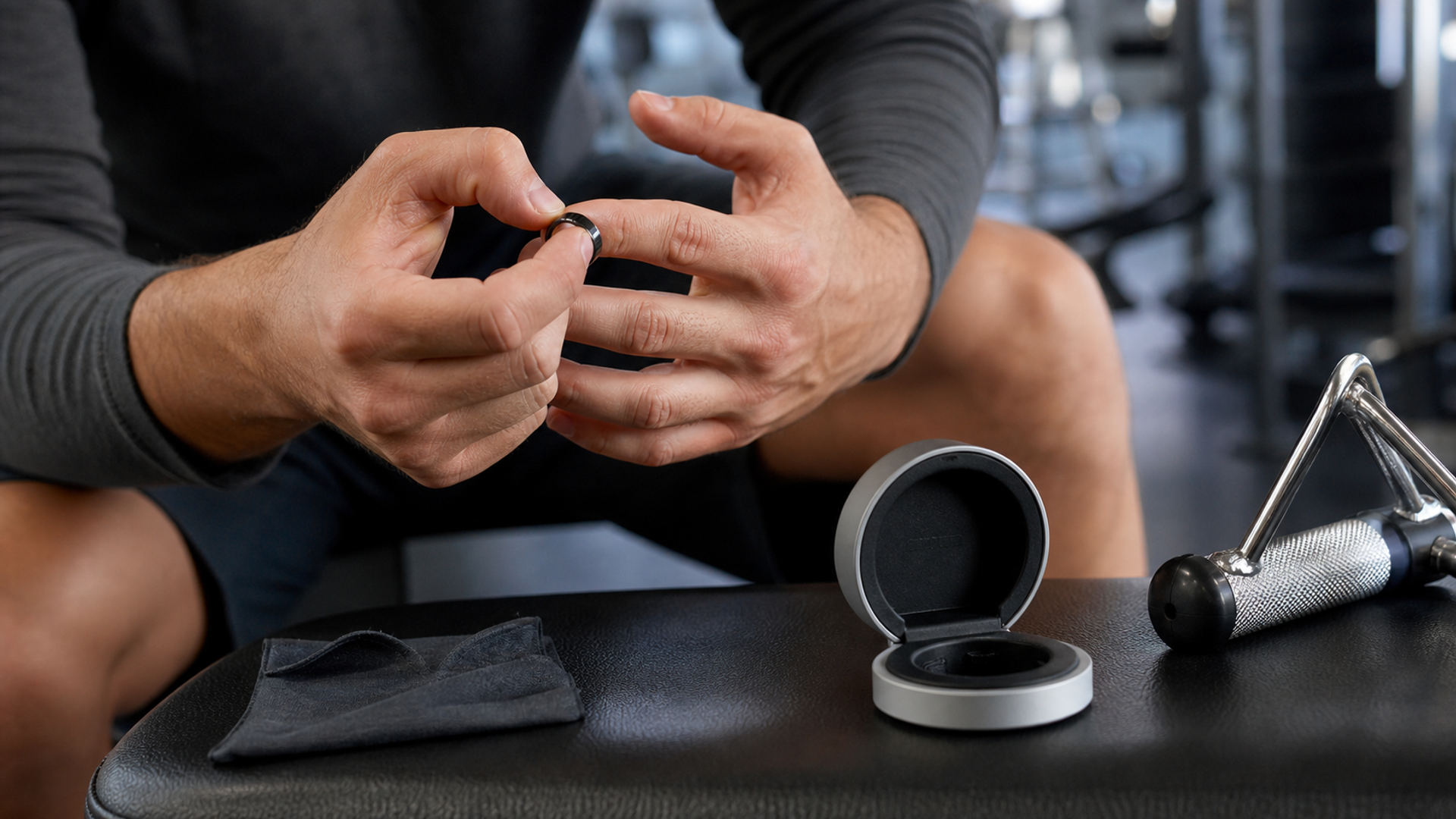
Take off a smart ring when gripping heavy metal equipment, exposing it to harsh chemicals, entering a sauna or steam room contrary to the maker's guidance, charging it, or dealing with swelling and skin irritation. Swimming and showering depend on the exact model's current water-resistance instructions. The correct habit is not “wear it always”; it is “wear it when the sensor contact and environment remain appropriate”.
That distinction protects three things at once: your finger, the ring's finish and the quality of the data it collects. Water resistance does not make a wearable immune to impact, detergent, salt, pressure or sudden temperature change.
The seven-moment decision table
| Situation | Wear, remove or clean? | Why |
|---|---|---|
| Barbell, dumbbell or heavy luggage handle | Remove | Hard objects can trap the ring, scratch it or concentrate pressure on the finger |
| Pool or shallow swim | Check model; often wearable | Water rating and after-care differ by model; rinse after salt or chemicals |
| Sauna, steam room or very hot spa | Remove unless explicitly permitted | Heat and sudden temperature change can affect battery, adhesive and water resistance |
| Sunscreen, sanitiser or cleaning chemicals | Remove or rinse promptly | Residue can irritate skin and affect surfaces or sensors |
| Long flight with finger swelling | Reassess fit; remove early if tight | A ring that becomes difficult to rotate is no longer a comfortable fit |
| Charging | Remove | Charging requires the ring to sit correctly on its dock or case |
| Redness, pain or persistent irritation | Remove and pause use | Clean and dry the ring and finger; seek professional advice if symptoms persist |
This table is a starting point. The user's manual for the exact model takes priority because construction, water rating and approved environments vary.
1. Remove it before heavy gripping
Weight training is the clearest “take it off” case. A metal bar or hard handle can press a rigid ring into the finger. It can also scratch or deform the ring's outer surface. Samsung's current Galaxy Ring precautions explicitly tell users to remove the ring when lifting or handling heavy, hard objects and not to wear it for exercises involving a hard bar such as weights or dumbbells.
The same logic applies outside a gym. Moving suitcases, carrying flight cases and pulling a stuck overhead bag can create a strong grip against an unforgiving handle. Remove the ring before the task rather than after it becomes uncomfortable.
Put it in a dedicated case, not a loose pocket. A tiny wearable is easy to leave on a bench or drop into a bag lining. The case should become part of the exercise routine: remove, store, train, clean hands, replace.
2. Treat swimming as a model-specific decision
An ATM or IP rating describes test conditions, not every real-world exposure. Samsung says its Galaxy Ring is certified to 10 ATM and IP68 under stated laboratory conditions, while warning that water resistance can deteriorate and that high-speed water, scuba diving, pressure washers and sudden temperature changes fall outside ordinary use.
The VERTU product knowledge base states that the current AI Aura Ring has a 5 ATM water-resistance rating. It does not authorise every aquatic activity. Use the live AI Aura Ring collection and the supplied model instructions to confirm the current version before entering water.
After a pool or sea swim, rinse a model that permits swimming with clean fresh water and dry it thoroughly. Chlorine, salt, sunscreen and soap are separate exposures from water itself. Do not leave moisture trapped between the ring and skin.
3. Remove it for heat that the maker does not approve
Saunas and steam rooms combine high temperature, moisture and rapid transitions. Samsung advises against sudden temperature changes in saunas and steam rooms because they may impair water resistance. Oura's guidance varies by generation and support document, which is exactly why generic advice is unsafe.
The sensible rule is conservative: if the current manual does not explicitly allow the environment, remove the ring. Never cool a warm ring abruptly with ice water. Let it return to room temperature naturally, and do not charge it while it remains unusually warm.
This is especially important on summer travel. A ring left in a car, on a sunlit windowsill or inside a closed beach bag can experience conditions that have little resemblance to normal wrist or finger wear.
4. Keep chemicals away from the sensor and skin
Sunscreen, hand sanitiser, perfume, detergent, insect repellent and cleaning products can collect on the inner surface. Samsung warns that sweat, oil, cosmetics, antibacterial sprays, hand cleaners and detergents can damage the ring or contribute to irritation if residue remains.
Remove the ring before applying a product when practical. If exposure occurs, follow the manufacturer's cleaning method. For the Galaxy Ring, Samsung recommends a soft cloth or rinsing with a soap-free detergent, followed by thorough drying; it warns against ultrasonic cleaners, abrasives, compressed air and external heat.
Do not transfer those instructions to every ring. Resin, ceramic, titanium, coatings and adhesives respond differently. The VERTU AI Aura Ring is specified as crystal glass and resin, so use only care instructions supplied for that product rather than assuming a metal-ring method applies.
5. Recheck fit during flights and hot days
Fingers can change size over a day. Heat, hydration, activity and a long period of sitting can make a previously comfortable ring feel tight. A recent 24-hour smart-ring sizing test is more informative than a five-minute try-on because it captures those changes.
During travel, rotate the ring gently as a fit check. If it becomes difficult to move, remove it before swelling makes removal urgent. Never force a tight electronic ring over a painful joint. Follow the manufacturer's emergency guidance or seek professional assistance.
Fit also affects data. A ring that spins freely may lose consistent sensor contact; one that leaves deep marks or causes numbness is too tight. “Continuous wear” has no value if the device is uncomfortable or positioned incorrectly.
6. Charging means planned downtime
A smart ring cannot be on your finger while it sits on a charging dock or in a charging case. The question is when to create that gap. Charge during a low-value measurement period: a shower if the ring is being removed anyway, desk work, or a short morning routine.
Do not wait until departure day to discover a proprietary charger is missing. Pack the dock and cable in the cabin, and confirm airline battery rules for the charging case if it contains its own lithium battery. IATA's current battery guidance for travellers recommends keeping lithium-powered devices accessible in hand baggage.
Battery claims also need qualifiers. VERTU's knowledge base states up to ten days for AI Aura Ring, but real endurance depends on use and configuration. Treat “up to” as a planning ceiling, not a promise that every trip will fit between charges.
7. Skin irritation is a stop signal
A ring creates a warm, enclosed contact area. Moisture, soap and residue can remain underneath it. If redness or discomfort appears, remove the ring, clean and dry both surfaces, and pause use. Samsung tells users to stop wearing its ring and consult a healthcare professional if irritation occurs.
This article is general ownership guidance, not medical advice. Persistent swelling, pain, broken skin or a ring that cannot be removed requires appropriate professional help, not an improvised internet technique.
A two-minute daily care routine
Remove the ring and inspect the inner surface.
Check for residue, chips, deformation or a damaged charging contact.
Clean using only the maker's approved method.
Dry the ring and finger completely.
Refit it on the intended finger and confirm it rotates without being loose.
Sync and charge before the battery becomes a travel problem.
Buyers comparing ring models should separate wellness features from ownership design. The current smart-ring guide can help identify the right category, but water rating, charger format, material and replacement support deserve equal weight.
Establish a fit baseline before travel
Judge fit across a full day, not at one cool moment in a shop. Fingers can change with temperature, hydration, salt intake, sleep and activity. A suitable ring should remain secure without leaving persistent deep marks, numbness or pain. Follow the maker's sizing kit and finger guidance because sensor layout and recommended position differ by model.
Before a long journey, record which finger and size remain comfortable overnight, during walking and after washing hands. If the ring becomes difficult to rotate when the hand is warm, remove it before swelling makes that harder. Do not force a tight ring over an injured or rapidly swelling joint; seek appropriate assistance.
Data continuity should not override skin health. Removing the ring for charging, cleaning or irritation creates a gap, but wearing it through an unsafe task can create a larger problem. When sharing wearable data with a clinician, identify the model and measurement context. Heart rate, temperature trend, sleep staging and oxygen estimates do not have identical validation or intended use across devices.
The practical verdict
The best smart-ring habit is selective continuity. Wear it for the periods that matter, but remove it before heavy gripping, unapproved heat, chemical exposure, charging and any episode of painful tightness or irritation. For water, follow the exact model's current instructions and clean it afterwards.
A few intentional gaps create a better ownership experience than chasing an unbroken streak at the expense of comfort or care.
Sources
VERTU product knowledge base, revision 136, fetched 14 July 2026