

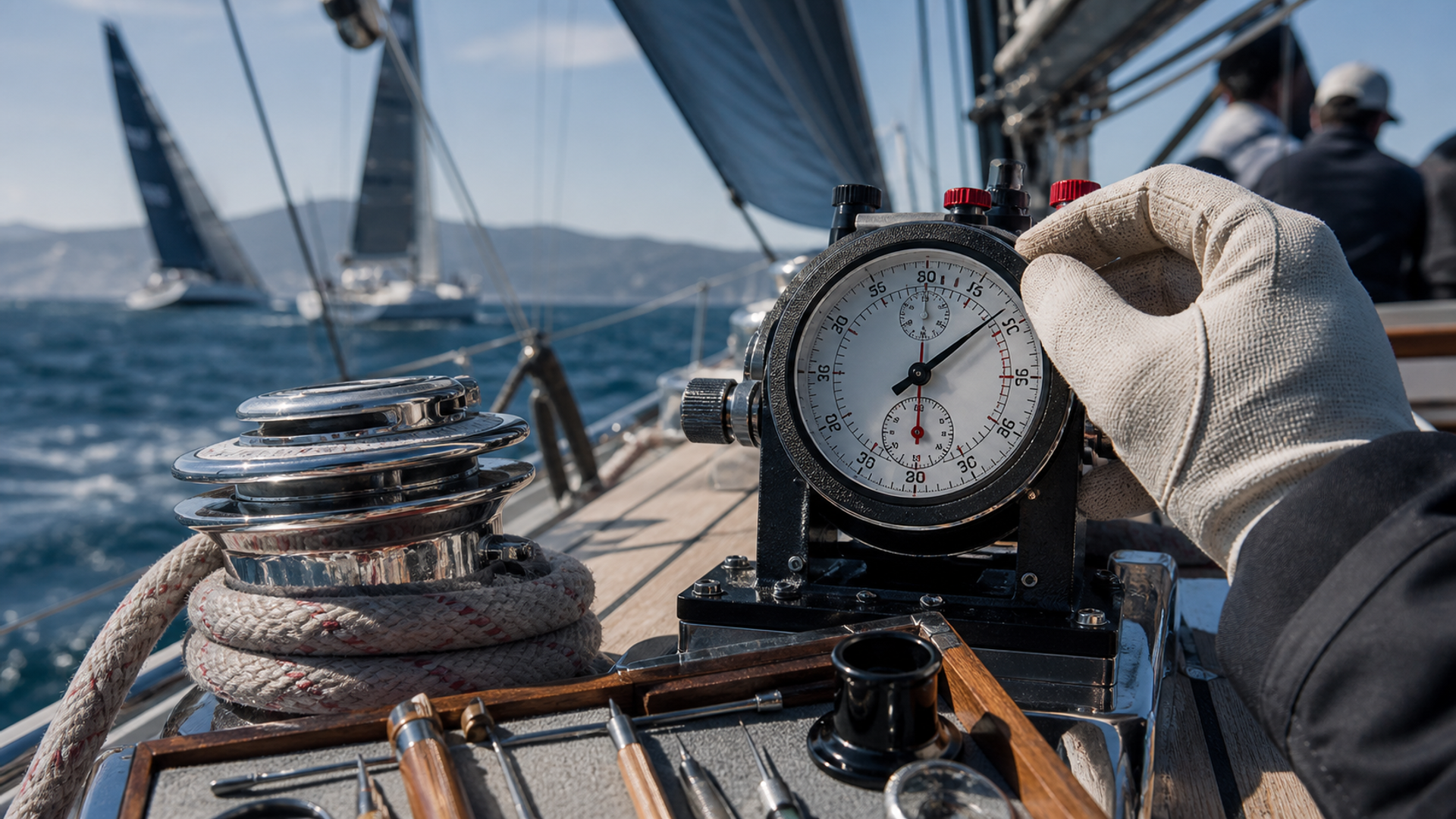
The 2026 Rolex Yacht-Master II is not a dial update to the previous regatta chronograph. Rolex has changed the way the countdown is programmed, moved the countdown scale to the flange, reversed the direction of the countdown hands and introduced calibre 4162. The model remains a 44 mm, 100-metre-water-resistant specialist sailing watch, but its operating logic is now materially different.
That distinction defines the buying decision. A previous-generation owner should consider the new watch only if the revised controls and display are easier in actual use. A new buyer should choose it only if a programmable regatta countdown has a genuine place in the collection. Anyone mainly seeking a versatile sports Rolex should resist treating technical novelty as proof of fit.
The exact 2026 change map
The table below separates Rolex-confirmed changes from the practical consequence a buyer should test. It is based on Rolex's 2026 launch page and detailed official newsroom release, both observed on 6 August 2026.
| Area | Previous-generation arrangement described by Rolex | 2026 arrangement | Buyer consequence |
|---|---|---|---|
| Countdown programming | Rotatable bezel and Ring Command system | Lower pusher advances the programmed minute in one-minute increments | Programming is separated from the bezel; test whether it is genuinely faster and less error-prone |
| Countdown scale | Integrated into the earlier display architecture | Dedicated 10-to-0 scale on a flange, with half minutes shown as triangles | Remaining minutes occupy a clearer, fixed reading track |
| Direction of display | Conventional direction on the previous model | Countdown minute and seconds hands move counterclockwise | The hands now travel towards zero; the wearer must decide whether this is more intuitive |
| Bezel role | Part of the former Ring Command programming interface | Bidirectional 60-minute Cerachrom bezel for measuring intervals | The bezel and countdown now have more distinct jobs |
| Movement | Calibre 4161 | Calibre 4162, described as an evolution of 4161 with a reengineered countdown | New operation is supported by a materially revised mechanism, not a cosmetic change |
| External design | Earlier case, bracelet and dial architecture | Restyled domed case sides, broader bracelet, slimmer clasp, matt white lacquer dial and winch-shaped pushers | Fit and visual balance need a fresh wrist test even for an existing owner |
This change map is the article's value object. It also defines the content boundary: the wider Rolex 2026 launch portfolio belongs in the separate range guide, while this article concentrates on one mechanism and one ownership decision.
Programming moves from the bezel to the lower pusher
Rolex says the former Yacht-Master II used the rotatable bezel and Ring Command system to programme the countdown. On the 2026 watch, the lower pusher performs that task. Each press advances the countdown minute hand by one increment until it reaches the required duration. The programmed duration is retained in mechanical memory, so a countdown of the same length can be started again without reprogramming.
The upper pusher starts and stops the countdown. If the watch was started early or late relative to the official race signal, pressing the lower pusher resets the centre seconds hand on the fly and synchronises the minute hand to the nearest minute. At the end of the programmed countdown, the minute hand stops at zero while the centre seconds hand continues until stopped. A further press of the lower pusher resets the hands to the last programmed duration.
These details matter because “easier to use” is not established by a product photograph. A buyer should programme three, five and ten minutes without assistance; start deliberately late; use the synchronisation; then reset and repeat. The correct watch is the one whose control logic remains clear after the sales explanation has ended.
Counterclockwise hands change the reading model
The countdown minute and seconds hands now move counterclockwise, which Rolex describes as a first for the brand. The intent is literal: the hands travel towards zero as the start approaches. The new flange is graduated from 10 to 0 minutes, and triangular marks show half-minute points. On the Oystersteel version, the countdown markings and related hands use red accents against a matt white lacquer dial designed to reduce reflections.
The blue Cerachrom bezel carries a 60-minute scale, with the first half hour marked minute by minute. It can measure a separate interval, such as time between two buoys. Rolex also explains that, when the bezel is returned to its neutral triangle-at-12 position, its first 30-minute graduations help read the final 30 seconds of the countdown.
That is a dense information system. Test it as a sequence rather than by asking whether the dial is “legible”. Read ordinary time, programme the countdown, identify minutes and seconds remaining, synchronise it, then use the bezel for a separate interval. Repeat in bright light, shade and at a realistic viewing angle. A cleaner layout still fails if the owner's eye searches the wrong scale under pressure.
Calibre 4162 is the mechanical centre of the redesign
Rolex identifies calibre 4162 as a self-winding chronograph movement developed and manufactured in-house, exclusive to the Yacht-Master II at launch. It evolves calibre 4161 but uses a completely reengineered countdown. The countdown mechanism uses a column wheel and vertical clutch, while the movement incorporates the Chronergy escapement, a blue Parachrom hairspring, Paraflex shock absorbers and winding by Perpetual rotor.
The official newsroom specification states an approximate power reserve of 72 hours. It also describes a cut-out oscillating weight and bridges decorated with Rolex Côtes de Genève. Those finishing details are visible evidence of the new generation, but they are secondary to the operating change for most owners.
Rolex also provides a model-level official specification brochure for the Oystersteel reference. Use it to confirm the exact reference and baseline technical sheet rather than relying on a retailer summary.
Calibre 4162 should not be described as proven superior in long-term ownership simply because it is newer. The launch material establishes its architecture and functions, not years of service history. A prudent buyer should ask the official retailer about operating instructions, warranty documentation and the normal service route, then follow the official user guide rather than experimenting with the pushers.
The case and materials remain deliberately substantial
Rolex offers the 2026 Yacht-Master II in Oystersteel and 18 ct yellow gold. Both use a 44 mm Oyster case guaranteed by Rolex to 100 metres, a blue ceramic Cerachrom bezel insert and an Oyster bracelet with Oysterlock safety clasp and an Easylink extension of approximately 5 mm. The yellow-gold bracelet includes ceramic inserts inside the links, which Rolex says help prevent premature wear and improve flexibility.
The diameter alone does not resolve fit. Rolex says the bracelet is slightly broader than on the previous version and the clasp slimmer, while the middle case has been restyled with domed sides. Those changes alter how the watch distributes its mass. Wear it for at least 20 minutes, type, turn a steering wheel and place the wrist under a jacket cuff. Inspect the clasp from below and the case from the side. Close-up wrist photographs can make a large watch appear more centred than it feels.
The gold version changes more than colour. The greater mass can make the watch feel either reassuring or tiring depending on wrist shape and activity. Compare steel and gold during the same appointment rather than relying on separate impressions.
The model's collection role is unusually narrow—and that is its strength
The Yacht-Master II is a regatta countdown chronograph. It is not a larger Yacht-Master, a substitute for a GMT-Master II or a conventional elapsed-time chronograph. Its complication addresses the pre-start sequence of a sailing race, where a crew needs to count down to a variable official start.
For an active sailor, that specificity can justify the watch if the pushers remain usable in movement and the display can be read at a glance. For a technical-watch collector, the mechanical memory, on-the-fly synchronisation and reversed display create an unusual proposition even if the watch is not used competitively. For a one-watch buyer, the same specialisation may be a disadvantage: the size and complexity occupy space that could be given to a date, second time zone or simpler daily legibility.
Write the intended role before discussing metal or availability. “Regatta instrument”, “mechanical interface study”, “large precious-metal sports watch” and “contrast piece in a collection” are defensible roles. “Newest sports Rolex” is not a role.
Should a previous-generation owner change?
An existing owner already has the defining concept: a programmable countdown with mechanical memory and on-the-fly synchronisation. The 2026 case for changing is therefore operational rather than categorical. The lower-pusher programming, fixed flange, counterclockwise display, calibre 4162 and revised ergonomics must create a better experience on the wrist.
Use a side-by-side test with the same countdown duration. Record the number of steps required to programme each watch, whether the display is understood without explanation, how quickly synchronisation can be performed and which case is more comfortable. Do not assume the new watch makes the previous one obsolete. Conversely, do not assume the Ring Command system is preferable merely because it is more mechanically theatrical.
Condition, provenance and service history matter if the alternative is a pre-owned previous-generation reference. Compare exact references and complete documentation, not “old” versus “new” as abstract categories. The official 2026 material does not establish secondary-market value, rarity or future appreciation.
A five-minute pre-purchase operating test
Confirm the exact reference, material and 44 mm case on the official listing.
Programme a five-minute countdown using only the lower pusher.
Start it with the upper pusher and deliberately create a timing error.
Synchronise on the fly, then observe the minute and seconds hands moving towards zero.
Reset and confirm that mechanical memory restores the programmed duration.
Put the bezel at neutral and read the final 30 seconds against its scale.
Wear the watch through normal wrist movements and test the Easylink adjustment.
Ask for the official operating guide and warranty terms before purchase.
If any operational step remains confusing after two attempts, pause the decision. A specialised complication should reward use, not require permanent interpretation by someone else.
For collection context, VERTU's guides to Rolex Yacht-Master vs Submariner and building a three-watch collection address different questions and do not substitute for the official 2026 specification.
Verdict
The 2026 Yacht-Master II is a genuine new generation because the operating architecture, display and movement have changed together. Its lower-pusher programming, counterclockwise countdown, dedicated flange and calibre 4162 make the regatta function easier to separate from the bezel and more explicit on the dial. That does not make it a universal upgrade. Buy it when the redesigned countdown is meaningful, the 44 mm case works through a real wear test and the watch adds a distinct role to the collection. Keep or choose another model when the complication will remain unused, the older interface is preferred or a simpler daily watch would serve more often.
![How to Scan Receipts and Documents with Your Phone [Full Guide]](https://cdn.sanity.io/images/e0gp1l2g/production/0db13feec1d5e72b8a8a5f976d1f3e86619c9228-3840x1860.webp?w=180&h=180&q=78&auto=format&fit=crop)
![How to Scan Receipts and Documents with Your Phone [Full Guide]](https://cdn.sanity.io/images/e0gp1l2g/production/0db13feec1d5e72b8a8a5f976d1f3e86619c9228-3840x1860.webp?w=800&h=450&q=82&auto=format&fit=crop)
![Top 10 Two-Tone Carbon-Fibre Watches for Men [2026 List]](https://cdn.sanity.io/images/e0gp1l2g/production/18870799ba33fab0e038968359cd5772d7d7db30-1024x576.webp?w=800&h=450&q=82&auto=format&fit=crop)
![Top 10 Luxury Watches with Digital Complication Displays for Men [Latest]](https://cdn.sanity.io/images/e0gp1l2g/production/c4f6bf8c080f291c39f7cc85c7344ecff2fd3799-1024x553.webp?w=800&h=450&q=82&auto=format&fit=crop)