

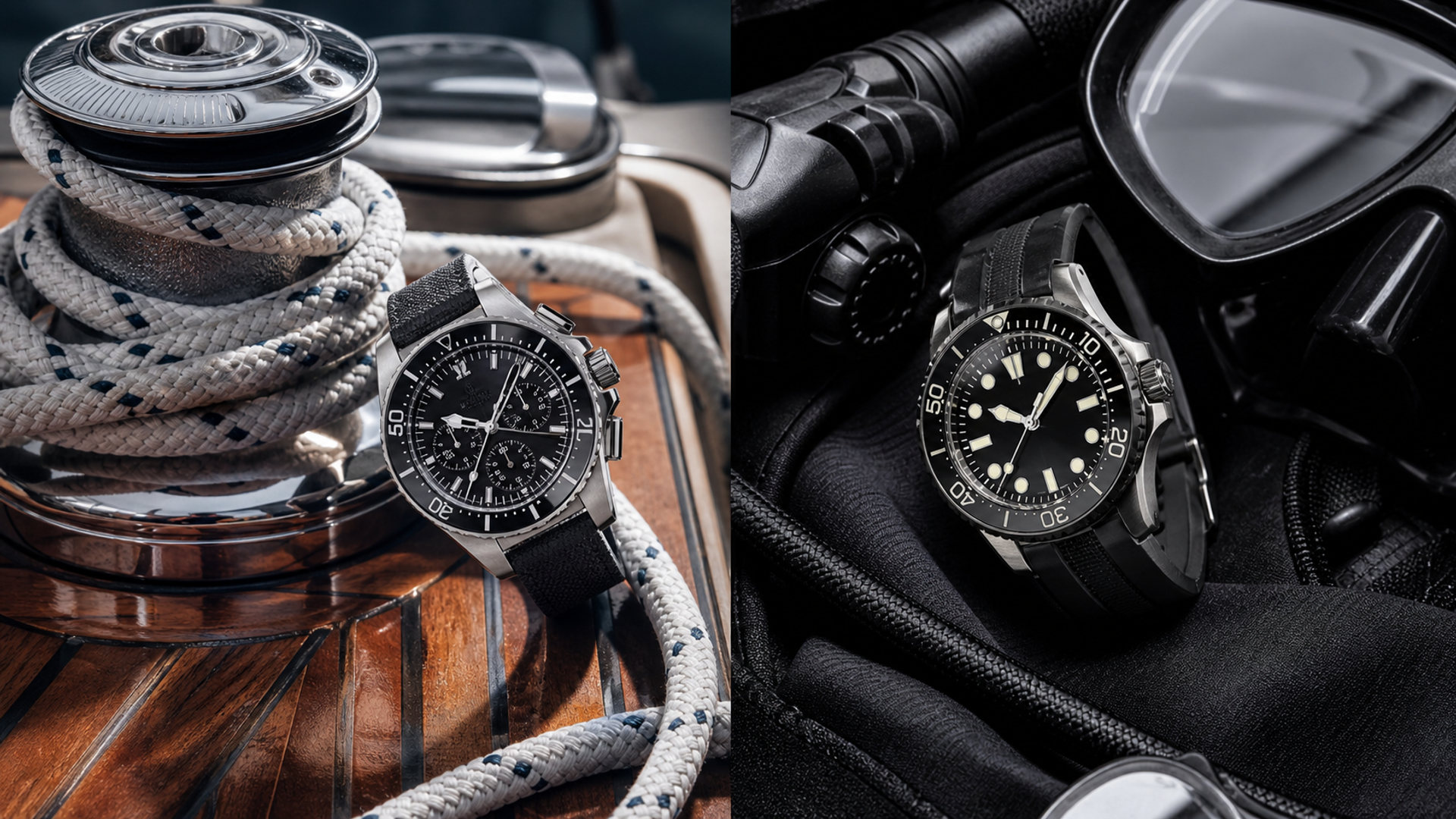
The Rolex Yacht-Master and Submariner share an Oyster-family visual language, but they solve different problems. The Submariner is a purpose-defined dive watch with a unidirectional timing bezel and 300-metre water resistance. The Yacht-Master is a nautically styled luxury sports watch with a bidirectional 60-minute bezel, broader material choices and 100-metre water resistance in current representative models. Choose by use, wrist, material and bezel function—not by assuming one is simply a more expensive version of the other.
This guide compares current official architecture and representative references. Rolex changes configurations over time, and availability varies by market and authorised retailer. It does not provide speculative investment returns or secondary-market price predictions.
Quick answer
Choose the Submariner if you want the clearer tool-watch brief, greater water resistance, a unidirectional dive bezel and a visually robust daily wearer. Choose the Yacht-Master if you prefer a more polished nautical character, a bidirectional timing bezel, varied sizes and materials, and a watch that moves more naturally between deck, resort and formal casual settings.
Neither choice is universally better. The Submariner is more functionally specialised; the Yacht-Master offers more expressive configurations.
Yacht-Master vs Submariner decision matrix
| Decision factor | Yacht-Master | Submariner | Buyer implication |
|---|---|---|---|
| Core identity | Nautical luxury sports watch | Professional dive watch | Style-led versatility vs tool clarity |
| Bezel | Bidirectional 60-minute graduated bezel | Unidirectional dive-timing bezel | Convenient countdown/reference vs safety-oriented dive timing |
| Water resistance | 100 m on current Yacht-Master 42 reference | 300 m on current Submariner reference | Surface/water lifestyle vs serious dive specification |
| Sizes/materials | 37, 40 and 42 mm families; precious metal, Rolesium and RLX titanium options | Current no-date reference is 41 mm Oystersteel; other Submariner variants exist | More configuration freedom vs a focused archetype |
| Visual tone | Polished, sculpted, often softer | Strong contrast and utilitarian stance | Dressier nautical vs iconic tool watch |
| Best for | Sailing, resort, varied wardrobes | Diving, rugged daily use, tool-watch collectors | Choose the story you will actually live |
Bezel direction reveals the design brief
Rolex's official Yacht-Master features describe a bidirectional rotatable bezel graduated over 60 minutes. It can time intervals in either direction and is central to the watch's nautical visual identity. Because it rotates both ways, it is convenient for general elapsed-time references but is not built around the same dive-safety logic as a unidirectional bezel.
The official Submariner overview identifies a unidirectional bezel and 300-metre waterproofness as defining dive-watch features. If a unidirectional dive bezel is knocked, it can generally indicate less remaining time rather than more. That functional asymmetry is part of the Submariner's professional brief.
For a buyer who will never dive, bezel direction may seem academic. It still shapes use. The Yacht-Master's bezel suits timing a tender, parking interval or race reference with quick adjustment. The Submariner communicates a more rigorous tool-watch purpose even when worn at a desk.
Water resistance: buy for credible use, not fantasy
The current Yacht-Master 42 reference 226627 publishes 100 metres of water resistance. That is substantial for normal surface-water and daily use when the watch is maintained and the crown is secured. The current Submariner reference 124060 publishes 300 metres.
The Submariner wins the specification comparison. The practical question is whether you need it. A sailor, swimmer or traveller may find 100 metres sufficient, while a diver or buyer who values the engineering margin will prefer 300 metres and the dive bezel.
Water resistance is not permanent. Gaskets age, impacts occur and service history matters. Any watch used in water should be pressure-tested at appropriate intervals by a qualified service provider. Vintage watches require particular caution; an old dial saying “waterproof” is not current evidence.
Size and material change the Yacht-Master experience
The Yacht-Master family has been offered in 37, 40 and 42 mm sizes with different material expressions. Rolesium combines Oystersteel and platinum; other references use precious metal, Oysterflex or RLX titanium. The current 42 mm titanium model is especially different in weight and surface character from a steel-and-platinum Yacht-Master.
The current no-date Submariner reference is a 41 mm Oystersteel watch. Its brushed Oyster bracelet, strong bezel contrast and compact dial architecture produce a familiar, purposeful look. Date-equipped Submariner variants add their own material and colour choices, so buyers should compare reference with reference rather than family name with family name.
Try watches on. Diameter alone does not determine comfort. Lug-to-lug length, thickness, bracelet taper, clasp, case material and wrist shape affect wear. A light 42 mm titanium watch may feel less imposing than a smaller but denser precious-metal one.
Dial and finishing: polish versus purpose
Yacht-Master dials and bezels often create more tonal nuance. Raised numerals, polished surfaces and material contrast can make the watch feel more luxurious and less purely instrumental. It works well with knitwear, tailoring and resort clothing while retaining the Oyster-case sports-watch structure.
The Submariner prioritises immediate legibility. Large luminous markers, clear hands and high bezel contrast serve low-light reading. Rolex's Chromalight display appears across the sports families, but the Submariner's visual hierarchy remains especially direct.
Polished surfaces show hairlines differently from brushed surfaces. A buyer who is sensitive to visible marks should inspect the exact material and finishing. Do not expect an active sports watch to remain showroom-perfect.
Movement and everyday performance
The Yacht-Master 42 reference cited above uses calibre 3235, while the no-date Submariner 124060 uses calibre 3230. Both are current-generation automatic movements with Rolex's Superlative Chronometer framework and approximately 70 hours of power reserve in the published specifications. The date is the obvious functional difference between those examples.
Movement comparison should not overshadow fit and use. Both are designed as modern daily-wear calibres. Serviceability, ownership history and case condition matter more in a pre-owned purchase than a small theoretical preference between related movements.
If choosing another Yacht-Master or Submariner reference, verify its movement rather than transferring these specifications across the entire family.
Ownership decision: narrative matters
Luxury watches are worn as symbols as well as tools. The Submariner has one of the clearest narratives in watchmaking: a professional dive-watch form that became a global daily-wear icon. That recognisability can be attractive or too familiar, depending on the collector.
The Yacht-Master offers a less utilitarian, more nautical story. It can feel more personal because material and size choices produce greater variation. A buyer who likes the Oyster sports-watch language but wants something softer or more unusual may prefer it.
Do not buy only for an imagined resale outcome. Secondary prices can change with reference, condition, completeness, geography and market cycle. Buy the reference whose use and design remain satisfying if prices are flat for years.
New, authorised and pre-owned buying
For a new purchase, ask an authorised retailer about the exact reference, warranty and availability without assuming a delivery date. Scarcity should not pressure you into an unsuitable size or material.
For pre-owned watches, require a clear seller identity, return terms, serial and reference consistency, service information and high-resolution images. Inspect case geometry, bracelet stretch, clasp, bezel action, crystal and dial. Over-polishing can alter case lines; replacement parts can affect collectability.
Authentication is not a single visual check. Use a reputable specialist and document the transaction. Box and papers support provenance but do not prove that every component is original.
The broader men's luxury watch guide helps place both models within category history. Buyers earlier in their collecting journey can use the entry-level luxury watch guide to compare spending priorities before committing to a Rolex sports model.
Five buyer profiles
The active diver
Choose the Submariner. The 300-metre rating, unidirectional bezel and professional dive-watch architecture directly support the use.
The sailor and resort traveller
Choose the Yacht-Master if the bidirectional timing bezel, material palette and more polished nautical identity appeal. Have the watch maintained and pressure-tested before water use.
The one-watch owner
The answer depends on wardrobe. The Submariner is exceptionally legible and robust; the Yacht-Master can feel more adaptable around smart-casual clothing. Try both with the clothes you wear.
The collector seeking an icon
The Submariner has the clearer historical archetype. Select reference, date/no-date and material carefully rather than buying the category name.
The collector seeking variation
The Yacht-Master's 37, 40 and 42 mm options and wider material range provide more room for an individual choice.
Try-on checklist
Does the case sit within your wrist without uncomfortable overhang?
Is the weight appropriate for full-day use?
Can you read the bezel and dial in the lighting you encounter?
Do you prefer bidirectional convenience or unidirectional dive logic?
Will 100-metre or 300-metre water resistance materially affect use?
Are polished surfaces compatible with your tolerance for visible marks?
Is the exact movement, reference and service history documented?
Would you still choose it without a resale narrative?
Final verdict
The Submariner is the better choice for a buyer who wants a focused dive-watch specification, maximum water-resistance margin and an unmistakable tool-watch identity. The Yacht-Master is better for someone who values nautical style, bidirectional timing, varied sizing and materials, and a more polished transition across settings. Verify the exact reference, try it on and buy the story that fits real life rather than the louder reputation.
Sources
Rolex, Yacht-Master features, accessed 3 August 2026.
Rolex, Yacht-Master 42 reference 226627, accessed 3 August 2026.
Rolex, Submariner overview, accessed 3 August 2026.
Rolex, Submariner reference 124060, accessed 3 August 2026.
![How to Scan Receipts and Documents with Your Phone [Full Guide]](https://cdn.sanity.io/images/e0gp1l2g/production/0db13feec1d5e72b8a8a5f976d1f3e86619c9228-3840x1860.webp?w=180&h=180&q=78&auto=format&fit=crop)
![How to Scan Receipts and Documents with Your Phone [Full Guide]](https://cdn.sanity.io/images/e0gp1l2g/production/0db13feec1d5e72b8a8a5f976d1f3e86619c9228-3840x1860.webp?w=800&h=450&q=82&auto=format&fit=crop)
![Top 10 Two-Tone Carbon-Fibre Watches for Men [2026 List]](https://cdn.sanity.io/images/e0gp1l2g/production/18870799ba33fab0e038968359cd5772d7d7db30-1024x576.webp?w=800&h=450&q=82&auto=format&fit=crop)
![Top 10 Luxury Watches with Digital Complication Displays for Men [Latest]](https://cdn.sanity.io/images/e0gp1l2g/production/c4f6bf8c080f291c39f7cc85c7344ecff2fd3799-1024x553.webp?w=800&h=450&q=82&auto=format&fit=crop)