

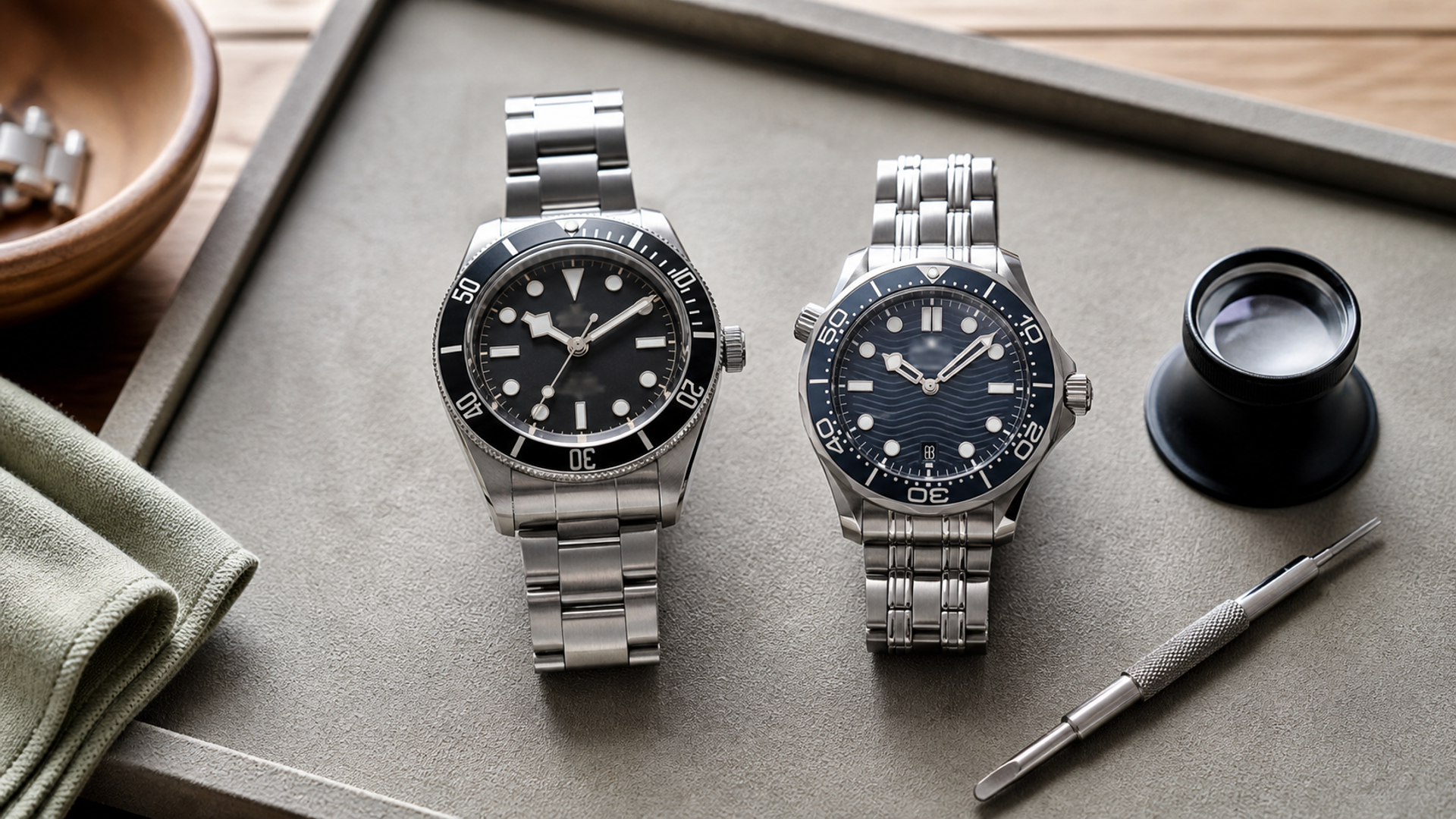
The costly mistake in this category is not simply choosing the less famous option. It is paying for a story that does not survive contact with the exact product, the owner's habits and the local service or buying conditions. This guide compares Rolex Submariner, Omega Seamaster Diver 300M and the disciplined alternative—Wait and inspect both—using current official material, a live VERTU content-inventory check and a decision framework designed for real ownership.
The aim is not to manufacture one universal winner. It is to identify which facts should change the choice, which claims need reference-level confirmation and when waiting is more intelligent than buying. Prices, availability, specifications, policies and service conditions can change by market and date, so verify the exact item and terms before committing.
The short answer
Choose the Submariner when compact visual discipline, a clasp built around incremental fit and long-term recognisability matter most. Choose the Seamaster when a more expressive dial, visible movement technology and broader specification choice suit your wrist and budget. If either watch sits poorly, wait: a one-watch collection has to feel right after ten hours, not only under boutique lighting.
That answer is deliberately conditional. A high-value decision should remain sensible after the novelty wears off, after the first repair or service question, and after the product has to perform in an ordinary week. If the recommendation collapses when one marketing assumption is removed, the evidence is not yet strong enough.
Comparison at a glance
| Decision factor | Rolex Submariner | Omega Seamaster Diver 300M | Wait and inspect both |
|---|---|---|---|
| Design character | Restrained, tool-led and highly recognisable | More expressive dial and bracelet/strap choices | Try the exact references side by side |
| Water resistance | 300 m on reference 124060 | Verify exact Diver 300M reference | Either exceeds normal daily needs |
| Movement story | Calibre 3230, 70-hour reserve | Master Chronometer varies by reference | Compare service access, not slogans |
| Fit adjustment | Glidelock clasp is a major daily advantage | Bracelet and clasp differ by reference | Wear for at least 20 minutes |
| Buying friction | Retail availability can be constrained | Often broader authorised-retail access | Do not pay urgency tax blindly |
| Best owner | Minimalist one-watch buyer | Buyer wanting more visual personality | Buyer whose wrist rejects both |
Read the table as a sequence of verification prompts, not a scorecard. Some factors are non-negotiable and others are preferences. Weight each row according to actual use, then compare the exact references and local terms on the same day.
What current official material confirms
Rolex currently specifies the no-date Submariner 124060 at 41 mm, 300 metres water resistance, an approximately 70-hour power reserve and its Glidelock-equipped Oyster bracelet. Omega's Diver 300M family varies by reference, strap and material, so the exact product page must control the comparison. METAS certification adds tests for magnetic resistance, water resistance, power reserve and chronometric performance, but certification does not make every case shape fit every wrist.
The primary sources used here are visible to readers:
Official pages are the best starting point for specifications, benefit wording and care guidance, but their scope matters. A family page may cover several references; a network benefit can depend on the issuer; and a material standard cannot prove personal fit. Save the exact page and date behind any fact that changes the purchase.
How to interpret the decision matrix
Design character. For Rolex Submariner, the practical case is: Restrained, tool-led and highly recognisable. For Omega Seamaster Diver 300M, it is: More expressive dial and bracelet/strap choices. The control is to try the exact references side by side. That last step matters because a headline specification or familiar name does not prove the result for the exact reference, market, owner or pattern of use. Record the evidence before letting price, scarcity or presentation decide the comparison.
Water resistance. For Rolex Submariner, the practical case is: 300 m on reference 124060. For Omega Seamaster Diver 300M, it is: Verify exact Diver 300M reference. The control is to either exceeds normal daily needs. That last step matters because a headline specification or familiar name does not prove the result for the exact reference, market, owner or pattern of use. Record the evidence before letting price, scarcity or presentation decide the comparison.
Movement story. For Rolex Submariner, the practical case is: Calibre 3230, 70-hour reserve. For Omega Seamaster Diver 300M, it is: Master Chronometer varies by reference. The control is to compare service access, not slogans. That last step matters because a headline specification or familiar name does not prove the result for the exact reference, market, owner or pattern of use. Record the evidence before letting price, scarcity or presentation decide the comparison.
Fit adjustment. For Rolex Submariner, the practical case is: Glidelock clasp is a major daily advantage. For Omega Seamaster Diver 300M, it is: Bracelet and clasp differ by reference. The control is to wear for at least 20 minutes. That last step matters because a headline specification or familiar name does not prove the result for the exact reference, market, owner or pattern of use. Record the evidence before letting price, scarcity or presentation decide the comparison.
Buying friction. For Rolex Submariner, the practical case is: Retail availability can be constrained. For Omega Seamaster Diver 300M, it is: Often broader authorised-retail access. The control is to do not pay urgency tax blindly. That last step matters because a headline specification or familiar name does not prove the result for the exact reference, market, owner or pattern of use. Record the evidence before letting price, scarcity or presentation decide the comparison.
Best owner. For Rolex Submariner, the practical case is: Minimalist one-watch buyer. For Omega Seamaster Diver 300M, it is: Buyer wanting more visual personality. The control is to buyer whose wrist rejects both. That last step matters because a headline specification or familiar name does not prove the result for the exact reference, market, owner or pattern of use. Record the evidence before letting price, scarcity or presentation decide the comparison.
The matrix also exposes false precision. A single numerical advantage rarely determines long-term satisfaction. The strongest choice combines minimum acceptable performance, low ownership friction and a design or service proposition the owner continues to value after the launch story disappears.
Define the exact references
A Submariner-versus-Seamaster debate becomes useless when it compares a no-date steel Rolex with an unspecified Omega family. Record the reference, material, bracelet or strap, case diameter and current product page for each watch. The Seamaster catalogue contains meaningful variations, while the Rolex comparison changes when a date, two-tone case or different generation enters the room. Compare like with like before discussing value.
Wrist fit beats catalogue diameter
Nominal diameter is only the first measurement. Lug shape, case thickness, bracelet articulation, clasp length and the position of the caseback determine whether a watch feels centred or top-heavy. A rounded wrist may accept one case far better than a flat wrist of the same circumference. Photograph both watches from above and from the side, then test them under a cuff and after the wrist has warmed.
Movement claims need context
Rolex publishes precision and power-reserve specifications for the finished watch. Omega's Master Chronometer references add a METAS-controlled testing framework that includes magnetic exposure and water-resistance checks. Those are useful facts, but an owner experiences winding feel, time-setting, reserve and service support more often than a certification badge. Buy the movement proposition you understand and can maintain.
The bezel and dial are working tools
Both watches use unidirectional timing bezels, but grip, click feel, numerals and lume presentation differ. Test the bezel with wet hands and in low light. The Seamaster's wave dial and skeletonised hands create more visual activity; the Submariner's dial is calmer and easier for some readers to parse instantly. Legibility is personal, especially for ageing eyes, so do not outsource it to photographs.
Bracelet and clasp change daily satisfaction
Micro-adjustment is not a minor specification on a watch worn across seasons, flights and long workdays. The Submariner's Glidelock system is one of its strongest functional arguments. On the Omega, verify the exact bracelet, clasp and adjustment range because references and generations differ. Also test taper, sharp edges, hair pulling and whether the clasp occupies too much of the underside of the wrist.
Availability changes the value equation
The sensible comparison uses authorised retail price, realistic availability and the cost of any unwanted bundle or secondary-market premium. A Rolex bought far above retail has a different risk profile from one obtained through an authorised retailer. An Omega discount is not automatically value if the chosen reference fits poorly. Set a walk-away price before contacting sellers and include insurance, tax and immediate sizing work.
Service records matter more than internet mythology
Both watches are sophisticated mechanical objects that eventually need inspection and service. Keep purchase documents, pressure-test results and service invoices. Ask whether polishing is optional, whether replaced components are returned and what warranty follows the work. A clean, documented ownership history protects confidence and resale more reliably than broad claims that one brand is always cheaper or easier to maintain.
Choose for the life you actually lead
A frequent swimmer may prioritise clasp adjustment and bezel grip. A collector who rotates watches may care more about power reserve and design distinction. A professional wearing one watch from meeting to weekend may prefer the calmer dial or the more expressive one depending on wardrobe. Write down the three situations in which the watch will be used most; the winning reference should solve those, not an imagined dive expedition.
Match the choice to the owner
One-watch executive
Prioritise fit, legibility and service access; avoid paying a premium for scarcity alone. Turn that recommendation into a testable buying rule: identify the feature that changes the outcome, confirm it on the exact product or service, and set a walk-away condition before the sales conversation. This keeps the decision attached to use rather than status.
Frequent swimmer
Test the clasp, crown and bezel with wet hands and maintain pressure-test records. Turn that recommendation into a testable buying rule: identify the feature that changes the outcome, confirm it on the exact product or service, and set a walk-away condition before the sales conversation. This keeps the decision attached to use rather than status.
Collector adding a diver
Choose the design language least duplicated by watches already owned. Turn that recommendation into a testable buying rule: identify the feature that changes the outcome, confirm it on the exact product or service, and set a walk-away condition before the sales conversation. This keeps the decision attached to use rather than status.
First mechanical watch
Buy authorised, learn the winding and care routine, and retain every document. Turn that recommendation into a testable buying rule: identify the feature that changes the outcome, confirm it on the exact product or service, and set a walk-away condition before the sales conversation. This keeps the decision attached to use rather than status.
These scenarios are intentionally different because one category can serve several jobs. The same buyer may also reach a different conclusion after a move, a change in travel pattern or a shift from occasional to daily use. Re-run the decision when the use case changes rather than defending an old purchase thesis.
The ownership-cost test
Start with the total amount required to acquire and put the choice into use. Add taxes, sizing or alterations, insurance, accessories, service, repair access and any cost created by the buying channel. Then estimate realistic years and occasions of use. A high price can still be rational when use is frequent and the product remains serviceable; a lower price can be poor value when fit, maintenance or duplicated benefits prevent use.
Avoid treating resale as a guaranteed rebate. Secondary-market outcomes depend on reference, condition, documentation, timing, fees and the spread between asking and completed prices. Use a conservative exit value or zero in the first calculation. If the decision only works with an optimistic resale assumption, the budget is carrying more risk than the product page reveals.
Time is another ownership cost. Waiting lists, claims, repairs, international shipping, repeated benefit enrolment and hard-to-source parts can outweigh a modest price difference. Record who will solve the problem, where the item can be serviced and what evidence is required before purchase. Premium should reduce meaningful friction, not merely rename it.
Pre-purchase verification checklist
Record both exact references and current official specifications.
Measure wrist circumference and photograph the watches from two angles.
Test clasp adjustment, bezel grip, crown operation and low-light reading.
Confirm authorised price, availability, warranty and return terms.
Ask what routine pressure testing costs locally.
Price insurance and a realistic future service reserve.
Reject any example with unclear provenance or mismatched serial/document history.
Wait 24 hours after the try-on before treating scarcity as a reason to buy.
Do the checklist with the exact reference, issuer, model, size or material in front of you. Save screenshots or documents for the facts that control the choice. If a salesperson cannot identify the source of an important claim, treat it as unverified until the relevant brand, issuer, certifier or service provider confirms it.
A practical scoring worksheet
Give each option a score from one to five for fit, verified performance, ownership support, daily usability and personal design preference. Multiply only the two factors that genuinely control the decision; leave the rest unweighted. Then subtract one point for every unresolved dependency such as unclear availability, missing policy wording, unknown service access or a specification that belongs to a different reference.
Next, write a one-sentence reason to buy and a one-sentence reason to walk away. The buy reason must describe an outcome, not prestige. The walk-away reason must be observable before payment. This simple discipline prevents an attractive object or benefit from becoming its own justification and makes comparison across retailers or markets more consistent.
Finally, wait long enough for urgency to cool. Recheck the evidence, the full cost and the alternative that already meets the minimum need. Scarcity can be real, but scarcity is not proof of fit. The better luxury purchase is the one that remains coherent without pressure.
Related VERTU guides
These internal guides provide adjacent decision frameworks, not substitute evidence for the current comparison. Use them to understand the wider ownership context, then return to the official source for the exact product, market, policy or service being considered.
Verdict
Choose the Submariner when compact visual discipline, a clasp built around incremental fit and long-term recognisability matter most. Choose the Seamaster when a more expressive dial, visible movement technology and broader specification choice suit your wrist and budget. If either watch sits poorly, wait: a one-watch collection has to feel right after ten hours, not only under boutique lighting.
Choose the verified outcome rather than the loudest category signal. Confirm the exact reference and local terms, price the ownership friction, and be willing to wait when the evidence does not yet support a confident purchase.
![Top 10 Luxury Smartwatches for Business Travel [2026]](https://cdn.sanity.io/images/e0gp1l2g/production/8b5e5b21db42a1c5f040e828bd041857353a8eb2-2560x1382.webp?w=800&h=450&q=82&auto=format&fit=crop)