

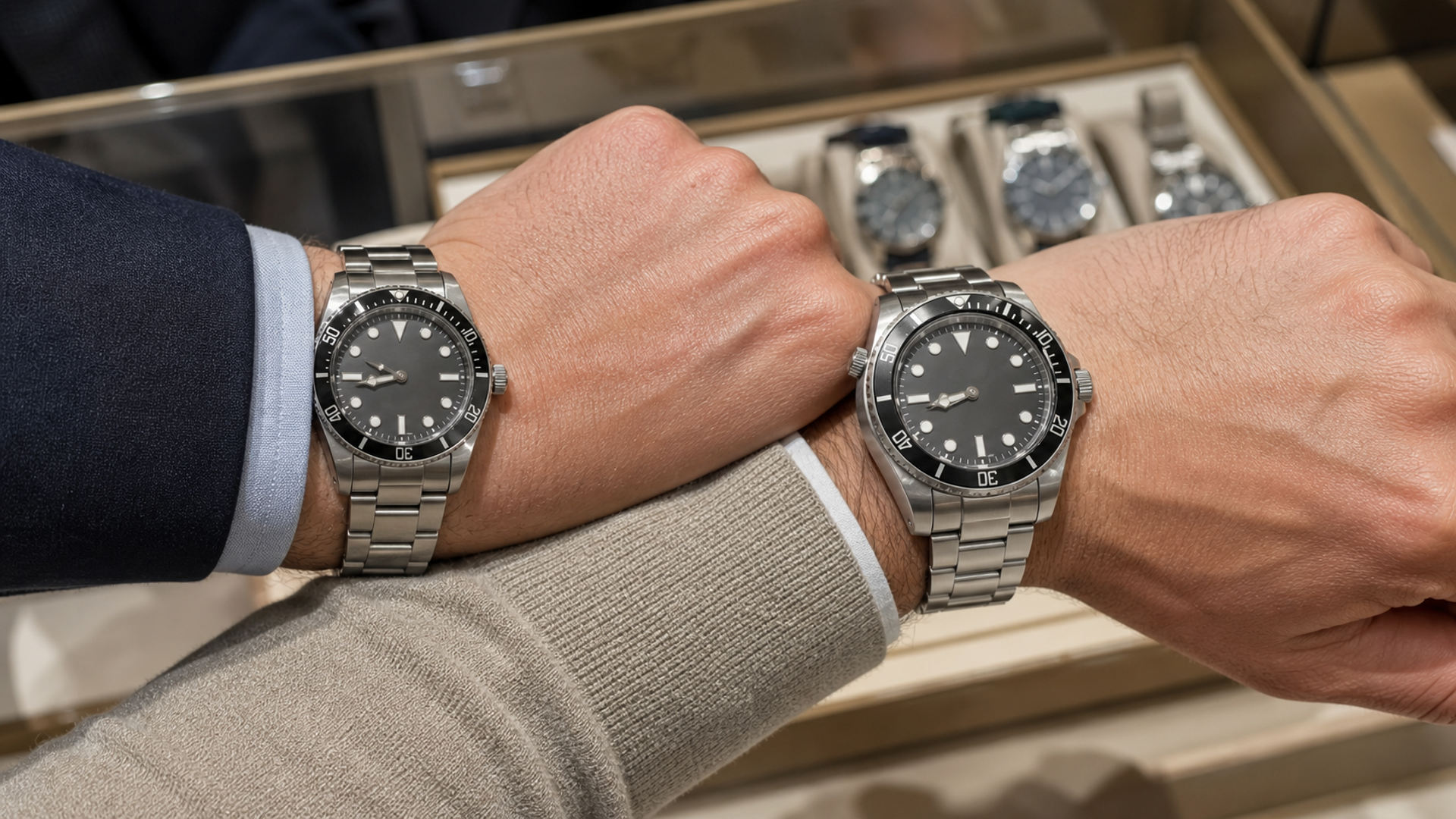
Choose the Rolex Submariner when you want the more versatile daily dive watch: a 41 mm case, 300 metres of water resistance and proportions that work more easily under a cuff. Choose the Sea-Dweller when you genuinely prefer a larger 43 mm case, its professional saturation-diving heritage, helium escape valve and 1,220-metre depth rating. For most owners, the Sea-Dweller’s additional capability is about character rather than practical need.
The decision should be made on the wrist, not from specifications alone. Case diameter tells only part of the fit. Thickness, lug-to-lug span, bracelet taper, clasp length, wrist shape and weight distribution decide whether a watch feels secure or top-heavy over a twelve-hour day.
Submariner and Sea-Dweller decision matrix
| Factor | Rolex Submariner | Rolex Sea-Dweller | Practical consequence |
|---|---|---|---|
| Case diameter | 41 mm | 43 mm | Sea-Dweller has greater visual and physical presence |
| Water resistance | 300 m | 1,220 m | Both exceed normal recreational needs; Sea-Dweller serves a professional narrative |
| Helium escape valve | No | Yes | Relevant to saturation-diving decompression, not routine swimming |
| Date choice | Submariner without date and Submariner Date variants | Current Sea-Dweller includes date and Cyclops | Submariner offers the cleaner no-date option |
| Wrist fit | More accommodating across wrist sizes | Demands more wrist area and tolerance for thickness | Try both with clasp fully adjusted |
| Cuff and travel | Easier under many sleeves | More likely to catch or announce itself | Consider work clothing and discretion |
| Underwater legibility | Classic high-contrast dive layout | Larger professional case with similar functional logic | Dial size is not the only readability factor |
| Ownership identity | Iconic all-purpose sports watch | Specialist, more physically assertive tool watch | Buy the personality you will still enjoy off the water |
Fit: diameter is not the whole measurement
The 2 mm diameter difference sounds small, but the Sea-Dweller also carries more height and mass. On a flat, broad wrist it can feel planted. On a narrow or rounded wrist the case may overhang, and the clasp can occupy a large portion of the underside. The Submariner’s proportions are easier for more people, though 41 mm is not small.
Judge fit with the bracelet sized correctly. A loose heavy watch slides and amplifies perceived weight; an over-tight watch becomes uncomfortable as the wrist expands in heat or during a flight. Use the Glidelock adjustment through its range and check whether the clasp centres under the wrist.
Photograph the watch from several metres away, not only in a close-up wrist shot. Phone cameras distort near objects and make any watch appear larger. Wear each candidate for at least fifteen minutes, move the wrist through typing and jacket use, and notice whether the crown or case edge presses into the hand.
The meaning of 300 metres versus 1,220 metres
Rolex rates the Submariner to 300 metres and the Sea-Dweller to 1,220 metres. Both have far more depth capability than ordinary swimming or recreational diving demands. A depth rating is not a schedule for maintenance and does not guarantee an old or damaged watch remains water resistant.
The Sea-Dweller’s helium escape valve is designed for saturation-diving environments, where divers live under pressure in helium-rich breathing gas. Helium can enter a watch and create pressure during decompression; the valve allows it to escape. It has no useful role on a normal flight, pool swim or scuba holiday.
If water use matters, pressure-test the exact watch at intervals recommended by Rolex or the servicing professional, especially after impact, crown damage or case opening. Do not test an unknown second-hand watch by jumping into water. Water resistance is a condition to verify, not a permanent property inherited from the model name.
Dial, date and visual balance
The Submariner family gives a meaningful aesthetic choice. The no-date Submariner presents a symmetrical dial and removes the need to reset a date after the watch stops. The Submariner Date adds daily utility and Rolex’s Cyclops magnifier. The current Sea-Dweller includes a date with Cyclops and uses red “Sea-Dweller” text as part of its identity.
Some buyers prefer the Sea-Dweller because it looks less ubiquitous than the Submariner while remaining recognisably Rolex. Others find the larger dial furniture and red line less versatile. These are not performance differences, yet they determine long-term satisfaction more than theoretical depth.
Check low-light legibility, bezel grip and crown handling. If the owner regularly changes the date, observe the setting procedure. If the watch will sit unworn, decide whether a no-date model’s simplicity is an advantage.
Bracelet, clasp and all-day wear
Both watches use robust Oyster bracelets and Glidelock adjustment systems designed to change fit without tools. The adjustment is valuable outside diving: wrists swell during heat, exercise and long-haul travel. The available range should be tested with the watch correctly sized, not with protective stickers and temporary links.
The Sea-Dweller’s greater weight can create pressure at the clasp or make the watch rotate. Correct link distribution—sometimes with an uneven number on each side—can centre the clasp. A skilled retailer can help without treating symmetry in link count as more important than fit.
Metal bracelets also mark desks and laptops, and polished surfaces on other objects can mark the clasp. Ordinary wear is expected. If the owner is distressed by the first hairline, either watch may be the wrong daily object.
Office, travel and discretion
The Submariner transitions more easily from water to office clothing. It remains visually assertive, but its lower profile is less likely to interfere with a shirt cuff. The Sea-Dweller is intentionally substantial and works best when the owner likes feeling the watch.
For frequent travel, thickness and visibility matter. A large recognisable watch can draw attention in airports and unfamiliar cities. Decide when to wear it and when a discreet alternative is smarter. Keep serial photographs and insurance documents secure and separate from the watch.
Neither model provides travel-time functionality. A GMT-Master II may be more useful for someone whose primary need is reading home and local time. Do not buy a dive watch to solve a time-zone problem simply because it is the more famous category.
Availability and purchase route
Retail availability varies, and secondary-market premiums can change. Do not let scarcity pressure turn a fit decision into a trophy decision. Try the models even if the exact configuration is unavailable, then define an acceptable reference, condition and purchase route.
An authorised Rolex retailer provides the clearest new-watch route and international guarantee under current terms. The official Rolex Certified Pre-Owned programme provides another controlled route for eligible second-hand watches sold through participating retailers. Independent secondary-market purchases require the layered authentication and transaction protections described in our Rolex authentication checklist.
Price the complete ownership plan: purchase, insurance, service, travel risk and any secondary-market premium. A cheaper watch that does not fit will not become better value through scarcity.
Servicing and case condition
Both watches are mechanical instruments that need periodic assessment. Service needs depend on age, use, water exposure and performance. Rolex’s current service recommendation and guarantee terms should be checked for the exact watch and market. A vintage model may have different water-use and originality considerations.
Case refinishing is a personal and collector decision. Heavy polishing can soften geometry; avoiding all polishing leaves honest wear but may not suit every owner. State preferences before service and document condition. Replaced components can improve function while changing originality.
The Sea-Dweller’s professional features do not make neglect safer. Crown threads, seals, crystal and valve condition must all perform for water resistance. The Submariner’s lower rating does not make it fragile.
Where VERTU Concierge fits
For eligible VERTU users, Concierge may assist with supported appointment coordination, travel planning or contact with an appropriate retailer where available. It cannot guarantee Rolex inventory, allocation, authentication or price, and it does not replace the official retail and inspection routes. Any booking, payment or external action requires user authorisation.
The useful role is logistical: fitting a secure retailer visit into a wider itinerary. The actual watch choice should remain grounded in fit, current official specifications and documented transaction evidence.
Wrist-and-life checklist
Does either case overhang the wrist when viewed straight on?
Can the clasp be centred with Glidelock in a useful position?
Is the Sea-Dweller’s weight comfortable after fifteen minutes?
Does the watch fit under normal work clothing?
Is 1,220-metre capability meaningful or simply the preferred story?
Is a no-date dial preferable to daily date utility?
Will the watch be used in water, and is pressure testing planned?
Does travel visibility create a security concern?
Is the purchase route authorised, CPO or independently protected?
Would a GMT watch solve the real use case better?
Verdict
The Submariner is the rational default: more versatile proportions, all the water resistance almost any private owner can use and a choice between date and no-date designs. The Sea-Dweller is the deliberate enthusiast’s choice: bigger, deeper-rated and tied to saturation-diving engineering. Buy the Sea-Dweller because its scale and specialist identity feel right on the wrist—not because 1,220 metres sounds four times as valuable.
Related VERTU reading
Compare a different Rolex ownership choice in Submariner versus GMT-Master II. If the watch will travel, watch roll versus travel case covers transport and protection.
![How to Scan Receipts and Documents with Your Phone [Full Guide]](https://cdn.sanity.io/images/e0gp1l2g/production/0db13feec1d5e72b8a8a5f976d1f3e86619c9228-3840x1860.webp?w=180&h=180&q=78&auto=format&fit=crop)
![How to Scan Receipts and Documents with Your Phone [Full Guide]](https://cdn.sanity.io/images/e0gp1l2g/production/0db13feec1d5e72b8a8a5f976d1f3e86619c9228-3840x1860.webp?w=800&h=450&q=82&auto=format&fit=crop)
![Top 10 Two-Tone Carbon-Fibre Watches for Men [2026 List]](https://cdn.sanity.io/images/e0gp1l2g/production/18870799ba33fab0e038968359cd5772d7d7db30-1024x576.webp?w=800&h=450&q=82&auto=format&fit=crop)
![Top 10 Luxury Watches with Digital Complication Displays for Men [Latest]](https://cdn.sanity.io/images/e0gp1l2g/production/c4f6bf8c080f291c39f7cc85c7344ecff2fd3799-1024x553.webp?w=800&h=450&q=82&auto=format&fit=crop)