

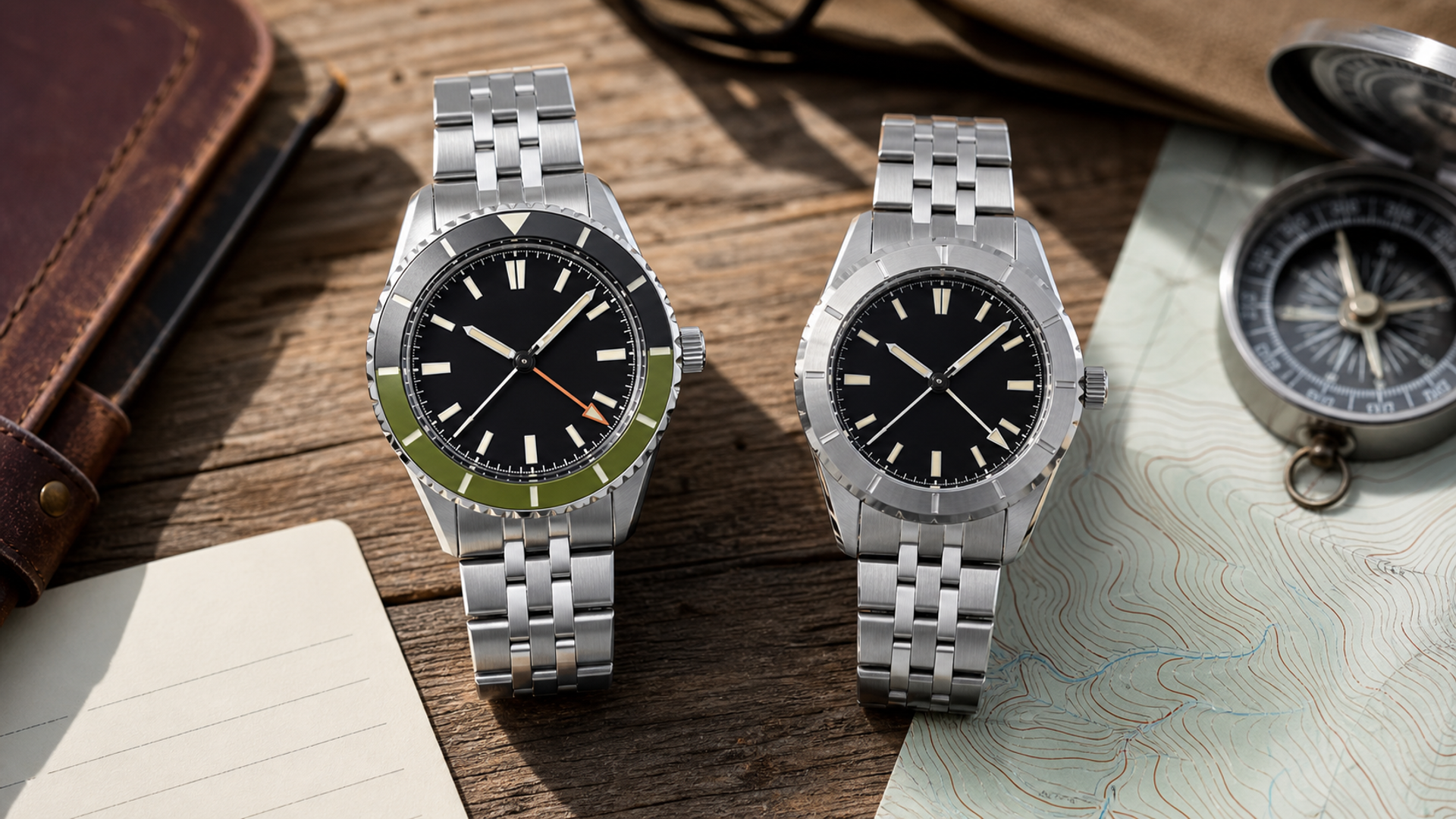
The Rolex GMT-Master II and Explorer II display a second time zone with closely related mechanical architecture, but their design priorities are different. The GMT-Master II uses a rotating 24-hour bezel to make international time flexible and visually prominent. The Explorer II fixes the 24-hour scale to a steel bezel and prioritises legibility, robustness and a quieter tool-watch identity.
Both can accompany travel. The real question is whether the owner wants a city-facing travel instrument that can reference a third time zone through the bezel, or a larger expedition-style watch whose fixed scale is less likely to move accidentally. Availability and secondary prices are not used as proof that one is mechanically superior.
Quick answer
Choose the GMT-Master II for frequent cross-border travel, a rotating 24-hour bezel and a more jewellery-like presence. Choose the Explorer II for a 42mm case, fixed steel bezel, high-contrast reading and an understated expedition identity. Because both use calibre 3285 and offer roughly 70 hours of reserve, ergonomics and use case should dominate.
Decision matrix
| Decision factor | Option A | Option B | Practical edge |
|---|---|---|---|
| Case | 40mm | 42mm | Wrist-dependent |
| 24-hour bezel | Rotating | Fixed steel | Use-dependent |
| Time-zone flexibility | Can reference an additional zone via bezel | Home/second zone focus | GMT-Master II |
| Movement | Calibre 3285 | Calibre 3285 | Tie |
| Power reserve | About 70 hours | About 70 hours | Tie |
| Visual role | Cosmopolitan and recognisable | Technical and understated | Taste-dependent |
| Bracelet options | Oyster or Jubilee by reference | Oyster | GMT for choice |
| Best fit | Air travel and versatile luxury | Field use and legibility | Owner-specific |
The bezel defines the instrument
The GMT-Master II's rotating bezel can shift the 24-hour reference, while the Explorer II's scale is fixed.
That makes the GMT more flexible for a traveller tracking several places. The fixed Explorer bezel is simpler and cannot be knocked into a misleading position.
Use this test: Decide whether you will actively use a third reference or prefer one permanent scale.
Case size changes the experience
Forty and 42 millimetres are close on paper but distinct on the wrist.
The Explorer II has a broad dial and stronger visual footprint; the GMT-Master II is more compact and may suit a wider range of cuffs.
Use this test: Try both with the bracelet properly sized and compare from a full-body mirror distance.
The movements do not settle the argument
Both current core models use Rolex calibre 3285 with a GMT function and approximately 70 hours of reserve.
Marketing discussions often imply a performance hierarchy that the shared calibre does not support. Reference-specific materials and bracelets still differ.
Use this test: Treat movement as a draw and focus on the human interface.
Legibility has two forms
The Explorer II emphasises a fixed, high-contrast 24-hour reading; the GMT-Master II uses colour and a rotating insert.
One is visually quieter, the other separates day and night more theatrically. Reflections and colour perception affect preference.
Use this test: Read both in dim indoor light and bright daylight rather than relying on studio photographs.
Bracelet choice changes the GMT's character
The GMT-Master II can be found with Oyster or Jubilee bracelets depending on reference.
Jubilee introduces more visual texture and articulation; Oyster reads as the simpler sports option. Explorer II remains strongly tool-oriented on Oyster.
Use this test: Choose the bracelet as part of the watch, not as a decorative afterthought.
Travel usefulness requires correct setting
A GMT watch only helps if the owner understands the independent local-hour adjustment and 24-hour hand.
Incorrect setup can make an elaborate watch less useful than a phone. Date changes around travel need deliberate handling.
Use this test: Practise setting home, local and bezel references before a trip.
The Explorer II's quietness is a feature
Its fixed steel bezel and larger case create a less jewellery-like identity than many GMT-Master II variants.
That can be preferable for an owner who dislikes recognisable colour combinations or wants a watch that works with utilitarian clothing.
Use this test: Consider social context and personal comfort, not only technical capability.
The GMT-Master II offers more visual range
Different bezel colours, metals and bracelet combinations create materially different ownership experiences.
Choice can improve fit with a wardrobe but also make the purchase process more speculative and availability-led.
Use this test: Select the reference whose colour and bracelet you would still choose if resale data disappeared.
Service and provenance outweigh online popularity
Condition, authenticity and service history are decisive when buying pre-owned.
A polished case, replaced parts or incomplete history can matter more than model-level demand. Only authorised or trusted specialists should inspect the watch.
Use this test: Budget for verification and maintenance instead of using market momentum as due diligence.
Collection role is the final filter
A GMT-Master II can be the polished travel watch; an Explorer II can be the robust second watch beside a dressier piece.
If the collection already contains a coloured-bezel sports watch, the Explorer may add more contrast. If it contains only simple steel watches, the GMT may broaden it.
Use this test: Map functions and visual roles across the collection before adding another dual-time model.
Who should choose what
| Traveller or owner | Better fit | Why |
|---|---|---|
| Frequent intercontinental city travel | GMT-Master II | Rotating bezel and compact versatility. |
| Outdoor work and low-key daily wear | Explorer II | Fixed scale and larger legible dial. |
| Smaller wrist or formal cuffs | GMT-Master II | More compact 40mm case. |
| Collection already includes a colourful sports watch | Explorer II | Stronger visual differentiation. |
Common mistakes
Calling one movement better when both use calibre 3285.
Buying a bezel colour for market attention rather than repeat wear.
Ignoring case condition and provenance on a pre-owned example.
Failing to learn how the 24-hour hand and local-hour setting interact.
How to measure personal value
The useful value of Rolex GMT-Master II vs Explorer II is the change it produces in a repeated, observable situation. Start with the article's value object—the travel-time, legibility, fit, robustness and ownership-role matrix—and mark which rows affect your own behaviour. In the Rolex GMT-Master II vs Explorer II decision, a feature that never changes a journey, security decision or ownership routine has little practical value even when technically impressive.
Use case as the first controlled comparison: one side is 40mm, while the other is 42mm. Then add the frequency of the relevant trip or use, the cost of Rolex GMT-Master II vs Explorer II mistakes, and the friction introduced by the more demanding option. For a Rolex GMT-Master II vs Explorer II purchase, divide the meaningful premium by expected uses rather than calendar years; for privacy, include the time and support required to keep controls correctly configured.
Create a minimum-success condition for Rolex GMT-Master II vs Explorer II. For this Rolex GMT-Master II vs Explorer II decision, success might be a full night's sleep, a watch still running on Monday, a phone policy that survives travel, or a bag carrying the real daily load without distortion. If neither Rolex GMT-Master II vs Explorer II option meets that condition, defer the purchase, choose another configuration or redesign the trip.
How to verify a changing specification
Facts surrounding Rolex GMT-Master II vs Explorer II can change after publication: airlines swap aircraft, manufacturers update references, software support terms move, and pre-owned condition differs from a catalogue description. Treat the current operator or manufacturer page as the Rolex GMT-Master II vs Explorer II starting point, not as a guarantee that every individual booking or object matches the general description.
Capture the exact date, model, route, configuration, material, firmware or fare family used for Rolex GMT-Master II vs Explorer II. Save the official Rolex GMT-Master II vs Explorer II specification and ask the seller or operator to resolve contradictions in writing. If a material Rolex GMT-Master II vs Explorer II feature is not identified at transaction level, assign it zero value until confirmed rather than assuming the best possible version.
For Rolex GMT-Master II vs Explorer II, repeat the check immediately before the cancellation, return or change window closes. That second Rolex GMT-Master II vs Explorer II check protects against substitutions and reveals whether the original decision relied on a benefit that is no longer available. Where Rolex GMT-Master II vs Explorer II involves authenticity, law, safety or security, independent specialist verification remains more important than an editorial comparison.
Keep an evidence-backed decision record
A short decision record makes Rolex GMT-Master II vs Explorer II auditable. Write the selected Rolex GMT-Master II vs Explorer II option, the rejected alternative, the three decisive facts, the sources checked and the condition that would reverse the choice. Attach a Rolex GMT-Master II vs Explorer II seat map, reference number, support policy, condition report or packing photograph where relevant. A Rolex GMT-Master II vs Explorer II record is especially useful when an assistant, travel coordinator, buyer or family member must act later without reconstructing the reasoning.
Separate measured Rolex GMT-Master II vs Explorer II facts from estimates. For Rolex GMT-Master II vs Explorer II, published dimensions, official benefits and documented support dates are facts for the referenced configuration; predicted sleep, resale, comfort and future availability are estimates. Label Rolex GMT-Master II vs Explorer II uncertainty openly and avoid converting one reviewer's experience into a universal claim.
The decision record for Rolex GMT-Master II vs Explorer II should also name an exit path: cancellation, return, service inspection, account suspension or resale review. A Rolex GMT-Master II vs Explorer II option with a clear, affordable correction path can be safer than a theoretically superior option whose failure is difficult to reverse.
Review the outcome after real use
Review Rolex GMT-Master II vs Explorer II after one representative trip or 30 days of ownership. Record which Rolex GMT-Master II vs Explorer II benefits were used, what created friction, what failed to matter and what new constraint appeared. Do not ask only whether Rolex GMT-Master II vs Explorer II felt premium; ask whether it solved the problem named in the decision record.
For the Rolex GMT-Master II vs Explorer II review, travel decisions should note sleep, delays, connection effort and useful hours after arrival; watch decisions should note comfort, timing, reserve and frequency of wear. For Rolex GMT-Master II vs Explorer II mobile privacy, review updates, permissions, account events and recovery readiness; for bags, inspect load, access, shape, marks and how often the object stayed at home.
That review turns Rolex GMT-Master II vs Explorer II into evidence for the next decision instead of an isolated opinion. If the Rolex GMT-Master II vs Explorer II outcome was weak, change one variable at a time—route, configuration, size, material, policy or use pattern—so the next comparison produces a clear lesson.
A verification checklist before you commit
For Rolex GMT-Master II vs Explorer II, confirm the exact reference, aircraft, fare, leather, device or service configuration rather than relying on a category label. Read the current Rolex GMT-Master II vs Explorer II manufacturer or operator page, preserve the quoted specification, and identify which facts can change before delivery or departure. Where Rolex GMT-Master II vs Explorer II involves money, safety or a high-value object, use a qualified seller, carrier, security team or specialist to verify the individual transaction.
Write the Rolex GMT-Master II vs Explorer II decision in one sentence: the option, the problem it solves and the condition that would change the choice. This keeps prestige, scarcity or one Rolex GMT-Master II vs Explorer II headline feature from replacing the actual use case. After Rolex GMT-Master II vs Explorer II ownership or travel, record what happened so the next decision uses evidence rather than memory.
![How to Scan Receipts and Documents with Your Phone [Full Guide]](https://cdn.sanity.io/images/e0gp1l2g/production/0db13feec1d5e72b8a8a5f976d1f3e86619c9228-3840x1860.webp?w=180&h=180&q=78&auto=format&fit=crop)
![How to Scan Receipts and Documents with Your Phone [Full Guide]](https://cdn.sanity.io/images/e0gp1l2g/production/0db13feec1d5e72b8a8a5f976d1f3e86619c9228-3840x1860.webp?w=800&h=450&q=82&auto=format&fit=crop)
![Top 10 Two-Tone Carbon-Fibre Watches for Men [2026 List]](https://cdn.sanity.io/images/e0gp1l2g/production/18870799ba33fab0e038968359cd5772d7d7db30-1024x576.webp?w=800&h=450&q=82&auto=format&fit=crop)
![Top 10 Luxury Watches with Digital Complication Displays for Men [Latest]](https://cdn.sanity.io/images/e0gp1l2g/production/c4f6bf8c080f291c39f7cc85c7344ecff2fd3799-1024x553.webp?w=800&h=450&q=82&auto=format&fit=crop)