Action cameras are now small enough to promise almost everything, but physics still forces trade-offs. Strong electronic stabilisation crops the image; high resolution and frame rate create heat; wide lenses can make subjects look distant; waterproof housings complicate audio. The best camera is the one whose failure mode is acceptable for the activity you actually record.
The short answer by activity
Choose a conventional rugged action camera for broad accessory support and dependable mounting, a low-light-led model when evening and mixed illumination dominate, or a modular 360-capable system when reframing after the event is worth more processing and storage. Test the exact resolution, stabilisation and temperature mode for the expected recording duration.
| Decision factor | Rugged action camera | Low-light-led camera | Modular or 360 system |
|---|---|---|---|
| Primary scene | Daylight movement dominates | Dusk and mixed light dominate | Reframing and unusual viewpoints dominate |
| Stabilisation | Wide crop leaves enough field of view | Noise and shutter remain acceptable | Horizon control justifies processing |
| Recording duration | Heat test passes the full session | Lower frame rate extends reliable capture | Multiple modules and batteries are managed |
| Water and impact | Native sealing suits the activity | Housing and lens protection are planned | Module joints and lens exposure are protected |
| Audio | Wind reduction and external options suffice | Voice remains usable in low light setup | Separate audio synchronisation is accepted |
| Editing | Fast mobile export matters | Colour and noise work are manageable | Large files and reframing are acceptable |
This best action cameras 2026 matrix is the article's working value object. Read the best action cameras 2026 rows together: the decisive failure mode depends on this topic's evidence, operating context and reader objective.
Understand crop, heat and sensor limits
Evidence 1. CIPA publishes camera and imaging standards, but buyers still need the manufacturer's exact mode, temperature and battery conditions for a specific action camera.
Evidence 2. YouTube's upload guidance shows that frame rate, resolution and encoding choices materially affect the final delivery workflow; capture settings should match the intended output rather than maximise every number.
Evidence 3. Waterproof depth, operating temperature and recording duration are model- and mode-specific claims that must be verified in the current product manual before use.
Evidence 4. Electronic stabilisation and horizon levelling use sensor area and processing, so the resulting field of view can differ from an unstabilised wide mode.
Reader-visible sources checked for this article:
cipa.jp — reader-visible current or official evidence
support.google.com — reader-visible current or official evidence
gopro.com — reader-visible current or official evidence
dji.com — reader-visible current or official evidence
For best action cameras 2026, these sources establish only the claims inside their documented scope. Recheck every changeable specification, availability condition, price, policy or service term in the relevant market before acting.
Build the mount and editing workflow together
On primary scene, popularity is not enough. The evidence for option one is that daylight movement dominates. Option two means dusk and mixed light dominate. Option three is rational where reframing and unusual viewpoints dominate. Recheck any changeable term immediately before commitment.
The decision changes at stabilisation. Choose the first path only if wide crop leaves enough field of view; move to the second when noise and shutter remain acceptable; use the third when horizon control justifies processing. Save the downside that would make this row fail.
For recording duration, the first route works when heat test passes the full session; the second requires lower frame rate extends reliable capture. The control for the third is multiple modules and batteries are managed. Verify this row against the exact product, property, account or environment before it can reverse the decision.
The water and impact row exposes a practical boundary. Route one assumes native sealing suits the activity, while route two is defensible only when housing and lens protection are planned. Route three depends on module joints and lens exposure are protected. If that evidence is absent, keep the more reversible option.
Read audio as a stop/go test: wind reduction and external options suffice supports the first option; voice remains usable in low light setup supports the second; and separate audio synchronisation is accepted supports the third. Record which source proves the condition and when it was checked.
A buyer can resolve editing without starting from a brand preference. Ask whether fast mobile export matters; compare that with whether colour and noise work are manageable; then use large files and reframing are acceptable as the third route's safeguard. An unknown condition stays unknown.
Facts that would reverse the current choice
Reversal control 1 — Primary scene. Before choosing Rugged action camera, write down how the decision changes if “Daylight movement dominates” proves false. Do the same for Low-light-led camera and “Dusk and mixed light dominate”. Keep the Modular or 360 system route available until “Reframing and unusual viewpoints dominate” is verified. This control belongs to best action cameras 2026; update it from the cited source or exact supplier rather than copying a generic checklist.
Reversal control 2 — Stabilisation. Before choosing Rugged action camera, write down how the decision changes if “Wide crop leaves enough field of view” proves false. Do the same for Low-light-led camera and “Noise and shutter remain acceptable”. Keep the Modular or 360 system route available until “Horizon control justifies processing” is verified. This control belongs to best action cameras 2026; update it from the cited source or exact supplier rather than copying a generic checklist.
Reversal control 3 — Recording duration. Before choosing Rugged action camera, write down how the decision changes if “Heat test passes the full session” proves false. Do the same for Low-light-led camera and “Lower frame rate extends reliable capture”. Keep the Modular or 360 system route available until “Multiple modules and batteries are managed” is verified. This control belongs to best action cameras 2026; update it from the cited source or exact supplier rather than copying a generic checklist.
Reversal control 4 — Water and impact. Before choosing Rugged action camera, write down how the decision changes if “Native sealing suits the activity” proves false. Do the same for Low-light-led camera and “Housing and lens protection are planned”. Keep the Modular or 360 system route available until “Module joints and lens exposure are protected” is verified. This control belongs to best action cameras 2026; update it from the cited source or exact supplier rather than copying a generic checklist.
Reversal control 5 — Audio. Before choosing Rugged action camera, write down how the decision changes if “Wind reduction and external options suffice” proves false. Do the same for Low-light-led camera and “Voice remains usable in low light setup”. Keep the Modular or 360 system route available until “Separate audio synchronisation is accepted” is verified. This control belongs to best action cameras 2026; update it from the cited source or exact supplier rather than copying a generic checklist.
Reversal control 6 — Editing. Before choosing Rugged action camera, write down how the decision changes if “Fast mobile export matters” proves false. Do the same for Low-light-led camera and “Colour and noise work are manageable”. Keep the Modular or 360 system route available until “Large files and reframing are acceptable” is verified. This control belongs to best action cameras 2026; update it from the cited source or exact supplier rather than copying a generic checklist.
Run a complete-duration heat test
Charge the camera, use the intended card and mount it as it will be used. Record continuously at the chosen resolution and frame rate in the expected ambient temperature. Note shutdown, warning, file splits and battery depletion. Airflow on a bicycle is different from a stationary dashboard or sealed housing. If the camera cannot complete the real session, a theoretically better image mode is irrelevant. Keep a lower-bandwidth fallback preset and know how to switch without navigating a long menu.
Treat mounting as part of image quality
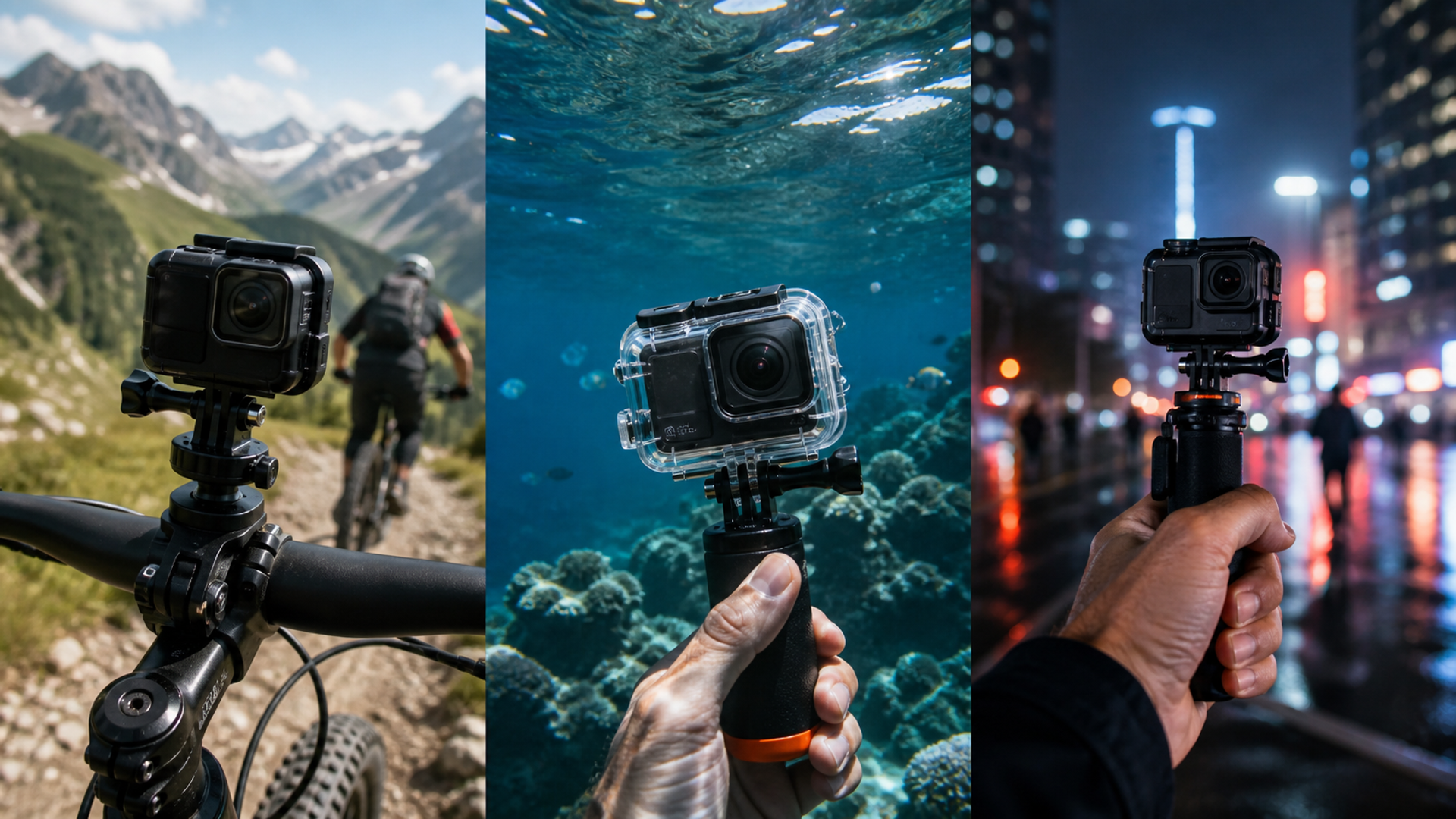
A rigid chest mount produces different motion from a helmet, handlebar, suction cup or hand grip. Check safety, snag risk and whether the lens remains level after impact. Wide lenses make mounting position decisive: a few centimetres can separate useful hands-and-road context from mostly sky. Use tethers where appropriate and inspect adhesive, bolts and seals. Avoid mounting where a camera can interfere with protective equipment or vehicle controls.
Design low-light expectations honestly
A larger sensor and processing can help, but fast motion at night still demands short exposures that raise noise. Stabilisation cannot recover detail blurred within each frame. Test faces, street lights and moving vehicles rather than a static illuminated display. Consider whether a phone or larger camera should cover the night segment. When colour correction is planned, preserve a consistent profile and avoid mixing automatic modes that change sharply between clips.
Budget time and storage for the edit
Estimate data per hour, card rotation, backup and transfer time before a trip. High-resolution or 360 footage can overwhelm a phone and consume cloud storage quickly. Name cards, create two copies before formatting and retain original files for important events. Confirm whether desktop software, codecs or subscriptions are required. The fastest camera-to-phone workflow often produces more usable films than the most ambitious specification that remains unedited.
Three shoots that change the recommendation
The daylight cycling trip
A conventional rugged camera with proven mount stability and efficient export is the strongest default. Define the fact that would reverse this recommendation before committing.
The evening city walk
A low-light-led setup wins only after moving subjects and full-duration heat are tested, not from static samples. Define the fact that would reverse this recommendation before committing.
The ski or dive production
A modular or 360 route can preserve creative angles, but lens protection, cold battery behaviour, sealing and file management become first-order decisions. Define the fact that would reverse this recommendation before committing.
Action checklist
Define the actual activity and final output.
Test full recording duration at expected temperature.
Check stabilised field-of-view crop.
Verify waterproof and operating limits.
Choose an endurance-rated compatible card.
Test the real mount and tether.
Record wind and voice audio samples.
Estimate storage and backup per day.
Confirm phone and desktop codec support.
Save a lower-bandwidth fallback preset.
Continue the decision
The linked VERTU articles expand adjacent parts of the best action cameras 2026 decision. They do not substitute for the external evidence above.
The action-camera verdict
Choose a conventional rugged action camera for broad accessory support and dependable mounting, a low-light-led model when evening and mixed illumination dominate, or a modular 360-capable system when reframing after the event is worth more processing and storage. Test the exact resolution, stabilisation and temperature mode for the expected recording duration.
Keep the best action cameras 2026 decision reversible until its material cost, safety, access, privacy and compatibility facts are verified. Unknown evidence stays unknown; it is never silently scored as favourable.