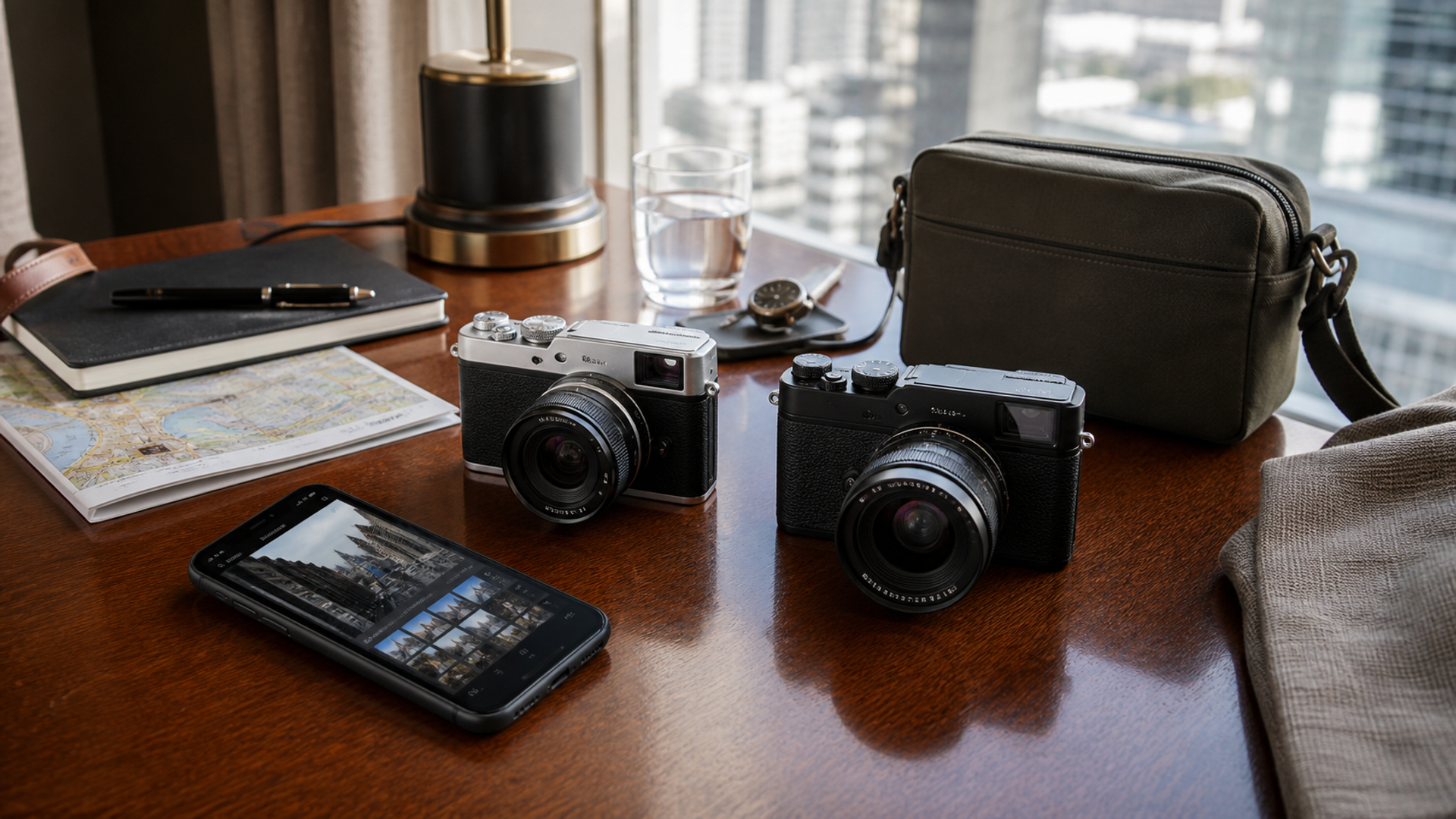
The best travel camera is the one that reaches the scene without turning the trip into an equipment exercise. Sensor size matters, but so do lens weight, charging, weather resistance, autofocus, backup and the speed at which photographs move to a phone or editor.
Start with the trip
Choose a camera system by the trip's hardest photographic moment and the weight you will carry every day. A compact fixed-lens camera suits city and family travel; a small interchangeable-lens system adds flexibility; full frame earns its burden only when low light, action or image quality justifies larger lenses.
| Decision factor | Fixed-lens compact | APS-C system | Full-frame system |
|---|---|---|---|
| Carry weight | Lowest when one focal range is enough | Balanced with compact primes or zooms | Rises quickly with bright or long lenses |
| Low light | Depends on lens and stabilisation | Strong with fast lenses and modern sensors | Best potential when the lens and technique support it |
| Wildlife and action | Limited reach and tracking flexibility | Good compromise with crop and lighter telephoto lenses | Strong autofocus options but expensive heavy glass |
| Discretion | Least conspicuous in cities and restaurants | Moderate depending on lens | Largest setup can change subject behaviour |
| Phone sharing | Fast when wireless transfer is reliable | Flexible JPEG recipes and RAW workflow | Large files demand better selection and connectivity |
| System growth | No lens decisions after purchase | Broad path without maximum bulk | Deepest specialist lens and accessory choices |
This best travel camera 2026 matrix is the article's working value object. Read the rows together: the decisive failure mode depends on this topic's evidence, operating context and reader objective.
Read system evidence, not body hype
Evidence 1. Sony's full-frame range shows that body choice is only one part of a system whose lenses determine much of the travel weight and cost.
Evidence 2. Fujifilm's current camera range spans fixed-lens and interchangeable-lens formats, demonstrating why trip style can matter more than a single sensor hierarchy.
Evidence 3. Canon's mirrorless range includes multiple body and lens classes, so compatibility, stabilisation and regional kit contents need exact model verification.
Reader-visible sources checked for this article:
electronics.sony.com — reader-visible current or official evidence
fujifilm-x.com — reader-visible current or official evidence
usa.canon.com — reader-visible current or official evidence
For best travel camera 2026, these sources establish only the claims inside their documented scope. Recheck every changeable specification, availability condition, price, policy or service term in the relevant market before acting.
Design the phone-to-archive workflow
For carry weight, the first route works when lowest when one focal range is enough; the second requires balanced with compact primes or zooms. The control for the third is rises quickly with bright or long lenses. Verify this row against the exact product, property, account or environment before it can reverse the decision.
The low light row exposes a practical boundary. Route one assumes depends on lens and stabilisation, while route two is defensible only when strong with fast lenses and modern sensors. Route three depends on best potential when the lens and technique support it. If that evidence is absent, keep the more reversible option.
Read wildlife and action as a stop/go test: limited reach and tracking flexibility supports the first option; good compromise with crop and lighter telephoto lenses supports the second; and strong autofocus options but expensive heavy glass supports the third. Record which source proves the condition and when it was checked.
A buyer can resolve discretion without starting from a brand preference. Ask whether least conspicuous in cities and restaurants; compare that with whether moderate depending on lens; then use largest setup can change subject behaviour as the third route's safeguard. An unknown condition stays unknown.
On phone sharing, popularity is not enough. The evidence for option one is that fast when wireless transfer is reliable. Option two means flexible JPEG recipes and RAW workflow. Option three is rational where large files demand better selection and connectivity. Recheck any changeable term immediately before commitment.
The decision changes at system growth. Choose the first path only if no lens decisions after purchase; move to the second when broad path without maximum bulk; use the third when deepest specialist lens and accessory choices. Save the downside that would make this row fail.
Facts that would reverse the current choice
Reversal control 1 — Carry weight. Before choosing Fixed-lens compact, write down how the decision changes if “Lowest when one focal range is enough” proves false. Do the same for APS-C system and “Balanced with compact primes or zooms”. Keep the Full-frame system route available until “Rises quickly with bright or long lenses” is verified. This control belongs to best travel camera 2026; update it from the cited source or exact supplier rather than copying a generic checklist.
Reversal control 2 — Low light. Before choosing Fixed-lens compact, write down how the decision changes if “Depends on lens and stabilisation” proves false. Do the same for APS-C system and “Strong with fast lenses and modern sensors”. Keep the Full-frame system route available until “Best potential when the lens and technique support it” is verified. This control belongs to best travel camera 2026; update it from the cited source or exact supplier rather than copying a generic checklist.
Reversal control 3 — Wildlife and action. Before choosing Fixed-lens compact, write down how the decision changes if “Limited reach and tracking flexibility” proves false. Do the same for APS-C system and “Good compromise with crop and lighter telephoto lenses”. Keep the Full-frame system route available until “Strong autofocus options but expensive heavy glass” is verified. This control belongs to best travel camera 2026; update it from the cited source or exact supplier rather than copying a generic checklist.
Reversal control 4 — Discretion. Before choosing Fixed-lens compact, write down how the decision changes if “Least conspicuous in cities and restaurants” proves false. Do the same for APS-C system and “Moderate depending on lens”. Keep the Full-frame system route available until “Largest setup can change subject behaviour” is verified. This control belongs to best travel camera 2026; update it from the cited source or exact supplier rather than copying a generic checklist.
Reversal control 5 — Phone sharing. Before choosing Fixed-lens compact, write down how the decision changes if “Fast when wireless transfer is reliable” proves false. Do the same for APS-C system and “Flexible JPEG recipes and RAW workflow”. Keep the Full-frame system route available until “Large files demand better selection and connectivity” is verified. This control belongs to best travel camera 2026; update it from the cited source or exact supplier rather than copying a generic checklist.
Reversal control 6 — System growth. Before choosing Fixed-lens compact, write down how the decision changes if “No lens decisions after purchase” proves false. Do the same for APS-C system and “Broad path without maximum bulk”. Keep the Full-frame system route available until “Deepest specialist lens and accessory choices” is verified. This control belongs to best travel camera 2026; update it from the cited source or exact supplier rather than copying a generic checklist.
Define the hardest shot
A city break may demand discretion and night street performance. Safari may require reach and tracking. Family travel rewards reliable autofocus and quick sharing. Underwater or expedition work changes weather protection and backup needs. Choose around the shot that cannot be recreated, then make sure the rest of the kit remains pleasant enough to carry.
Calculate complete-system weight
Add the body, two likely lenses, spare battery, charger, cards, strap and protective bag. Repeat the exercise for the smallest credible kit, not an aspirational catalogue. A light body with a large zoom can be heavier than a supposedly bigger format paired with one compact prime. Weight also affects how often the camera leaves the hotel safe.
Build the mobile workflow before departure
Install the manufacturer's app, pair the phone, transfer both JPEG and a representative RAW file and edit without hotel Wi-Fi. Decide whether location data is embedded and how images are backed up. Disable automatic cloud uploads for sensitive work or costly roaming. A camera that makes transfer unreliable may lose to a phone for daily storytelling.
Carry power and storage deliberately
Confirm whether the camera charges over USB-C while off and whether it can operate from a power bank. Use reputable cards with enough sustained speed for the chosen video mode. Split the trip across cards rather than placing every image on one medium. Keep one backup separate from the camera bag after each important day.
Four traveller profiles
A luxury city weekend
Choose a discreet fixed-lens camera or compact APS-C body with one fast lens. Prioritise quiet operation, low-light autofocus and a reliable phone transfer. Define the fact that would reverse this recommendation before committing.
A safari
An APS-C or full-frame body with proven tracking and a manageable telephoto zoom is more appropriate. Test handholding and vehicle-space constraints before departure. Define the fact that would reverse this recommendation before committing.
A family multi-country trip
Prioritise autofocus, stabilisation, charging simplicity and fast sharing. One versatile zoom and a phone backup usually beat a complex lens collection. Define the fact that would reverse this recommendation before committing.
Action checklist
Name the hardest unrepeatable shot.
Weigh the complete kit.
Check weather protection and insurance.
Test autofocus on moving subjects.
Verify USB-C charging behaviour.
Pair the phone before travel.
Transfer and edit a RAW file.
Plan card rotation and backups.
Disable unwanted location sharing.
Carry the camera for a full test day.
Continue the decision
The linked VERTU articles expand adjacent parts of the best travel camera 2026 decision. They do not substitute for the external evidence above.
The final camera choice
Choose a camera system by the trip's hardest photographic moment and the weight you will carry every day. A compact fixed-lens camera suits city and family travel; a small interchangeable-lens system adds flexibility; full frame earns its burden only when low light, action or image quality justifies larger lenses.
Keep the best travel camera 2026 decision reversible until its material cost, safety, access, privacy and compatibility facts are verified. Unknown evidence stays unknown; it is never silently scored as favourable.