

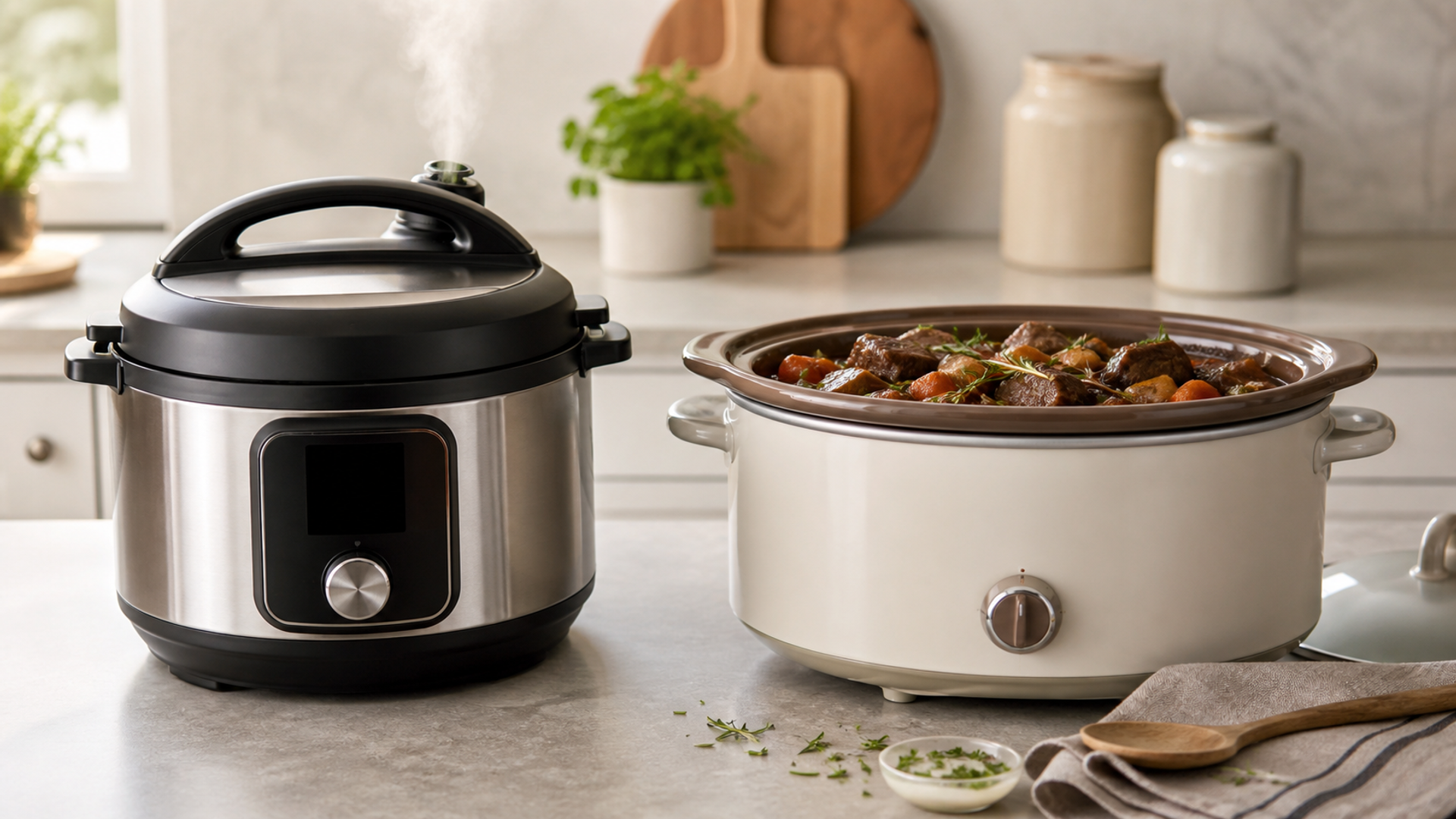
Pressure cookers and slow cookers can both turn firm ingredients into tender meals, but their operating logic is opposite. A pressure cooker raises pressure and boiling temperature in a sealed vessel to accelerate cooking; a slow cooker holds food at a lower controlled temperature over hours. Speed is not the only outcome: evaporation, browning, liquid concentration, timing flexibility, release method and food-safety controls all affect whether the meal works on a real weekday.
Start with the meal schedule
Choose a pressure cooker when late starts, beans, grains, stocks and tough cuts need faster transformation and the user can manage loading and pressure release. Choose a slow cooker when morning preparation, predictable all-day cooking and hands-off timing fit the household. Use conventional cooking when searing, reduction, delicate timing or direct visual control is central to the dish.
| Decision factor | Pressure cooker | Slow cooker | Use conventional cooking |
|---|---|---|---|
| Schedule | Cooking starts near mealtime | Preparation can happen many hours earlier | Stovetop or oven supports active control |
| Texture | Sealed high heat rapidly tenderises | Long gentle heat supports braises | Conventional heat allows staged texture |
| Liquid | Little evaporation requires careful amounts | Lid retains moisture over time | Open pan reduces and concentrates |
| Browning | Sauté first or finish separately | Brown separately for deeper flavour | Brown and cook in one vessel |
| Safety | Fill, vent and release rules are critical | Safe thawing, loading and hot holding are critical | Monitor time and temperature directly |
| Power interruption | Sealed cycle may need safe restart guidance | Long interruption can compromise food safety | Switch method only with verified temperatures |
This pressure cooker vs slow cooker matrix is the article's working value object. Read the pressure cooker vs slow cooker rows together: the decisive failure mode depends on this topic's evidence, operating context and reader objective.
Pressure and time shape texture differently
Evidence 1. USDA guidance stresses safe thawing, loading, temperature and handling for slow-cooker meals.
Evidence 2. Pressure-cooker fill limits, vent inspection and release methods vary by model and by foaming or expanding ingredients.
Evidence 3. Neither method replaces searing or reduction when those steps create the intended flavour and sauce concentration.
Evidence 4. A delayed start with perishable food can create a safety risk even when the appliance later reaches cooking temperature.
Reader-visible sources checked for this article:
fsis.usda.gov — reader-visible current or official evidence
instantpot.com — reader-visible current or official evidence
For pressure cooker vs slow cooker, these sources establish only the claims inside their documented scope. Recheck every changeable specification, availability condition, price, policy or service term in the relevant market before acting.
Test a complete recipe safely
Read schedule as a stop/go test: cooking starts near mealtime supports the first option; preparation can happen many hours earlier supports the second; and stovetop or oven supports active control supports the third. Record which source proves the condition and when it was checked.
A buyer can resolve texture without starting from a brand preference. Ask whether sealed high heat rapidly tenderises; compare that with whether long gentle heat supports braises; then use conventional heat allows staged texture as the third route's safeguard. An unknown condition stays unknown.
On liquid, popularity is not enough. The evidence for option one is that little evaporation requires careful amounts. Option two means lid retains moisture over time. Option three is rational where open pan reduces and concentrates. Recheck any changeable term immediately before commitment.
The decision changes at browning. Choose the first path only if sauté first or finish separately; move to the second when brown separately for deeper flavour; use the third when brown and cook in one vessel. Save the downside that would make this row fail.
For safety, the first route works when fill, vent and release rules are critical; the second requires safe thawing, loading and hot holding are critical. The control for the third is monitor time and temperature directly. Verify this row against the exact product, property, account or environment before it can reverse the decision.
The power interruption row exposes a practical boundary. Route one assumes sealed cycle may need safe restart guidance, while route two is defensible only when long interruption can compromise food safety. Route three depends on switch method only with verified temperatures. If that evidence is absent, keep the more reversible option.
Facts that would reverse the current choice
Reversal control 1 — Schedule. Before choosing Pressure cooker, write down how the decision changes if “Cooking starts near mealtime” proves false. Do the same for Slow cooker and “Preparation can happen many hours earlier”. Keep the Use conventional cooking route available until “Stovetop or oven supports active control” is verified. This control belongs to pressure cooker vs slow cooker; update it from the cited source or exact supplier rather than copying a generic checklist.
Reversal control 2 — Texture. Before choosing Pressure cooker, write down how the decision changes if “Sealed high heat rapidly tenderises” proves false. Do the same for Slow cooker and “Long gentle heat supports braises”. Keep the Use conventional cooking route available until “Conventional heat allows staged texture” is verified. This control belongs to pressure cooker vs slow cooker; update it from the cited source or exact supplier rather than copying a generic checklist.
Reversal control 3 — Liquid. Before choosing Pressure cooker, write down how the decision changes if “Little evaporation requires careful amounts” proves false. Do the same for Slow cooker and “Lid retains moisture over time”. Keep the Use conventional cooking route available until “Open pan reduces and concentrates” is verified. This control belongs to pressure cooker vs slow cooker; update it from the cited source or exact supplier rather than copying a generic checklist.
Reversal control 4 — Browning. Before choosing Pressure cooker, write down how the decision changes if “Sauté first or finish separately” proves false. Do the same for Slow cooker and “Brown separately for deeper flavour”. Keep the Use conventional cooking route available until “Brown and cook in one vessel” is verified. This control belongs to pressure cooker vs slow cooker; update it from the cited source or exact supplier rather than copying a generic checklist.
Reversal control 5 — Safety. Before choosing Pressure cooker, write down how the decision changes if “Fill, vent and release rules are critical” proves false. Do the same for Slow cooker and “Safe thawing, loading and hot holding are critical”. Keep the Use conventional cooking route available until “Monitor time and temperature directly” is verified. This control belongs to pressure cooker vs slow cooker; update it from the cited source or exact supplier rather than copying a generic checklist.
Reversal control 6 — Power interruption. Before choosing Pressure cooker, write down how the decision changes if “Sealed cycle may need safe restart guidance” proves false. Do the same for Slow cooker and “Long interruption can compromise food safety”. Keep the Use conventional cooking route available until “Switch method only with verified temperatures” is verified. This control belongs to pressure cooker vs slow cooker; update it from the cited source or exact supplier rather than copying a generic checklist.
Map the week
Record when ingredients are available, when cooking can start and when people actually eat. Separate active minutes from total elapsed time and include pressure build and release. Record the exact product, material, room, garment, vehicle, water report or operating condition and the time of the check. Separate observed behaviour from marketing language, and repeat the comparison in the intended setting rather than an ideal demonstration. If the appliance shifts work to an impossible morning or late cleanup, reverse the choice. Preserve the evidence that would reverse the choice: a change in fit, specification, maintenance, safety, price or environment must reopen the decision rather than inherit an old conclusion.
Run a matched braise
Use equal meat, vegetables, liquid and seasoning and record starting temperature and batch mass. Compare tenderness, sauce dilution, vegetable integrity and total energy only after safe completion. Record the exact product, material, room, garment, vehicle, water report or operating condition and the time of the check. Separate observed behaviour from marketing language, and repeat the comparison in the intended setting rather than an ideal demonstration. If one method needs extensive finishing, include that time in the verdict. Preserve the evidence that would reverse the choice: a change in fit, specification, maintenance, safety, price or environment must reopen the decision rather than inherit an old conclusion.
Control food safety
Thaw ingredients safely, respect fill limits, keep vents clear and follow model-specific release instructions. For slow cooking, follow authoritative loading and temperature guidance; refrigerate leftovers promptly. Record the exact product, material, room, garment, vehicle, water report or operating condition and the time of the check. Separate observed behaviour from marketing language, and repeat the comparison in the intended setting rather than an ideal demonstration. If power fails or temperatures are unknown, follow food-safety guidance rather than tasting to decide. Preserve the evidence that would reverse the choice: a change in fit, specification, maintenance, safety, price or environment must reopen the decision rather than inherit an old conclusion.
Assess maintenance
Inspect gasket, valve, lid lock, inner pot, cord and replacement availability. Clean every steam path and document parts that age or absorb odours. Record the exact product, material, room, garment, vehicle, water report or operating condition and the time of the check. Separate observed behaviour from marketing language, and repeat the comparison in the intended setting rather than an ideal demonstration. If safety-critical parts are unavailable, conventional cookware may be the durable answer. Preserve the evidence that would reverse the choice: a change in fit, specification, maintenance, safety, price or environment must reopen the decision rather than inherit an old conclusion.
Three weeks, three answers
Beans after a late workday
A pressure cooker can compress the timeline. Define the fact that would reverse this recommendation before committing.
Morning-prepared winter braise
A slow cooker can fit the household schedule. Define the fact that would reverse this recommendation before committing.
Sauce requiring staged browning and reduction
A Dutch oven may remain the best tool. Define the fact that would reverse this recommendation before committing.
Action checklist
Map start time.
Include build and release.
Thaw safely.
Respect fill line.
Inspect vent.
Brown where needed.
Measure liquid.
Plan leftovers.
Clean safety parts.
Keep manual available.
Continue the decision
The linked VERTU articles expand adjacent parts of the pressure cooker vs slow cooker decision. They do not substitute for the external evidence above.
The pressure-versus-slow-cooker verdict
Choose a pressure cooker when late starts, beans, grains, stocks and tough cuts need faster transformation and the user can manage loading and pressure release. Choose a slow cooker when morning preparation, predictable all-day cooking and hands-off timing fit the household. Use conventional cooking when searing, reduction, delicate timing or direct visual control is central to the dish.
Keep the pressure cooker vs slow cooker decision reversible until its material cost, safety, access, privacy and compatibility facts are verified. Unknown evidence stays unknown; it is never silently scored as favourable.
![How to Scan Receipts and Documents with Your Phone [Full Guide]](https://cdn.sanity.io/images/e0gp1l2g/production/0db13feec1d5e72b8a8a5f976d1f3e86619c9228-3840x1860.webp?w=180&h=180&q=78&auto=format&fit=crop)
![How to Scan Receipts and Documents with Your Phone [Full Guide]](https://cdn.sanity.io/images/e0gp1l2g/production/0db13feec1d5e72b8a8a5f976d1f3e86619c9228-3840x1860.webp?w=800&h=450&q=82&auto=format&fit=crop)
![Top 10 Two-Tone Carbon-Fibre Watches for Men [2026 List]](https://cdn.sanity.io/images/e0gp1l2g/production/18870799ba33fab0e038968359cd5772d7d7db30-1024x576.webp?w=800&h=450&q=82&auto=format&fit=crop)
![Top 10 Luxury Watches with Digital Complication Displays for Men [Latest]](https://cdn.sanity.io/images/e0gp1l2g/production/c4f6bf8c080f291c39f7cc85c7344ecff2fd3799-1024x553.webp?w=800&h=450&q=82&auto=format&fit=crop)